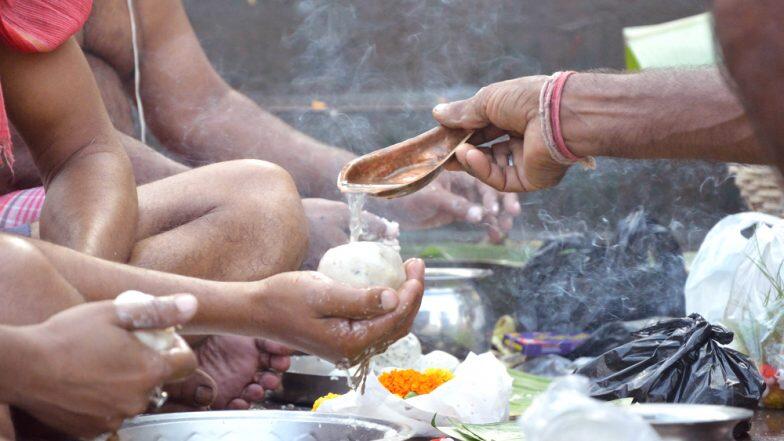
Tag: Mahalaya Paksha

  • Mahalaya,Pitru Paksha Tharpan  Explained

    Mahalaya,Pitru Paksha Tharpan Explained

    What is Mahalaya, Pitru Pakshs

    The period between New Moon and Full Moon in Simha Maasa (approximately in September)for 15 days is named as Mahalaya Paksha.

    Lunar Calendar of Hindus divides a month with reference to the waxing and waning of the Moon,into two.(for details on Hindu/Indian Calculation of Time’ please read my Blog’TIME-Non-Linear Theory,filed in Astrophysics).

    The waxing period is called Sukla Paksha(Sukla in Sanskrit means White,  here indicates the waxing of the Moon),ending in Full Moon, Pounima, also called Pournamasya.

    The waning period is called Krishna Paksha( Krishna means Black),culminating in New Moon called Amavasya.

    Each Paksha has 14 Days ,one Amavasya and one Pournima makes a Month.

    One is expected to perform the duties due to the Departed daily, that is do Tharppana daily.

    This applies all Castes, Brahmana,Kshatriya ,Vaisya and Sudra.

    We have conveniently omitted to follow the Sastras, by saying that the Srardha and Tharppana  are to be performed only by  Brahmins .

    We also have made it a habit of performing Tharppana only on Amavasya,Beginning of the New Month,Mahalaya ,Aadi ,Grahana( Eclipses)  periods and Srardha Thithi.

    This Behavior is not  sanctioned by The Sastras.

    Of all The Tharppanas ,Mahalaya Tharppana is very Special.

    This period falls in The Dakshinayana-movement of the Sun to Southern Latitudes ,this is for six months.

    This begins from Adi and extends up to Makara Sankaranthi ( January 14)

    https://ramanisblog.in/2011/09/13/mahalaya-amavasyatharpana-explained/

    Aghora Pasupatha Homa Evil Eye Protection Mukthi

    Removal of Evil eye, Protection from forces that hinder Spiritual development. Protection from Black magic,Animals. Increases self confidence and self assurance. Clarity of thought.. Above all,Mukthi and Gnana are facilitated.

    Rig Veda Inflenced Civilizations Outside India

    Date of Rig veda in Ramanisblog According to Ramanisblog, the date of the Rig Veda is subject to considerable debate, with modern scholarly estimates generally ranging between 2000 BCE to 1000 BCE[1]. However, Ramanisblog highlights that Hindu tradition considers the Vedas to be timeless and without a specific beginning[1]. Perspectives on Rig Veda Dating Ramanisblog…

    Navavarana Pooja 1 Guru Stuthi

    Following in the Ai Generated transcript of the Navavarana Pooja Mantras . Recorded and sent to my Shishyas. This is being made public so that this secret knowledge is not lost to posterity. Those who want to be initiated may contact me through mail at ramanan50@gmail.com. Also they can contact through the comment column. If…

    Join 4,576 other subscribers
  • Subha Thithi Punya Thithi Difference

    When one goes through information about Hinduism and it’s Practices,one would find that each and every practice is loaded with information that signifies some fact or the other which underscores the Core Belief of Sanatan Dharm.

    I have written various aspects of Hindu Rites and their significance and meaning.

    And about Sankalpa,which is recited by Hindus on both auspicious and inauspicious occasions.

    Sankalp is the Right Determination,be it in thoughts,Words or Deeds.And Sankalpa contains portions which Geotag the performers.

    It also refers to the Time frame when the Act is performed, indicating the Aeon,day or night parameters of the Aeon,Year, Movement of the Sun 🌞,Season,Month,Star ruling that day ,Movement of the 🌒,and Day.

    Hinduism considers Time to be Eternal and A stream. Time is cyclic.What we perceive as yesterday, today and tomorrow is nothing but the instrument of our minds through which we perceive.

    As such , essentially there is nothing in the Universe that is good or bad.

    This includes Days as well,though there are good days and bad days indicated by the Almanacs, Panchanga.

    However,days do not determine what happens to you , either Good or Bad.

    The reason why they are called as good and bad are is determined depending on the actions performed by you in the past and in the present.As you sow,so you Reap. In Hinduism you can not escape the consequences of your actions, whoever you might be,even of you are an Avatar. God is not above Cosmic law.

    The indication a day, star gives you as good or bad is but a forewarning that good or bad, from your standpoint, may befall as a result of your actions.

    Yet there are two occasions which are classified differently.The are exceptions to the Rule.

    Performance of Karma, in accordance with the procedures laid out in Vedas,the Scripture of Hindus ,and Smritis, that is remembered practices, on specific days- these days are called Auspicious days,Subha Thithi.

    On the other hand, death,which is not in our hands and a Harbinger of Rebirth and a beginning of new birth and deaths or merging with the Reality,is not considered auspicious. However Hinduism does not place the blame on the day.

    Based on these two principles, Sankalpa makes a fine distinction.

    One may note in the Sankalp, when done for auspicious occasions, it reads ‘Subha Thithou’.

    This term is used for Ayush homas,Upanayan, Marriage etc.

    But for Grahana, Sraddha,Pitru/Mahalaya Paksha, Amavasya ,the Sankalp reads thus.

    ‘Punya Thithou’

    There are Karmas which are beyond us and as such are classified as days that augur well for Good passage in Life.

  • Pitrus Presiding Deties Sraddha

    Details of Pitrus present and the Deities of Sraddha.


    1 Pururav-Aardrav and Dhurilochan

    Pururav-Aardrav and Dhurilochan are deities of ancestors’ souls. They are referenced in the ritual of Shraddha.

    1.2. Vasu-Rudra-Aditya

    1.‘Shraddha is associated with the benevolent deities Vasu, Rudra and Aditya of the ancestors’ souls. The mantras chanted during the Shraddha and the rites performed enables one to connect to these deities.’ (6)

    2. The deceased person for whom the ritual of Shraddha is being performed, is considered as a follower of Vasu, his parents are considered as followers of Rudra and his grand parents are considered as followers of Aditya. Therefore during Shraddha, the names of father, grandfather and great grandfather (or mother, grandmother and great grandmother) are pronounced as representatives of Vasu-Rudra-Aditya respectively.


    Presiding Deity of
    the departed ancestors
    Associated mission
    Vasu Desire
    Rudra Dissolution
    Aditya Action

    During the ritual of Shraddha the Vishvedevs called Pururav-Ardrav and Dhurilochan are also invoked. Vishvedev means the ‘group of Deities which represents the Deities during a sacrificial fire’.


    Pitrus, Ancestoes present during Mahalaya Sraddha.


    . Father, grandfather, great grandfather (Pitrutrayi) 10. Maternal uncle
    2. Mother, grandmother and great grandmother (matrutrayi) 11. Brother
    3. Step mother 12. Father’s sisters
    4. Mother’s father, grandfather and great grandmother (matamahatrayi) 13. Mother’s sisters
    5. Mother’s mother, grandmother and great grandmother 14. Sisters
    6. Wife 15. Father-in-law
    7. Sons 16. Other relatives
    8. Daughters 17. Guru (if the Guru-disciple relationship exists)
    9. Paternal cousins 18. Disciple (if the Guru-disciple relationship exists)

    http://kramans.blogspot.in/2012/01/shraddha.html

  • No Pitru Paksha for Sri Vaishnavas?

    A close friend of mine, a Sri Vaishnava told me that he does not perform the Mahalaya Paksha Tharpana.

    He informed me that , as an Iyengar belonging to Thengalai Sampradya, he does not do it as it is prohibited by Ramanucharya.

    He told me that the other sect of Iyengars in Tamil Nadu, Vadagalai Iyengars perform the Pitru Paksha Tharpana.

    As I am unable to find any authentic source on this, I am posting my views.

    Those who know the subject well may quote with source.

    In Hinduism there are two paths in terms of Lifestyle.

    One is called Pravritti Marga and another Nivrutti Marga.

    Pravrutti Marga is the leading of our daily lives , as normally do, by going after the sense objects.

    Nivrutti Marga is renunciation of the sense objects.

    Hinduism teaches how to live,taking into account the limitations and the frailties of Human Life including the desire to go after sensory objects for pleasure.

    So Hinduism has devised the four stages of Life.

    Brahmacharya, the young Celibate.

    Gruhastha when one gets married begets children and goes about Life.

    Vanaprastha,when one, after the son becomes capable managing the Family leaving the Family, either with or without wife to seek Reality either in the Forest or staying at Home in a detached way.

    My friend quoted Visishtadvaita to support his view that one need not perform the Karmas,excepting Sandhyavanadan and Amavasya Tharpana as Sri Vaishnavism gives priority to surrender to Lord Vishnu and once one surrenders himself to God, one need not, should not perform Karma , including Pitru Paksha Tharpana.

    He quoted the Sloka form the Bhagavad Gita, this is also called the Karna Mantra,,

    Sarva Dharma Parijyasya Maameka Charanam Vraja,

    Aham Thva Sarva Paapepyp0Mokshayisyami Maa sucha. Chapter 18

    Leave all actions, and surrender only to Me.

    I shall absolve you of all your sins and grant you Moksha’

    I think my friend does not seem to have understood Krishna and this sloka is often misunderstood.

    What Krishna says is that He shall grant Moksha and one need not perform any action(Karma)  if one surrenders to Krishna.

    The surrender , Krishna means a surrender  is not a lip service but one of total Surrender,mind ,words and deeds.

    By merely saying one has surrendered to Krishna does not mean total surrender.

    Draupadi who wass a cousin of Krishna and an ardent devotee had to throw her arms up and pray Lord Krishna when Dhuchashana was stripping her.

    Krishna did not pay heed to her earlier entreaties to save her when she held her hands to her saree: only when, she ,devoid of Ego , called out, leaving her hands off the saree, did Krishna rescue her modesty.

    Such a devotion is very difficult to come by.

    It needs years of practice ,Abhyasa and determination(vairagya)

    This, I think we do not, posses at least I do not.

    So the statement , presumably said by Ramanucharya, that one need not perform Karmas if one surrenders to Vishnu, is meant for evolved souls;such loved souls like Ramadasas,Ramakrishna Paramahamsa may and can follow this as they had lost Dehatma Buddhi, the attachment to Body.

    We can not compare ourselves to these souls.

    Again, while talking about Renunciation, Krishna says  in the Bhagavad Gita, those who call the,selves Sanyasis , while their Minds are after sense objects, may appear so outwardly. are only Aashaadaboothis(hypocrites)

    The determination to relinquish the fruits of action even at the mental level while performing the action is called renunciation.

    With such a mindset one can even be in family Life, like Janaka, father of Sita.

    Therefore the non-performance of Pitru Pksha , quoting some Acharya is contrary to Vedas and as such is incorrect as Pitru Yagnya is one of the most important and mandatory Yagnya for every one.

  • Pitru Dosha and Parihara

    When somebody tells me that they are going through a rough patch due to circumstances beyond their control, I tell them first to be sure that they are performing Sraddha for their ancestors regularly and whether they are following the Sumangali Prarathana done in their Homes.


    As for as I know these are the prima facie reasons fo misfortune before we try doing any parihara.


    I have some articles on the subject.


    Such is the seriousness of Pitrudosha that it can nullify the effects of Poojas and Punyapalas.


    As an aside, Matru Dosha is not being talked about as much.


    Pirtu generally means ancestors, which includes women as well.


    But there is difference in performing Sraddha between for Men and Women.


    No Homa is done for Women.


    Clarification, correction welcome.


    Pitru Dosha does not happen not only because of the Horoscope, non-performance of Sraddha and Tharpana.


    It applies to the sins accruing to one for not taking care of Parents when they were Alive.


    It is very difficult to atone for the sin of ill treating parents while they were alive, not withstanding grand Dhanas and Sraddha after death.


    Some signs of Pitru Dosha.


    Their children may suffer from physical or mental disabilities right fro Birth.
    Pitru Dosha leads to unfavorable environment in the house and Marital Disharmony.

    Delayed marriage.

    Unmanageable debts.

    Infant Mortality.

    Childlessness.

    Accidents.

    Unemployment.


    There are some remedies.


    Perform“Trapandi Shraddha
    • perform Sraddha every year.
    • Water The the Banyan tree.
    • Perform Tharpana on every day during Mahalaya Paksha
    • Feed  Brahmins on every “Amavasya”.
    • Feed the poor during “Amavasya” and “Poornima” in a temple.

    Feed the Crows daily

    Feed the Ants  mixture of Rava or Broken Roasted Bengal gram(Pottukadalai) with Sugar.


    Image Credit.


    http://3.bp.blogspot.com