
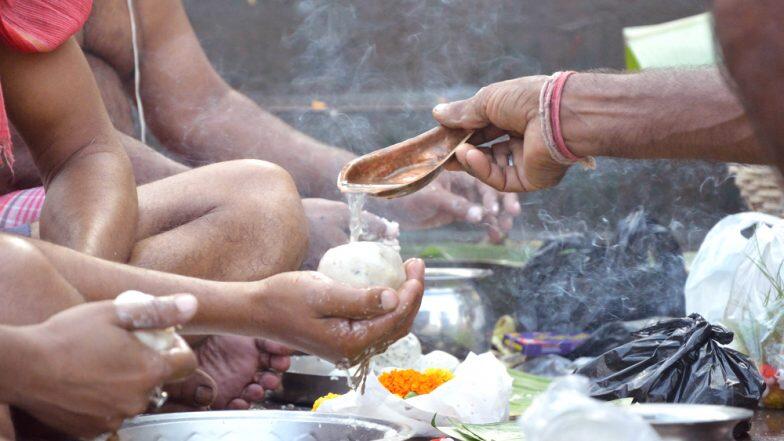

The period between New Moon and Full Moon in Simha Maasa (approximately in September)for 15 days is named as Mahalaya Paksha.
Lunar Calendar of Hindus divides a month with reference to the waxing and waning of the Moon,into two.(for details on Hindu/Indian Calculation of Time’ please read my Blog’TIME-Non-Linear Theory,filed in Astrophysics).
The waxing period is called Sukla Paksha(Sukla in Sanskrit means White, here indicates the waxing of the Moon),ending in Full Moon, Pounima, also called Pournamasya.
The waning period is called Krishna Paksha( Krishna means Black),culminating in New Moon called Amavasya.
Each Paksha has 14 Days ,one Amavasya and one Pournima makes a Month.
One is expected to perform the duties due to the Departed daily, that is do Tharppana daily.
This applies all Castes, Brahmana,Kshatriya ,Vaisya and Sudra.
We have conveniently omitted to follow the Sastras, by saying that the Srardha and Tharppana are to be performed only by Brahmins .
We also have made it a habit of performing Tharppana only on Amavasya,Beginning of the New Month,Mahalaya ,Aadi ,Grahana( Eclipses) periods and Srardha Thithi.
This Behavior is not sanctioned by The Sastras.
Of all The Tharppanas ,Mahalaya Tharppana is very Special.
This period falls in The Dakshinayana-movement of the Sun to Southern Latitudes ,this is for six months.
This begins from Adi and extends up to Makara Sankaranthi ( January 14)
https://ramanisblog.in/2011/09/13/mahalaya-amavasyatharpana-explained/

Avidyanaam , Soundaryalahari Sloka 2 Visualized Meaning
अविद्यीनामन्तस्तिमिरमिहिरद्वीपिनगरीजडानां चैतन्यस्तबकमकरन्दस्रुतिझरी ।दरिद्राणां चिन्तामणिगुणनिका जन्मजलधौनिमग्नानां दंष्ट्रा मुररिपुवराहस्य भवति ॥ ३ ॥ avidyānām antaḥ-timira-mihira-dvīpa-nagarī jaḍānāṁ caitanya-stabaka-makaranda-sruti-jharī |daridrāṇāṁ cintāmaṇi-guṇanikā janma-jaladhau nimagnānāṁ daṁṣṭrā The dust under the lotus feet of the Divine Mother acts as a supreme remedy for four human conditions: For the ignorant: It is like the radiant city of the rising sun that destroys the…

Taniyamsum , Soundaryalahari 2 Visualization with Meaning
.stk-ybjj8pf .stk-img-wrapper{height:350px !important;}:where(.stk-hover-parent:hover, .stk-hover-parent.stk–is-hovered) .stk-ybjj8pf .stk-img-wrapper::after{background-color:#000000B3 !important;} .stk-m2iqo3k {margin-top:56px !important;opacity:0 !important;}:where(.stk-hover-parent:hover, .stk-hover-parent.stk–is-hovered) .stk-m2iqo3k{opacity:1 !important;}.stk-m2iqo3k .stk–svg-wrapper .stk–inner-svg svg:last-child, .stk-m2iqo3k .stk–svg-wrapper .stk–inner-svg svg:last-child :is(g, path, rect, polygon, ellipse){fill:#FFFFFF !important;} तनीयांसं पांसुं तव चरणपङ्केरुहभवंविरिञ्चिस्सञ्चिन्वन् विरचयति लोकानविकलम् ।वहत्येनं शौरिः कथमपि सहस्रेण शिरसांहरस्संक्षुद्यैनं भजति भसितोद्धूलनविधिम् ॥ २॥tanīyāṃsaṃ pāṃsuṃ tava caraṇapaṅkeruhabhavaṃviriñcissañcinvan viracayati lokānavikalam .vahatyenaṃ śauriḥ kathamapi sahasreṇa śirasāṃharassaṃkṣudyainaṃ bhajati bhasitoddhūlanavidhim ..…

Sadhana Panchakam Adi Shankaracharya Word by Word meanings
Seek the company of the wise and establish firm devotion to the Lord. Cultivate tranquillity and the other disciplines of the mind, and decisively renounce binding action. Approach a competent teacher, serve and honour the teacher daily, inquire into Brahman symbolized by Om, and listen attentively to the great Upaniṣadic declarations.

