Tag: Human Migration

  • Genetic Study Proves Dravidan Movement To North,The World

    The study of genes is very interesting.

    I have written a few articles on this subject.

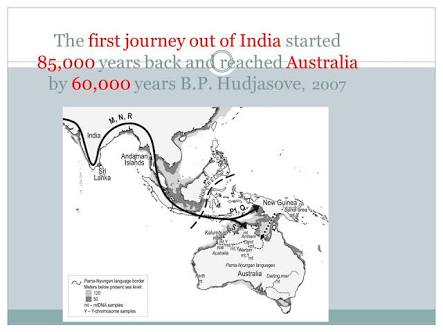
    Human Migration.Image.
    Human Migration.

    There have been attempts to manipulate data by assigning Caste to genes.

    While we are advanced in Genetics, we are not advanced enough to assign a caste marker to Gene.

    The information, rather the misinformation is provided by the Government of India.

    They have taken distance as the factor to determine Caste!

    That is if you are away from India, you do not have caste!

    Apart from the fact we do not have the technology to assign caste to genes, people forget the Geology of 5000 ago.

    India was not as it is.

    The landmass encompassed a wider area.

    Who set the boundaries for those areas?

    Same logic applies to determine languages based on Genes.

    Proof for this has o be found elsewhere, in archaeology, linguistics and cultural behavior.

    Again, my researches indicate the presence of Indians as far away in Ireland, Russia and in some places Brahmin practices were found , according to Archaeological  finds and cultural practices.

    Now to the study.

    ‘R1a is typical in populations of Eastern Europe,Indian Subcontinent and parts of Central Asia. It has a significant presence in Northern Europe,Central Europe, Iran, Altaians and Xinjiang(China) as well as in Siberia. R1a can be found in low frequencies in the Middle East, mostly inIndo-European speakers or their descendants…

    The Modern studies for R1a1 (M17) suggest that it could have originated in South Asia. It could have found its way initially from Western India (Gujarat) through Pakistan and Kashmir, then viaCentral Asia and Russia, before finally coming to Europe”…”as part of an archaeologically dated Paleolithic movement from east to west 30,000 years ago

    Points and inferences from this study.

    1.That Human genes originated in south Asia.

    This is supported by archaeology,astronomy ,linguistics and culture.

    2.’It could have found its way initially from Western India (Gujarat) through Pakistan and Kashmir, then viaCentral Asia and Russia, before finally coming to Europe”…”as part of an archaeologically dated Paleolithic movement from east to west 30,000 years ago’

    Here the point is that the early Genes were linked to South India, to be specific near Madurai, Tamil Nadu.

    The implication is that there has been a movement from the south necessitated by a Tsunami, which has been recorded in History and validated.

    This has been found in Tamil Classics and world legends of Floods.

    Note the time frame in another study.

    ‘The dates we report have significant implications for Indian history in the sense that they document a period of demographic and cultural change in which mixture between highly differentiated populations became pervasive before it eventually became uncommon. The period of around 1,900–4,200 years BP was a time of profound change in India, characterized by the deurbanization of the Indus civilization, increasing population density in the central and downstream portions of the Gangetic system, shifts in burial practices, and the likely first appearance of Indo-European languages and Vedic religion in the subcontinent. The shift from widespread mixture to strict endogamy that we document is mirrored in ancient Indian texts. [notes removed -Razib]’

    Taking these facts into account, it is sane to theorize that the earliest genes were from the south of India and there was a shift to the north around 4000/5000 BC.

    This is the time when the Tsunami struck in the south and people emigrated from the south.

    Towards which direction is the question.

    They could have moved towards the north of India, east and west.

    Hindu Texts state that Satyavrata Manu, ancestor of Lord Rama moved towards north with his sons to found the Iksvaku Dynasty.

    Please read my Post .

    They could not have moved to wards the south as they were deep down the south as the land mass ended here as described in the Tamil Classics of the First Sangam and in Sanskrit texts.

    Another direction they could have moved towards  is the west

    This is worth considering because of these facts.

    a)There has been worship of Shiva and Murugan in deep south then but not much is known about Vishnu though mention is made of Mayon(Vishnu),in the earliest available Tamil text Tholkaapiyam.

    b)Tamil Kings attended the Swayamvara of sita of Ramayana and even Nala and Dmayanti not not to forget the Swayamvara of Draupadi.

    c)Tamil Kings participated in the Mahabharata battle.

    d)Lord krishna and Arjuna visited Tamil Nadu then the Dravida Desa, married there and had children through Tamil princesses .

    e)Balarama worshiped Lord Subrahmanya, called Murugan in Tamil, in South India.

    f) Kapila who compiled the Purananuru, a Sangam Classic states that he was from Dwaraka.

    g) Parashurama came from south and though he is considered an avatar of Vishnu he worshiped Shiva and received Pasupathasrara.

    h)Arjuna received Pasupathastra  in the south.

    Now Satyavrata Manu moved to North.

    Who had been left behind and who and where had Shiva, Ganesha and Murugan gone?

    My research indicates  that Shiva and Ganesha left through the middle east ,traveling through Europe, Africa, what is now called Americas, to Arctic and returned to India  through the Khyber pass. leaving behind a trail of Sanatana Dharma .

    Nothing else could account for the artifacts , language affinity and cultural heritage found throughout the area.

    Their home-coming through the Khyber has been interpreted or misinterpreted as Aryan Invasion.

    Thus the genes prove that the early humans were from the south , moved northwards and westwards.

    They could have moved towards he east as well.

    This is certain because of the spread of Santana Dharma in the far east, extending up to New  Zealand and Australia.

    Please check mu Pots on all these.

    One of the advantages of not  being a scholar is that I am not bound by one study.

    I can study various studies, research  papers and collate with Indian sources and arrive at a Theory.

    If west can rely only on western sources, why not rely on western and Indian sources?

    Excerpt ,Sources from different studies

    The first group spread across the upper and middle reaches of the map, the Austro-Asiatics (the tribals or Adivasis) were clustered in the centre and east, the Dravidians covered the south as far up as Andhra Pradesh and the Tibeto-Burmans were confined to small border areas to the north.

    “Now look at these. This stuff was very unexpected.” He pointed at the coloured circles on the map. “You will see that Indians are more similar than you would think across the country. There are membership exchanges within these four groups. It’s all mixing up, even with the Dravidians.”

    Now I understood the circles: they showed genetic groups where you would least expect to find them. In Kashmir, there were people who were genetically similar to Dravidians. In Gujarat and eastern Orissa the same was true, though the markers were weaker. In parts of Andhra Pradesh and Karnataka in the south of the country, the situation was reversed: here were Indo-Europeans. In Madhya Pradesh in central India, you could find groups whose ancestors had come from the Himalayas. So people who thought they were a product of a place where their family had lived for in infinite generations were genetically closer to Indians who lived a thousand miles away, and spoke a different language.

    When I pointed to a spot on the map and asked Dr Mukhopadhyay exactly where it was, he hesitated. “We don’t say the place names. We agreed, because of the political risks, not to release the ID of the blood-sampled groups — Hindus, Muslims, Sikhs. This is uncomfortable territory.” He touched two red circles near Pakistan. “They probably would not eat in one another’s home. How deep are our genetic relationships, and yet how different are our social relationships. The cultural structures we are following are new: it takes time for practices like not marrying into another community to come out genetically. It takes a few thousand years.”

    Tens of thousands of years?

    “No, thousands of years.”

    So with all this mixing and complexity, could you test for caste?

    “There is no scientific basis to say you could have a caste gene. For a start, in our research we use samples of fifty or a hundred people, not individuals. If you test a population group in India and look at twelve genetic markers — DNA sequence variations — you have nearly a 100 per cent chance of knowing if they are tribals or not, and an 85 per cent chance of establishing their language group. The data would not tell you the caste, because there is no basis.( http://www.hindustantimes.com/books/a-brahmin–in-your-genes/article1-650873.aspx )

    This would tell you the Russian, Arctic connection of Hindus.

    ‘I want to highlight one aspect which is not in the abstract: the closest population to the “Ancestral North Indians”, those who contributed the West Eurasian component to modern Indian ancestry, seem to be Georgians and other Caucasians. Since Reconstructing Indian Population History many have suspected this. I want to highlight in particular two genome bloggers, Dienekes and Zack Ajmal, who’ve prefigured that particular result. But wait, there’s more! The figure which I posted at the top illustrates that it looks like Indo-European speakers were subject to two waves of admixture, while Dravidian speakers were subject to one!

    http://blogs.discovermagazine.com/gnxp/2013/08/indo-aryans-dravidians-and-waves-of-admixture-migration/#.VV1Ka7kirIV

  • Caucasians Whites From Dravidian World Races From India Study

    The effort of the Caucasians ,the Whites to portray themselves as the ancient people of the world is pathetic and amusing.

    The Khyber Pass.jpg
    The Khyber Pass.

    ‘The falsity of White history begins and ends with their desire to hide their true nature; that being that they are derived from Albinos. Their efforts to make all peoples of historical significance White, would appear to be their effort to make themselves the “New Normal” i. e. “See everybody important was White, therefore White is good – the best even!” This fabricated concept of themselves, is obviously so satisfying, and so ingrained, that it has become delusional. Even today, there are many Whites who refuse to believe that the ancient Egyptians, and the other original civilizations as well, were Black people! This in spite of the countless evidences to the contrary: Egypt IS in Africa, there are countless statues and paintings which clearly show them to be Black people. Even scientific studies of ancient Egyptian Bones and Mummy tissue,..

    Race distribution in Eurasian Steppes.jpg
    Race distribution in Eurasian Steppes.

    Whites will still doggedly point to artifacts from the periods of Greek and Roman rule and say: See, these are the “Real Egyptians”. Of course, there is absolutely no reason a reasonably intelligent human being, would ever think that the ancient Egyptians were White people, but then again, reason and intelligent thought, have nothing to do with this: This is about a “Need” to believe. This persistence in thinking, is then clearly not intellectual, put rather purely emotional.’

    They are so obsessed that they have portrayed Christ as a Caucasian  in appearance,though Christ, if He existed at all, was from the middle east!

    He was turned into a White.

    he was a man of simple appearance, mature age, black-skinned (melagchrous), short growth, three cubits tall, hunchbacked, prognathous (lit. ‘with a long face’ [macroprosopos]), a long nose, eyebrows meeting above the nose … with scanty [curly] hair, but having a line in the middle of the head after the fashion of the Nazaraeans, with an undeveloped beard.”

    This short, black-skinned, mature, hunchbacked Jesus with a unibrow, short curly hair and undeveloped beard bears no resemblance to the Jesus Christ taken for granted today by most of the Christian world: the tall, long haired, long bearded, white-skinned and blue eyed Son of God. Yet, this earliest textual record matches well the earliest iconographic evidence.

    The earliest visual depiction of Jesus is a painting found in 1921 on a wall of the baptismal chamber of the house-church at Dura Europos, Syria and dated around 235 A.D. The Jesus that is “Healing the Paralytic Man” (Mark 2:1-12) is short and dark-skinned with a small curly afro – see below.’

    For more read here.

    The second Out Of Africa (OOA) migration event (The first being Humans to Australia), saw Blacks from Africa with straight hair and “Mongol features” take an “Inland route” through southern Asia and on up to China, where they settled. Included with this group, were straight haired Blacks “without” Mongol features – now called “Dravidians” who stayed close to Africa, and settled in India and other areas of southern Asia. Also included with this second (OOA) group were Albinos, who were probably motivated by a quest for relief from the heat and burning Sunshine of southern Africa – and relief from the torment heaped upon them by normal Africans. Even today, superstitious Blacks of southern Africa; maim and mutilate Albinos in the ignorant belief that their body parts process magical properties, which they use in rituals…

    In Book 4 – MELPOMENE: Herodotus describes the Budini people, east of the Ister (Danube) River,

    Human Migration Map Based on Herodotus  description.Image.jpg
    Human Migration Map Based on Herodotus description.

    The Budini are a large and powerful nation: they have all deep blue eyes, and bright red hair. There is a city in their territory, called Gelonus, which is surrounded with a lofty wall, thirty furlongs each way, built entirely of wood. All the houses in the place and all the temples are of the same material. Here are temples built in honour of the Grecian gods, and adorned after the Greek fashion with images, altars, and shrines, all in wood. There is even a festival, held every third year in honour of Bacchus, at which the natives fall into the Bacchic fury. For the fact is that the Geloni were anciently Greeks, who, being driven out of the factories along the coast, fled to the Budini and took up their abode with them. They still speak a language half Greek, half Scythian.

    [4.109] The Budini, however, do not speak the same language as the Geloni, nor is their mode of life the same. They are the aboriginal people of the country, and are nomads; unlike any of the neighbouring races, they eat lice. The Geloni on the contrary, are tillers of the soil, eat bread, have gardens, and both in shape and complexion are quite different from the Budini. The Greeks notwithstanding call these latter Geloni; but it is a mistake to give them the name.

    The Roman historian Cornelius Tacitus (56-118 A.D.) said this about the Germanic tribes (Not the same as Germans): All have fierce blue eyes, red hair, huge frames, fit only for a sudden exertion..

    In human genetics, Haplogroup R is a Y-chromosome DNA haplogroup, a subgroup of haplogroup P, defined by the M207 mutation.

    This haplogroup is believed to have arisen around 26,800 years ago, somewhere in Central Asia or South Asia, where its ancestor Haplogroup P is most often found at polymorphic frequencies. Cambridge University geneticist Kivisild et al. (2003) suggests that southern and western Asia might be the source of this haplogroup:

    Given the geographic spread and STR diversities of sister clades R1 and R2, the latter of which is restricted to India, Pakistan, Iran, and southern central Asia, it is possible that southern and western Asia were the source for R1 and R1a differentiation.

    The R haplogroup is common throughout Europe and western Asia and the Indian sub-continent, and in those whose ancestry is from within these regions. It also occurs in North and Sub-Saharan Africa. The distribution is markedly different for the two major subclades R1a and R1b.

    Haplogroup R1a is typical in populations of Eastern Europe, Indian Subcontinent and parts of Central Asia. R1a has a significant presence in Northern Europe, Central Europe, Altaians and Iran as well as in Siberia. R1a can be found in low frequencies in the Middle East, mostly in Indo-European speakers or their descendants.

    Haplogroup R1b predominates in Western Europe. R1b can be found at high frequency in Bashkortostan (Russia). R1b can be found at low frequency in Central Asia, Middle East, South Asia as well as North Africa. There is also R1b in Sub Saharan Africa. In Europe, R1b coincides with areas of Celtic influence.

    The Albinos finding India not much better than Africa, at some point, decided to head further north. They found a pass through the Hindu Kush mountain range, now called the “The Khyber Pass” they passed through it, and entered the grasslands (Steppes) of Central Asia, where they settled. It seems logical to assume that over the many thousands of years that it took for these migrants to reach northern Asia, and their close proximity there, that there would have been some interbreeding between the Mongols and the Albinos; which probably allowed the Albinos to gain some fixed degree of pigmentation. Proof of this admixture, is in the fact that Whites and Mongols (Chinese), both share the same founding Y-DNA haplogroup “K”. Which seems to have evolved during their migration to northern Asia, but while they were still in Southern Asia. Haplogroup “K” is not found in Africa – of course the founding haplogroup of “K” is found in Africa. Also, as we know from everyday life, the product of Black and White mating, often has a slight Yellow hue to the complexion.

    The Khyber Pass

    The Khyber Pass (altitude: 3,510 ft) is a mountain pass linking Pakistan and Afghanistan. The Pass was an integral part of the ancient Silk Road and throughout history, it has been an important trade route between Central Asia and South Asia. The summit of the Khyber Pass is 5 kilometres (3.1 mi) inside Pakistan at Landi Kotal and it cuts through the northeastern part of the Safed Koh mountains which themselves are a far southeastern extension of the Hindu Kush range..

    Some facts emerge.

    1.The Dravidian was the ancestors of the Caucasians.

    When one reads of Human Immigration in Europe, one would find that , while talking of the history of any European Nation, it is stated that there was an influx of people first.

    Then it is noted that it is from Asia.

    They do not bother to check what was in Asia , who were living there and why they have moved out of Asia, for it is inconvenient to face the truth that they have come from Asia and Dravidian!

    2.Considering the Archaeological finds relating to Vedic, Sanatana Dharma being found all over the world, I have posted with evidence extensively,the Flood theory being confirmed by History and Geology, the Astronomical dating of Hindu texts,and the etymology of the world languages and the affinity, if not their identity with Sanatana Dharma, it is clear that the Caucasians evolved from the Dravidian.

    3.The evidence that the early Humans originated from Africa or Australia is not well supported by local customs, legends of these countries.

    In the case of Africa traces of their History before the advent of Christianity, has been erased .

    Evidence of Sanatana Dharma presence in Australia/New Zealand/Polynesia has been confirmed.

    Please read my post Agastya in New Zealand , The Tribal dance of Shiva with the Third Eye in Aboriginal  Tribes of Australia.

    4.Satyavrata Manu, ancestor of Rama, left the south of India with his sons to Ayodhya to found Ikshvaku dynasty.

    Shiva , with his son Ganesha left for the Arctic through the middle east, Africa, Europe, Americas before returning to India through  (via Russia) the Khyber Pass.

    This instance has been deliberately used b the West to misinform people that the Aryans invaded India.

    Citation and References.

    http://realhistoryww.com/world_history/ancient/White_people.htm

    http://humanorigins.si.edu/evidence/genetics

    https://ramanisblog.in/2014/08/12/human-migration-world-histoy/

  • World Human Races are From India

    What is the original source and authority on any subject?

    I encountered this issue when a comment for a Post mine stated that the Links/sources provided by me depend on each other and as such they commit the fallacy of Circular reasoning.

    Hence they are unacceptable.

    India where Human Races spread from.Image.jpg
    Human Race From India.

    The comment also observed that I must provide a reliable source like Text Books(?) or a reputed authority.

    What then is a source that is dependable?

    You depend and take reference to the one that is in agreement with known facts that are available.

    And these facts are to be borne out by physical evidence such as Archaeology  an , in my opinion, Astronomy  as one can not tamper with Astronomical events while one can with Archaeology.

    And in addition one may have to depend on contemporary references of the relevant period  where the events have occurred and the foreign sources which were contemporary in terms of Time that refer to these events.

    This the procedure I follow in validating information.

    But all these have to stop at one point where the trail ends.

    If you star doubting the authenticity of this, then no knowledge is possible.

    Science conveniently circumvents this by saying some fundamentals are self-evident,Axioms, and are not to be questioned.

    But Arts and History does not have this privilege.

    The first source has o be proved as in Philosophy.

    Philosophy tries to answer questions that are unanswerable by Science.

    So the talk about God Reality evokes a lot of arguments an denials.

    These areas need perception combined with inference,and testimony.

    If one were to deny Inference as it may be faulty because non availability of all the facts then Inference can not be used.

    In that case many day-to-day activities might come to a standstill.

    And on Testimony if one were to doubt every testimony , I can not even say who my parents are!

    Indian philosophy accepts Inference and Testimony(Sabda) as sources of Knowledge, under certain conditions.

    I shall be writing on the sources of Knowledge shortly.

    Now to the subject on hand, that of where did all the races originate from?

    If one were to check western sources, both historical and religious,they would simply state that it was there or it is from another place.

    You check on Human migration to Europe,

    Waves of people came in intervals in they state.

    Then they add from Asia.

    Please read my post on Human Migration.

    The trail ends there.

    But the source they quote, namely India,comes out with references then they are dismissed at Myths.

    Bu the west’s statement that human migration just happened and it is from Asia people accept it.

    Why?

    I leave it at that.

    Now when we find human races History the same pattern is observed.

    This is what  is Race about.

    Groups of humans have always identified themselves as distinct from neighboring groups, but such differences have not always been understood to be natural, immutable and global. These features are the distinguishing features of how the concept of race is used today. In this way the idea of race as we understand it today came about during the historical process of exploration and conquest which brought Europeans into contact with groups from different continents, and of the ideology of classification and typology found in the natural sciences.

    The European concept of “race,” along with many of the ideas now associated with the term, arose at the time of the scientific revolution, which introduced and privileged the study of natural kinds, and the age of European imperialism and colonizationwhich established political relations between Europeans and peoples with distinct cultural and political traditions.[37][38] As Europeans encountered people from different parts of the world, they speculated about the physical, social, and cultural differences among various human groups. The rise of the Atlantic slave trade, which gradually displaced an earlier trade in slaves from throughout the world, created a further incentive to categorize human groups in order to justify the subordination of African slaves.[39] Drawing on Classical sources and upon their own internal interactions — for example, the hostility between the English and Irish powerfully influenced early European thinking about the differences between people[40] — Europeans began to sort themselves and others into groups based on physical appearance, and to attribute to individuals belonging to these groups behaviors and capacities which were claimed to be deeply ingrained. A set of folk beliefs took hold that linked inherited physical differences between groups to inherited intellectual, behavioral, and moral qualities.[41] Similar ideas can be found in other cultures,[42] for example in China, where a concept often translated as “race” was associated with supposed common descent from the Yellow Emperor, and used to stress the unity of ethnic groups in China. Brutal conflicts between ethnic groups have existed throughout history and across the world.[43]

    The 1775 treatise “The Natural Varieties of Mankind,” by Johann Friedrich Blumenbach proposed five major divisions: the Caucasoid race,Mongoloid race, Ethiopian race (later termed the Negroid race), American Indian race, and Malayan race, but he did not propose any hierarchy among the races.[47] Blumenbach also noted the graded transition in appearances from one group to adjacent groups and suggested that “one variety of mankind does so sensibly pass into the other, that you cannot mark out the limits between them”.[48]

    From the 17th through the 19th centuries, the merging of folk beliefs about group differences with scientific explanations of those differences produced what one scholar has called an “ideology of race”.[38] According to this ideology, races are primordial, natural, enduring and distinct. It was further argued that some groups may be the result of mixture between formerly distinct populations, but that careful study could distinguish the ancestral races that had combined to produce admixed groups.[43] Subsequent influential classifications by Georges Buffon, Petrus Camper and Christoph Meiners all classified “Negros” as inferior to Europeans.[47] In the United States the racial theories of Thomas Jefferson were influential. He saw Africans as inferior to Whites especially in regards to their intellect, and imbued with unnatural sexual appetites, but described Native Americansas equals to whites.[49]

    Where is the evidence here on Races?

    Check the source provide here or check any other source.

    The same information under esoteric words with no shred of hard evidence and what is quoted in rare cases as an archaeological finds point out Indian connection and no body shall pursue it.

    This blog does that ,Pursuing sources  and the trail stops with the Puranas and Ithihasas.

    And the facts mentioned by them are borne out by archaeology9Indain and Foreign) and Astronomy.

    On the issue of races this is what the Puranas, Ramayana, Mahabharata and The Puranas have to say.

    And my research shows most of them have been validated and I have published them.

    I shall continue to pursue what has not yet been covered.

    King Yayati a king of the Lunar Dynasty is mentioned to have 5 sons, all of whom became the founders of many royal dynasties.

    The sons of Yadu are known by the name of the Yadavas: while those of Turvasu have come to be called the Yavanas. And the sons of Drahyu are the Bhojas, while those of Anu, the Mlechchhas. The progeny of Puru, however, are the Pauravas (1:85). Yadavas became strong in central India. The Pauravas (Kurus and Panchalas were branches of this race) became strong in northern India. The sons of Anu were also called Anavas, thought to be the Iranian tribes, who were all grouped as Mlechas. The Yavanas along with the Anavas established themselves in the far western regions.

    It is not clear if the Bhojas mentioned here represents the Bhoja-Yadavas, a sub-sect of the Yadavas. However the epic mentions a king named Kunti-Bhoja (the king of Kunti and the foster-father of Pandava’s mother Kunti) and a city named Bhojakata in Vidarbha. There is a highly speculative possibility that the Druids of Ireland were the descendants of Drahyu.

    Race from Kamadhenu.

    When the sage Vasistha was attacked by king Viswamitra’s army, Vasistha’s cow, Kamadehnu, brought forth from her tail, an army of Palhavas, and from her udders, an army ofDravidas and Sakas; and from her womb, an army of Yavanas, and from her dung, an army of Savaras; and from her urine, an army of Kanchis; and from her sides, an army of Savaras. And from the froth of her mouth came out hosts of Paundras and Kiratas, Yavanas and Sinhalas, and the barbarous tribes of Khasas and Chivukas and Pulindas andChinas and Hunas with Keralas, and numerous other Mlechchhas.

    This is also found in Ramayana:- the tribes like the Kambojas, Barbaras, Pahlavas, Yavanas, Sakas, Mlecchas, Haritas and Kiratas etc. had originated from the body parts of the divine cow, Kamadhenu of sage Vasistha, as hords of army men, to protect him from the attack of the king Viswamitra (Ramayana 1.55.2-3). The following passage from Mahabharata. At (12:35) is mentioned:- What duties should be performed by the Yavanas, the Kiratas, the Gandharvas, the Chinas, the Savaras, the Barbaras, the Sakas, theTusharas, the Kankas, the Pathavas, the Andhras, the Madrakas, the Paundras, the Pulindas, the Ramathas, the Kamvojas, the several castes that have sprung up fromBrahmanas and Kshatriyas, the Vaisyas, and the Sudras, that reside in the dominions of (Arya) kings?

    They were later given the status of Sudras. The Mekalas, the Dravidas, the Lathas, the Paundras, the Konwasiras, the Saundikas, the Daradas, the Darvas, the Chauras, the Savaras, the Varvaras, the Kiratas, the Yavanas, and numerous other tribes of Kshatriyas, have become degraded into the status of Sudras through the wrath of Brahmanas. (13:35). It is in consequence of the absence of Brahmanas from among them that the Sakas, the Yavanas, the Kamvojas and other Kshatriya tribes have become fallen and degraded into the status of Sudras. The Dravidas, the Kalingas, the Pulandas, the Usinaras, the Kolisarpas, the Mahishakas and other Kshatriyas, have, in consequence of the absence of Brahmanas from among their midst, become degraded into Sudras (13:33).

    Kamadhenu in this context has to be taken in its meaning of perennial.

    It means that the Races originate from India perennially.

    A passage in the Mahabharata, which is rendered as a futuristic prediction mentions thus:- The Andhra Kingdom, the Sakas, the Pulindas, the Yavanas, the Kamvojas, theBahlika Kingdom Valhikas and the Abhira Kingdom Abhiras, will then become possessed of bravery and the sovereignty of the earth (3:187).

    Yavana rulers might have spread throughout ancient India, who established their city-states or small kingdoms during the period of Mahabharata. Many ancient Indian warriors like Pandu, Arjuna, Nakula, Sahadeva, Karna and Vasudeva Krishna were mentioned as encountering Yavana kings.

    Mention of Yavanas who fought with Arjuna and his father Pandu:- The king of the Yavanas himself whom the powerful Pandu even had failed to bring under subjection was brought by Arjuna under control (1:141). Mention of a Yavana stronghold in Mathura:- The Yavanas, the Kamvojas, and those that dwell around Mathura are well skilled in fighting with bare arms (12:100). Nakula the son of Pandu reduced to subjection the fierce Mlechchas residing on the sea coast, as also the wild tribes of the Palhavas, the Kiratas, the Yavanas, and the Sakas. And having subjugated various monarchs, and making all of them pay tributes, Nakula that foremost of the Kurus, full of resources, retraced his way towards his own city (2:31). Sahadeva, the son of Pandu, brought under his subjection and exacted tributes from the Paundrayas and the Dravidas along with theUdrakeralas and the Andhras and the Talavanas, the Kalingas and the Ushtrakarnikas, and also the delightful city of Atavi and that of the Yavanas (2:30). The Yavana city mentioned here seems to be a south Indian port city of the Yavanas during the ancient era.

    Having come to the western regions, Karna made all the Yavana and Varvara kings pay tribute. The Suta’s son brought the Sasakas and the Yavanas under his sway.(3:252).Vasudeva Krishna slew the Yavana called Kalyavana (3:12). The Sakas, and the Yavanas with followers, were all vanquished by Krishna. (7:11).

    Citations.

    http://en.wikipedia.org/wiki/Yavana_Kingdom

    http://en.wikipedia.org/wiki/Race_%28human_classification%29#Historical_origins_of_racial_classification

  • Human Migration World History India

    I have often wondered about terms like Domicile and migration.

    Human migration.png
    Human migration.png


    If we understand History and follow it, we shall know that no one can claim to be a domicile of any place!


    The movement of Humans from prehistoric times is so complex and changing, it is impossible to say who was in one place first.


    Whenever we read History of Human migration we find that when people move from one place,it is stated that they mixed with the people in that place.


    How did these people come to be there?


    And from where?


    If migration takes place it has to be from one place to another.


    The place from where they moved from, how did they arrive there at the first place?


    European History says that Asia served as a sort of reservoir for Humans to migrate from.


    How did they come to be there at all?


    European history says, in migration, people came in waves from Asian, through the Urals and Russia, through the landmass of mideast .


    The group that came through Russia settled down and mingled with people over there.


    The other group .


    The first wave settled in Spain Pyrenees, North of Africa, in England,Scotland and Wales,and in Gaul.


    The second wave settled in Bulgaria, Hungary


    The third wave Huns, settled finally in Germany, after raiding all the ethnic groups settled before them.


    Then there were the Vikings who raided the Gauls, Anglo-Saxon.


    However all the information here are theories.


    There is yet another theory that states that people migrated from Africa.


    Curious is that while the west acknowledges that The Vedas are the first Literature of Mankind and were in existence at least from 5000 BC

    no body bothers to check the refernces found in the Vedas , Puranas, and Ithihasas on people, culture and places.


    There is another Language and civilisation found in India which is as old as the Vedas .


    Tamil.


    Tamil literature is at least 500o years old.


    Puranas quote Tamils, Tamil Kings.


    Ramayana and Mahabharata do the same.


    References are found in Sanskrit Literature, Tamil Literature  ,Vedas Puranas ,Ramayana and Mahabharata about people and places which are now Europe, US,Africa, Russia,


    Middle east, Iran, Southeast Asia, Polynesia .


    These references are not used, I presume, it hurts the pride of these scholars to accept India as a the cradle of Human Civilisation.


    So overwhelming are the artifacts and archeological finds, they have to grudgingly accept Indus Valley civilisation!


    They are yet to accept the Sarasvati Valley Civilisation.


    The Tamil civilisation is totally ignored as also the influence of this culture in Huan Migration in world History.


    I have also noticed a curious fact,


    Hindu,Indian Religious, Cultural artifacts and archeological finds are found all over the world.


    I have quite a few posts on this under Hinduism.


    But not a single artifact or archeological find has been found in India relating to History or culture or Religion of the other civilisations in the world which predate Vedic period or Tamil culture.


    I shall be examining the concept of Human migration from Dravida to rest of the world, including the Sarasvati Valley civilization.


    This will be with help of Vedas, Puranas,Ramayana, Mahabharata, Tamil and Sanskrit Literature.


  • Rama’s Ancestor Manu Dravida, Bhagavatha Purana

    Rama’s Ancestor Manu Dravida, Bhagavatha Purana

    I have been intrigued when I read about ancient History and Human migration.


    It is said that a Group moved from the South Eastern portion, near Urals of the USSR to towards the east, south-east ans settled down in the land mass which was later christened as  India.


    This is the beginning of the Aryan Invasion theory.


    Another group moved in waves intermittently into Europe.


    Some people of the first wave from this group settled down in Spain, North Africa.


    Then came the second wave, people from this group settled down area which are now called Bulgaria, Hungary and Germany.


    Curious is the fact that the same theory states that these people had driven out or mingled with the people in these areas , like the Gauls, Saxons.


    My confusion is that if the earlier people had come into Europe only from the east, it is agreed that these waves of migration originated from Asia,how is it one finds people settled in these places already?


    Similarly, it is also stated that the group which moved into India mingled with people in India, from the Sarasvati/Sindhu delta!


    Then we have the Dravidas to think about.


    They seem to have been here for quite some time before the advent of these migrations.


    How and why?


    I have been checking up books and the web to find a clue.


    I searched the Vedas, Puranas and Tamil literature as these are the oldest records of Humanity.


    Based on the information found in these texts I have been able to find places, Temples in the areas mentioned in them.


    The Tamils are mentioned in the Vedic and Puranic texts and Tamil mentions extensively the Sanskrit Legends and Language.


    There is this doubt of mine, if Rama is from the North, how is it he is Dark, Blue Black and Krishna Black?


    North Indians are of fair complexion.


    The worship of Skanda is mentioned in the Vedas but not in a very detailed manner.


    But Tamil Literature calls him the personification of Tamil and is a chief God after Shiva.


    Shiva is extolled in tamil more than in the Vedas.


    Vedas speak more of Rudra.


    Is there any connection?


    Another thought.


    Why should the Migration emanate from the Urals?

    Why not from the areas where people have been living before these migrations that too in an advanced civilization?


    The there is this unaccountable, based on the present theory,presence of Hindu, Vedic practices, temples and Tamil culture in the Americas, Italy, Polynesia,Middle east.


    Then we have the history of Lemuria or Kumari Kandam.


    What if the movement started form the southern areas ,that is from the Tamils?


    Tamil History records the tsunami, which destroyed lands and Tamil Sangam.


    One group might have moved towards the North  , to Saraswati River.


    This can account for the presence of Tamil Brahmi scripts and the artifacts relating to the burial o the Dead, mention of Tamil Kings , Lands in the Ramayana Mahabharata and Puranas.


    Another group moved into Europe by the sea ‘ spreading as far as Sumeria, and even the Maya Kingdom.


    I shall be posting on these.


    In the mean while I found a sloka in the Bhaghavatham which states that Satyavata Manu, the ancestor of Lord Rama was a Dravidian.


    “Yo ‘sau satyavrato nāma, rājarṣir draviḍeśvaraḥ

    Jñānaḿ yo ‘tīta-kalpānte, lebhe puruṣa-sevayā

    Sa vai vivasvataḥ putro, manur āsīd iti śrutam

    Tvattas tasya sutāḥ proktā, ikṣvāku-pramukhā”

    -Srimad Bhagavatham 9.1.2-3

    yaḥ asau — he who was known;

    satyavrataḥ — Satyavrata;

    nāma — by the name;

    rāja-ṛṣiḥ — the saintly king;

    draviḍa-īśvaraḥ — the ruler (lord, master) of the Draviḍa countries;

    jñānam — knowledge

    ; yaḥ — one who;

    atīta-kalpa-ante — at the end of the last kalpa,

    lebhe — received;

    puruṣa-sevayā — by rendering service to the Purusha;

    saḥ — he;

    vai — indeed;

    vivasvataḥ — of Vivasvān;

    putraḥ — son;

    manuḥ āsīt — was  the Vaivasvata Manu;

    iti — thus;

    śrutam — I have already heard;

    tvattaḥ — from you;

    tasya — his;

    sutāḥ — sons;

    proktāḥ — have been explained;

    ikṣvāku-pramukhāḥ — headed by Ikṣvāku;

    nṛpāḥ — many kings.

    That saintly king and ruler (king) of the Dravida Countries who was known by the name of Satyavrata, at the end of the last kalpa (before the Pralaya) .. received knowledge by service to The Purusha, he indeed was Vaivaswata Manu, the son of Vivaswan, his sons have been proclaimed as the kings, famous as the Ikshvakus.


    sloka Citation.


    http://ancientindians.wordpress.com/2009/12/13/sri-ramas-ancestor-vaivasvata-manu-was-a-dravidian-king-srimad-bhagavatam/

    Join 4,575 other subscribers