Tag: Temple inscriptions

  • 43000 Tamil Nadu Inscriptions In Eight Languages

    43000 Tamil Nadu Inscriptions In Eight Languages

    Epigraphs and Copperplates Inscriptions form one of the sources for Indian history. Kings recorded their.. . https://en.m.wikipedia.org/wiki/Early_Indian_epigraphy

    About 43000 inscriptions are found in Tamil Nadu. Apart from a wealth of information, what interested me most was the number of languages used in these records. Eight languages have been used! To my surprise Prakrit occupies the second place to Tamil.And Local language is also used. I am not sure what it is. Might be local dialect. Am providing image showing the percentage of languages used in these records.

    Inscriptions.Languages used.

    • Reign details
    • Wars won,lost,
    • Genealogy,
    • Grants provided to the Temples,if any has been made or a temple built
    • Or if a donation to a group of people are made
    • Or donation by an individual to the temple or the Kings’ Coffers.

    Information such as these are recorded in

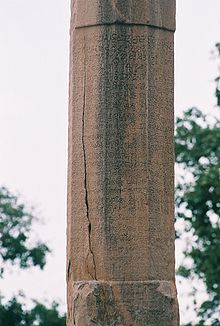
    • Temple walls.
    • In Copperplates,which are left in the custody of some people or buried in a safe place.
    • Written on Palm leaf 🍂.

    Indian copper plate inscriptions are historical legal records engraved on copper plates in India.

    Donative inscriptions engraved on copper plates, often joined together by a ring with the seal of the donor, was the legal document registering the act of endowment. It was probably necessary to produce them when required to prove ownership/ the claim to the rights. The retrievability of the copper plates was perhaps crucial in the newly settled lands. Detailed information on land tenures and taxation available from these copper plate grants….

    Indian copper plate inscriptions (tamarashasana), usually record grants of land or lists of royal lineages carrying the royal seal, a profusion of which have been found in South India. Originally inscriptions were recorded on palm leaves, but when the records were legal documents such as title-deeds they were etched on a cave or temple wall, or more commonly, on copper plates which were then secreted in a safe place such as within the walls or foundation of a temple, or hidden in stone caches in fields. Plates could be used more than once, as when a canceled grant was over-struck with a new inscription. These records were probably in use from the first millennium.

    Some of the oldest inscribed copper plates to be found in the Indian subcontinent date to the Mature Harappan era, consisting of up to 34 characters and thought to be used for copper plate printing…Indian Copperplates .

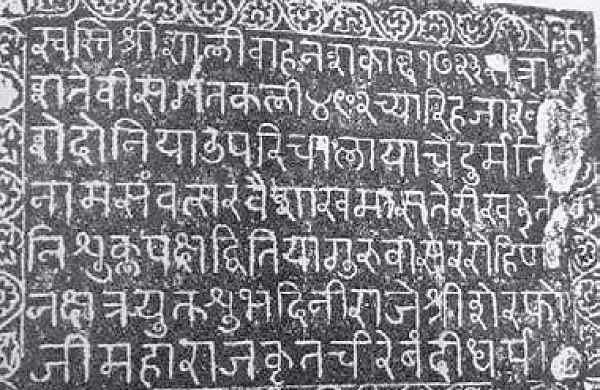
    Epigraphy is the study of Inscriptions on Rocks, Pillars, Temple walls, Copper plates and other Writing-materials like Stones, Metals, Potteries, Woods, Palm leaves, Clothes, Conch shells, Mural paintings and Coins. It is one of the most fascinating and instructive studies. It deals with the art of writing, which distinguishes man from animals and provides us with an instrument for conservation and transmission of historical traditions from generation to generation. ….It has been estimated with a fair degree of accuracy that the inscriptions written in Tamil occupy the first position in volume, amounting nearly 20,000, followed by those in Kannada (10,600), Sanskrit (7,500) and Telugu (4,500). Inscriptions in Tamil language are noticed from the third century BCE onwards. (Source: Journal of the Epigraphical Society of India Volume 19 : 1993)….

    A separate epigraphy wing was started during the year 1966. The primary function of this wing is to copy inscriptions on boulders, stone pillars, stones, temple walls and on copper plates. The inscriptions are deciphered,edited and published. So far, about 24,771 inscriptions are copied and their estampages (ink impression) are preserved in this wing. Some original copper plates and old palm leaf manuscripts are also under the custody of this department.

    Department of Archaeology, Government of Tamil Nadu
  • Epigraphs Copperplates Legal,Not Archeological Records

    Epigraphs Copperplates Legal,Not Archeological Records

    It is with consummate ease with which Indian historical records are dismissed with Elan, in the guise of a research paper by a Scholar .I am providing excerpts from the research paper that is supposed to research on Copperplates and Epigraphs of India.

    Abstract: Indian copper-plate grants, initially issued by ruling kings from the third
    century CE onwards and increasingly by private individuals as time passed, are very
    specific documents, as they are kept by the grant beneficiaries as title-deeds. They are
    usually treated as inscriptions due to them being made of such hard material. How-
    ever if the main character of an inscription is its being publicly displayed, copper-
    plate grants are not inscriptions, as they were often found buried for safety’s sake.
    Based on South Indian materials, it is argued here that Indian copper-plate grants are
    neither inscriptions (i.e. publicly displayed writings on temple walls, steles, rocks,
    etc.) nor documents or archival records (i.e. private or state records on palm leaf), but
    are situated at the ‘hinge’ between these two categories, as revealed by their format,
    content and purpose.
    Among the many issues raised by the nature of archival records, I will address here
    only a selection. How, by whom and for which purposes are administrative, legal,
    archival records produced? Is there any observable difference between archives, in-
    scriptions and literary manuscripts concerning materials, formats, and producers?
    Where are archives stored? Are there other objects stored together with the records?
    Which practices are involved inside the archive, how and by whom are they used?
    I will deal with these issues by focussing on Indian copper-plate grants, in par-
    ticular South Indian examples of the first millennium CE and the beginning of the
    second, which show that the copper-plate grants’ content and format are similar to
    that of palm-leaf account books. Still, Indian copper-plate grants are traditionally
    treated as inscriptions because of the durability of the material. But are they? And if
    not, what are they? Documents? My argument is that copper-plate grants, i.e. charters
    of donation inscribed on copper so as to serve as permanent title-deeds, are a peculiar
    type of documents to be situated at the intersection between inscriptions and archives
    for several reasons, which, I hope, will be clear at the end of this essay……..

    Conclusions
    Indian copper-plate grants in general and many other examples of texts engraved
    on metal do not comply to what is a restrictive definition of inscriptions as ex-
    posed or publicly displayed texts, as they were usually kept privately and some-
    times buried. There is further the fact that texts (or parts of texts) found engraved
    on copper are also recorded on other supports such as the palm leaf or paper of
    account books, which fall in the category of archival records since they are ad-
    ministrative documents, or the stone of temple-walls and steles, which fall in the
    category of inscriptions since they are public records. The same text could thus
    be materially instantiated for different reasons: account keeping (archives), pub-
    lic information, proclamation and personal display (inscriptions), securing fu-
    ture rights (copper plates).
    But one question remains: why take so much effort in placing at the begin-
    ning of copper-plate grants lengthy eulogies of kings, if these documents were
    not meant in the first place to be read? The answer might be that there were oc-
    casions when the plates had a ‘public life,’ when read, possibly at the time they
    were delivered to the grantees with a kind of ritual reception or at the time they
    were produced in case of legal dispute. Anyhow, if we are to keep the general
    label copper-plate inscriptions, we should hasten to add that, due to their value
    as title-deeds, these, especially grants, are not usual inscriptions in spite of their
    enduring support, nor usual state archives, but rather belong to an intermediate
    category, for which the best label would simply be copper-plate grants.
    Acknowledgements:
    Many thanks to Arlo Griffiths for providing me excellent pictures of North Indian copper-plate
    grants and of the Pātagaṇḍigūḍem plates, for polishing my English and for offering many sug-
    gestions. I am also indebted to R. Balasubrahmanyam for the permission to photograph copper
    plates in the collections of the Chennai Government Museum and to R.K. Tewari …. Citation.

    ‘To cite this version:
    Emmanuel Francis. Indian Copper-Plate Grants: Inscriptions or Documents?. Alessandro Bausi;
    Christian Brockmann; Michael Friedrich; Sabine Kienitz. Manuscripts and Archives: Comparative
    Views on Record-Keeping, De Gruyter, pp.387-418, 2018, ff10.1515/9783110541397-014ff. ffhalshs-
    01892990ff. https://halshs.archives-ouvertes.fr/halshs-01892990

  • How Tamil Kings Are Named Identified Epigraphs Inscriptions

    How Tamil Kings Are Named Identified Epigraphs Inscriptions

    Recently I received an email from one of the readers of my blog asking me how the Ancient Kings of Tamil Nadu were mentioned in Epigraphs and Inscriptions.He wanted to know whether these Kings were mentioned as Dravidas or how they were referred to.

    An interesting question. Though I had written articles based on Epigraphs of Tamil Kings, this thought never struck me. I replied to the reader that though the Purans, at some places refer to Kings of Tamils as Kings of Dravida desa, here Dravida denoting South. Bhagavada Purana describes First Human Being Manu as an Emperor of Dravida Desa.But in other places these texts and Ithihasas mention Dravida kings in some places and Chera, Chola ,Pandya; in other places Kings reigning Dravida desa; or they mention the Kings by their names.

    In the case of Epigraphs and Inscriptions , method is followed by the Kings is to record their names and also identify their Dynasty by their Titles, like Parakesari,Valavan,Sembiyan… in the case of Cholas; மாறவர்மன்(Maravarman), சடய வர்மன்(Satayavarman) got Pandyas; வானவரம்பன்(Vaana varambhan) ,இமய வரம்பன்( Imayavaramban) in the case of Chera.

    Many kings added their unique achievements as their Titles, like Ariyappadai kadantha neduncheralathan,Mudukudumi Palyaga saalai Peruvazhuthi,Yaanaimerth thunjiya Chozhan,Kadaaram Kondaan,Perunchotru udhiyan Neduncheralathan.

    # Link provided in Tamil copperplate inscriptions in this article is good source for Tamil inscriptions. Please check out.

    A record of the Chola king Madhurantakadeva alias Uttama Chola.

    Records that the temple of Tirunallamudaiyar was built of stone by Madevadigalar alias Sembiyan Madeviyar queen of Gandaradittadeva and mother of the king[18]

    Yet another inscription of him from the Masilamanisvara temple in Tirumullaivayil,Dated in the reign of the Chola king Parakesarivarman alias Uttama Chola deva;

    records in his fourteenth year, gift of land by Sembiyan Madeviyar, queen of Gandaraditta Perumal and daughter of Malavarayar. The lands were purchased from the villagers in Ambattur in Ambattur-nadu, a district of Pular kottam Uthama Chola inscription

    The Sanskrit portion of the bigger &nnamanfir plates begins with a fragmentary verse 
    in which the king (perhaps Pdndya) boasts of having subdued the ocean—an attribute which
    the mythical Pdndya kings generally assumed in consequence, perhaps, of their sea-bordering
    kingdom, their naval power, and their sea-borne trade, from the earliest historical times.
    Prom him were descended the kings known as Pdndyas (v. 2) ‘ who engraved their edicts on the
    Himalaya mountain ’ and whose family-priest wffs the sage Agastya (v. 3). One of the
    Phndya kings is said to have occupied the throne of Indra (v. 4) and another to have shared
    it with that god, and still another, to have caused the Ten-Headed (i.e., Havana of Lanka)
    to sue for peace (v. 5). One was a conqueror of the epic hero Arjuna (v. 7) 2 . VerseS
    refers to a king who cut off his own head in order to protect that of his master and also to a
    certain Sundara-P&ndya who had mastered all the sciences. Many kings of this family had
    performed Vedic sacrifices Rdjasuya and A&samddha, (v. 9). 3

    ' Bp. Ind., Yol. YIII, p. 317 f.

    * See Jnd. Ant., Yol. XXII, p. 59 and foot-note 4. •

    l he Tamil portion gives many more of each attributes to the Psndya ancestors ; see below p. 443. Source.
    Tamil copperplate inscriptions.