Tag: Saka Dweepa

  • Tamil Lands Sanjaya Description Tallies Tamil Work Tholkaapiyam?

    Tamil Lands Sanjaya Description Tallies Tamil Work Tholkaapiyam?

    I have written articles on the relationship between Tamil/s and Sanatan Dharma. Based on references to Sanskrit,Puranas Ithihasas found in Tamil Literature of ancient times, (Five Epics, poems of Sangam period) and references in Sanskrit, Prakrit , Puranas, Ithihasas Ramayana and Mahabharata about Tamil and Tamil Kings, I have written about Vedic practices , inclusion of Tamils cultural practices in Sanatan Dharma .From these I had also mentioned about the marriage of Sri Krishna, Arjuna to Tamil princesses; Krishna had a daughter through the South Indian Princess and got her married to a Pandyan prince. Sri. Rama’ s sister, Shantha, was married to Rishyashrunga from Sringeri, Karnataka.The references are too many to be listed here. You may read some of them here.

    Based on such references in Sanskrit texts, I tried to elaborate what Bharata Varsha and it’s extent.You may read some of them here.

    In these posts, I have shown some of the areas mentioned in Sanskrit texts.I have also written von references to Tamil lands in Sanskrit texts. Please read  some of them here. Srimad Bhagvad purana and Skanda Purana identify Kumarikandam.

    Now I am trying to explore the Tamil lands from the statements by Sanjaya in Mahabharata.

    Sanjaya mentions six regions in Sakat dweepa, one of the areas mentioned as part of Earth’s landmass. They are.

    • Mahameru – Mountainous region
    • Mahakaasam- Pastoral land, where grass grows aplenty,Mullai.
    • Jaladham . Marutham.
    • Kumudhotharam,means where it rains, conducive to farming, The place water lilies,Aambal , ஆம்பல் in தமிழ், NymphaeaPubesecens.
    • Jaladhaaram- Where copious rains fall, Neydhal
    • Subrahmanya is referred to Sukumara in Sanskrit,which means handsome, good, nice Son; Tamil calls Subrahmanya as Murugan means, Exquisite, handsome. So, Sukumaaram land might indicate Mountain regions where Subrahmanya resides. In Tamil Literature, Murugan is assigned Mountains region; Vishnu as Krishna to Pastoral lands; Varuna to Sea and adjoining areas; Marutham belongs to Indra and Paalai to Kotravai, Durga.

    Tamil grammar defines six landmass. Kurunji ( Mountain and surrounding areas); Mullai ( Forest and adjoining areas); Marutham( Arable land); Neydhal(Sea and adjoining areas) and Paalai( Desert).

    So it is reasonable to infer Sanjaya was speaking about Tamil Lands.

    The desert region called Paalai in Tamil Literature is found in Seven then panai naadu, Seven  lands of  Normal and short Palmyra trees. Palmyra trees grow in and around Deserts. These Paalai lands were further classified into nearly Desert முன் பாலை and Desert பின் பாலை.

    The seven landmasses based on the list of areas ruled by Tamil Kings, Thennan , தென்னன், One who belongs to South, are as follows.

    தெங்க நாடு ஏழு,மதுரை நாடு ஏழு,முன் பாலை நாடு ஏழு,பின் பாலை நாடு ஏழு,குன்ற நாடு ஏழு,குணகரை நாடு ஏழு,குறும்பனை நாடு ஏழு.

    That is Thenga Nadu ( Seven in number) had Palmyra and Coconut groves; Madurai Nadu ( Seven) corresponds to Marutham ,Jaladham(;Kunakarai Nadu ( Seven) corresponds to Neydhal Sea  and adjoining areas); Kunra Nadu ( Seven) mountainous region;pin Paalai and mun Paalai might indicate dessert..

    Comments for improving this line of thought welcome.

    Reference. https://thamizhan-thiravidana.blogspot.com/2011/07/59-3.html?m=1

  • Scythians Central Asia From India Tamils?

    Scythians Central Asia From India Tamils?

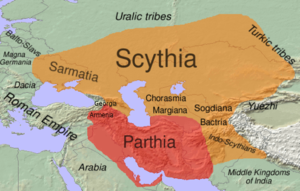
    Scythians were a civilization that flourished as per present evolving study of Ancient Human civilizations, in Central Asia, sometimes described as Inner Asia.

    The Scythian people were referred to in Mahabharatha, one of the two great Epics of India as Milechas, that is those who do not follow Vedic system of Living.

    They were called as Sakas and the region they lived was called Saka Dweepa, Saka Island.

    The island might refer to the present Black Sea and the Sakas could have lived north of Black Sea in the present Russia.

    There is ample evidence of these people having evolved from India tribes.

    And look at the reference in Mahabharatha here.

    ‘Sakas are described in Sanskrit sources as a Mlechcha tribe grouped along with the Yavanas, Tusharas and Barbaras. There were a group of Sakas called Apa Sakas meaning water dwelling Sakas, probably living around some lake in central Asian steppes. Sakas took part in Kurukshetra War….

    mentions about a whole region inhabited by Sakas called Sakadwipa to the north-west of ancient India, at (6:11):-There in that region are, many delightful provinces where Siva is worshipped, and thither repair the Siddhas, the Charanas, and the Devas. The people there are virtuous, and all the four orders are devoted to their respective occupation. No instance of theft can be seen there. Freed from decrepitude and death and gifted with long life, the people there grow like rivers during the season of rains. The rivers there are full of sacred water, and Ganga herself, distributed as she hath been into various currents, is there as Sukumari, and Kumari, and Seta, and Keveraka, and Mahanadi and the river Manijala, and Chakshus, and the river Vardhanika, these and many other rivers by thousands and hundreds, all full of sacred water, are there. It is impossible to recount the names and lengths of rivers. As heard by all men there, in that region of Saka, are four sacred provinces. They are the Mrigas, the Masakas, the Manasas, and the Mandagas.

    The Mrigas for the most part are Brahmanas devoted to the occupations of their order. Amongst the Masakas are virtuous Kshatriyas. The Manasas live by following the duties of the Vaishya order. Having every wish of theirs gratified, they are also brave and firmly devoted to virtue and profit. The Mandagas are all brave Shudras of virtuous behaviour.

    In these provinces there is no king, no punishment, no person that deserves to be punished. Conversant with the dictates of duty they are all engaged in the practice of their respective duties and protect one another. This much is capable of being said of the region called Saka.

    The region called Sakadwipa is mentioned again at (12:14) as a region to the east of the great Meru mountains.’

    Source. https://en.m.wikipedia.org/wiki/Sakas_in_the_Mahabharata

    Note that Siva who was only indirectly mentioned in the Vedas through Sri Rudram, there is no Siva Suktha or Hymns directly addressed to Shiva, is mentioned as having been worshiped in Saka Dweepa.

    Not only this.

    IT was a place where Siddhas lived.

    Siddhas are unique to Tamil Culture.

    They were realized Souls.

    Shiva is regarded as the First Siddha, Adi Siddha.

    Agastya, Bhogar and Panini ere his chief disciples.

    Agastya along with Shiva is believed to have founded Tamil Language.

    Tamil is still spoken in its rudimentary form in the North Western province of present Pakistan.

    Tamil Chola King, Sibi ancestor of Lord Rama ruled from the northwest Region of India, where his second capital was located.

    Alexander when he invaded India subdued the Sagodas a sub tribe of Sakas.

    His wife Roxane was a Saka or Sagoda probably.

    IT looks as though the Scythians were connected to Tamils or were Tamils.

    Will be writing on Tamils and Scythians:the Vasishta connection to Scythians:Scythian Tamil land anamoly.

  • Atlantis White Island, Of White Skinned?

    There are scholars who maintain that Atlantis was first mentioned by Plato.

    But references to the area designated as Atlantis are found in many cultures.

    Atlantis was given its name by the Greeks after Atlas.

    But early Greek legends indicate Sanatana Dharma, Hinduism connection.

    Balarama, Krishna legends have found and there is a view that the Pillars of Hercules was made in honor of Lord Krishna.

    Please check my posts by Googling the term and ramanan50.

    Be that as it may.

    Saka Dweepa is deemd to be Atlantis by taking reference to Sanskrit Texts.

    Atala, one of the regions, out of 14,is a part of the nether world probably indicating that it lies, below, the equator( at least a portion of it).

    Atlantis, Location.jpg Atlantis, Location

    The Vishnu Purana, one of the oldest of the Hindu Puranas, speaks of “Atala, the White Island,” one of the seven dwipas (islands) belonging to Patala (Book II, chaps. i, ii, and iii). This ancient text locates Atala geographically on the seventh (heat, or climate) zone, which according to Francis Wilford (the translator) is 24 to 28 degrees north latitude, putting it in the same latitude as the Canary Islands just off the North African coast. Col. Wilford rightly calls Atala, “Atlantis, the White Island”. (Wilford, 1808)

    At least one “authority” has attempted to identify Atala with Italy, but Italy is not an island. Also, Italy is 38 to 45 degrees north latitude. Finally, I fail to see any possibility that the “Western Ocean,” mentioned in the texts as its location, could be the Mediterranean Sea when the Karna Parva of the Mahabharata clearly describes Africa as comprising that ocean’s eastern shoreline—placing that body of water clearly to the west of Africa!

    Another non-Sanskrit scholar implies that Atala might be one of the well-known northern lands, such as Iceland or Greenland, and that the epithet “White Island” refers to its being covered with snow the majority of the time—even the mythological Hyperborea has been suggested. This does not appear to be the case.

    Atala and Sveta Dwipa (“White Island”) are not the only names for Atlantis in Sankrit lore. Another name, Saka Dwipa, is used just as often in the Puranas; and according to the Sanskrit Dictionary (1974), Saka Dwipa means “island of fair skinned people.” It is therefore quite possible that “white” refers to the skin color of its inhabitants, rather than to the dominant color of the island—although it should not be assumed that all Atlanteans were white-skinned.

    The terms “Atala” and “White Island” are used also by the Bhavishya Purana (4th cent. B.C.). Here it is stated that Samba, having built a temple dedicated to Surya (the Sun), made a journey to Saka Dwipa, located “beyond the salt water” looking for the Magas (magicians), worshippers of the Sun. He is directed in his journey by Suryahimself (i.e., journeys west following the Sun), riding upon Garuda (the flying vehicle of Krishna and Vishnu) he lands at last among the Magas.

    The Mahabharata (circa. 600 B.C.) also refers to “Atala, the White Island”, which is described as an “island of great splendour.” It continues: “The men that inhabit that island have complexions as white as the rays of the Moon and they are devoted to Narayana . . . Indeed, the denizens of White Island believe and worship only one God.” (Santi Parva, Section CCCXXXVII)

    Although there are numerous ancient Egyptian king-lists in existence, only a few include the famous “reign of the gods”. These include the Palermo Stone (2565-2420 B.C.), the Turin Papyrus (1300 B.C.), and Manetho’s Egyptian Chronicles (250 B.C.). Of these, the Turin Papyrus is by far the most complete source.

    The Turin Papyrus (Gardiner, 1987; Smith, 1872) lists ten kings who ruled during the “reign of the gods,” complimenting the fragments of Manetho which have come down to us. Most importantly, it informs us as to the correct number of actual kings, thus helping us to equate Egyptian names with the corresponding Greek names. Below is a list of god-kings from the Turin Papyrus, with Manetho’s fragmented list alongside:

    The Turin Papyrus Manetho’s King-list
    Ptah Hephaestus
    Ra Helios
    Su Agathodaemon
    Seb Cronos
    Osiris Osiris
    Set Typhon
    Horus . . .
    Thoth . . .
    Ma . . .
    Horus Horus


    So we have ten Aulitean (or, Aletean) kings reigning in a “foreign land” during the precise time Plato says ten Atlantean kings reigned in Atlantis. The Turin Papyrus also records the installation of the next series of kings in 9850 B.C.! This date is so close to the date given for the end of Atlantis that coincidence is virtually out of the question. In such a case, the equation “Aletean=Atlantean” doesn’t seem out of the question. ‘

    The Santi Parva also describes Atala as being inhabited by white men who never have to sleep or eat. (Ibid.) Interestingly enough, the Greek historian Herodotus (450 B.C.) describes a tribe of Atlanteans who “never dream and eat no living thing”. (History, Book IV) Can this be coincidence? And just as the god Poseidon is very much involved in the Atlantis story, likewise in the Sanskrit accounts we find Varuna (the Hindu Poseidon) very much involved in Atala.

    In other words, Atala, the White Island is remarkably similar to Plato’s Atlantis, even down to its circular capital city, Tripura! Tripura is made in three concentric parts, just as Plato’s Metropolis is divided into three parts by concentric canals. During the war of the gods and Asuras, the wicked cities of the Asuras began to fall, one by one, amidst loud cries of woe: “Burning those Asuras, he [the hero] threw them down into the Western ocean” (Karna Parva, Section XXXIV).

    Concerning the “concentric arrangment” of Tripura, a recent archeological discovery of a fortified palace in Bactria, India, known as Dashly-3, turned out to be a concentric 3-ringed structure of the “tripura type”. [Their words, not mine.] The archaeologists, excavating under the auspices of the Archaeological Departments of Pakistan and India (Mahadevan, 15), also state that the Dasyas, the builders of Dashly-3, were “Asura-worshippers”.

    In the Surya Siddhanta, an ancient Sanskrit text on astronomy, the translator (W. D. Whitney, 1860) mentions an “island” (dwipa) called Jambu Dwipa, surrounded by rings of alternating land and water. I am tempted to equate Jambu Dwipa with the Atlantean capital, which Plato describes as surrounded by circular canals, “making alternate zones of sea and land” (Critias)…


    For instance, it has been alledged that Plato called Atlantis “a continent,” whereas Atala was only an island; therefore, it is reasoned, they could not be one and the same.

    In actual fact, Plato never calls Atlantis a continent: only a “large island”. That Atala is also a very large island can be deduced from the Mahabharata, which describes Atala as having a capital city (Tripura), other major cities with houses, palaces, and streets, and as being populated by numerous tribes, some of whom chose to wage war against other nations. This is not a description of a small island.

    That whether it was an Island or a Continent is a non issue.

    Continent may be  a large mass surrounded by water.

    Like Australia.

    ‘The Santi Parva also describes Atala as being inhabited by white men who never have to sleep or eat. (Ibid.) Interestingly enough, the Greek historian Herodotus (450 B.C.) describes a tribe of Atlanteans who “never dream and eat no living thing”. (History, Book IV) Can this be coincidence? And just as the god Poseidon is very much involved in the Atlantis story, likewise in the Sanskrit accounts we find Varuna (the Hindu Poseidon) very much involved in Atala.

    In other words, Atala, the White Island is remarkably similar to Plato’s Atlantis, even down to its circular capital city, Tripura! Tripura is made in three concentric parts, just as Plato’s Metropolis is divided into three parts by concentric canals. During the war of the gods and Asuras, the wicked cities of the Asuras began to fall, one by one, amidst loud cries of woe: “Burning those Asuras, he [the hero] threw them down into the Western ocean” (Karna Parva, Section XXXIV).

    Concerning the “concentric arrangment” of Tripura, a recent archeological discovery of a fortified palace in Bactria, India, known as Dashly-3, turned out to be a concentric 3-ringed structure of the “tripura type”. [Their words, not mine.] The archaeologists, excavating under the auspices of the Archaeological Departments of Pakistan and India (Mahadevan, 15), also state that the Dasyas, the builders of Dashly-3, were “Asura-worshippers”.

    In the Surya Siddhanta, an ancient Sanskrit text on astronomy, the translator (W. D. Whitney, 1860) mentions an “island” (dwipa) called Jambu Dwipa, surrounded by rings of alternating land and water. I am tempted to equate Jambu Dwipa with the Atlantean capital, which Plato describes as surrounded by circular canals, “making alternate zones of sea and land” (Critias)’

    Try this one!

    The term Asura means powerful.


    While Ravana from the southern part of Bharatavarsha is called a Rakashsa, the people of Atala, Atlantis were called Asuras.


    This term set me to search for a landmass which had a culture similar to Sanatana Dharma.


    One finds references to this in the Ramayana where Sugriva directs hs army to search for Sita in Peru, identifying it with the Nazca Lines, which he called


    as  Shiva’s Trishul Mark, the Nazca Lines resemble the Trishul Mark.


    The description of Tripura confirmed suspicion that Atlantis is Tripura mentioned in the Purana and destroyed by Lord Shiva.


    However, secondary tradition founded by people and limited in time, and the original tradition has superhuman origin and timeless nature. Because of this myth, and even the Bible texts “Egyptian Book of the Dead” is only secondary to the polar revelation contained in the text of “Avesta”, “Rig” and “Popol Vuh.”There is direct textual overlap between the myth of Tripura and dredaniem of Atlantis. First of all, ‘of course, we are talking about uniformity describe the appearance of Tripura and Atlantis. “Matsya Purana” and “Mahabharata” reported three round town, merged into one, and the first one was made of gold, the other – from the silver, and the third – of iron [29]. In turn, Plato in the dialogue “Critias” said a central island surrounded by the “alternate water and earth rings (earth was two, and water – three) all larger diameter, conducted as if the compass of the middle of the island, at equal distance from each other” [ 30]. Central island and two earthen ring – this is a description of a triple-like Tripura. The walls of each of these cities were covered with metal. The outer city wall was covered with copper, middle – tin, and the inner city – precious orichalcum. [31] The walls of the temple of Poseidon were lined with silver and gold. [32] Such detailed description of the matches in the Indian holy city of ancient myth and prove not only the relationship of the two stories, but the stories of historical authenticity.In other Indo-European sacred myths we find the same pattern. In “Avesta” description Vary, a town built on the orders of Yima Ahuramazda, fits the description of Atlantis and polar Tripura.


    Tripura destroyed by Shiva Atlantis

    Delhi Indraprastha Built by Builder from Atlantis

    More to follow.


  • Delhi,Indraprastha Built by Builder From Atlantis

    Maya is the Architect of the Devas, Beings of a Higher Plane from the Humans.

    They are called Devas, Indra being their Head.

    Early Atlanteans spread.jpg Early Atlanteans spread.

    Indian Philosophy, Religion and History are so intermingled that at times it is difficult for the reader to determine one from another.

    One has to be cautious while evaluating them.

    One such concept is the Devas.

    Devas indicate a state of evolution of  man where he ‘ she reaches higher in terms of perception and abilities.

    It also indicates beings of a different plane of Existence.

    It means a group of people on the earth as well.

    Confirming the later there is the Amravathi city of Indra, the Chief of the Devas in Russia.

    There is also the Rig Veda Mandala City as well.

    Indra Amravathi Baikal

    Baikal Vaikanasa Theertha

    Krishna’s son Pradhyumna built a city in Russia.

    Siberians worship Ayur Devathas.

    These are Dhanavas, excepting Pradhyumna who was a human being.(Dhanavas, Beings of a Higher Plane and living in area which was considered sacred)

    The Rig Veda was composed in the Arctic,Shiva leading it, Vasishta , along with the other Rishis.

    And the Mayas and Incas trace their origin to the Tamils.

    Ravana was an Asura,meaning valorous.

    The Asuras lived, in general, The Pathala Loka.

    There is also the Nazca Lines of Peru resembling Shiva’s Trishul.

    I had written about Shiva leaving the south and traveling through the western hemisphere,Europe, Americas before finally reaching the Arctic.

    And Atlantis was there in the path.

    ‘Maya is a generic name for the people of sakadweepa.or Atlantis.In other words ,Maya,the yavanasilpi or architect of olden times was also a Magha Brahmin and who knew solar and lunar calendars and vaasthuvidya.

    He was the one who built Indraprastha during Yudhishtira’s time and another of his race with the same generic name was the father of Mandodari .(Ravana’s wife).

    He was an original inhabitant of sakadweepa(Atlantis)and he had come to live in present Rajasthan during Ravana’s time.

    The word Asura and Azorus ,Atlantis and Atlantic ocean and Athalam of the scriptures are from the same root .

    According to Sounakahora ,Maya was a astronomer of excellence and he taught astronomy to the great Rajarshi Viswamithra.

    The original abode of Maya according to Indian scriptures is Romakapura in Athalam.

    (The Romakapura spoken by the Mahgha Brahmin Varahamihira ,is this Romakapuram of Atlantis and not Rome.)

    Romakasidhantha of Maya,the yavanaguru came from Atlantis and not Rome as the historians of Astronomy think.

    The knowledge came to India in very very ancient times .

    When Viswamithra accepted the southern stars as polestar there was a great debate between his disciples and disciples of Vasishta who followed the northern star clusters.’

    Modern Delhi ,( portion of it) was called Indraprastha .

    It was built by Maya.

    Maya was from Sakadweepa.

    Saka Dweepa was Atlantis.

    More on Atlantis to follow.

    Earth as Seven Islands.

    King Priyavratha had seven sons each with names synonymous with Agni or fire God.The purana considers the world as 7 dweepa or islands belonging to these 7 Agni or fire,who were brothers.
    Jambudweepa Agneendran
    Plakshadweepa Idmadwajan
    Salmali dweepa Yagnabahu
    Kusadweepa Hiranyarethas
    Krounchadweepa Grithaprishtan
    Sakadweepam Methathithi
    Pushkaradweepam Veethihothran

    Jambu Asia Eurasia
    Plaksham South America South America
    Salmali Australia Australia
    Kusa oceania oceania
    Krouncha Africa Africa
    Saka Europe Atlantis
    Pushkaram North America North America
    According to Blavatsky the Plaksha ,kusa ,salmali and Krouncha had been under the sea for a long time and surfaced again and Sakam which is at present submerged is the legendary lost Atlantis.

    A part of sakadweep called the swethadweepa or white island(Shet land)is the present Greenland and parts of Siberia.

    Bhavishyapurana says that swethadweepa lies beyond the salty sea and Magha Brahmins of this land had once built a sun temple for Sambha,the son o f Krishna and Jambavathy .(Varahamihira was adescendent of Magha Brahmins).

    Jambavathy,the daughter of Jambavan,the oldest root race of inhabitants of the world(partly human and partly Riksha-the bear-ape man)was a south Indian wife of Krishna and belonged to the oldest Adivasi of the continent.

    Thus ,the relation of Atlantean race and Indian race is mentioned in scriptures.

    Citation.

    http://www.online-literature.com/forums/entry.php?3455-Division-of-globe

    There is a view that the Saka Dweepa was in the South west of the present India.