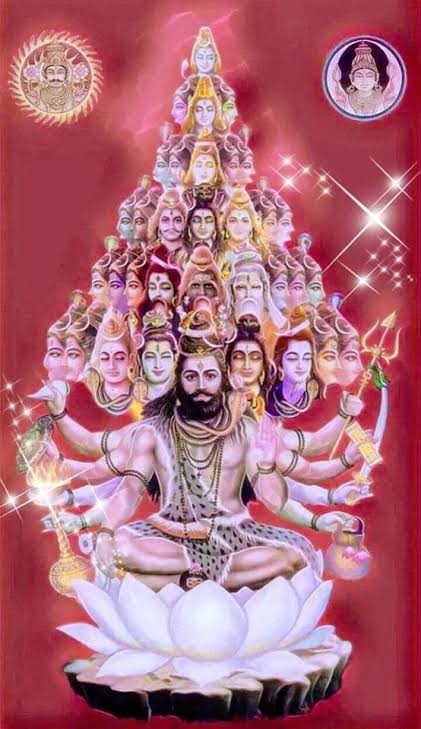
Tag: Nataraja
-

Sivamurtham 2
Dhyana Slokas of these Five Siva Murthams.
cha.ndra shekharar
abhaya varada hastam.h saumya shR ^ i.ngAra bhAvam.h vipula vadana netram.h chandra biMbA.nga mauLim.h | R ^ ijutanu samapAdasthAnakam.h vidrumApam.h hariNa parashu pANim.h padmapIThoparistham.h ||
umA maheshvarar
dhavaLApa sukhAsana sannihitam.h mR ^ iga DiMbaka Ta.nka varAbhayadam.h | sumukham.h paramutpaladhR ^ ik.h varadam.h umayA sahitam.h praNamAmi bhavam.h ||
naTarAjar
ekAsyantu chaturbhujam.h trinayanam.h vAmetu dhurdhUrakam.h chandram.h patra shikhi prasArita karam.h chordhvam.h padam.h kuJNchitam.h | savye svastika kuNDalam.h damarukam.h ga.ngAbhayepipradam.h vande kIrNajaTam.h naTeshamanisham.h hyapasmAra dehesthitam.h ||
tripurAri
raktApam.h paripUrNa chandravadanam.h kR ^ ishhNam.h mR ^ igam.h kArmukam.h vAme savyakare sharaJNcha tathatam.h Ta.nkaJNcha devyAyutam.h | ga.ngAchandra kalAdharam.h hariviriJNchAdyaissadA sevitam.h hAsairdagdha puratrayam.h tribhuvanAdhIsham.h purArim.h bhaje ||
jalandarAri
raktApam.h ugra gamanam.h trivilochanAbhayam.h Ta.nkAsi kR ^ ishhNa mR ^ iga chApa sushobhi hastam.h | bhUmistha chakra dharaNodga jalandharasya kaNThagna mAbhaja jalandhara harasvarUpam.h ||
https://shaivam.org/scripture/English-Script/152/maheshvara-murtham-dhyana-shlokas
-
VEDAS COMPLIED IN THE ARCTIC WHY HOW BY WHOM ? PART 3 Clarification
In the previous two articles I have mentioned some facts and did not provide the relevant Links.
The reason, as I have mentioned in the article is that providing too many Hyperlinks in an article affects the site technically.
Many have corresponded on the authenticity of the statements I have made in these articles and requested details.
My intention is to provide information on Indian History and the Purana, Ithihahasa and The Vedas that they are not stories or fantasies but facts and history ,aprt from conveying deep philosophical thoughts.
However there are some objections to the concept that Arctic was the Home of The Vedas and there are scholars who dispute this, including Professor Vartak.
I intend anaylsing them in the present series in a separate article.
One comment on the article is reproduced below and I am providing the information with the link, though it is not a Hyperlink.
One may copy paste it to read the full article.
My replies are in Italics.

Shiva In Thiruvannamalai. ‘Your intention is good, your effort is commendable, your blog is very informative.
A little muscle to the foundations of your arguments would help. Could u give references of specific verses from spiritual literature to bolster your arguments. That would help.
For eg: Arguments like:
The Vedas refer repeatedly to long periods of day long periods of night.‘The information of the relevant texts are provided in Tilaks Book.
Link .https://en.m.wikipedia.org/wiki/The_Arctic_Home_in_the_Vedas
and more by way of objections by Shri Vartak at,
In his support Tilak cites Rigveda 7-76-2 and translates it: "The Devayana path has become visible to me. The banner of the Dawn has appeared in the east." From this verse he infers that the Devayana started at the rise of the Dawn. This inference appears correct apparently, but is not true, because Tilak himself has told that in the Polar and Arctic regions the sun rises in the south. Then how is it that the banner of the Dawn was seen in the east? Tilak has taken support of Pi try ana also. He states that the Hindus consider Pitryana as unauspicious for a man to die. This tradition is easily and rationally explained if the Pitryana represented a period of continuous darkness. The funeral ceremonies of any one dying during the long night were deferred till the break of the dawn. Now the question arises that if there was a continuous spring at the Arctic region in the ancient era when Aryas lived there, as Tilak says, then is it possible to keep the dead body at home for six months?
Link https://archive.org/stream/ScientificKnowledgeInVedas/Scientific_Knowledge_in_Vedas_djvu.txt
They also speak of days in yet another context ,extending for 60 Nazhigais,which corresponds to our normal day.
Southern direction is being treated as some thing beyond more like alien territory.
When one reads the Vedic Texts,reference to Dravida desa is made as though it is a distant land, though a part of Sanatna Dharma,and it was considered as a place where a sloghly different culture was followed and was considered fit to banish people, as in the case of Viswamitra who banished his 51 sons to the Dravida Desa.
And Vasishtas Tribes in Dravida desa indicates the southern connection.
https://ramanisblog.in/2016/11/17/vasishtas-fourteen-dravidian-tribes-greeks-chinese-huns/
Kanchipuram ,Tamil Nadu tribe is mentioned in Vasishta Viswamitra War.
Please google viswamitra sons +ramanan50 to read more articles on this subject.
They were called as Dravida
The Shiva cult precedes Sanatana Dharma.
https://ramanisblog.in/2015/07/05/pre-sanatana-dharma-shiva-in-south-predates-sanatana-dharma/
You may read more articles on this by Googling Pre Sanatna Dharma Shiva.
But the texts are clear that Shiva as a separate Entity though not in conflict with the Vedas is mentioned as the Ancient One.
This refers to Then (south) Madurai which was devored by the sea.
This speaks of a parallel system of philosophy in the south,though not at variance with the the Vedas.
Lord Shiva is considered to be the founder of the Tamil language.
Thiruvannamalalai,Tamil Nadu is 3.64 billion years old and Jwalapuram,Cuddapah,Telengana,which houses Nataraja is 74,000 years old.
For Thiruvannamalai being 3.64 Billion year old,Jwalapuram 74,000 years old, kindly check my articles on these issues by googling the search term plus ramanan50.
Rest assured my intention is not negative. Kudos and looking forward to read ahead.
(I hv read Lokmanya Tilak’s Artic theory of the vedas but i am not convinced since a lot of our great scholars and noblemen in those days were under duress to kowtow to the British empire which is understandable. No fault of theirs….Those were very trying times and they did the best what they could do so that we could live in a free India).’Related.
-
Shiva A Person God or Reality
The worship of Shiva precedes the Sanatana Dharma and the worship of Shiva seems to have originated from the South of the Vindhya Mountains.
And the worship of Shiva is intriguing as a God.
One can find Shiva beibg worshiped as a Human being in the form of Nataraja and in other forms as a Human being, this mode of worship of Shiva in the north of Vindhyas is very limited when compared to the South.
In the South one can find the worship of Shiva both as a Linga and as a Human being or resembling a human being.
In the north the worship of Shiva as Linga is predominant.
And the worshio of Shiva as Ardhanaresswara form, of Shiva and Devi in one form is prevalent in the south.
Another interesting point is that the Gods as described in the Vedas do not seem to have a description as a human being.
Only their attributes are provided in the Sukthas and seem to be a reoresentation of the Principles of Nature.
Purusha Suktha drscribes the Evolution of the Universe,
The Narayana, Vishnu, Sri and Durga Sukthas describe the various aspects of the Universe.
However , the Sri Suktha calls Sri, Lakshmi as the one who resides in the
House of Sikleetha Rishi- Sikleetha
Vasame gruhe.
Excepting these lines no mention is
Made to the Gods as Humans.
The core of the Vedas is that the Reality , Brahman is without and beyond Attributes .

Shiva In Thiruvannamalai. Nirguna.
However later concept s brought in the description of Gods in rhe image of Man in the Puranas and the Ithihasas Ramayana and Mahabharata.
Even here there is a uniqueness of Shiva.
Shiva appears, as recorded in the Tamil Classics and the Thiruvilayadal purana which describes the activities of Shiva at various points of Times while not much of this nature is found in the literature of North India.
And note the spread of Hinduism towards the East where Muruga, Subrahmanya worship is prevalent from Lanka to Australia and the spread of Shiva Cult here and also to thecwest of India from Middle East to Arctic and Russia.
However there are legends that Shiva was worshiped as a Tribal Chief.
Even today the Austrakians perform the Trinetra Dance of Shiva.
And there is a Temple for Shiva asKratha Shiva’ Shiva the Hunter in Kerala.
‘
The Indian tribes worship Shiva in their natural abode – jungles, hills, mountains, agricultural fields’ etc. It is the Hindus who brought him into temples. Shiva is always worshiped among the tribals in His presence as lingam.
In the bramhanical Hindu fold Lord Shiva has several names. Prominent among them are as follows: Shankar, Ashutosh, Shiva, Neelkantha, Jatadhari, Pasupati, Bholanatha, Viswanatha, Baidyanath, Kailashpati, Tripurari, Rameshwar, Ravaneshwar, Somnatha, Mahakal, Omkar, Nagesh, Trayambakeshwar, Chidambaram, Kedranath, Shambhu, Gauripati, Girijapati, Mahadeo, Umapati, Maulishekhar, Shashank-Shekhar, Chandrashekhar, Lingraj, Devadhideva, Hara, Bambhola. His every name makes him unique, peculiar, caring for his believers and followers but careless about himself. He does not run after the worldly affairs and luxuries. He is the divine guru. He is the sun that opens the lotuses of the hearts of great Yogis. He is most compassionate. He absorbs the devotees’ afflictions. He is the manifestation of the three worlds. He abides in bliss. He is delighted with devotees. He is forever blissful. He absolves the sins of the faithful. He lights up his devotees. He is beyond thought. He is associated with right thoughts. He is boundless. He is birth-less. He is without beginning or end. He is associated with knowledge. He is supreme in bliss and knowledge. He is slave of the devotees. He responds to the devotees. He is attentive to the devotees. He is the light of the devotees. He is a killer of devotee’s grief. He is the experience of devotees. He rescues devotes. He supports devotees. He is approachable through pure thoughts. He is the embodiment of consciousness. He has eliminated bodily passions.
From the available narratives of many tribal communities (as described in the latter part of this paper) it appears that the Hindu ancestors adopted Him much later. Gods are fathers and Lord Shiva is s father like personality for the all other gods. He is the greatest god, Mahadeo. He helps his indigenous people in all walks of life and in all geographical, ecological and natural conditions. He is malevolent. He is benevolent. He is supreme Lord. He is Lord of lords. The Taittiriya Samhita therefore, in the form of Rudra, rightly describes Him:
“Hail to him of the drum, hail to him of the drum stick, hail to the courageous and to the creations, to him on the footpath, hail to him of the pond, and to rivulet, hail to him of the lake. Hail to him of the well. Hail to him of the rain, hail to him of the cloud, hail to him of the sunshine and to him of the storm. Hail to him of the dwelling and to the guardian of the dwelling (TS.4.5.7.)”.
Non-tribal and tribal interaction in ancient India started much earlier than the Vedic period. A minute survey of the Rig Vedareveals that these indigenous people were considered low, uncultured, mindless and substandard people and referred to asDasavarna (black colour or Dasa colour),Adavea (the godless community), Ayajyavah(non-sacrificiers), Anindra (non-believers in Indra), Murudeva (worshippers of dummy Gods), Sishnadeva (worshippers of phallic Gods), Mridhravaaka (those whose language was obscure and unintelligible),Maleecha (a non-Aryan) anas (flat nosed people) Akratuh, Avratuh, Ayyajnya, Vratya, Pani, and dasa. Here anas is a tribal andsisnadeva is the phallus god- Lord Shiva. Tribals with black skin were humiliated by the Vedic community as dasavarna where as other tribes were criticized on the basis of their flat nose. They were initially not permitted to mix up with the Hindu community but very soon it was realized that the existence of Vedic cult would not be possible without incorporating the existence of Shiva in the Vedas. And all of a sudden in the later part of Rig-Veda we see how Rudra has appeared with his all power and grace combining malevolent and benevolent characters.
The three Vedas – Rig, Sam and Yajur – were recognized as canonical and calledTrayi Vidya (the threefold knowledge). TheAtharva Veda (atharvam = charm), written later, was included in the canon only after a long struggle. Influenced by the religious and ritual practices of the tribes, which they used to practice in order to appease the gods (and many of them are still doing), it included spells and incantations for the practice of magic.
Slowly and gradually the Vedas developed six major limbs – Vedanga-s:
- a) Siksha (Phonetic Science which mainly deals with pronunciation)
- b) Vyakarana (Grammar)
- c) Nirukti (Context conclusive meaning; etymology)
- d) Chandas (Meter)
- e) Jyotisha (Time Science; astronomy & astrology)
- f) Kalpa (Rituals)
The seers and scholars who realized these aspects of knowledge from the Vedas, composed Sutras (short but potent phrases which convey a lot of meanings) on eachVedanga. Kalpa-sutra-s are of four categories, viz., Srouta (collective sacrifices), Grhya(family rituals), Dharma (occupational duties) and Sulba (building of sacrificial fireplaces, altars etc.).
According to the different levels of conditioned consciousness there are instructions in the Vedas for worship of different controllers, with the aim of reaching different destinations and enjoying different standards of sense enjoyment. Agamas(emanated scriptures) are books which are classified into five for this purpose:
Basic nature of the Deity
Deity who controls
Branch of Agama
Energy Shakti
Shakta Agamas Visible source ( Sun)
Surya Sourya Agamas Controller Ganapati Ganapatya Agamas Destroyer Shiva Saiva Agamas Ultimate source Vishnu Vaikhanasa Agamas Slowly and gradually the Vedic seers and scholars made the place for the tribal people and their rituals and tantrikpractices in the Vedic fold. They said, for those who are below standard for Vedic purificatory process, Lord Shiva gave theTantra Shastra-s. These have two general classifications, right and left. While the right aspect contains regulations for purification for those who are grossly engaged in meat eating, intoxication and illicit sex, the left aspect contains low class activities like black magic etc.
We find some legends of Lord Shiva Among the tribals of Chotanagpur, now in Jharkhand. I will begin with the case study of the Santhal – the largest Tribal community of Jharkhand. The supreme God of Santhal is called Marang Buru, Thakur Buru, or Mahadeo. His character is basically very similar to that of Shiva. Interestingly, the great and historicalJyotirlinga of Baidyanath, popularly known as Ravaneshwar Mahadeo, is located in the heartland of Santhal at Deoghar. Many Santhals claim that it is the entry point to the Santhal Territory. It is a place where all gods and goddesses reside with Lord Baidyanath. The prominent characteristic of the Santhal religious practices is belief in and worship of spirits or bongas and worship in the sacred grove.’
There is a school of thought which states that cthe Shiva worship was drwan to Sanatana Dharma from the South and later incorporated in the Vedic and puranas.
In essence the vedas treat Shiva more as Principle than as Human Being.
But considering the numerous references to Shiva as a Human being , the spread of Sanatana Dharma by Shiva and His son Ganesha, the archaeological finds around the world,mostly among the tribes who worship Shiva as their ancestor, I am of the opinion that Shiva wa a human being and He was a realized soul.
Note that the Siddhas consider Shiva as the first Siddha.
Siddhas transcend time and Space.
The view that human beings are God is not incompatible with Hinduism..
Man is a part of the Reality, Brahman
Those who Realize the Self are elevated to God hood.
Thus Shiva was a human being who realized Self and was elevated to Godhood embodying the principles of the Universe and The Tantra Sasta, the means of realuzing Self.
Citation and references.
http://ignca.nic.in/kmsh0003.htm


You must be logged in to post a comment.