The information one gets by searching the ancient concepts of Hinduism against modern scientific developments is amazing.
I have written about the Nataraja statue being kept in the CERN facility ,Geneva Switzerland.
Scroll down for Videos.
… the tunnel’s section resembles the structure where Shiva is always depicted, doing his Anandatandava aka Cosmic Dance , Ananda Tandava.
Why a statue of Nataraja has to be kept in a facility that has been set up to find the God particle, I have wondered.
Sanskrit , Arabic Inscriptions in CERN .
But I forgot to pursue the matter further,
It is to be noted that the CERN facility does not have a strong commitment to Indian Philosophy, to have the Nataraja Statue installed at CERN.
Hindu “god” SHIVA, right in front of the CERN building, (European Center for Research in Particle Physics) in Geneva. We know that scientists of world wide have been working on LHC development, including Indian scientists, but a 2m high statue of the most feared hindu deity EVER, in front of the LHC facility, seems too odd.
On searching further I have come across information that theLHC may have been designed after Nataraja’s Ananda Tandava.
Probably it is the scientists acknowledgement of the profound thoughts behind the principle of Nataraja concerning sub atomic particles.
Text of the plaque kept next to Nataraja Statue.
‘
Ananda K. Coomaraswamy, seeing beyond the unsurpassed rhythm, beauty, power and grace of the Nataraja, once wrote of it “It is the clearest image of the activity of God which any art or religion can boast of.”
More recently, Fritjof Capra explained that “Modern physics has shown that the rhythm of creation and destruction is not only manifest in the turn of the seasons and in the birth and death of all living creatures, but is also the very essence of inorganic matter,” and that “For the modern physicists, then, Shiva’s dance is the dance of subatomic matter.”
It is indeed as Capra concluded: “Hundreds of years ago, Indian artists created visual images of dancing Shivas in a beautiful series of bronzes. In our time, physicists have used the most advanced technology to portray the patterns of the cosmic dance. The metaphor of the cosmic dance thus unifies ancient mythology, religious art and modern physics.”
There are one hundred Tandavas of Lord Shiva, as Nataraja.
The Ananda Tandava is the Cosmic Dance of Bliss.
‘When Sati (first wife of Shiva, who was reborn as Parvati) jumped into the Agni Kunda (sacrificial fire) in Daksha’s Yajna and gave up her life, Shiva is said to have performed the Rudra Tandava to express his grief and anger. The Shivapradosha stotra says when Shiva performs theSandhya Tandava, the other gods like Brahma, Vishnu, Sarasvati, Lakshmi and Indra play musical instruments and sing Shiva’s praises.[4] Ganesha, the son of Shiva, is depicted as Ashtabhuja tandavsa nritya murtis (Eight armed form of Ganesha dancing the Tandava) in temple sculptures.[7] The Bhagavata Purana talks of Krishna dancing his Tandava on the head of the serpent Kaliya. According to Jain traditions, Indra is said to have performed the Tandava in honour of Rishabha (Jain tirthankar) on the latter’s birth.’
‘
The LHC is a particle booster, built to beam up protons in very high speed and opposite directions, until they collide creating a huge amount of energy capable to reproduce similar cosmic conditions that have creating such phenomena as dark matter, antimatter and ultimately the creation of the universe billions of years ago. The scientist team keeps the beam up speed, between 3.5 and 7 TeV (Teraelectron Volts) to reach a collision energy around 90 times to over 500 TeV. They plan increase the speed of beam up around 12 TeV until 2012.
Under the radar:
1) According to Prof Irina Aref’eva and Dr Igor Volovich, both mathematical physicists at the Steklov Mathematical Institute in Moscow, the energies generated by the subatomic collisions in the LHC may be powerful enough to rip space-time itself, spawning wormholes.
2) According to Fermilab director, Pier Oddone, 7 TeV of beam up speed could cause a collision with energy enough to reproduce to reproduce the conditions of the universe one second after the Big Bang. (Remember that the scientists want reach 12 Tev until 2012)
3) According to a team of brainiac scientists as the Nobel physicist Frank Wilczek, the Astronomer Martin Rees, the physicist Adrian Kent of Cambridge, the space engineer Richard Wagner and the chemist and physicist Ph.D Otto Rossler, the LHC could “turning the planet into a smoking asteroid the size of a baseball park” or “to create a micro black hole swallowing the Earth from the core outwards, if not the sun”, through the generation of a huge amount of energy equivalent to a thermonuclear bomb per second…
Above you see a statue of the Hindu “god” SHIVA, right in front of the CERN building, (European Center for Research in Particle Physics) in Geneva. We know that scientists of world wide have been working on LHC development, including Indian scientists, but a 2m high statue of the most feared hindu deity EVER, in front of the LHC facility, seems too odd…
That’s weird… The pictures you were taken within the LHC facility… Strange panels with ancient writings assembled onto a structure with some kind of blue beam light surrounding it,..
that seems to be a movement sensor or something. They could be just fancy messages left by foreign scientists, representing their nations. Some panel seems ancient Mandarin, other some Arab characters, but one particular panel has very strange characters, that don’t seem nothing I’ve seen before and other panel has Sanskrit characters…
This device is also linked to Osiris’s Device and Annunaki.(Osiris Ta-Wer)
The details that have been taken into account to construct a Temple in India of the olden days is amazing.
These details reveal not only the depth of Devotin to the Deity/ies,but also the deep knowledge they had of the universe and its principles.
Lord Nataraja.
The designs of these temples are narrated in the Agama sastra.
Please refer my Posts on this.
The Building of the halls, breaking them up into Praharas(outer Corridor),Mandapas(halls),Artha Mandapas( halls of half the measurement of the Mantapas),Pillared Halls, Sabha Mantapas and the Sanctum, Garbha Gruha…..
all these follow either geological or magnetic , electromagnetic, astronomical principles or all of these put together.
I shall be writing on these aspects of some great temples of India.
I shall start with the Thillai Natarja temple, Chidambaram, Tamil Nadu, India.
More than the well-known Temples, it is the less known temples which have astounding characteristics.
I have written on some of these.
For the present Let me concentrate on Nataraja, Chidambaram.
Nataraja,a form of Shiva, temple in Chidambaram is one of the Pancha Bhutha Sthalas(,Earth, Water, Fire,Air and Ether)
representing the Ether.
There is Empty Space in the enclosure adjacent to Nataraja idol in the temple.
Aarthi is performed to this Space after an Aarthi is offered to Nataraja.
This empty Space reflects the Abstract principle Brahman, the Reality.
Researches have been conducted on this temple on various aspects, its construction, Roof, Pillars, Magnetic Radiation,
Natarja’s Big Toe is presumed to represent the center of the universe.
It is also stated that Lord Nataraja ‘s big toe is the Centre Point of World ‘s Magnetic Equator.
Chidambaram ,Kanchipuram and Sri Kalahasti lie in a straight line at 79* 41 East Longitude.
Curious as these happen to be among the Panchabhuta Sthalas, Places of Five Elements, Earth, Water, Fire, Air and Ether.
The Southern Cross and Canopus tally with Trishanku Swarga and Agasthya Star respectively.
Hence I did not want to dismiss the point that Chidambaram being the Centre of earth’s /universe’s Magnetic field.”
Research into the Idol of Lord Nataraja scholars indicate and confirm that the Idll’s design represents the Crab super Nova Explosion of 1054 AD!
‘Although the Nataraja metal icon with right leg extended was regarded as a tenth century Chola innovation, this study suggested that two fine Nataraja bronzes previously classified as Chola better fitted the metallurgical profile of Pallava bronzes of about 800 AD (Srinivasan 2001, 2004). The likely worship of Nataraja by the Pallava period at Chidambaram with ideas of cosmic creation and destruction is suggested in Manikkavachakar’s Tiruvachakam, which says, ‘Let us praise the Dancer (kuttan) who in good Tillai’s hall dances with fire, who sports (vilaiyatu), creating, destroying, this heaven and earth and all else’ [Dehejia (2002: 103)]. For me, it has been rather lovely and apt, that what had not really been discerned by conventional art history had been revealed through the dance of science and its patterns of elemental and isotopic particles. …
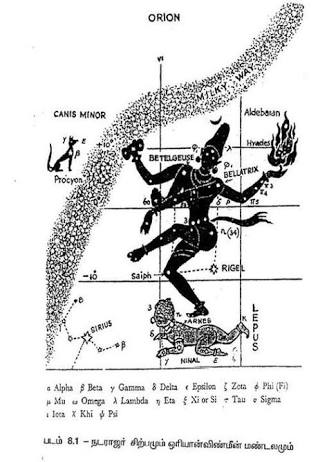
There seem to be astronomical connotations to the rituals associated with Nataraja worship at the Chidambaram temple. Arudra/Ardra darisanam is a ten-day annual festival in December related to the moon being full in the lunar asterism of the naksatra ardra (the reddish star Betelguese or Alpha Orionis), associated with the wrathful aspect of Siva. The constellation of Orion and surrounding stars is bathed in the soft glow of the full moon when it is high in the sky at Chidambaram. A thousand years ago, devoid of the present smog and light flares, the stars must have been even brighter in the tropical night sky.
Another annual festival at Chidambaram, the Brahmotsavam of Ani Thirumanjanam, which is related to the lunar asterism of Uttara Nakshatra around June-July, seems to have begun in the mid-eleventh century from inscription. The Indian zodiac of 360 degrees is divided into 27 parts based on the moon’s sidereal period such that a nakshatra denotes the longitudinal position of the moon within 13 degrees 20 minutes. Thus, by using astronomical software, Dr. Raghavan could ascertain that in 1054 AD the moon would have been full in Uttara Nakshatra on 11 July. This is uncannily close to the date that Chinese astronomers recorded the crab supernova explosion of 4 July! Although this is a preliminary finding, it could suggest a perceived metaphoric link between an observed cosmic phenomenon and notions of cosmic dance.
Indeed, a drawing from a Tamil manuscript sourced by Raja Deekshitar of Chidambaram shows how the Nataraja icon itself was probably traditionally visualized within the stars around Orion. In an exciting collaborative study with Dr. Raghavan, we took some photographs of Nataraja images dated from archaeometallurgical fingerprinting and plotted star charts for the constellation Orion of that corresponding era onto them. As reported in Orientations (Srinivasan, 2006), the star positions were found to a fair extent to correlate with iconometric design as noted in an image in the British Museum attributed from archaeometallurgical fingerprinting to the Pallava period (c. 800 AD). Moreover, the star chart for 1054 AD fitted well the iconometric design of a Nataraja image from Kankoduvanitham archaeometallurgically fingerprinted to the mid-eleventh century AD. Here, the hypothetical position of the crab supernova which exploded in 1054 AD lies near the top left of the head, close to the crescent moon. Chinese records suggest that the crab supernova came into view with a morning crescent moon near it and was visible for 23 days, being four times as bright as Venus. Even American Indians are believed to have made cave paintings of a supernova with a crescent moon. Could it be that the iconometric design of this icon had indeed taken into account the observation of
the supernova explosion?
Crab Nebula Explosin 1054 AD
At any rate, the above studies suggest scope for further investigation into the history of astronomy. No less than celebrated astronomer Carl Sagan suggested that the Nataraja imagery conveyed ‘a premonition of modern astronomical ideas’
I have written quite a few articles on the Indian, specifically Tamil connection to Incas, Mayas and Aztecs.
That the idols of Shiva, Ganesha and Devi are found there as ruins.
Th Incas celebrated Makara Sankaranthi Tamil style.
The Sanctum of Chichen Itza Pyramid and the Sanctum of Chidambaram Natarja temple are identical.
As this blog journeys through the world to find Sanatana Dharma traces ,I have come across some information,( which I should have anticipated,in the light of the Tamils being the ancestors of the Meso American cultures, Chidambaram being replicated in Chichen Itza),worth sharing.
That is the design of the Tikal Temple in Complex bears a striking resemblance to Madurai Meenakshi Temple.
One finds the ruins of a Thousand Pillars ,Aayirangal Mantapam, in chichen Itza , called warriors Tomb as the one in Madurai.
Devadasis performed there!
The Concept of Devadasis(Servant Maids of God) is a unique concept of the Tamils/Sanatna Dharma.
I may add that many South Indian Temples have the 1000 pillars, e.g.Chidambaram.Warangal
Considering that Meenakshi was a Queen and her husband was Shiva, who is a pre Sanatana Dharma Deity, I should have looked deeper in the Americas about the Tamil presence.
I had written that Satyavrata Manu, ancestor of Lord Rama migrated to Ayodhya and his son Ikshvaku founded the Ikshvaku Dynasty.
This was due to a great Tsunami in the South of India.
Tamil classical literature speaks of this event in great detail.
Around the same time, Shiva , with his son Ganesha left westwards of India, leaving Murugan(Subrahmanya ) behind.
He seems to have moved eastwards of India.
More to follow on this later.
Ganesha and Shiva left their legacy in the west of India before reaching the Arctic where the Rig Veda was composed.
Then they returned to India through Russia through the Khyber Pass, which was manipulated to show that Aryans invaded India.
The remains of Tamil culture in the Mesoamerican and many Nations of the west would support my theory as also the remains and in many cases thriving Sanatana Dharma in South East Asia.
“The largest temple in Mexico City was the temple of Lord Shiva, the War God of the Mexican whom the Spanish invaders found entwined by golden snakes. This temple was built in the 15th century and had 3000 Deva-Dasis to perform religious ceremonials. The Mexican temple had the Gopuram style. Here you see a reconstruction of the same after it was destroyed by the Spaniards. The temples at Tikal in Mexico also bore the imprint of our famous temple at Madura. No wonder E. G. Squire in his American archaeological researches in 1851 wrote:
“It is believed a proper examination of these monuments would disclose the fact that in their interior structure as well as in their exterior form and obvious purposes these buildings correspond with great exactness to those of Hindustan and the Indian Archipelago.’ Group of a Thousand Columns at the Chichen Itza World Heritage Site. Image Credit. “Chichen-Itza-1000-Warriors-Columns” by Uspn – Own work. Licensed under CC BY-SA 3.0 via Wikimedia Commons – https://commons.wikimedia.org/wiki/File:Chichen-Itza-1000-Warriors-Columns.jpg#/media/File:Chichen-Itza-1000-Warriors-Columns.jpg
The layout of Chichen Itza site core developed during its earlier phase of occupation, between 750 and 900 AD. Its final layout was developed after 900 AD, and the 10th century saw the rise of the city as a regional capital controlling the area from central Yucatán to the north coast, with its power extending down the east and west coasts of the peninsula.The earliest hieroglyphic date discovered at Chichen Itza is equivalent to 832 AD, while the last known date was recorded in the Osario temple in 998….
..Tikal.
The closest large modern settlements are Flores and Santa Elena, approximately 64 kilometres (40 mi) by road to the southwest.[12] Tikal is approximately 303 kilometres (188 mi) north of Guatemala City. It is 19 kilometres (12 mi) south of the contemporary Maya city of Uaxactun and 30 kilometres (19 mi) northwest of Yaxha. The city was located 100 kilometres (62 mi) southeast of its great Classic Period rival, Calakmul, and 85 kilometres (53 mi) northwest of Calakmul’s ally Caracol, now in Belize.
..
Chichen Itza is located in the eastern portion of Yucatán state in Mexico.The northern Yucatán Peninsula is arid, and the rivers in the interior all run underground. There are two large, natural sink holes, called cenotes, that could have provided plentiful water year round at Chichen, making it attractive for settlement. Of the two cenotes, the “Cenote Sagrado” or Sacred Cenote (also variously known as the Sacred Well or Well of Sacrifice), is the most famous.
According to post-Conquest sources (Maya and Spanish), pre-Columbian Maya sacrificed objects and human beings into the cenote as a form of worship to the Maya rain god Chaac. Edward Herbert Thompson dredged the Cenote Sagrado from 1904 to 1910, and recovered artifacts of gold, jade, pottery and incense, as well as human remains. A study of human remains taken from the Cenote Sagrado found that they had wounds consistent with human sacrifice.
From Space, Air, Fire from Air, Water from Fire,Earth from water.
I shall be writing on the scientific progression involved in this.
Tiruvanaikkaval is located at around 3 degrees to the south and exactly 1 degree to the west of the northern tip of this divine axis, while Tiruvannamalai is around midway (1.5 degree to the south and 0.5 degree to the west).
Fire and Water are not kept together to facilitate Evolution.
I shall be writing in detail about each of these Mystic and scientific Temples.
You must be logged in to post a comment.