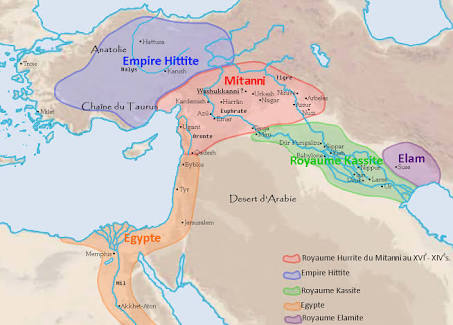
Tag: Mittani empire

  • Dasaratha Had Sons other Than Four,In Sumeria Mittani Kings List?

    Dasaratha Had Sons other Than Four,In Sumeria Mittani Kings List?

    While checking up the spread of Sanatana Sharma, I stumbled upon facts ,which though initially seemed at variance with Indian texts,deeper study has proved that the information provided by Indian texts are in agreement with foreign sources.

    Only after such verification, I write.

    But one information, I am unable to reconcile.

    That is Ramayana.

    Rama’s Empire extended throughout the world and his sons were found in the far east and northwest of India.

    Rama”s legacy is found in abounds in Iraq and the middle east.

    The issue I am facing is that while names of Ramayana,Bharata( not Rama’s brother,but Dushyanta’s son) and Dasaratha are found in the Sumerian Kings List,and names of Dasaratha,Parashurama are found in the Kings List of Mittani.

    But the progenies’ names of Rama are not found,though the names in these Kings Lists after Dasaratha are of Sanskrit origin .

    But Bharatha,Lakshmana and Shatrugna do not find a place in these lists,though Rama’s son Lava founded the present day Lahore in Pakistan.

    I am unable to find mention of any sons of Dasaratha,other than Rama,Lakshmana,Bharatha and Shatrugna.

    So if Dasaratha,spelled as Tusharatta in these Kings Lists,who were Dasaratha’s successors in Sumerian and Mittani Empire?

    Names of the sons of Ramayana,Lava and Kusa are not found ,either.

    Could it be that the Kings of Sumerian and Mittani are the children of Bharatha,Lakshmana,Shatrugna?

    Or the sons of Dasaratha, through his consort other than Kausalya,Kaikeyi and Sumitra?

    According to Hindu Sharma,A King can not anoint a son not through Queens.

    Is it that Dasaratha gave away these far lands to his console’s son?

    Though it is stated that Dasaratha married 60,000 wives to avoid the wrath of Parashurama,Valmiki records the 350 wives of Dasaratha.

    Valmiki Ramayana, Ayodhya Kanda, Chapter 34, Verse 10

    Dasaratha said to Sumantra,
    “Oh, Sumantra! being all my wives, who are here. Surrounded by all of them, I want to see the virtuous Rama.”
    (‘who are here’ means available at the capital city then)
    Valmiki Ramayana, Ayodhya Kanda, Chapter 34, Verse 13:
    अर्ध सप्त शताः ताः तु प्रमदाः ताम्र लोचनाः |
    कौसल्याम् परिवार्य अथ शनैः जग्मुर् धृत व्रताः || २-३४-१३
    “ardha sapta shataah taah tu pramadaah taamra locanaah |
    kausalyaam parivaarya atha shanaih jagmur dhrita vrataah ||” 2-34-13
    atha= thereafter; taah= those; ardha sapta shataah= THREE
    HUNDRED AND FIFTY pramadaah= women; dhritavrataah= steadfast in their vow (of devotion to their husband); taamra lochanaah= having red eyes; parivaarya= encircling; kausalyaam= Kausaly; jagmuh= went; shanaih= slowly.
    ‘Encircling Kausalya, three hundred fifty women, steadfast in their vow (of devotion to their husband), with their eyes reddened, went there slowly.’
    (ii) Valmiki Ramayana, Book II : Ayodhya Kanda, Chapter (Sarga) 39, Verse 34 & 35:
    Rama said to Queen Kausalya, His mother,
    “Oh, mother! You do not grieve. You look after my father. The end of exile will come rather soon.”

    Dasaratha wives 3,350,60,000

    Scholars may clarify whether Dasaratha had any more sons than the four.

    Kings List Sumerian.image
    Rama in Sumerian Kings List

    I have posted an article that Lord Rama and Bharata’s names are found in the Kings List of Sumerians chronicling their Kings.

    Not only Rama and Bharata, but the names of other Hindu Puranic figures find a place in the Kings List.

    The Names found are,

     Indra,Pururavas,Dasaratha,Parashurama,Satyavrata,Iksvahu,Kakusha,Janaka,Vasishta, Janamejaya,Dushyanta(Father of Bharata,after whom India is named as Bharatavarsha),Rishis Gautama,Dundhu,,Muchukunda,Drupada,Harischandra,Sagara,Bhagiratha, Lava, Kusha(Rama’s sons),Aja and Raghu(Rama’s ancestors),Pundarika,

    Curious enough ‘ all of them belong to Solar Dynasty mentioned in Puranas.

    Sumerian Kings List

    Mittani Kings List. Source. https://en.m.wikipedia.org/wiki/List_of_rulers_of_Mitanni


  • Croatia From Sanatana Dharma,Dasaratha,Saraswathi ? Mittani Kings List

    One would like check the information one comes across while studying,

    The History of the world,

    Ancient civilizations,

    World languages,

    World cultures,

    World Regious texts,

    Folk lore,

    Legends,

    Archeological sites and

    Santana Dharma of India.

    While studying older/est Languages like Sanskrit and Tamil(my knowledge is limited to these two), I have been able to find and validate that, Sanatana Dharma was present/influenced,

    Countries,

    Burma,Sri Lanka,Singapore,Indonesia,Malaysia,Vietnam,Cambodia,Korea,Laos,Japan,Philippines,Newzealand and Australia towards the east of India, and

    To the West of India,

    Arabian peninsula,

    Turkey,

    Greek,

    Middle East,

    Europe,

    And

    Continents of Africa,Americas.

    Mittani,Aztec,Mayans,Incas civilizations trace back to Sanatana Dharma,Sanskrit And Tamil.

    I have written on articles on each of these countries mentioned above.

    Focussing on Europe,the settlements began in this area when Great Flood struck what is now Asia and migration to Europe took place.

    One finds Sanatana Sharma presence in all the countries in Europe.

    Croatia and Croat is no exception.

    Dasaratha,father of Rama is mentioned in Mittani Kings List.

    Mittanis were the forefathers of Croatia.

    Croat language and culture is rooted in Sanskrit and Goddess Sarasvathi.

    I am providing excerpts from an article.

    I have provided the Link towards the close of this article.

    Goddess Sarasvathi.Image.
    Goddess Saraswathi,Goddess of Learning,Knowledge,Wisdom.Hindu Deity.

    For most of the Croatian people (or as they call themselves, Hrvati) when it comes to defining their origins and tracing their ancient roots they turn towards the land of Iran and Persia. According to academia the name Hrvat comes from Hrovat which comes from the Slavic  Horvat which originates from the Indo/Slavic Harvat and which is ultimately traced to Persia and the name Harahvaiti.

    Harahvaiti however, is the corrupted name of Sarasvati, the great Vedic Goddess, the Mother of Sanskrit, the great river of the Rig Veda and the Goddess of learning. The Persians had a tendency to replace a Sanskrit ‘S’ with a Persian ‘H’, and so the word Haravaiti is actually Sarasvati.

    This tendency can be seen in their word for ‘week’, hapta, which is in the Sanskrit sapta meaning week. Their name for the ‘Sun’,Hvar, is the Sanskrit Svar meaning the same. In the Avestan we find the seven rivers of the Aryan land are described as  hapta hendu, an obvious corruption of sapta sindhu, the seven rivers of India. Finally there are the rivers of Iran, Haravaiti and Harayu which are the Vedic rivers of Sarasvati and Sarayu. And so if the name of Croat (Hrvat) comes from  Harvat and this in turn comes from Harahvaiti, we must conclude that the source is Sarasvati.

    Sarasvati is one of many words which are cognate with the Croatian language.

    Med is a Croatian word meaning honey and this comes from the Sanskrit Madhu, a name for Krsna. The Russian Medvedev and the Croatian  Medvjed both mean ‘honey eater’ a name for the bear and they both come from the Sanskrit Madhava, a name for Krsna which means ‘he who intoxicates like honey’. Below are some of the many similarities which are shared between the Sanskrit and Croatian language.

    Sanskrit Croatian English
    Kada Kada When
    Phena Pjena Froth
    Tamas Tama Dark
    Da Dar Gift
    Kuta Kuća House
    Sabha Soba Room
    Tada Tada Then
    Dadati Dan/Dati Give
    Matr Mater Mother
    Tata Tata Father
    Jiva Živ/Živa Alive
    Krs Krš Ruin

    According to academia, the oldest recorded name Harvat, was found in the Mittani/Hurrian documents spoken by King Tusratta some 3500 years ago. In the documents he refers to his Kingdom as Huravat Ehillaku.

    We should note, however, that the King who spoke this 3,500 year old inscription was a Vedic/Hindu King, Tusratta being a corruption of  Dasarathadasa being Sanskrit for ‘ten’ and ratha Sanskrit for ‘chariot’.

    King Dasaratha, according to academia, was one of many Vedic Kings who ruled the Kingdom of Mittani. The chronology of these Mittani Kings are as follows: Kirta – Suttarna – Baratarna – Parsatatar – Saustatar – Rtadharma – Suttarna II – Artashumara – Dasaratha – Mativasa – Sattuara – Vashasatta – Sattuara II.

    These names are all Sanskrit/Vedic. Suttarna is Sanskrit for ‘good son’; Dasaratha is Sanskrit for ‘ten chariots’; Parsatatar is a variation of Sanskrit Parasu, ‘he who rules with the axe’; Mativasa is Sanskrit for ‘the abode of prayer’; Ritadharma is Sanskrit for ‘the law of dharma’ and Artashumarais Sanskrit for ‘the winds of righteousness’.

    It is an academic fact that the Kingdom of Mittani was ruled by Vedic Kings. Here we note that the capital of Mittani was called Vasukhani.  Vasu being Sanskrit for ‘wealth’ and Khani means ‘mine’ – ‘a mine of wealth’. So if the roots of Croatian civilization are intimately connected with Iran and Persia, and in particular Mittani and the Hittites, one should take into consideration the Vedic influence behind it all.

    The Croatian name for God is Bog which once again comes from the Sanskrit Bhaga, meaning Bhagavan, ‘the supreme Lord’. We see a nice example of this in the capital of Iraq, Bhagdad, Bhagbeing the Sanskrit Bhaga and dad coming from the Sanskrit  dadati meaning ‘gift’ – ‘the gift of God’. Below are more similarities between the Sanskrit and Croatian languages.

    Sanskrit Croatian English
    Niska Niska Beads
    Znata Poznata/Poznati Know
    Kesa Kosa Hair
    Zara Žar Fervid
    Loka Luka Province
    Pluta Pluta Floats
    Mus Miš Mouse
    Gir Gor/Gora Mountain
    Bhavati Bivati Exist
    Zvana Zvana Called
    Griva Griva Mane

    Block Quote and citation.

    http://www.vina.cc/2016/08/18/sanskrit-in-croatia-from-sarasvati-to-hrvati/

  • Bullfighting Jallikkattu Spain corrida de toros Started By Krishna

    The presence of Bull in Hinduism is on two counts.

    One is as the Mount of Lord Shiva.

    As Shiva’s mount the bull is called Nandi.


    There are temples dedicated to Nandikeshwara or Nandeswara.

    There is a Huge Nandi, among other places in India, in Bangalore.

    A road is also named as Bull Temple Road in Bangalore.

    Another instance of buffalo is the slaying of it by Mahishauramardhini.

    Tamil literature speaks of bull fighting as Jallikkattu , which is about 5000 Years old practice.

    This event takes place in Tamil Nadu even today.

    The important place where the jallikkatu takes place is Alanganaalur,near madurai, Tamil Nadu, India.

    The Bullfighting practice has been in vogue in many ancient cultures.

    The bullfighting in Spain and Latin American countries is called corrida de toros.

    Lord Krishna married a  Pandyan princess, had a daughter through her, Pandya and gifted her 100 Yadava families as dowry.

    Krishna also attended Tamil Sangam as a Guest.

    Please read my posts on this.

    It is probable that Krishna introduced bullfighting in Tamil Nadu and throughout the world.

    Bullfighting Inscription in Tamil Nadu musuem.jpg
    Bull fighting in Tamil Literature. “A Bull baiting inscription 1” by Thamizhpparithi Maari – Own work. Licensed under CC BY-SA 3.0 via Commons – https://commons.wikimedia.org/wiki/File:A_Bull_baiting_inscription_1.JPG#/media/File:A_Bull_baiting_inscription_1.JPG

    Bullfighting Inscription in Tamil Nadu musuem.

    Spanish Bullfight.jpg Spanish Bullfight.

    Bullfighting (Spanish: corrida de toros [koˈriða ðe ˈtoɾos] or toreo [toˈɾeo]; Portuguese: tourada [toˈɾaðɐ]), also known astauromachia or tauromachy (Spanish: tauromaquia  listen , Portuguese: tauromaquia; from Greek: ταυρομαχία“bull-fight”),is a traditional spectacle of Spain, Portugal, southern France and some Latin American countries (Mexico,Colombia, Ecuador, Venezuela and Peru),[7] in which one or more bulls are fought in a bullring. Although a blood sport, by definition, some followers of the spectacle prefer to view it as a ‘fine art’ and not a sport,[8] as there are no elements of competition in the proceedings.’

    The Mitanni Empire covered what is now known as Iraq, Turkey Syria, Lebanon,Egypt and included Italy.

    They were the ancestors of these people.

    Mitanni were the ancestors of the Egyptians as well…

    These Kings and even a Roman Emperor sported Thiruman, The Vaishnavite marks on their Body.

    The Sun King Akhenaten of Egypt who ruled between 1352-1336 BC was a son-in-law of Tushratta, the Mitanni king. The name Tushratta has been recorded in the Hittite cuneiform script.

    Some have suggested that the Sanskrit origin of Tushratta is Dasaratha, a few others that it is Tvesaratha (having splendid chariots), a name which is attested in the Rigveda.

    “The first Mitanni king was Sutarna I (good sun). He was followed by Baratarna I (or Paratarna great sun), Parasuksatra(ruler with axe),…. Saustatar (Sauksatra, son of Suksatra, the good ruler), Artadama (abiding in cosmic law)..Tushratta (Dasaratha), and finally Matiwazza (Mativaja, whose wealth is thought) during whose lifetime the Mitanni state appears to have become a vassal to Assyria”. Subhash Kak traces the ‘arna’ syllable in the names of the kings to ‘araNi’ (अरणि) meaning ‘sun’…

    (Akhenaten, Surya, and the Rigveda’, Prof Subhash Kak (an Indian American computer scientist, previous Head of Computer Science Department, Oklahoma State University)…

    Bull fighting in Spain started around 18th century. There are different versions of bull fighting. In Spain the bull is killed ,that too with a weapon like we see in the Indus seals. This type of bull fighting has spread to Latin America and Mexico when the Spanish culture was introduced.

    Whether it is Tamil Nadu or Spain special kind of bulls are raised exclusively for this purpose with a special type of diet and special training. Tamils have practised this ancient sport for at least two thousand years. They call it Jalli kattu or Manju Virattu or Eru Thazuvuthal. It means chasing the bull or tackling the bull. In ancient Tamil Nadu the horns of the bulls were tied with coins, may be gold coins…

    We have lot of proof to believe that the Bull fighting was started by Lord Krishna who was the most popular cowherd (Yadava Kula Tilaka) in the world. Kaliyuga started in 3102 BC after the death of Krishna. But Mahabharata war took place between 1000 and 1500 BC according to majority of the scholars. Even if we go by this date, Krishna was the first one to have a fight with almost all the animals. He fought with an elephant, a bull, a python, a horse, a cran , a donkey and many more . All were set up by his uncle Kamsa according to Hindu mythology. These anecdotes have produced huge literature in Tamil and Sanskrit which has got no parallel in any part of the world. Krishna’s episodes are mentioned in film songs even today in almost all the Indian languages. The bull Krishna fought was Aristasura.

    The proof for Krishna starting this comes from 2000 year old Sangam Tamil literature. Kalitokai is one of the eight anthologies of Sangam (Cankam) period. Nalluruthtiranar who sang Mullai Kali gave a graphic description of bull fighting. Justifying his name Shiva (Rudra), the poet mentioned Lord Siva in all his poems. Justifying that it was started during Mahabaharata days the poet gave lot of references to Mahabharata episodes. He said that it was practised by the Ayar community (cowherds)in the pastoral areas.

    The poet mentioned how the bulls tear the bull fighters apart like the buffalo riding Yama, God of Death. The colourful bulls are described and compared to various personalities -white bull to Balarama and black bull to Krishna and so on. The Mullaik Kali has got 16 poems beautifully describing the pastoral culture of ancient Tamilnadu. Anyone who reads this Mullaik Kali will get a better picture of how it was practised in ancient Tamil Nadu. All the suspense, gossip, flirting, amorous desires of Ayar girls are dealt with in hundreds of lines- a feast to Tamil lovers.’


    Jallikkattu.

    Jallikkattu, Alanganallur.jpg Jallikkattu, Alanganallur.

    Jallikattu (Tamil: சல்லிகட்டு, callikaṭṭtu) also known Eruthazhuvuthal (Tamil: ஏறுதழுவல், ērutazhuval) or Manju viraṭṭu (Tamil: மஞ்சு விரட்டு), is a bull taming sport played in Tamil Nadu as a part of Pongal celebrations on Mattu Pongal day. Bulls are bred specifically for the sporting event and a specific breed of cattle bred for this purpose is known as “Jellicut”. In May 2014, the Supreme Court banned the sport citing animal welfare issues.

    Jallikattu, which is bull-baiting or bull cuddling/holding was a popular sport amongst warriors during the Tamil classical period. Bull fighting was common among the ancient tribes who lived in the ‘Mullai’ geographical division of the ancient Tamil country.[5] Later, it the sport became a platform for display of bravery and prize money was introduced for entertainment. The term “Jallikattu” originated from the words “Jalli” and “Kattu”, referring to silver or gold coins tied to the bulls’ horns.[5] A seal from the Indus Valley Civilization depicting the sport is preserved in the National Museum, New Delhi.[6] A single painting discovered in a cave about 35 km west of Madurai shows a lone man trying to control a bull and the painting, done in white kaolin is estimated to be about 1,500 years old

    Citation.

    http://archbhoo-india.blogspot.in/2015/01/lord-krishna-started-bull-fighting.html

    https://en.wikipedia.org/wiki/Bullfighting

    https://en.wikipedia.org/wiki/Jallikattu

  • Sivas City Turkey Hinduism Tamil Manu Needhi Chola

    Sivas City Turkey Hinduism Tamil Manu Needhi Chola

    I have written articles on the connection between Anatolia,(Asia Minor), Mesopotamia, Sumeria and Babylon.

    They are,

    Hindu kings of Iraq, Turkey, Syria, Lebanon, Egypt and Italy,

    Mitanni (/mɪˈtæni/; Hittite cuneiform KUR URUMi-ta-an-ni; alsoMittani Mi-it-ta-ni) or Hanigalbat (Assyrian Hanigalbat, Khanigalbatcuneiform Ḫa-ni-gal-bat) or Naharin in ancient Egyptian texts was a Hurrian-speaking state in northern Syria and southeast Anatoliafrom ca. 1500 BC–1300 BC. Founded by an Indo-Aryan ruling class governing a predominantly Hurrian population, Mitanni came to be a regional power after the Hittite destruction of Amorite[1] Babylon and a series of ineffectual Assyrian kings created a power vacuum in Mesopotamia.

    The Mittanni was in northern Mesopotamia , roughly from 1500-1300 BC.

    At its height the empire extended from Kirkuk (ancient Arrapha) and the Zagros Mountains in the east through Assyria to the Mediterranean Sea in the west.

    …These Kings and evena Roman Emperor sported Thiruman, The Vaishnavite marks on their Body.

    Mittani, Hitties

    I had also written on the migration of Shiva with his son Ganesha westwards from the south of Vindhyas, because of a Tsunami.

    This was the time Lord Rama’s ancestor Satyavrata Manu migrated to Ayodhya .

    Satyavrata manu’s son Ikshvaku founded the Sola dynasty, Ikshvaku.

    The traces of Shiva are found everywhere from the Middle east to the Arctic!

    The Chola dynasty traces its origins to ikshvaku dynasty of Rama.

    The story of Chola King Sibi is narrated in the Vishnu Purana, as the ancestor of Rama.

    Apart from the evidence of Hitties being influenced by the Tamils, it might be possible that the Cholas were in Hittie Kingdom,possibly they had a hand in forming the Hittie Empire.

    The Hittites relied on their mastery of chariot warfare. Resembles Manuneedhi Chola, Tamil King of Solar Dynasty
    The Hittites relied on their mastery of chariot warfare. Resembles Manuneedhi Chola, Tamil King

    This is a speculation I have in the light of many of the Hitties customs and the depiction of a chariot  running over a man.

    In the Tamil Classics, King Manu Needhi Chola ran his son down by his chariot because his son ran over a calf and because the cow had complained of this to him by ringing the bell set up by the king for the people to let him know of their problems!

    Monument in Siva, Turkey.jpg Monument in Siva, Turkey.

    It wasn’t until explorer Charles Texier stumbled upon ruins he had hoped belonged to an ancient Roman city that history would gradually begin to allow the Hittites to take their rightful place. Texier made his discovery in the isolated village of Bogazköy, in central Anatolia, roughly half way between Ankara and Sivas. The year was 1834. Though he didn’t know it at the time, he had in fact discovered the imperial Hittite city of Hattusa. However, the road to understanding the Hittites would prove to be a long one.

    Stones covered with mysterious hieroglyphs were being discovered in northern Syria and all over Anatolia and they seemed to relate to the hieroglyphs found at the Hattusa site. Archaeologists were beginning to consider the possibility that these hieroglyphs belonged to an ancient forgotten empire. In 1880, English Assyriologist Archibald Sayce shocked the world with his announcement that this empire and the Hittites of the Old Testament were one and the same people.

    Excavations at the site did not start until 1906, and tablets found in the Hittite’s cuneiform language revealed a surprising twist. The language of the Hittites belonged to the Indo-European languages with the Hittite word for water (‘watar’) for instance uncannily resembling English and German, leading to speculation that the Hittites may originally have migrated from Europe. Other theories, however, claim that Indo-European languages originated elsewhere, perhaps even in Anatolia itself. Whatever the truth may be, English and a host of other languages can thus be traced back to a single root hidden somewhere in the darkness of prehistory..

    ‘Excavations at a mound known as Topraktepe indicate Hittite settlement in the area as early as 2600 BC, though little is known of Sivas’ history prior to its emergence in the Roman period. In 64 BC as part of his reorganization of Asia Minor after the Third Mithridatic War, Pompey the Great founded a city on the site called “Megalopolis”. Numismatic evidence suggests that Megalopolis changed its name in the last years of the 1st century BC to “Sebaste”, which is the feminine form of the Greek name corresponding to Augustus. The name “Sivas” is the Turkish version deriving from the name Sebasteia, as the city was known during late Roman empire. Sebasteia became the capital of the province of Armenia Minor under the emperorDiocletian, was a town of some importance in the early history of the Christian Church; in the 4th century it was the home of Saint Blaise and Saint Peter of Sebaste, bishops of the town, and of Eustathius, one of the early founders of monasticism in Asia Minor. It was also the place of martyrdom of the Forty Martyrs of Sebaste, also 4th century. Justinian I had a fortified wall around it rebuilt in the 6th century…

    …’Historian Christopher Scarre describes Hattusa as “a vast fortress-city sprawling over the rocky terrain, with craggy citadels and elaborate temples. It became the center of a powerful empire that covered not only most of Anatolia but also at times extended far to the south, into Syria and the Levant” (206). Hattusa was originally founded by the Hatti (an aboriginal tribe of Anatolia) in 2500 BCE, and their culture may have provided the basis for that of the Hittites.  This very important complex and those who built it along with their vast empire, however, remained almost unknown until their writings were discovered, first by the Irish missionary William Wright  in 1884 CE, and then by the German archaeologist Hugo Winckler in 1906 CE. By the year 1912 CE, Winckler “had recovered 10,000 clay tablets from the Hittite royal archives” (Scarre & Fagan, 206).  These tablets, on which they had recorded their history and transactions, were deciphered relatively quickly.

    ..

    Sivas (Armenian: Սեբաստիա; Latin: Sebastia, Sebastea, Sebasteia, Sebaste) is a city in central Turkey and the seat of Sivas Province. According to a 2011 estimate, its urban population is 425,297.

    The city, which lies at an elevation of 4,193 feet (1,278 m) in the broad valley of the Kızılırmak river, is a moderately-sized trade center and industrial city, although the economy has traditionally been based on agriculture. Rail repair shops and a thriving manufacturing industry of rugs, bricks, cement, and cotton and woolen textiles form the mainstays of the city’s economy. The surrounding region is a cereal-producing area with large deposits of iron ore which are worked at Divriği.

    Sivas is also a communications hub for the north-south and east-west trade routes to Iraq and Iran, respectively. With the development of railways, the city gained new economic importance as junction of important rail lines linking the cities of Ankara,Kayseri, Samsun, and Erzurum. The city is linked by air to Istanbul.

    Citations.

    http://www.ancient.eu/hittite/

    https://en.wikipedia.org/wiki/Sivas

    http://www.turkeytourism.in/cities/city_c.php?id=321

  • First Pyramid Builder Roman Emperor With Vaishanava Marks

    Mittani are the ancient people in Mesopotamia.

    They were the ancestors of the Egyptians.

    Look at the Sanatana Dharma connection.


    Mitanni (/mɪˈtæni/; Hittite cuneiform KUR URUMi-ta-an-ni; also Mittani Mi-it-ta-ni) or Hanigalbat (Assyrian Hanigalbat, Khanigalbatcuneiform Ḫa-ni-gal-bat) or Naharin in ancient Egyptian texts was a Hurrian-speaking state in northern Syria and southeast Anatoliafrom ca. 1500 BC–1300 BC. Founded by an Indo-Aryan ruling class governing a predominantly Hurrian population, Mitanni came to be a regional power after the Hittite destruction of Amorite[1] Babylon and a series of ineffectual Assyrian kings created a power vacuum in Mesopotamia.


    The Mittanni was in northern Mesopotamia , roughly from 1500-1300 BC.

    At its height the empire extended from Kirkuk (ancient Arrapha) and the Zagros Mountains in the east through Assyria to the Mediterranean Sea in the west.


    Mittani Kings, but the Egyptian Pharaohs have also have been known to have a major Indic influence.
    Egyptian King with Vaishnava marks.image.jpg
    Egyptian King with Vaishnava marks.
    These Kings and even a Roman Emperor sported Thiruman, The Vaishnavite marks on their Body.
    Mittani and Egyptian King with Vaishnava Marksjpg.
    Mittani and Egyptian King with Vaishnava Marks.


    The Sun King Akhenaten of Egypt who ruled between 1352-1336 BC was a son-in-law of Tushratta, the Mitanni king. The name Tushratta has been recorded in the Hittite cuneiform script.

    Roman Emperor with Vaishnava Marks.image.jpg
    Roman Emperor with Vaishnava Marks.

    Some have suggested that the Sanskrit origin of Tushratta is Dasaratha, a few others that it is Tvesaratha (having splendid chariots), a name which is attested in the Rigveda.

    Mittani Empire.Image.jpng
    Mittani Empire.


    “The first Mitanni king was Sutarna I (good sun). He was followed by Baratarna I (or Paratarna great sun), Parasuksatra(ruler with axe),…. Saustatar (Sauksatra, son of Suksatra, the good ruler), Artadama (abiding in cosmic law)..Tushratta (Dasaratha), and finally Matiwazza (Mativaja, whose wealth is thought) during whose lifetime the Mitanni state appears to have become a vassal to Assyria”. Subhash Kak traces the ‘arna’ syllable in the names of the kings to ‘araNi’ (अरणि) meaning ‘sun’…

    (Akhenaten, Surya, and the Rigveda’, Prof Subhash Kak (an Indian American computer scientist, previous Head of Computer Science Department, Oklahoma State University)

    A number of Indo-European sounding words have been identified in the cuneiform documents of the Mitanni kingdom (1500-1200 BC). In addition to nouns and adjectives with parallels in Sanskrit this Hurrian speaking kingdom had kings with Indo-Aryan names and two documents even list the main Gods of the Indian pantheon….”

    (About the  Mittani-Aryan Gods’, Arna ud Fournet)

    Citation,