When one delves deep into Purana, Ithihasa and ancient texts of India, including regional language texts, one finds one Corroborates the other. Events,Persons mentioned in one is corroborated by the other. While the Purana is in Sanskrit, others are in ancient languages like Pali , Prakrit. Some languages like these may belong to Dialects. However, Tamil, an ancient language of India with which I am familiar, is rich in literature and grammar and it goes back to thousands of years along with Sanskrit. The archeological finds at Poompuhar, Tamil Nadu pushes the date of Tamil, at least, to 20,000 years. An Advanced Tamil civilization site near Chennai,reveals it to be a Million year old! . Thiruvannamalai,Tamilnadu is about 3.94 billion years old, Tirupati 2200 million years old, Jwalapuram Cuddapah, Andhara Is 74,000 years old Guruvayur, Kerala is over 25,000 years!
Lemuris 230 Million years old My Tedtalk
Ancient Bharathavarsha, in South, had Dravida Desa, Southern Countries. This landmass was ruled by three dynasties, Chera, Chola and Pandyas. The Kings of these dynasties trace their lineage to either Surya Vamsa , Ikshvaku Dynasty founded by Ikshvaku, son of the first human being Manu(Manu was the ancestor of Sri Rama) ;or to Chandra Vamsa, Lunar dynasty of Ila, Daughter of Manu.
Ruins of Tamil land off Japan’s coast
Quote on Tamil
Manu, aka Satyavrata Manu or Vaivaswatha Manu was a Dradiva Emperor. This is recorded in the Bhagavadha Purana. I had written an article on this.
While Satyavrata Manu was offering oblations to ancestors, a 🐠🐋🐟 Matsya appeared.
There is a river by name “Krita-Maala”, today famously known as River Vaigai. On the banks of this River Krita-Maala, there was this “Shraadha-Manu”, who had the name “Satyavrata”. As this Satyavrata is living his life at this place, one day he goes to the river bank to do his regular “Tharpana” (Spiritual Practice) in the evening. As he was performing the “Tharpana”, there was a small little fish that got into his hands.
“Tasyaa dheenataram vaakyam ashrutya sa maheepathihi!
As the little fish enters into Satyavrata’s hands, it suddenly started to talk! Upon hearing a fish talk in human language, Satyavrata was surprised! The little fish talks to Satyavrata thus, “Oh Satyavrata! As you see, I’m such a small little fish, just taken birth! Please do not leave me again into this mighty river amidst the fast-flowing water. There are bigger fishes here, which would eat me off. Therefore, please help me out!” Upon hearing this, Satyavrata was moved! He asks the fish thus, “Oh little one! I don’t have any problem in helping you and ensuring your safety. Please tell me what should I do!” The fish replies back, “Oh Satyavrata! Why don’t you put me into your ‘Kamandala’ vessel and take me to your home? You can put me into a small tank at your place, where I would be safe and secure!”
Accordingly, Satyavrata takes the little fish into his vessel, takes it to his home and tries to put it into a nicely made tank, exclusively for that fish alone. But as Satyavrata tries to transfer the little fish into the tank, he is in for another surprise! Within the time that he walked back to his home, the fish has grown in size! It is not able to come out of the ‘Kamandala’ vessel. Now the fish replies thus, “Oh Satyavrata! I think this vessel nor this tank would be of sufficient size to house me. Perhaps you should put me into the well in your house.“ Accordingly thus, Satyavrata takes the fish to the well and drops it inside! Again, Satyavrata is in for a surprise! As he drops the fish into the well, it again grows quickly to a bigger size, which renders the well to be useless to hold it anymore. Again, Satyavrata puts the fish into another big tank, but in vain! Again the fish grows into a mammoth size, engulfing the whole tank!
Upon seeing this, Satyavrata couldn’t understand what is going on here! Hence, he takes the fish and puts it into the river again! Now, the fish grows into a huge whale-like size and engulfs the whole river too! This leaves Satyavrata stunned beyond words! He is clearly running out of options and doesn’t know what is going on around him. This is surely some message from someone who is all-pervasive and all-powerful. At one point, Satyavrata starts to doubt whether this is really a fish or something or someone else!
As Satyavrata looks on with awe and shock, the fish tells him thus, “Oh Satyavrata! Looks like even this river is not capable of holding my mammoth size. I think it’s best that you take me to the ocean and leave me there!” Now Satyavrata is clearly perplexed here! He doesn’t know whether to really honour these words of the fish. With all his past experiences with the fish, he was damn sure that even if he is going to leave it in the ocean, it is going to say that this ocean is also insufficient! What would he do then? Mustering up his courage thus, Satyavrata asks the fish thus, “I do not think that you are an ordinary little fish! You are somebody else! Please tell me who are you and what do you want from me! Why are you playing this game with me?” Skanda 8,Srimad Bhagavadham. https://www.google.com/amp/s/theindiandharma.org/2020/05/05/episode-242-the-matsya-avatara-satyavratas-encounter-with-a-fish/amp/
Now, the purport of this article is not about Manu and the evolution of World as described in the Srimad Bhagavadham. We focus on where Satyavrata Manu was offering Tharpana, Oblations.
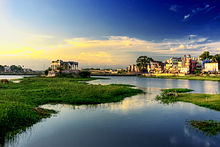
It was in River Kritamala. Kritamala is the name of River Vaigai, at Madurai Tamil Nadu India. So, it is reasonable to postulate that Vaigai, and consequently Madurai is as old as Manu!
https://www.google.com/amp/s/ramanisblog.in/2017/05/20/lemuria-the-home-of-tamils-my-tedtalk-at-coimbatore/amp/Based on Tectonic shift, Archeology and related evidence Ihad ,earlier,arrived at a figure of 230 million years for Lemuria of which Madurai was a part. It was Then Madurai then. Because of tectonic shift, it had moved to it’s present location. The present information in this article is Mind blogging. It is easy to dispose it off as Non sense. But evidence presented and the recent confirmation about the nature of Time as Non linear by Quantum would make one ponder.
More to follow.
This yuga cycle is called maha (in english, it means great/big) or divya (divine) yuga. One thousand such cycles forms one day of Brahma (a demigod in hindu religion which governs the universe). So one day of Brahma is 4.32 million * 1000 = 4.32 billion human years. Each such day of Brahma is called a “kalpa”. His night also constitutes 4.32 billion human years. During his day, life exists in universe. In nighttime, no form of life exists. So one complete day and night has 8.64 billion human years.
-> Age of Brahma is 100 years. Each year of Brahma has 360 days and same number of nights. Thus, total age of Brahma is 360 * 100 * 8.64 billion = 311,040 billion human years. i.e. 311.04 trillion years. This period is called “maha kalpa”. -> The life span of the universe is one “maha kalpa”. i.e. 311.04 trillion human years. This time span is also the duration of one breath of “Vishnu” (the ultimate god in hindu religion). When he exhales, thousands of universes emerges and one “Brahma” is born in each universe. When “Vishnu” inhales, all universes get sucked and Brahma dies. -> This cycle is non-ending and eternal. Thats why “Vishnu” is considered eternal in Vedic Science (or religion). How much old is our universe: -> Note that the period of Satya Yuga is 0.4x, Treta Yuga is 0.3x, Dwapara Yuga is 0.2x and Kali Yuga is 0.1x where x is the time-span of one maha-yuga cycle. I will use ‘x’ as 1 maha-yuga cycle subsequently. -> In 1 day of Brahma, there are 14 “manvantara”. Each “manvantara” is divided into 71 “maha-yuga” cycles. So total make 14*71 = 994x (mahayuga cycles). -> Remaining cycles (1 day of Brahma contains 1000 maha-yuga cycles) are used to fill gaps between manvantara. Before and after each manvantara (called as “sandhya” and “sandhyamsa” respectively), there is a junction of 1.728 million (age of Satya Yuga, or 0.4x) human years. Total number of junctions are 15 (since there are 14 manvantaras). So total gap period is = 0.4 * 15 = 6x. Hence total makes 1000 maha-yuga cycles or 1 brahma day. -> According to the Vedic texts, current age of Brahma is 50 Brahma years and 1 brahma day (we are in the 1st day of 2nd half of brahma)and we are in the seventh “manvantara”, in the 28th turnover of its 71 yuga cycles. In this cycle, we are in the start Kali Yuga. Age of kali yuga is not known perfectly but it is around 5000-10000 years. For calculation, lets assume 8000 human years. -> So current age of our universe (in terms of maha-yuga cycles) = (50 * 720 * 1000) — 50 years * (360 days + 360 nights) * total no. of cycles in one day/night + (6 * 71) — 6 manvantara each of 71 maha-yuga cycle + (7 * 0.4) — 7 junctions or gaps for 6 manvantara + (27 * 1) — we are in 28th cycle of 71 + (0.4+0.3+0.2) — In this cycle, we are in Kali Yuga. Satya Yuga, Treat Yuga and Dwapara yuga are 0.4x, 0.3x and 0.2x respectively. + around 8000 human years — very small, so ignoring it.
Thus total age = (36,000,000 + 456.7)x = 36,000,456.7 * 4.32 million = 155,521,972.944 million years = 155.521972944 trillion human years. Now add the age of kaliyuga. i.e. around 8000 human years. One we calculate the exact age of kaliyuga, we can know the exact age of universe.https://www.cs.ubc.ca/~goyal/age_of_universe.php
The Aryan Invasion Theory floated by the British to divide and rule India through paid missionaries like Max Mueller, who under the garb of translating ancient texts of India, sowed the seeds of Divisive tendencies, is long dead and and buried.
The new Archeological finds in India, Afghanistan, Pakistan and elsewhere have provided evidence to the presence of Sanatan Dharm and the so called Dravidian Culture coexisted amicably. Presence of Tamil Brahmi Script, Murugan’ s Kavadi( a sort of Bamboo balance used by the Faithful to carry it to Murugan’s temple as a practice), in Harappa ,the establishment of a second capital by a Chozha King, Sibi, aka Sivi, in what is now the SWAT region of Pakistan are a few examples.
The Vedas and ancient Tamil classics refer to two distinct landmasses. One, the land of Tamils and another land of Aryas, Aryavarta.These texts also mention other lands like Yavanas(Greeks)Chinese, calling them as milechas.
The term milechas is used by Vedic and puranic texts denote people who deny the authority of the Vedas and in general were Atheists.
However,Tamils were called as Dasyus,the term indicating people who follow Sanatan Dharma but do not follow Fire Worship,which was primary in Vedic period. Other than this, Tamils were following the concept of God as found in Vedas and in even refined the Concept.
Earliest available Grammar work of Tamil , Tholkaappiyam, divides the land of Tamils into five regions .They are,
Kurinji( mountainous region),Mullai( Forest lands,Marutham(Arable land),Neydhal(Land consisting of ocean and surroundings and Paalai( Desert Region).
Each region was assigned a God. Kurinji-Murugan, Subrahmanya;Mullai- Vishnu; Marutham-Indra; Neydhal – Varuna and Paalai – Durga ,called Kotravai.
In addition to this, the five Great epics of Tamils,
Silappadikaaram
Chhevakachinthamani
Valayapathi
Kundalakesi
Manimekalai
These five great epics of Tamil Sangam Period speak highly of Sanatan Dharma, though Cheevakachinthamnai speaks more about Jainism.Other Sangam works.Aatruppadai Anthologies, Maduraikkkanchi , Puranaanuru ,Aganaanuru and other texts refer to Sanatan dharma.I have mentioned only a few as the list is endless.The Bakthi Literature of Naayanmars, and Azhwars of the Middle Ages have made such a rich contribution to Bhakthi Yoga, that if one removes them from Tamil Language, Tamil Language would become soulless.
Vedas Reference to Tamil
Madurai 360 view
The Vedas refer to Tamils and Tamil Kingdoms , right from the Rig Vedic Period.The Rig Vedic Hymns state that the special items for performance of Yagnya , Akil( a Type of Incense from log), Sandalwood,Spices,Tusks and elephants, are to be procured from Tamil( Pandya Kingdom).The reference of Shiva in Tamil Classical literature is quite exhaustive.The early Avatars of Siva are mentioned in Thiruvilayaadal Puranam.Siva is regarded as the Founder of Tamil Language, along with Agastya and He gave the custody of Tamil to His son Subrahmanya, aka Murugan in Tamil. The Text Irayanar Agapporul, a treatise ‘called ‘The study of stolen love’” is attributed to Shiva, in His Avatar as Chokkanatha, who ruled Madurai.The core sixty verses were reported to have been composed under Altar of Chokkanatha in Madurai Meenakshi Amman Temple.Tamil and Sanskrit have emerged from the Damaru of Siva simultaneously and the ancient Tamil and Sanskrit had fifty one letters each and they represent the Fifty Aksharas of Devi.
Mahabharata References.
Madurai Meenakhi’s( Presiding deity of Madurai Meenaksi Amman Temple) Father Malayathdwaja, also called Saranga took part in Mahabharatha Battle and he fought valiantly against Drona.The refernce is found in Vyasa Mahabharata.
A Chera King, Perun chotru Udiyan Neduncheralaathan fed both Kaurava and Pandya Armies in the Epic battle of Mahabharata.
Arjuna, Bheema went on a pilgrimage to South and they mariied Tamil Brides, Bheema a Naga ,Arjuna a Pandyan Parincess.
Krishna took part in the Second Conclave of Poets in Kavatam, Kapatapuram as Chief Guest.Krishna married a Pandyan Princess and had a Daughter whom he married off to A pandyan Prince.Krishna gave away 101 Families as Dowry to His daughter at Madurai.Silappadikaaram, one of the great epics in Tamil mentions this in Aaychiyar Kuravai.
References to Sanatana Dharma By Tamil Kings, Epigraphs, Copperplates.
Thiruvaalangadu Copperplates, found in Thiruvcaalankadu, near Chennai state that the Chozhas Belong to Ilshvaaku Dynsty of Rama.Chozhas have traced their ancestry to Solar/Suryavansh.They also declare that the belong to Kasyapa Gotra.These Copperplates belong to Rajendra Chola, son of the Great Rajaraja Chozha.This information is reinforced in Kanyakumari Epigraphs.Tamil Epic Silappadikaaram devotes an entire chapter to the Raasa Leela of Krishna as Aaychiyar Kuravai .Vedic symbols are found in ancient Coins issued by Tamil Kings.Chozha Kings use the Title Sembiyan.This term is from King Sibi( Sivi) who was a chozha King, a predecessor of Rama.
Copper plates belonging to Chera ,Udiyan Cheralaathan and Karaikal Chozha mention that these kings granted lands to Brahmins ,ordaining them to perform Vedic Rites,Agnihotra daily.
Udiyan Cheralaathan performed Tharpana for the Dead in Mahabharata battle , in Chera Kingdom. Tamil Sangam literature records this.
Dravidian Roots of Rama.
Rama belongs to Ikshvaku Dynasty. Ikshvakku is the son of Manu, First Human.Manu was a Dravida King.
I found a sloka in the Bhaghavatham which states that Satyavata Manu, the ancestor of Lord Rama was a Dravidian.
“Yo ‘sau satyavrato nāma, rājarṣir draviḍeśvaraḥ
Jñānaḿ yo ‘tīta-kalpānte, lebhe puruṣa-sevayā
Sa vai vivasvataḥ putro, manur āsīd iti śrutam
Tvattas tasya sutāḥ proktā, ikṣvāku-pramukhā”
-Srimad Bhagavatham 9.1.2-3
yaḥ asau — he who was known;
satyavrataḥ — Satyavrata;
nāma — by the name;
rāja-ṛṣiḥ — the saintly king;
draviḍa-īśvaraḥ — the ruler (lord, master) of the Draviḍa countries;
jñānam — knowledge
; yaḥ — one who;
atīta-kalpa-ante — at the end of the last kalpa,
lebhe — received;
puruṣa-sevayā — by rendering service to the Purusha;
That saintly king and ruler (king) of the Dravida Countries who was known by the name of Satyavrata, at the end of the last kalpa (before the Pralaya) .. received knowledge by service to The Purusha, he indeed was Vaivaswata Manu, the son of Vivaswan, his sons have been proclaimed as the kings, famous as the Ikshvakus.Srimad Bhagavadham. 9.1.2.3
Sagara ,Ramas Ancetor Link.
‘Sagara) is a prominent king of the Suryavansha dynasty in Satya Yuga. He has two wives, one a princess of the Vidarbha, and the other from royal lineage of Sivi,’ a Chozha King.
Details of the lineages of Ramayana and Seetha are described in the Bala Kanda of Valmiki Ramayana.
43. naabhaagasya aja bhabhuuva= Naabhaaga’s, Aja, became – son; ajaat dasharathaH abhavat= from Aja, Dasharatha, is manifest; asmaat dasharathaat= from him, from Dasharatha,; bhraatarau raama lakSmaNau jaatau= brothers, Rama, Lakshmana, are born.
“Aja was Naabhaaga’s son and from Aja, this Dasharatha is manifest, and from him, from this Dasharatha, these brothers, Rama and Lakshmana are born… [1-70-43]’
Rama was the son of Dasaratha and therefore the grandson of Aja.
Aja married Indumathi,a Pandyan Princess at her Swayamvara.
Details of the lineages of Ramayana and Seetha are described in the Bala Kanda of Valmiki Ramayana.
43. naabhaagasya aja bhabhuuva= Naabhaaga’s, Aja, became – son; ajaat dasharathaH abhavat= from Aja, Dasharatha, is manifest; asmaat dasharathaat= from him, from Dasharatha,; bhraatarau raama lakSmaNau jaatau= brothers, Rama, Lakshmana, are born.
“Aja was Naabhaaga’s son and from Aja, this Dasharatha is manifest, and from him, from this Dasharatha, these brothers, Rama and Lakshmana are born… [1-70-43]’
Rama was the son of Dasaratha and therefore the grandson of Aja.
Aja married Indumathi,a Pandyan Princess at her Swayamvara.
This is mentioned in Balakanda of Ramayana and Raghu Vamsa of Kalidasa.
Rama’s sister Shantha married Rishyashrunga,from Sringeri,Karnataka.
Tamil Kings attended the Swayamvara of Nala and Damayanthi, ancestors of Rama
Rama, Atlantis, Lemuria.
As Rama’s name has been found in the Sumerian King List, I checked Mesopotamia and Sumeria back ground.
We find Sanatana Dharma remains in these areas,not restricted to Rama alone.
There were three civilizations since 30,000 years ago.
‘
30,000 BC
First Illuminatus, Gruad, rules in Atlantis.
15,000 BC
Tiahuanaco, the height of the Lemurian remnant, begins construction.
According to historians, Kuadam was very close to Tiruchendur. Abraham Pandithar says that Greeks in those days named it as Periplus port’ ( Wiki)
The Tami land extended from Kapadapuram to Then Madurai.
The distance is about 7460Kms and the western side the land stretched to Africa!( 700 Katham)
In this area there were 49 Tamil Kingdoms, called Ezheezh Nadukal( 7*7 countries).
‘
Adiyarkunallar mentions that the lost land extended from Pahruli river in the north to the Kumari river in the South. It was located to the south of Kanyakumari, and covered an area of 700 kavatam (a unit of unknown measurement). It was divided into 49 territories (natu), classified in the following seven categories:
Elu teñku natu (“Seven coconut lands”)
Elu Maturai natu (“Seven mango lands”)
Elu munpalai natu (“Seven front sandy lands”)
Elu pinpalai natu (“Seven back sandy lands”)
Elu kunra natu (“Seven hilly lands”)
Elu kunakarai natu (“Seven coastal lands”)
Elu kurumpanai natu (“Seven dwarf-palm lands”)(wiki)
Many Tamil Hindu shrines have legendary accounts of surviving the floods mentioned in Hindu mythology. These include the prominent temples of Kanyakumari, Kanchipuram, Kumbakonam, Madurai, Sirkazhi and Tiruvottiyur.[8]:57–69 There are also legends of temples submerged under the sea, such as the Seven Pagodas of Mahabalipuram. The Puranas place the beginning of the most popular Hindu flood myth – the legend of Manu – in South India. The Sanskrit-language Bhagavata Purana (dated 500 BCE-1000 CE) describes its protagonist Manu (aka Satyavrata) as the Lord of Dravida (South India). TheMatsya Purana (dated 250–500 CE) also begins with Manu practicing tapas on Mount Malaya of South India.[8]:57Manimeghalai (dated around 6th century CE) mentions that the ancient Chola port city of Kavirippumpattinam (present-day Puhar) was destroyed by a flood. It states that this flood was sent by the Hindu deity Indra, because the King forgot to celebrate a festival dedicated to him.
There are refernces in Atlantis legends that the earth had an inner core populated with people.
“The first is Mother Earth’s inner crust, which is a continuation of the external surface crust. The two Polar Regions each have a large entrance or hole, somewhat like a cored apple, and the crust wraps itself down and around the mantle into the hollow interior. The outer and inner crusts have very similar topography: Both comprise oceans, continents, mountain ranges, lakes, and rivers. It is merely that the inner crust faces the Earth’s core. This core glows and is surrounded by a cloudy veil. The light given off is more diffuse that the light of the Sun, so the daylight in inner Earth is softer and gentler than on the Earth’s external surface. The second main feature of inner Earth is the so-called cavern worlds. These are immense hollows within the mantle, some of which are natural features created by Mother Earth, while others were made using the advanced technology of inner Earth’s major society, the land of Aghartha. This land is the last living remnant of Earth’s second Galactic Federation colony, Lemuria.
Lemuria, in her original form, was a surface society with a subterranean component. The primary capital city was situated on the large island that sank beneath the waves of the Pacific some 25,000 years ago. A secondary capital city was located in inner Earth. It was to this city that the government of Lemuria moved after the cataclysm. The new ruler of the surface, the Empire of Atlantis, ordered the major tunnel entrances to be sealed. It was only during the final days of Atlantis that the Lemurians broke these seals and thus saved many surface dwellers from certain death. These people formed a society that subsequently returned for a time to the surface and became the Rama Empire situated in Southern Asia. Then the Great Flood of 8,000 BC ended this attempt to save humanity from the dark ways of the Anunnaki. Despite this setback, Lemuria persisted in her role of protecting the surface world from these havoc-wreaking rapscallions. It was her galactic emissaries that maintained membership for this solar system in the Galactic Federation.
After the Great Flood and the demise of the Rama Empire, the Lemurians regrouped and named their newly combined society Aghartha. The capital Shamballah was relocated to a cavern located far beneath the city of Lhasa in modern Tibet. Many tunnels connect Shamballah to the surface in the Himalayas. These were used by holy men who came to spread their great energy and divine wisdom to the outside world. In this area, an extraordinary place was kept for special occasions, where holy men and their chosen disciples met in order to maintain Mother Earth’s sacred energy grids. This work, together with numerous rituals performed daily throughout inner Earth, is largely responsible for keeping alive the divine energy that is Lemuria’s main legacy to the surface peoples of Mother Earth. Lemuria, and later on Aghartha, have continuously held the Light for your transformation back into fully conscious Beings of Light.”( Source. http://www.paoweb.com/sn020706.htm)
The term Kapatam means Window.
Probably the reference in the Atlantis legend means Kapadapuram when they say Lemurians emerge from the sea.
The Kapadapuram was established by a Tamil Pandya King .
‘With this loss of the large territories of the Pandiya country and the demise the Paandiya king Kadungkon, the next successor to Paandiyan throne was the king Paandiyan Nediyoan. This king escaped the great disaster and moved more towards the north and captured many new regions including parts of Chera and Chola countries and made them into a new Pandiyan country.
He distributed the captured lands to his subjects who met the loss of their own lands but possibly escaped this great tragedy, made him get the title “Nilam Tharu Thiruvit Pandiyan” (which means: “the Pandiyan who made the kind gesture of lands”) and as “Nilam Tharu Thiruvit Nediyoan”.
The Paandiyan king Nediyon built his new capital city at Kapaadapuram (Kavaadam) closer to the sea. The Paandiyan king with a view of preventing further sea disasters had a festival in celeberation for the Sea God, and hence he was known as “Munneer Vilavu Nediyon” (Munner Vilavu = Sea (God) celeberation) and also as “Vadivalamba nintra Paandiyan”.
He also excavated a new artificial river named “Pahruli Aaru” flowing through the city of Kapaadapuram towards the sea of the Indian Ocean possibly to make the region fertile and self sufficient in water.
He also re-organised the Second Thamil Sangam at Kapaadapuram and as an initial measure requested the renowned Tamil Poet of the period the Tholkaappianaar to compose a new Tamil Grammer, as the original Tamil Grammer composed during the period of first Thamil Sangam by the great Poet Agaththiyar known as Ahaththiyam, apparently was lost in the great Land Slide in which the first capital city ‘Then Mathurai’ (South Mathurai) also known as “Naan maadak Koodal” went under sea.
“. The new ruler of the surface, the Empire of Atlantis, ordered the major tunnel entrances to be sealed. It was only during the final days of Atlantis that the Lemurians broke these seals and thus saved many surface dwellers from certain death. These people formed a society that subsequently returned for a time to the surface and became the Rama Empire situated in Southern Asia. Then the Great Flood of 8,000 BC ended this attempt to save humanity from the dark ways of the Anunnaki.”
The Atlantis people’ sealing the Lemurians’ probably means the Mascarene plateau.
Lemuria existed south of this plateau, which was consumed by the sea about 6000 years ago.
The surfacing of Rama dynasty may indicate the fact that Satyavrata Manu ancestor of Rama had migrated to Ayodhya(whose son Ikshvaku founded the Ikshvaku Dynasty) and the subsequent emergence of Lord Rama and His Kingdom.
One may note that the Ramayana and the Puranas call the Tamil areas as Dravida, meaning South, Dasyu, meaning who do not follow all the percepts of Sanatana Dharma( though they were practicing Sanatana Dharma they were not Fire (Agni) worshipers),and Viswamitra banished his sons to the south directing them to go to the Dasyu Land.
Normally this area has been taken as stretching from the Vindhyas, but due to the emergence of the Fact about Mascarene Plataeu , the reference may be to Manscarene plateau
To sum up,
The Lemurians (Tamils) were in existence during the Ramayana Period,
Their land was extended to Then Madurai from Kapadapuram.
They were a part of the Rama Empire,
The continent was destroyed by three large floods which wiped out most of the golden civilization with it:
12,000 BC
Indian country of Rama existed. Remains of their large cities still exist in the deserts of India and Pakistan (Mohenjodaro). Indian texts from this period tell of anti-gravity space ships called Vimanas, or Astras, and a war with the Atlanteans on the moon. Curiously, Soviet scientists have discovered what they call “age-old instruments used in navigating cosmic vehicles” in caves in Turkestan and the Gobi Desert. The “devices” are hemispherical objects of glass or porcelain, ending in a cone with a drop of mercury inside. Some ancient Indian texts describe a war with Atlantis (who flew Vailixi machines) using flying machines and atomic bombs.,,
King Atlas (King Of Atlantis) and Prince Osiris (heir to the throne) desired to create secondary domains where they could re-establish the Lemurian Empire . This intention was thwarted by the actions of Osiris’ younger brother, the Emperor Seth. As present ruler of the Libyan/Egyptian Empire (that covered all of Africa), Seth decided that with the fall of Atlantis his Empire (in league with the rebel Sons of Belial) was to be its last stronghold. He made it his goal to re-establish the Atlantean Empire with himself as its all-powerful, ‘divine right’ emperor (of the world).
‘conflicting objectives resulted in deadly warfare between Osiris and his brother Seth. Leading Osiris’s Egyptian armies was Osiris’ eldest son Horus. After Osiris’ unfortunate ‘death’, Horus succeeded his father as king of the Libyan/Egyptian Empire. Intuitively, Horus knew what would happen when they landed in Libya. He completely distrusted his uncle. Horus persistently warned his father about Seth’s stubbornness and treachery. Osiris, believing in the goodness of the human heart, initially ignored his son’s advice. Subsequently, Osiris landed in Libya and after Seth’s abdication became Emperor’
After the demise of Osiris, his son Horus entered into a pact with Rama Empire(Emperor Zata’ar’s eldest son, Prince Rama.) to defeat Seth, the usurper.
This new Indus river civilization allowed Horus to establish a temporary chain of powerful fortress cities in the Sinai. Thus, Horus was able to attack Seth’s forces and later kill Seth in a mighty battle.
And when forces attacked Rama at Rishi Valley , they were defeated by Rama.
Thus for service rendered Rama go the territories in Sumeria.
Valmiki concludes the Ramayana with the coronation of Rama and nothing more is heard of him later from Indian sources (at least to my knowledge) except extolling Rama’s virtues and reading Ramayana
Knowing Valmiki for his graphic details and narration of facts, in my opinion, he would not left this information.
As there are many versions of Ramayana, we might have lost a chapter detailing Rama’s empire.
This could have been before Rama’s departure from this world
And there followed the first( or second) Great flood after Rama’s period, as recorded in world literature.
A webinar is being organised by Department of History , Choudhary Charan Singh University, Meerut and Itihas Sankalan Samiti of Meerut Prant on 21 October at Three PM(IST)
Details are under.
Presentation will be in English and Hindi. Those who speak other languages may also join as translation facility is available. Question and answer session follows the Presentation.
Sri. Rama
‘There is a big lobby in India that is working overtime to break India. Rajiv Malhotra and Arvindan Neelkandan have written extensively about such conspiracies in Their Book “Breaking India”. Those who are working to break India has found two faultlines- Dravid and Dalit. Many pseudo intellectuals of this breaking India gang instigate gullible people of India that Northern India is Aryan whereas Southern India is Dravid. Ram is the ideal hero of North India Aryans whereas Ravan is hero of Dravids. It is the recent articles by a devoted scholar Venkata Ramanan, a Tamil Brahmin, who is trying to establish that Shri Ram had South India ancestors. Vaivasvat Manu after a powerful Tsunami migrated to higher lands of North India.They established Kaushal Rajya. His son Ikshwaku floated a dynasty after his name. Shri Ram was his descendant. He spread his empire all over the globe. And after several millenia his descendant Rajaraja Chol established a very powerful Chol dynasty in the South India and spread across vast areas. Shri Venkata Ramanan’s thesis, based on ancient Tamil and Sanskrit texts is a very powerful repudiation of the divisive narrative of Breaking India brigade. Deaprtmrnt of History of Chaudhary Charan Singh University, Meerut and Itihas Sankalan Samiti of Meerut Prant is jointly organising a Webinar on above subject.Shri Venkata Ramanan will be the main speaker. This online webinar will be presided by the Vice Chancellor Prof. Narendra Kumar Taneja ji.And HOD Prof. Mrs.Ajay Vijay Kaur and Prof. Vighnesh Tyagi ji will participate.This will be attended by faculty, students, social activists, and many enlightened persons having interest in the glorious past of Bharat. No pre registration is required for joining the webinar.All persons having interest in the subject may join the event. Thanks. Date: 21, October 2020, Wednesday Time: 03:00 PM Join Zoom Meeting https://us02web.zoom.us/j/84590698596 Meeting ID: 845 9069 8596
You must be logged in to post a comment.