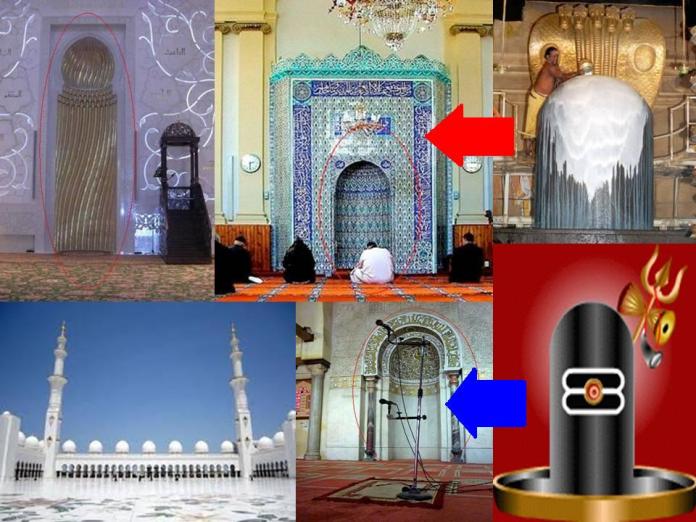
Tag: Kaaba shiva

  • Vedic Practices in Islam Podcast

    Vedic Practices in Islam Podcast

    Above is the Video showing Shiva Linga in Mecca.

    This was taken surreptitiously.

    I received it.

    I have written on the presence of Sanatana Dharma in pre Arabic period in the Middle East, how Saptha pathi, the Marriage vow was present there, Lord Murugan'(Subrahmanya, Karthikeya ) Tribe, the Peacock tribe is among the Yazidi and OM when flipped is 786 and more.

    It is a known fact that Muslims plundered the kingdoms they have conquered and carted away valuables, including Idols , calling the Idol worshipers as ‘kafirs’

    I am reproducing some photographic evidence.

    The joke is that both Islam and Christianity which mock at Hinduism for worshiping Gods as Idols in the form of Man and animal (Hanuman,Varaha, Narasimha) have now ended up prayinga Stone(kaaba) and Symbol for addition, The Cross!

    Now there is evidence that the Muslims carted a Shiva linga and had it installed it in Mecca and it is worshiped.

    Shiv Linga in Mecca.

    Muslims Worship Shiv Lingam At Mecca Masjid Al Haraam Says Islamic Site,

    Prophets Uncle wrote Siva Sthuthi, A Prayer On Lord Shiva,

    Sapthapathi of the Marriage ceremony of the Hindus and Navagrahas in Arabia, Listen to the Podcast.

  • Brahmin King Of Arabia Descendants of Aswathama

    ‘A popular saying refers to the Hussaini Brahmins or Dutts thus:
    Wah re Dutt Sultan,
    Hindu ka Dharm
    Musalman ka Iman,
    Adha Hindu Adha Musalman
    Oh! Dutt, the king
    [Who follows] the religion of the Hindu
    and the faith of the Muslim
    Half Hindu, half Muslim.’

    HERE IS WHAT THE COLUMBIA ENCYLOPEDIA SAYS:

    [Sixth Edition – 2001]Kaaba or Caaba’ (both: kä´b or kä´b) (KEY)  [Arab.,=cube], the central, cubic, stone structure, covered by a black cloth, within the Great Mosque in Mecca, Saudi Arabia. The sacred nature of the site predates Islam: tradition says that the Kaaba was built by Adam and rebuilt byAbraham and the descendants of Noah. Also known as the House of God, it is the center of the circumambulations performed during the hajj, and it is toward the Kaaba that Muslims face in their prayers (see liturgy, Islamic). Pre-Islamic Meccans used it as a central shrine housing their many idols, most notable of which were al-Lat, al-Uzza, and Manat, collectively known as al-Gharaniq or the Daughters of God, and Hubal, a martial deity. The Black Stone, possibly of meteoric origin, is located at one of its outside corners. Also dating from pre-Islamic times as a heavenly relic, this stone is venerated and ritually kissed. Worn hollow by the centuries of veneration, the stone is held together by a wide silver band. The actual structure of the Kaaba has been demolished and rebuilt several times in the course of its history. Around the Kaaba is a restricted area, haram, extending in some directions as far as 12 mi, into which only Muslims may enter.”

    be798-kaaba_shiva_temple

    The above provides impeccable evidence about that pragmatic role played by the Datt Mohyals in the catastrophe of Karbala. There are more than a dozen ballads composed centuries ago which vividly and with great passion describe the scenario of the historic event.

    Ancient Shiva Linga in Kaaba
    Ancient Shiva Linga in Kaaba

    Photo by Suzanna Olsson

    In the Preface of a famous historical novel by Munshi Prem Chand, titled “Karbala”, published in 1924 from Lucknow, has stated that the Hindus who fought and sacrificed their lives in the holy war of Karbala, are believed to be the descendants of Ashvathama (hero of “maha bharata”).This clearly establishes their link with the Datts who consider Ashvathama as an ancestor of their clan.

    I have written articles on the Vedic roots of Arabia.

    If one were to look at the history of Arabia and Africa, one would find that, in the case of Arabia, the entire history of Arabia is dispensed with something  like’Idol worshipers were defeated ‘ and Muhammad established his religion,Islam; in the case of Africa it is dismissed with ‘Tribes with superstitious beliefs were engaged in internecine war!( I am surprised that those who make this statement are also the people who say with a straight face that Human migration began from,  Africa and it was in Africa Humans evolved from forgetting that such an early civilization could have nothing to offer except wars!).

    But real history is different.

    Saudi Arabia,, in the earlier days, was a part of Mesopotamia /Sumeria and these were ruled by Sumerians.

    One can find , among the Kings of Sumeria, in the Kings List of Sumeria, the names of Lord Rama, his father Dasaratha and Bharatha.

    And there is the Tamil connection of Arabia with the unique practice  patronizing  Poets in Tamil style by offering Gifts to them in return for their praising the Kings.

    Sapthapathi was practiced in Arabia and Navagraha Idols were found in Mecca.

    Not to forget that Mecca was /is a Shiva temple.

    Chandra Gupta Maurya ruled over Arabia and his inscription is found in Mecca.

    Prophet’s Uncle composed a Poem on Lord Shiva and the hereditary rights of maintaining the Shiva temple was entrusted to Brahmin Families who settled there.

    There are reports that Seramaan Perumaal Nayanaar, a Shiva Bhaktha and King of present Kerala having met prophet and became a follower of Islam.

    The evidence about Seramaan Perumaal becoming a follower of Islam is not strong.

    Now to the Brahmins and Brahmin Kings of Arabia.


    According to “vide Bandobast Report of Gujarat” by Mirza Azam Beg page 422 and widely famous folk songs, “Later on, when umvies and abbasies let loose an orgy of vendetta on Ahl e Bayet (A.S), Shias and Datts, then Datts returned to their motherland around 700 AD and settled at Dina Nagar, District Sialkot and some drifted to as far as the holy Pushkar in Rajasthan. Starting from Harya Bandar (modern Basra on the bank of river Tigris) with swords in hand and beating durms, they forced their way through Syria and Asia Minor and marching onwards captured Ghazni, Balkh and Bukhara. After annexing Kandhar, they converged on Sindh and crossing the Sindh at Attock they entered the Punjab”.

    An ancestor of Rahab named Sidh Viyog Datt assumed the title of Sultan and made Arabia (old Iraq) his home. He was a tough and tenacious fighter.

    He was also known as Mir Sidhani. He was a worshipper of Brahma. He was the son of the stalwart Sidh Jhoja (Vaj) who was a savant and saint and lived in Arabia (Iraq) around 600 AD.

    The supporters of imam Hassan (A.S) and imam Hussain (A.S) honored the Datts with the title of “Hussaini Brahmin” and treated them with great reverence in grateful recognition of the supreme sacrifices made by them in the war of Karbala. According to Jang Nama, written by Ahmed Punjabi, pages 175-176, “At the time to the Karbala, fourteen hundred Hussaini Brahmins lived in Baghdad alone”

    According to the “encyclopedia of Indian casts” page 579 “Hussaini Brahmins are a group bringing harmony and brotherhood between Muslim and Hindu religions. They are greatly influenced by martydom of Imam Hussain (A.S), grandson of ProphetMuhammad(peace be upon him and on his children), at Karbala in 680 AD. It is also claimed that their ancestors were fought with imam hussain and martyred during the war of karbala. When the holy month of Muharram starts these Brahmins starts lamenting the death of Imam Hussain (A.S) in Lucknow with the muslims. Brahmins are the highest caste in Hindu hierarchy”
    The Hussaini Brahmin sect, located mostly in Indian Punjab, also known as Dutts or Mohyals. Unlike other Brahmin clans, the Hussaini Brahmins have had a long martial tradition, which they trace back to the event of Karbala.

    Some Mohyal Brahmins migrated eastward and became as some sub-divisions of Bhumihar Brahmins, some of whom are also descendants of Hussaini Brahmins and mourn the death of Imam Hussain (A.S). An eminent example was Sir Ganesh Dutt Singh. Sir Ganesh Dutt Singh, who was a freedom fighter, administrator and educationist in which capacity he did a lot for improving education and health services in the state of Bihar in the pre-independence era. Sir Ganesh Dutta made generous donations from his earnings and personal property for the development of educational institutions, like radium institute in Patna Medical College, Darbhaga Medical College, Ayurvedic College and schools for the blind, deaf and dumb, among others. A short film based on the life and works of Sir Dutt has been made by Prakash Jha. His essays, articles and books etc, clearly show his love towards imam hussain (A.S).


    According to a Hindu news paper “Par tap(English)” 21 April 1949

    “The Hussaini Brahmins are concentrating in “satghara katas” (the Rawalpindi-Jhelum regions of Pakistan) for the mourning of the muslim imam “hussain” (A.S).  According to the traditions, the Hussaini Brahmins believe that their ancestor Rahab Dutt and his sons fought on the side of Imam Hussain (A.S) at Karbala and they were martyred along with the Imam. They remained Hindus but the tragedy of Kerbala was commemorated from generation to generation in their families and even now their clans observe it all over India, although the younger generation is less keen on such traditions”.

    What is particularly striking about the observances of the month of Muharram in large parts of India is the prominent participation of Hindus in the ritual mourning. In several towns and villages, Hindus join Muslims in lamenting the death of Hussain (A.S), by sponsoring or taking part in lamentation rituals and taazia processions. In Lucknow, seat of the Shia nawabs of Awadh, prominent Hindu noblemen like Raja Tikait Rai and Raja Bilas Rai built Imambargahs to house Alams, standards representing the Karbala event.

    The non-Muslim tribal Lambadi communities in Andhra Pradesh have their own genre of Muharram lamentation songs in Telugu. Among certain Hindu castes in Rajasthan, the Karbala battle is recounted by staging plays in which the death of Imam Hussain(A.S) is enacted, after which the women of the village come out in a procession, crying and cursing Yazid for his cruelty. This custom is known as “Pitna Daalna”.

    In large parts of rural India, Hindus believe that if barren women slip under a Moharrum Alam they would be blessed with a child.
    Another story, which seems reliable (but no strong historic avidence is found yet to prove it completely), is related as to how the Dutts of Punjab came to be known as Hussaini Brahmins. According to this version, one of the wives of Imam Hussain(A.S), the Persian princess bibi Shahr Banu(A.S), was the sister of “Chandra Lekha” or “Mehr Bano”, the wife of an Indian king called Chandragupta famous as “raja jaisalmer”.

    When it became clear that Yazid was adamant on killing the Imam Hussain (A.S), and “Raja jaisalmer” received the information regarding this, he came to Iraq with a large army to assist the Imam Hussain (A.S). By the time they arrived, however, the Imam (A.S) had been slain. In the town of Kufa, in Iraq, he attacked Damascus the capital of yazid and got martyred by yazeed army however Imam Ali ibn al Hussain (A.S), known as zain ul Abideen, made them alive by the grace of Allah. They went back gathered their army, met with Mukhtar Saqaffi, (a disciple of the Imam(A.S)), who arranged for them to stay in a special part of the town, which even today is known by the name of Dair-i-Hindiya or ‘the Indian quarter’.

    Some Dutt Brahmins, under the leadership of one Bhurya Dutt, got together with Mukhtar Saqafi to avenge the death of the Imam. They stayed behind in Kufa, while the rest returned to India. Here they built up a community of their own, calling themselves Hussaini Brahmins, keeping alive the memory of their links with the Imam (A.S).

    The Hussaini Brahmins believe that in the “Bhagwadgita”  Krishna had foretold the event of the Imam’s death at Karbala. According to them, the Kalanki Purana, (the last of eighteen Puranas), as well as the Atharva Veda, the fourth Veda, refer to Imam Hussain(A.S) as the divine incarnation or avatar of the ”Kali Yug”, the present age. They hold Rasool Allah, in particular reverence, referring to him as “MAHA DEV MAHA MADD” (greatest God) and Imam Ali (A.S), (Imam Hussain’s father, and son-in-law and cousin of the Prophet Muhammad(peace be upon him and on his children)), with the honorific title of ‘Om Murti’. (God’s face).

    They also believe that in “ramaayana” “SIRI RAAM JI” told about the birth of Prophet MUHAMMAD (peace be upon him and his children).

    Uttar ramaayana says “Siri RAAM said! Behold! that after 4000 years there would be a revelation of a “dev atee dev” (GOD of the gods) near the world’s greatest temple of black stone (kaba) in the land of dates, his name would be “MAHA DEV MAHA MADD” his greatest disciple “OM MURTI (God’s face) shall miraculously revealed beyond the black stone temple. His daughter “DURGA” will get married with “OM MURTI” known as Lion of God and they will have two lions one of them will be martyred on a river bank however he would be thirsty for three days”

    Though other Hindus do not believe that it is said for Prophet Muhammad(peace be upon him and his children) but The Hussaini Brahmins observe it like Muslim beliefs.

    The Hussaini Brahmins, along with other Hindu devotees of the Imam Hussain (A.S), are today a rapidly decreasing. Younger generation of Hussaini Brahmins are said to be abandoning their ancestral heritage, some seeing it as embarrassingly deviant.

    No longer, it seems, can an ambiguous, yet comfortable, liminality be sustained, fuzzy communal identities giving way under the relentless pressure to conform to the logic of neatly demarcated ‘Hindu’ and ‘Muslim’ communities. And so, these and scores of other religious communities that once straddled the frontier between Hinduism and Islam seem destined for perdition, or else to folkloric curiosities that tell of a bygone age, when it was truly possible to be both Hindu as well as Muslim at the same time.’

    Citation and Reference.

    Author:  Syed Haider Jafri. ( http://haiderjafri.com/hussaini-brahmins/ )


  • Vedic Practices In Kaaba Islam

    It is curious to know that the history of Arabia  before the advent of Prophet Muhammad  is blank.

    The Pre Prophet  Arabian history is summed up in the statement that the Arabs were Nomads, warring tribes and worshiped Pagans.

    shivlingam Abhisheka in Thanjavur,Tamil Nadu India.
    Shiva Linga Abhisheka Being performed at Thanjavur Big Templend the doors of the Kaaba.

    Islamic History records that Muhammad, after his return from Medina destroyed 360 Idols in Kaaba.

    This was done with the help of Seven allies with whom Muhammad formed an alliance and these people were tribal chiefs.

    The early unruly and warring tribes of Arabia was subjugated by King Vikramaditya of India in 100 BC.

    He established Hindu Dharma and laid the foundation of Sanatana Dharma in Arabia.

    Along with other idols , he also installed a Shiva Linga in Kaaba.

    it is believed that Jats from India were entrusted with the protection of the Kaaba temple.

    And they also doubled up as physicians.

    ‘It is mentioned in the Abadis i.e., the authentic traditions of Prophet Mohammad compiled by Imam Bukhari that the Indian tribe of Jats had settled in Arabia before Prophet Mohammad’s times. Once when Hazrat Ayesha, wife of the Prophet, was taken ill, her nephew sent for a Jat physician for her treatment. This proves that Indians enjoyed a high and esteemed status in Arabia. Such a status could not be theirs unless they were the rulers. Bukhari also tells us that an Indian Raja (king) sent a jar of ginger pickles to the Prophet. This shows that the Indian Jat Raja ruled an adjacent area so as to be in a position to send such an insignificant present as ginger pickles. The Prophet is said to have so highly relished it as to have told his colleagues also to partake of it. These references show that even during Prophet Mohammad’s times Indians retained their influential role in Arabia, which was a dwindling legacy from Vikramaditya’s times.9slaram, net)

    There is yet another evidence that priests were sent from Kerala by the King Cheraman Peruman Nayanar to perform Poojas in the Kaaba temple.

    He was a contemporary of Prophet.

    As a matter of fact this is the only solid historical evidence from external sources for the existence of Prophet.

    Ibn Battuta accounts say that Calicut King( Kerala,India) Cheraman Perumal had a head priest cum accounts in-charge at the Shiva Temple ( called PAGAN temple by the west ) at Mecca which was a watering oasis for the camels , enroute to Jerusalem and Petra.

    May 2026
    M T W T F S S
     123
    45678910
    11121314151617
    18192021222324
    25262728293031

    For whatever reasons, the disturbed King decided to make a trip to Mecca , as soon as he heard that Mohammed founded Islam and installed a black stone , on the SE corner of the Kaaba.

    He took a ship from Calicut to Salalah and form there went by caravan route to Mecca. He met Mohammed , and the Islamic grapevine says that he was impressed by Islam and got converted from Hindu to Muslim.

    The King’s court at Calicut does NOT record this conversion, though messages were sent fast by carrier pigeons and hawks. The Encyclopedia Islamia admits as much when it says: “Muhammed’s grandfather and uncles were hereditary priests of the Kaaba temple which housed 360 Vedic idols!” The encyclopedia Britannica records this too.( Captain Ajit Vadakayil)

    That the Kin was converted to Islam is not corroborated.

    The Vedic Practices in Kaaba that are observed even today.

    Kaaba doors open at Pradosha Time, between 4. 30 and 5. 30 PM.

    1.The perambulation  in the anti clock wise direction around the Kaaba is the Hindu practice of perambulating  Shiva in the anti clockwise direction direction during pradosha, the sacred day to worship Shiva.

    2.Shiva Linga,after Abhisheka(bathing the Deity, is dried by slightly applying Silk Cloth .

    “One of my Pakistani Second Engineers, who had done religious studies in Khandahar and in Iran for many years , told me that every time he went to Mecca his friends and relatives would gives him dozens of silk handkerchiefs , to rub on the black stone . And every time he spent some time hurriedly doing that , he would get whipped quite severely by someone who was paid to do this (to time usurpers )( captain Ajith Vadakayil)

    3. In Hinduism deities are to be worshiped by wearing unstitched cloth, Dhoti.

    The Muslim garment worn in Kaaba is without stitches.

    ‘As the pilgrim proceeds towards Mecca he is asked to shave his head and beard and to don special sacred attire that consists of two seamless sheets of white cloth. One is to be worn round the waist and the other over the shoulders. Both these rites are remnants of the old Vedic practice of entering Hindu temples clean- and with holy seamless white sheets.’

    4. Ganga Water is sacred for Hindus and those ho visit Varanasi bring the Ganga River water in a Brass vessel. Of late people bring this in a plastic bottle.

    Another Hindu tradition associated with the Kaaba is that of the sacred stream Ganga (sacred waters of the Ganges river). According to the Hindu tradition Ganga is also inseparable from the Shiva emblem as the crescent moon. Wherever there is a Siva emblem, Ganga must co-exist. True to that association a sacred fount exists near the Kaaba. Its water is held sacred because it has been traditionally regarded as Ganga since pre-Islamic times (Zam-Zam water).

    [Note: Even today, Muslim pilgrims who go to the Kaaba for Haj regard this Zam-Zam water with reverence and take some bottled water with them as sacred water.]-Salagram.net.

    5.Namaz and Pancha Maha Yagnyas.

    Recital of the Namaz five times a day owes its origin to the Vedic injunction of Panchmahayagna (five daily worship- Panch-Maha-Yagna) which is part of the daily Vedic ritual prescribed for all individuals.

    6.Anga suddhi. Purification of the parts of the Body.

    Muslims are enjoined cleanliness of five parts of the body before commencing prayers.

    This derives from the Vedic injuction

    ‘Shareer Shydhyartham Panchanga Nyasah’

    7.Etymological similarities.

    Kaaba temple from Kabaaleeswara( Shiva)

    Eed means worship and Griha means ‘house’, the Islamic word Idgah signifies a ‘House of worship’ which is the exact Sanskrit connotation of the term. Similarly the word ‘Namaz’ derives from two Sanskrit roots ‘Nama’ and ‘Yajna’ (NAMa yAJna) meaning bowing and worshiping.

    8.Vratas and Months.

    The Muslim month ‘Safar’ signifying the ‘extra’ month (Adhik Maas) in the Hindu calendar. The Muslim month Rabi is the corrupt form of Ravi meaning the sun because Sanskrit ‘V’ changes into Prakrit ‘B’ (Prakrit being the popular version of Sanskrit language). The Muslim sanctity for Gyrahwi Sharif is nothing but the Hindu Ekadashi (Gyrah = elevan or Gyaarah). Both are identical in meaning.

    Four months of the year are regarded as very sacred in Islamic custom. The devout are enjoined to abstain from plunder and other evil deeds during that period. This originates in the Chaturmasa i.e., the four-month period of special vows and austerities in Hindu tradition. Shabibarat is the corrupt form of Shiva Vrat and Shiva Ratra. Since the Kaaba has been an important centre of Shiva (Siva) worship from times immemorial, the Shivaratri festival used to be celebrated there with great gusto. It is that festival which is signified by the Islamic word Shabibarat.

    The Islamic term ‘Eed-ul-Fitr’ derives from the ‘Eed of Piters’ that is worship of forefathers in Sanskrit tradition. In India, Hindus commemorate their ancestors during the Pitr-Paksha that is the fortnight reserved for their remembrance. The very same is the significance of ‘Eed-ul-Fitr’ (worship of forefathers).

    The Islamic practice of observing the moon rise before deciding on celebrating the occasion derives from the Hindu custom of breaking fast on Sankranti and Vinayaki Chaturthi only after sighting the moon.

    Barah Vafat, the Muslim festival for commemorating those dead in battle or by weapons, derives from a similar Sanskrit tradition because in Sanskrit ‘Phiphaut’ is ‘death’. Hindus observe Chayal Chaturdashi in memory of those who have died in battle.

    The Islamic practice of Bakari Eed derives from the Go-Medh and Ashva-Medh Yagnas or sacrifices of Vedic times. Eed in Sanskrit means worship. The Islamic word Eed for festive days, signifying days of worship, is therefore a pure Sanskrit word. The word MESH in the Hindu zodiac signifies a lamb. Since in ancient times the year used to begin with the entry of the sun in Aries, the occasion was celebrated with mutton feasting. That is the origin of the Bakari Eed festival.

    [Note: The word Bakari is an Indian language word for a goat.]

    9. Shiva Stuthi by Muhammds’ Uncle.

    The Shiva Sloka

    Kafavomal fikra min ulumin Tab asayru
    Kaluwan amataul Hawa was Tajakhru
    We Tajakhayroba udan Kalalwade-E Liboawa
    Walukayanay jatally, hay Yauma Tab asayru
    Wa Abalolha ajabu armeeman MAHADEVA
    Manojail ilamuddin minhum wa sayattaru
    Wa Sahabi Kay-yam feema-Kamil MINDAY Yauman
    Wa Yakulum no latabahan foeennak Tawjjaru
    Massayaray akhalakan hasanan Kullahum
    Najumum aja- at Summa gabul HINDU

    Translation.

    The man who may spend his life in sin
    and irreligion or waste it in lechery and wrath
    If at least he relent and return to
    righteousness can he be saved?
    If but once he worship Mahadeva with a pure
    heart, he will attain the ultimate in spirituality.
    Oh Lord Shiva exchange my entire life for but
    a day’s sojourn in India where one attains salvation.
    But one pilgrimage there secures for one all
    merit and company of the truly great.

    Citation and References.

    http://ajitvadakayil.blogspot.in/2009/07/vedic-practises-in-mecca-ajit-vadakayil.html

    http://www.salagram.net/VWHMid-East.html

    Join 4,576 other subscribers

    ← Back

    Thank you for your response. ✨

  • Shiva Linga In Mecca, OM Is 786?

    Shiva Linga In Mecca, OM Is 786?

    Bharatvarsha , as explained in the Purans included the areas now we call as Australia,Egypt, Europe apart from Africa,present Confederation of Russia.

    Please read my posts on this subject under Hinduism.

    When compared to Hinduism, Christianity And Islam are of recent origin.

    It is a known fact that Muslims plundered the kingdoms they have conquered and carted away valuables, including Idols , calling the Idol worshipers as ‘kafirs’

    I am reproducing some photographic evidence.

    The joke is that both Islam and Christianity which mock at Hinduism for worshiping  Gods as Idols in the form of Man and animal (Hanuman,Varaha, Narasimha) have now ended up praying a Stone(kaaba) and Symbol for addition, The Cross!

    Now there is evidence that the Muslims carted a Shiva linga and had it installed it in Mecca and it is worshiped.

    Shiv Linga in Mecca.

    As in the headquarters of Christianity (namely the Vatican in Rome) at the headquarters of Islam too (namely in the Kaaba temple in Mecca city of Saudi Arabia) the ancient Hindu Shiva Linga may still be seen. This cylindrical stone, rendered immovable for security by being fixed in the outer corner of a wall, is the object of reverence of all Muslims. Here Muslims still continue the seven perambulations in the age old Hindu style except that they move anti-clockwise. White silver foil shrouds the stone. The oval uncovered central portion gives the pilgrims an idea of how the stone looks. Syrians had once carried away the stone as a war trophy and kept it for 22 years.

    “The King Vikramaditya inscription was found on a gold dish hung inside the Kaaba shrine in Mecca, proving beyond doubt that the Arabian Peninsula formed a part of his Indian Empire. (Ref: page 315 of a volume known as ‘Sayar-ul-Okul’ treasured in the Makhtab-e-Sultania library in Istanbul, Turkey). King Vikrama’s preachers had succeeded in spreading the Vedic Hindu sacred scriptures in Arabia and Arabs were once followers of the Indian Vedic way of life. The annual fair known as OKAJ which used to be held every year around the Kaaba temple in Mecca and the present annual hajj of the Muslims to the Kaaba is of earlier pre-Islamic congregation. . Even to this day ancient Siva emblems can be seen. It is the Shankara (Siva) stone that Muslim pilgrims reverently touch and kiss in the Kaaba.

    The Kaaba has 360 idols. Traditional accounts mention that one of the deities among the 360 destroyed when the place was stormed was that of Saturn; another was of the Moon and yet another was one called Allah. That shows that in the Kaaba the Arabs worshipped the nine planets in pre-Islamic days. In India the practice of ‘Navagraha’ puja, that is worship of the nine planets, is still in vogue. Two of these nine are Saturn and Moon. In India the crescent moon is always painted across the forehead of the Siva symbol. Since that symbol was associated with the Siva emblem in Kaaba it came to be grafted on the flag of Islam.

    The Hindu Vedic letter in Sanskrit “OM” if seen in a mirror one can see the Arabic numbers 786 and this is the most sacred number for Muslims and copies of the Arabic Koran have the mysterious figure 786 imprinted on them. In their ignorance simply they do not realize that this special number is nothing more than the holiest of Vedic symbols misread and none of the Arabic scholar has been able to determine how they chose 786 as the sacred for them. In short muslims are also going around Siva Lingam at Kaaba, seven times as Hindus go around it seven times.

    A few miles away from Mecca are a big signboard which bars the entry of any non-Muslim into the area. This is a reminder of the days when the Kaaba was stormed and captured solely for the newly established faith of Islam. The object in barring entry of non-Muslims was obviously to prevent its recapture. Kaaba is clothed in a black shroud. This custom also originated from the days when it was thought necessary to discourage its recapture by camouflaging it.

    Another Hindu tradition associated with the Kaaba is that of the sacred stream Ganga (sacred waters of the Ganges river). According to the Hindu tradition Ganga is also inseparable from the Shiva emblem as the crescent moon. Wherever there is a Siva emblem, Ganga must co-exist. True to that association a sacred fount exists near the Kaaba. Its water is held sacred because it has been traditionally regarded as Ganga since pre-Islamic times (Zam-Zam water).

    Source:


    http://www.krishnapath.org/photographic-evidence-taj-mahal-a-vedic-temple/

    http://answers.yahoo.com/question/index?qid=20120818031707AATChYC

    Yahoo link doesn’t work now as Yahoo groups is closed

    Images from Krishnapath.com.

    Join 4,576 other subscribers