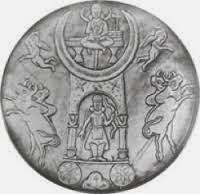
Tag: Gobekli Tepe

  • Turkey Sun God  Mitra Shiva Kingdom

    Turkey Sun God Mitra Shiva Kingdom

    Considering the fact that,

    There was Sanatana Dharma in the south of India much before the Indus/Sarasvathi Civilization,

    Shiva is described in detail in the Ancient Tamil Classics,

    Sage Agastya ,along with Shiva founded the Tamil language,

    The present geographical area of Syria,Lebanon,Jordan and Turkey was a part of  Lemuria/MU of the Tamils,

    The first Man, Manu,Satyavrata/ Vaivasvatha Manu was a Dravidian King,

    He meditated near Madagascar,

    He moved to Ayodhya in the north ,along with his son,who later founded the Ikshvaku Dynasty,

    Lord Rama refused to fight against the Lemurians quoting his Lemurian ancestry,

    The ancient Tamil Kings had a flourishing trade relationship with Turkey,


    Shiva,along with his son Ganesha moved towards the west from the south of India because of a Tsunami,which incidentally forced Manu to move to North,

    Shiva temple is found in Lebanon,

    Tamil city is found in  Sumeria,

    Mitra ,deity. Image
    Mitra,a name of son God,Surya

    ‘1.Lord Rama’s Chapel was found in UR, Iraq.*

    2.A burial ground called as Nagar is fond in Syria. It is called Tel Brak now.

    3.Idols of Rama,Sita and Lakshmana are found.*

    4.Ancestors of the Syrians were the Halaf and Ubaid.

    They date back to 6100 BC.

    They had connection with the Tamils and this is reflected in the ruins of  Nagar.*

    These people traded with the Tamils.

    ”Naram-Sin traded with Meluhha (almost certainly corresponding to the Indus Valley civilization), and controlled a large portion of land along the Persian Gulf. He expanded his empire by defeating the King of Magan at the southern end of the Persian Gulf, and conquering the hill tribes to the north in the Taurus Mountains.

    5.Akkadian’s( Forefathers of the Sumerians) Moon God was Naram Sin, Narasimha.*

    6.There are repeated references in the Sumerian/Akkadian language to Meluuha.’

    Ancient Tamil Brahmi Scripts were found in Oman and Egypt.

    These facts establish that,

    The Tamils were an advanced civilisation by 2200 BC(Akkadian Empire)

    The Hindu Gods and Goddesses were worshiped in Sumeria,

    Names of Lord Rama and Bharata were found in the Kings List of Sumeria.

    * Read My posts on This.’

    Source. Tamil city in Sumeria

    Lord Rama is mentioned in Sumerian Kings List.

    The traces of Shiva are found everywhere from the Middle east to the Arctic!

    The Chola dynasty traces its origins to ikshvaku dynasty of Rama.

    The story of Chola King Sibi is narrated in the Vishnu Purana, as the ancestor of Rama.

    Apart from the evidence of Hitties being influenced by the Tamils, it might be possible that the Cholas were in Hittie Kingdom,possibly they had a hand in forming the Hittie Empire.

    This is a speculation I have in the light of many of the Hitties customs and the depiction of a chariot  running over a man.

    In the Tamil Classics, King Manu Needhi Chola ran his son down by his chariot because his son ran over a calf and because the cow had complained of this to him by ringing the bell set up by the king for the people to let him know of their problems!


    Shiva city.

    It wasn’t until explorer Charles Texier stumbled upon ruins he had hoped belonged to an ancient Roman city that history would gradually begin to allow the Hittites to take their rightful place. Texier made his discovery in the isolated village of Bogazköy, in central Anatolia, roughly half way between Ankara and Sivas. The year was 1834. Though he didn’t know it at the time, he had in fact discovered the imperial Hittite city of Hattusa. However, the road to understanding the Hittites would prove to be a long one.

    Stones covered with mysterious hieroglyphs were being discovered in northern Syria and all over Anatolia and they seemed to relate to the hieroglyphs found at the Hattusa site. Archaeologists were beginning to consider the possibility that these hieroglyphs belonged to an ancient forgotten empire. In 1880, English Assyriologist Archibald Sayce shocked the world with his announcement that this empire and the Hittites of the Old Testament were one and the same people.

    Excavations at the site did not start until 1906, and tablets found in the Hittite’s cuneiform language revealed a surprising twist. The language of the Hittites belonged to the Indo-European languages with the Hittite word for water (‘watar’) for instance uncannily resembling English and German, leading to speculation that the Hittites may originally have migrated from Europe. Other theories, however, claim that Indo-European languages originated elsewhere, perhaps even in Anatolia itself. Whatever the truth may be, English and a host of other languages can thus be traced back to a single root hidden somewhere in the darkness of prehistory..

    ‘Excavations at a mound known as Topraktepe indicate Hittite settlement in the area as early as 2600 BC, though little is known of Sivas’ history prior to its emergence in the Roman period. In 64 BC as part of his reorganization of Asia Minor after the Third Mithridatic War, Pompey the Great founded a city on the site called “Megalopolis”. Numismatic evidence suggests that Megalopolis changed its name in the last years of the 1st century BC to “Sebaste”, which is the feminine form of the Greek name corresponding to Augustus. The name “Sivas” is the Turkish version deriving from the name Sebasteia, as the city was known during late Roman empire.

    Shiva city in Turkey

    Shiva connection in Haran in Turkey, Murugan was worshiped in Iraq,Narasimha and Tamil connection in Syria, Lord Rama’s name in Sumeria’s King List.

    Now on Gobekli Tepe, the remains in Turkey has a Temple, Burial /worship Ground.

    Gobekli Temple built by Brahmins

    Mittanai Mitra Kingdom.

    Mitanni (Mitranya Desa) appears in history in 1480 BCE, when Parrattarna (Pratardhana) was in control of Aleppo in Syria , By the end of 15th century BCE, Saushatar brought Assyria under Mitannian control. Tushratta was assassinated by his son in 1340 BCE. He was the last king of independent Mitanni. His kingdom was destroyed by the Hittites and Assyrians. A document from the Hittite capital Hattusa records a treaty in which Tushratta’s son Shattiwaza is recognised as the ruler of Mitanni as a Hittite vassal. Mitanni’s capital was called Washukanni (Vedic God Vasu) .
    A powerful Hurrian (Surya Vamsa; Hurrian=Suryan)) state in north Mesopotamia and Syria (named after Surya, Hindu sun god) , Mitanni is first mentioned in an Egyptian tomb inscription dating to the early the fifteenth century BCE and last attested at the time of Assyrian king Tiglath-pilesar 1115—1077 BCE.

    The name Mitanni comes from a personal name maiita (MITRA for Sun) known from Nuzi In Iraq. Since Bogazkoy inscription mentioned Mitra in Mitannian Peace Treaty, there is no doubt that it denotes MITRA, the Vedic God. Hurriya is also Surya=Sun=Mitra.’

    Source. https://tamilandvedas.com/2014/10/11/hindu-kings-who-ruled-syria-and-turkey/

    In a treaty between the Hittites and the Mitanni, the deities Mitra, Varuna, Indra, and Nasatya (Ashvins) are invoked. Kikkuli’s horse training text includes technical terms such as aika (eka, one), tera (tri, three), panza (pancha, five), satta (sapta, seven), na (nava, nine), vartana (vartana, turn, round in the horse race). The numeral aika “one” is of particular importance because it places the superstrate in the vicinity of Indo-Aryan proper as opposed to Indo-Iranian or early Iranian (which has “aiva”) in general.

    Another text has babru (babhru, brown), parita (palita, grey), and pinkara (pingala, red). Their chief festival was the celebration of the solstice (vishuva) which was common in most cultures in the ancient world. The Mitanni warriors were called marya, the term for warrior in Sanskrit as well; note mišta-nnu (= miẓḍha,~ Sanskrit mīḍha) “payment (for catching a fugitive)”.

    Sanskritic interpretations of Mitanni royal names render Artashumara (artaššumara) as Arta-smara “who thinks of Arta/Ṛta”, Biridashva (biridašṷa, biriiašṷa) as Prītāśva “whose horse is dear”, Priyamazda (priiamazda) as Priyamedha “whose wisdom is dear”,Citrarata as citraratha “whose chariot is shining”, Indaruda/Endaruta as Indrota “helped by Indra”, Shativaza (šattiṷaza) as Sātivāja “winning the race price”, Šubandhu as Subandhu “having good relatives”, Tushratta (tṷišeratta, tušratta, etc.) as *tṷaiašaratha, Vedic Tvastr “whose chariot is vehement”

    Source.https://en.m.wikipedia.org/wiki/Mitanni


    Rulers of Mittani Empire.

    The first king was Shuttarana

    His dynasty followed the Hindu/Vedic custom of naming the child after  paternal Grandfather.

    We have Kirata city in Turkey.

    Full Name: Kirata

    Primary Country Code: TU (Turkey)

    First-order administrative division code: 00 (Turkey (general) )

    Region Font Code: 4 (Russia/ Central Asia)

    Unique Feature Identifier: -753482

    Unique Name Identifier: -1087078

    Latitude in decimal degrees: 37.733333

    Longitude in decimal degrees: 44.016667

    Kirta (1500 BCE) = Kreeta/Crown or Kirti=Fame
    Shuttarna = Sudhana or Sudharsana (Gautama Buddha’s father name was Sudhodana)
    Paratarna = Pratardhana in Vishnu Sahsranama
    Shaushtatara = Suacadhara (Pure?)
    Artatama = Like Rudra Daman.
    Shuttarna II
    Artashumara = Artha Kumara
    Artatama II
    Shuttarna III
    Shattivaza/ Kirtiwasa = Sathya vakya, Sathya Vacha, Kirti Vacha, Krittivasan is name of Lord Shiva
    Shattuvara= Satvavara or Sathyavaran
    Wasashatta = Vasu satva or Sathya
    Shattuara II =

    Shiva is called Kirata,Hunter.


  • Ravana Reserve Army Atlantis Rama Atlantis War

    Valmiki provides a lot of Geographical information in the Ramayana.

    Most of them are found when he describes the Aranya vasa of Lord Rama., his search for Sita, his travel to Lanka, Rama’s return from Lanka by Pushpaka Vimana and Sugriva’s directions to his army about the possible places where Ravana could have taken Sita.

    Of interest is the description by Sugriva about the Nazca Lies of Peru ad Russia, though one can find references to other countries as well.

    Location of Atlantis.jpg Location of Atlantis.

    I have written articles on California being the Kapila Aranya, Mount.Ashes ,USA is the place where Sagara’s(Rama’s ancestor) sons were turned into ashes.

    I have referred to the Quadrilateral Temple of Shiva in Colorado and a Natural Vishnu Temple in Grand Canyon,US.

    I remembered about the Moola Sainya ( Reserve Army of Ravana, which he called up during his battle with Rama.

    Lemuria Kumari Kandam.png Lemuria, KumariKandam. “Kumari Kandam map”. Licensed under CC BY-SA 3.0 via Commons – https://commons.wikimedia.org/wiki/File:Kumari_Kandam_map.png#/media/File:Kumari_Kandam_map.png

    ‘A grieved Ravana soon collected himself and sent word for his reserve forces all over the globe (moola bala sainya). That was a frightful army that Ravana did not think of using against these ‘puny creatures’ at all. He considered it below his dignity to use such a powerful force against humans and monkeys. It was like killing a fly with a sledgehammer, for him. In fact, Kumbakarna had advised him otherwise. If you have decided to fight against them, then the better strategy would be to collect all our forces together. ‘pandhiyir pandhiyir padagaLai vittu avai sindhudal kaNdu nee irundhu thEmbudal mandhiram andru.’ It is not right to send our army in small lots convenient enough for them to wipe off and to weep over their death. ‘nam vali elaam udan undhudal kadan.’ It is of utmost importance to collect all our forces here and now and go to the field in such vast numbers so that it becomes difficult for them to encounter such a vast army’.(Kamba Ramayaa ,Tamil-http://www.heritagewiki.org/index.php?title=Vibhishana_-_Part_4)

    Valmiki also talks about the Moola Sainya in the Yuddha Kada

    And the location of Kara and Dushana who were killed by Rama.

    And there is this point of Hanuman flying to Lanka,

    The Adams Bridge, Rama Sethu is about 30 Kms from Rameswaram, India

    But Valmiki says it is about 800 Miles!

    And there is evidence that Hanuman traveled at a speed of 660Kms/hour!

    I shall be writing on this shortly.

    I recalled about Lemuria and Atlantis.

    Lemuria is the Lost continent of the Tamils.

    And the US is the Patala Loka.

    Please read my posts on this and Atlantis.

    Plato’s description of Atlantis reminds me of the descriptions of the Patala Loka, inhabited by the Rakshasas.

    The presence of Hanuman ad his son Makaratwaja in Central America and the reference to Tamil Kings of the south of Vindhyas made me wonder whether there is any connection between Atlantis. Ramayana and Lemuria.

    So,

    Considering the distance covered by Hanuman in his flight to Lanka,

    The Lanka of Ravana could not have been where it is today,( Please red my Post)

    Lemuria and Atlantis being different entities and that The Tamils occupied that land,

    Atlantis had the Sanatana Dharma presence, including the Rotating city of Tripura, which was destroyed by Shiva,

    Shiva migrated towards the west of India, when a great flood struck South India(when Rama’s ancestor Sathyavrata Manu migrated to Ayodhya),

    The presence of Shiva in these countries, including the Nazca Lines of Peru and Mecca, Petro Jordan having Shiva Temples,

    Rama’s name is found, along with Dasaratha and Bharatha in the Sumerian Kings List,

    Shiva worship preceded the Sanatana dharma in the south,

    The Rakshasas having bee present in this land, where the Moola Sainya of Ravana was kept,

    Ravana having been a Shiva worshiper,

    Hanuman and Makaratdwaja is found in Honduras,

    The land mass at these times was different than what we find today,

    Thiruvannamalai in South India being 3 Billion years old,

    There is a room in Romania which is connected to Iraq,Kailsh,

    Gobekli Tepe was built by Brahmins.

    It stands to reason that The Atlantis people were a part of Sanatana Dharma .

    And there is evidence to suggest that there was a great war between Rama and the Atlanteans.

    Ravana was in Lemuria, had his Reserve army in Atlantis

    There is also a view that ET were involved in this.

    ‘Some Wedha and Jain manuscripts, among others, the Ramayana and the Mahabharata it contains evidence of historical and technological overview of Rama’s dynasty which is believed to have experienced the golden age of the seven main cities ‘Seven Rishi City’ which is one of Mohenjo Daroo (Northern Pakistan).

    From various sources I have learned, can generally be described a wide range of theories and research on the subject of this study provide some interesting material. Include:

    – Atlantis and Rama dynasty had experienced the golden era (Golden Age) at the same time (30000-15000 BC).

    – Both have mastered nuclear technology.

    – Both the aerospace and aeronautics technology has advanced to have enabled aircraft and shaped like a UFO (by some accounts) called Vimana (Rama) and Valakri (Atlantis).

    – Residents of Atlantis has an aggressive nature and led by the clergy (priests Enlighten), according to Plato’s text.

    – Rama dynasty has seven major cities (Seven Rishi’s City) with the capital city of Ayodhya where one of the results found are Mohenjo-Daroo.

    – Competition of the civilization reached its peak with the use of nuclear weapons.

    – The experts found that the debris and the remains of human skeletons found at Mohenjo-Daroo containing radioactive residue that can only be produced by large-scale thermonuclear explosion.

    – In a seloka of the Mahabharata, narrated by the figure of a weapon of mass destruction is a result similar to the present nuclear weapons.

    – Some Seloka Wedha and Jain in the book is explicitly and completely describe the shape of the ‘flying vehicle’ called ‘Vimana’ that its characteristics resemble flying saucers today.

    Most of the written evidence it was in India in the form of literary texts, while the physical evidence would be in the western world the Pyramids in Egypt and South America.

    In short all the above investigations denounce mankind had advanced in the civilization of Atlantis and Rama. Even long before man ever entered the century 4000SM space and nuclear technology. But the golden age was ended by a devastating nuclear war until the aftermath, people had time to go back to primitive times to the advent of Sumerian civilization around 4000SM or 6000tahun ago.’

    Citation.


    https://sites.google.com/site/vansalegend/home/articles/ancient-wars-nuclear-atlantis-vs-ramaR

  • World’s Oldest Temple Gobekli Turkey Built By Brahmins

    I have posted articles on the connection between Sanatana Dharma, called as Hinduism, and Sumeria and Mesopotamia.

    Shiva connection in Haran in Turkey, Murugan was worshiped in Iraq,Narasimha and Tamil connection in Syria, Lord Rama’s name in Sumeria’s King List.

    Now on Gobekli Tepe, the remains in Turkey has a Temple, Burial /worship Ground.


    Scroll down for Videos

    “Six miles from Urfa, an ancient city in southeastern Turkey, Klaus Schmidt has made one of the most startling archaeological discoveries of our time: massive carved stones about 11,000 years old, crafted and arranged by prehistoric people who had not yet developed metal tools or even pottery. The megaliths predate Stonehenge by some 6,000 years. The place is called Gobekli Tepe, and Schmidt, a German archaeologist who has been working here more than a decade, is convinced it’s the site of the world’s oldest temple’

    And

    Nevalı Çori was an early Neolithic settlement on the middle Euphrates, in Şanlıurfa Province, Southeastern Anatolia, Turkey. The site is famous for having some of the world’s oldest known temples and monumental sculpture. Together with the earlier site of Göbekli Tepe, it has revolutionised scientific understanding of the Eurasian Neolithic.

    The settlement was located about 490 m above sea level, in the foothills of the Taurus Mountains, on both banks of the Kantara stream, a tributary of the Euphrates.

    Note the name Kantara, name of Kandhari, wife of Dhritarashtra,Mahabharata.

    Nevali Cori may be a distortion of ‘Na-Valay-Akriti’ or “Na-Valay-Akrit’.

    Nevali Cori ruins, Brahmin with tuft.jpg
    Nevali Cori ruins, Brahmin with tuft.

    ‘Na’ (न) as in ‘Not’. ‘Valay’ (वलय) is Sanskrit for ‘Bracelet-like or Circular’. ‘Akriti’ (आकृति) is ‘shape’ or ‘design’. Nevali-Cori may be ‘Na-Valayakrit’ (न-वलयीकृत) which means ‘Not shaped like a bracelet or not-circular ‘.Nevali Cori is said to be closest in design to Kalasasaya Temple [Sanskrit: Kala (Time) + Sasaya (Good Wish or to be desired)]. Kalasasaya Temple is also rectangular in shape.

    Nevali Cori may also be a distortion of the Sanskrit ‘naval’ (नवल) meaning ‘new’ and ‘akriti’ (आकृति) meaning ‘shape’ or ‘design’ and could be a reference to an architectural design which was new and different from what was prevalent at the time.

    The Yazdis.

    The Yazidis perform a form of Sandhyavandana.

    Yazidis have five daily prayers:[63]

    Nivêja berîspêdê (the Dawn Prayer), Nivêja rojhilatinê (the Sunrise Prayer), Nivêja nîvro (the Noon Prayer), Nivêja êvarî (the Afternoon Prayer), Nivêja rojavabûnê (the Sunset Prayer). However, most Yezidis observe only two of these, the sunrise and sunset prayers.

    Worshipers should turn their face toward the sun, and for the noon prayer, they should face toward Laliş. Such prayer should be accompanied by certain gestures, including kissing the rounded neck (gerîvan) of the sacred shirt (kiras). The daily prayer services must not be performed in the presence of outsiders, and are always performed in the direction of the sun. Wednesday is the holy day, but Saturday is the day of rest.[63][64] There is also a three-day fast in December.’

    The Yazidis worship Malak Ṭāʾūs , Peacock and Peacock is the vehicle of Lord Subrahmanya.

    For details on this, read my post on this.

    Sapta Rishis in Yazidis.

    Hinduism has seven  Rishis and they are entrusted with the task of laying down rules for each Aeon, Yuga.

    Yazidis believe in ,

    “Two key and interrelated features of Yazidism are: a) a preoccupation with religious purity and b) a belief in metempsychosis. The first of these is expressed in the system ofcaste, the food laws, the traditional preferences for living in Yazidi communities, and the variety of taboos governing many aspects of life. The second is crucial; Yazidis traditionally believe that the Seven Holy Beings are periodically reincarnated in human form, called a koasasa.”

    Citation.

    https://ramanisblog.in/2015/01/27/sandhyavandan-sapta-rishis-in-islamic-tribe-yazidis/

    http://www.smithsonianmag.com/history/gobekli-tepe-the-worlds-first-temple-83613665/?=&preview=&page=1&no-i=

    May 2026
    M T W T F S S
     123
    45678910
    11121314151617
    18192021222324
    25262728293031

    Gobekli Tepe, located in southeastern Turkey, is an ancient archaeological site that has been described as the world’s oldest temple. It is a place of immense historical significance, predating Stonehenge by around 6,000 years. The site consists of massive carved stones arranged by prehistoric people who did not have metal tools or pottery.

    The discovery of Gobekli Tepe has revolutionized our understanding of the Neolithic period and has challenged traditional archaeological beliefs. The German archaeologist Klaus Schmidt, who has been working at the site for over a decade, believes that Gobekli Tepe was a place of worship and rituals.

    Nevali Cori is another important archaeological site in Turkey, known for its ancient temples and monumental sculptures. It is located in the Şanlıurfa Province and, like Gobekli Tepe, provides valuable insights into the Eurasian Neolithic period.

    The connection between Sanatana Dharma (Hinduism) and these ancient civilizations is an intriguing topic. Some theorists propose connections between Hindu deities and the worship of certain ancient gods in Sumeria, Mesopotamia, and other regions. For example, references to Shiva, Murugan, Narasimha, and Lord Rama have been found in ancient texts and inscriptions in these areas.

    While it is fascinating to explore these connections, it’s important to approach such claims with caution. Archaeological and historical research is ongoing, and definitive conclusions can only be drawn with solid evidence and scholarly consensus.

    If you are interested in further reading on this topic, you can refer to the blog post on Ramanisblog that provides additional insights into the connections between the Yazidis, Sapta Rishis, and Sandhyavandana rituals in Hinduism.

    Sources:

    Above summary is by Jetpack AI