Tag: Chandra Vamsa

  • Solar Lunar Dynasties Surya Chandra Vamsa From One Woman Ila, A Dravida

    There were two ancient dynasties in India.

    Other dynasties have sprung from the two.

    These two dynasties are,

    Surya Vamsa, the Solar Dynasty and

    Chandra Vamsa, the Lunar dynasty.

    Lord Rama belonged to Ikshvaku Dynasty which is the same as Surya Vamsa, Solar Dynasty.

    Pandavas and Kauravas belonged to Chandra Vamsa,Lunar Dynasty.

    When one tries to find out the origin of Man Genealogy, and the first pair , one gets stuck, either with Incest or the origin of one of the pair remaining with no visible parentage.

    I seek the indulgence of the readers for my vagueness in the foregoing sentence.

    This is to avoid that useless controversy.

    Those who can read between the lines would understand.

    Now to the point at hand.

    Ila with Budha, son of Moon,Chandra.image
    Ila with Budha, son of Moon,Chandra.

    If there were two dynasties, then who was the first one; how did the second dynasty come into play;how these two are related?

    Indian texts are clear on Cosmology and Genealogy, besides pther things.

    There are Eighteen Puranas and many Upa Puranas.

    Please read my post on list of Indian Texts.

    There may be minor variations in details among the Puranas, but all agree on essential major facts.

    Thus Genealogy and Cosmology descriptions, explanations do not have discrepancies among the Puranas.

    Thus under Genealogy, Puranas describe the dynasties and list the Kings.

    It may not be of place to mention that Cosmology and Genealogy are two of the characteristics laid down for a text to be qualified as Purana.

    Please read my article on Characteristics of Purana.

    The Firs human was Manu, He is called Vaivaswatha Manu for the present Time scale, Kali Yuga, which has a span of 4,32,000 years.

    He had one daughter and nine sons.
    Manu begot ten other children named Vena, Dhrishnu, Narishyan,Nabhaga, Ikshvaku, Karusha, Sharyati, the eighth, a daughter named Ila, Prishadhruthe ninth, and Nabhagarishta, the tenth. ( https://en.m.wikipedia.org/wiki/Shraddhadeva_Manu#Descendants )

    His son Ikshvaku was from the south of the Vindhya mountains, Dravida Desa.

    His kingdom was centered around Madagascar.

    When a Tsunami struck , Manu mediatated in a plateau near Madagascar.

    He left south with his sons for Ayodhya, where he founded the Solar Dynasty, called as Surya Vamsa.

    Manu had left his only daughter Ila in the South.

    She remained in the South,Dravida Desa.

    Her descendants ruled from the south.

    This dynasty is the Chandra Vamsa, Lunar Dynasty.

    The descendants of Ila and Ikshvaku are first cousins.

    In Hindu way of explaining relationships, children of aunt and uncle.

    Though both Ila and Ikshvaku belong to the Genealogy of Manu, the Dynasty is called Ikshvaku, Manu’s son.

    I shall write as to why.

    While the dynasty of Ikashvaku is called Solar, that of Ila is Lunar, Chandra Vamsa.

    Chandra Vamsa is named after Chandra, Moon.

    Ila was both a man and woman.

    ‘According to the Ramayana, when Ila approached Shiva for help, Shiva laughed with scorn but the compassionate Parvati reduced the curse and allowed Ila to switch genders every month. However, as a male he would not remember his life as a female and vice versa. While Ilā roamed the forest in her new form with her female attendants, Budha, the god of the planet Mercury and the son of the moon-god Chandra, noticed her. Although he had been practising asceticism, Ilā’s beauty caused him to fall in love with her at first sight. Budha turned Ilā’s attendants into Kimpurushas (hermaphrodite, lit. “is it a man?”)[10][14] and ordered them to run away, promising that they would find mates as Ilā had.

    Ilā married Budha and spent an entire month with him and consummated the marriage. However, Ilā woke one morning as Sudyumna and remembered nothing about the past month. Budha told Ila that his retinue had been killed in a rain of stones and convinced Ila to stay with him for a year. During each month she spent as a woman, Ilā had good time with Budha. During each month as a man, Ila turned to pious ways and performed austerities under the guidance of Budha. In the ninth month, Ilā gave birth to Pururavas, who grew to become the first king of the Lunar dynasty. Then, as per the advice of Budha and Ila’s father Kardama, Ila pleased Shiva with a horse sacrifice and Shiva restored Ila’s masculinity permanently.

    Another legend from the Vishnu Purana credits Vishnu of restoring Ilā’s manhood as Sudyumma. The Bhagavata Purana et al. texts tell that after Pururavas’s birth, the nine brothers of Ila – by horse sacrifice – or the sage Vasistha – the family priest of Ila – pleased Shiva to compel him to give the boon of alternate month manhood to Ila, turning him into a Kimpurusha.The Linga Purana and the Mahabharata record the birth of Pururavas, but do not narrate the end of Ila’s alternating gender condition. In fact, the Mahabharata describes Ilā to be the mother as well as the father of Pururavas.According to another account found in the Vayu Purana and the Brahmanda Purana, Ilā was born female, married Budha, then was transformed into a male called Sudyumna. Sudyumna was then cursed by Parvati and transformed once again into a female, but became a man once again through Shiva’s boon.

    In almost all versions of the tale, Ila wants to live as a man, but in the Skanda Purana, Ila desires to be a woman. The king Ela (Ila) entered Parvati’s grove at Sahya mountain and became the woman Ilā. Ilā wished to remain a woman and serve Parvati (Gauri) and Ganga, the goddess of the Ganges river. However, the goddesses dissuaded him. Ilā bathed in a sacred pool and returned as Ela, bearded and deep-voiced.’

    The Bhagavata Purana, the Devi-Bhagavata Purana and the Linga Purana declare that Ila ascended to heaven with both male and female anatomy.[18] Ila is considered the chief progenitor of the Lunar Dynasty through Pururavas and of the Solar Dynasty through his brother Iksavaku and sons Utkala, Gaya, and Vinatashva.[9][22] The marriage of Ilā, a descendant of the Sun, and Budha, the son of the Moon, is the first union of the solar and lunar races recorded in the scriptures.[11]

    Reference and citation.

    https://en.m.wikipedia.org/wiki/Ila_(Hinduism)

  • First Tribes Dynasties of The World Solar Lunar Origin Details

    First Tribes Dynasties of The World Solar Lunar Origin Details

    When one reads History one has to take facts as they are, bearing in mind the geographical differences between then and now, the conditions existing during the period of study.

    Unfortunately in India both seem to be at a premium.

    People while reading Indian history were and still are dependent on foreign sources with agenda.

    Most of the history taught in India is dis/misinformation by the rulers for over five hundred years.

    This includes the Mughals and the British.

    The Mughals had to keep their religion and empire intact and hence taught what was in their interests.

    The Britishers had the same approach.

    They went two steps further.

    They first divided people based on Religion.

    And introduced English. And they had psudeo researchers like Max Mueller to infiltrate Hinduism to make Indians lose respect for their texts.

    Some of these Missionaries outwardly Embraced Hinduism and propagated Christianity.

    People like Veeramamunivar in Tamil.

    The nett result is Indians do not refer Indian texts and even if they do, they do so through English!

    So Indian history looks to be confused and looks like fables.

    But if one were to study Indian texts diligently with the approach that there was no south, north divide, nor was a linguistic chavunism.

    And the land mass of Ancient times was different.

    With this, let us look at Indian history.

    The first major world war in indiay, called ten Kings war, Dadarjaniya war between two warring groups.

    Essentially there were two major tribes or groups in India.

    IT is worth remembering that the first Human being was Manuywho belonged to the southern hemisphere, called Dravida டிச.

    The term Man is from Manu.

    Manu had sons and a daughter.

    When a Tsunami struck South, he, along with his son left for Ayodhya.

    His son Ikshvaku founded the Surya Vamsa, Solar dynasty.

    His daughter, Ila, who was left behind in South, here south meaning from the Saraswathi valley to the present south india, running through the coast of Arabian sea, which was not called thus then.

    She married Chandra and had a son Budha.

    Then came Puru.

    This is the Lunar Dynasty, Chandra Vamsa.

    All dynasties of India can be traced back to these two dynasties including the Tamil Kings Chera, Chola and Pandyas.

    Please read my articles on Solar, Lunar and Tamil dynasties.

    There were sub dynasties like Yadu, Thurvasa.

    Some of these migrated outside Bharata kanda and settled around the world.

    Hence we find remains of Hinduism everywhere in the world.

    India’s name Bharat or Bharat-Varsh is named after a descendant of the Puru dynasty King Bharat.

    There were two main Vedic cultures in ancient India. The first was a northern kingdom centered on the Sarasvati-Drishadvati river region dominated by the Purus and the Ikshvakus. The second was a southern culture along the coast of the Arabian Sea and into the Vindhya Mountains, dominated by the Turvashas and Yadus and extending into groups yet further south. These northern and southern groups vied for supremacy and influenced each other in various ways as the Vedas and Puranas indicate. The northern or Bharata culture ultimately prevailed, making India the land of Bharata or Bharatavarsha and its main ancient literary record the Vedas, though militarily the Yadus remained strong throughout history….. ‘

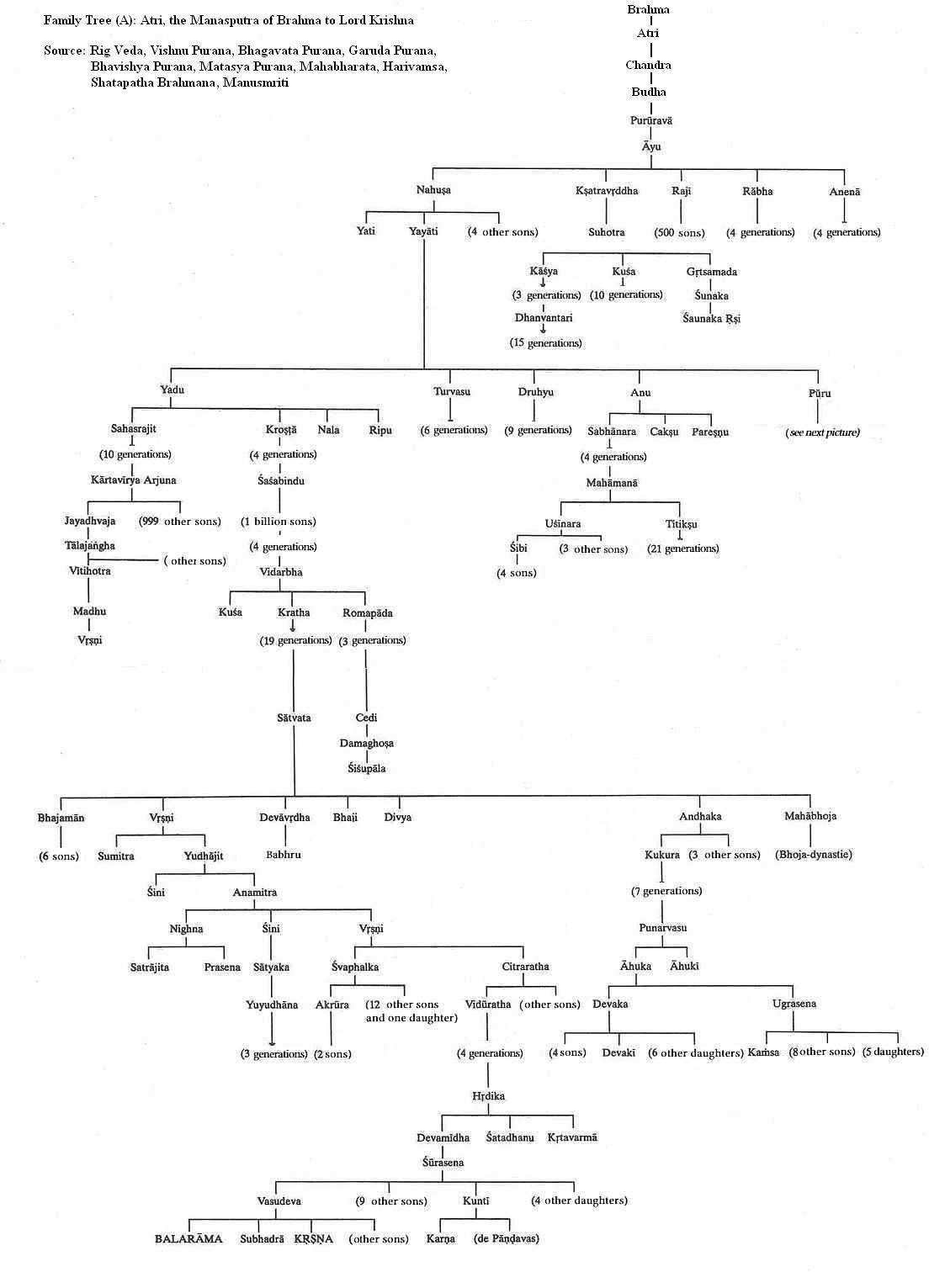
    According to Puranic legend the Chandravanshi lineage is:
    Brahma -> Atri -> Chandra -> Budha (married to Manu’s daughterIla) -> Pururava -> Ayu -> Nahusha -> Yayati -> Puru andYadu

    King Yayati’s elder son Yadu had officially lost the title to govern by his father’s command since he had refused to exchange his youth with his father. Thereby, he could not have carried on the same dynasty, called Somvanshi. Consequently, the generations of King Puru, Paurav or Puruvanshi were the only one to be known as Somvansa.

    Yayati divided up his kingdom into five quarters (VP IV.10.1708). To Turvasha he gave the southeast (Bay of Bengal); to Druhya the west Gandhara; to Yadu the south (By Arabian sea); to Anu the north Punjab; and to Puru the center (Sarasvati region) as the supreme king of Earth’

    Luna dynasty (also known as Somavansha, Chandravansha and as Ailas) is one of the four principal houses of the Kshatriya varna, or warrior–ruling caste.This legendary dynasty was descended from the moon (Soma or Chandra), ,

    According to the Mahabharata, the dynasty’s progenitor Ilaruled from Prayag, while his son Shashabindu ruled in the country of Bahli.

    The great sage Vishvamitra the son of king Gadhi of Kanyakubja dynasty was a descendant of Amavasu, the son of Pururava of Chandravansha clan.

    Ila’s descendants, the Ailas (also known as Chandravansha), were a dynasty of kings of ancient India. Pururavas, the son of Budha was the founder of this dynasty.

    Reference and Citations.

    https://en.m.wikipedia.org/wiki/Lunar_dynasty

    https://en.m.wikipedia.org/wiki/Puru_(Vedic_tribe)

  • History Of India 1 Ikshvaku To Chandragupta Maurya.

    History Of India 1 Ikshvaku To Chandragupta Maurya.

    Most History text books in India begin with Maurya Dynasty and Bimbisara,as if there were no history in india before that period,dismissing them as Legends and hyperbole in the imagination of Poets.

    The History conveniently begins prior to Alexander’s invasion of India.

    Alexander’s invasion of India is a myth as revealed by Greek historians.

    But the real history of India,as revealed by the Vedas,Puranas,Ramayana,Mahabharatha,Sanskrit and Tamil literature ,validated by Archeology,foreign literature,especially Greek,Etymological similarities between world languages and Sanskrit and Tamil,Astronomical /Carbon/Infrared dating of artifacts recovered in India and abroad confirm what the Indian texts say.

    To understand Indian history,one has to,

    Approach Indian texts with open mind,

    Verify them with the tools I have mentioned,

    Understand that there was no Aryan Invasion,

    Sanatana Dharma coexisted with the Tamil culture,which also followedcSanatana Dharma,

    There was no North South Divide save the wars between the usual wars between kings,

    That the history of India extends to thousands of years,

    That the Concept of Time in India is Cyclic and not linear,

    There were two major dynasties,Solar and Lunar,Suryavamsa and Chandravamsa and there were many sub dynasties,

    The Solar dynasty ,though its ancestor Manu was a Dravidian King,was established in North India,while thexLunar dynasty also flourised in south India,through Ila,Daughter of Manu.

    The South Indian  kings trace their ancestry to. Solar ,Ikshvaku Dynasty and also to Lunar dynasty,Chandra vamsa.

    The Ikshvahu dynasty frm Treta Yuga ,from million years ago extended upto Dwapara yuga and ended with King Sumitra who was defeated and driven away from Ayodhya.

    Then we find continum from that period from Magadha dynasty,which belongs to Lunar Dynasty,Chandravamsa from Bruhatradha.

    Lunar, Dynasty,Chandravmsa.image
    Lunar dynasty,Chandra vamsa.

    ‘Barhadradha Dynasty Before the Mahabharata War of 3138 B.C.

    1. Barhardradha I :-

    According to Mahabharata, Brihadradha-I, the founder of Barhadradha Dynasty was the eldest son of Uparichara Vasu , the seventh in the descent from the Great Kuru, son of Samvarna, a descendant of the Lunar Dynasty (Chandravamsajah) of kings. He founded the kingdom of Magadha probably about 3709 B.C. or 571 years before the Great war of Mahabharata at Kurukshetra between the Pandavas and the Kauravas.

    This  battle according to Mahabharata, the important Puranas, and all other ancient Hindu, Bauddha and Jaina authorities and traditions, took place. 36 years before the commencement of the Kaliyuga—the present Yuga.   Kali Yuga  began immediately after the departure of Sri Krishna, son of Vasudeva by Devaki, from this world on the 20th February, 3102 B. C., in the year Pramadhin of the Southern School of Hindu astronomers. (Vide Indian Eras By this author, Kota Venkata Chelam)

    Brihadradha married the two beautiful twin daughters of the king of Kasi; and by the blessing of a Rishi, he obtained a most powerful son by name Jarasandha. The king, after installing his mighty son Jarasandha on the throne of Magadha retired into a forest and led an ascetic life. In this context the Mahabharata gave the next prominent dynasty of Jarasandha, leaving some generations of kings in the interval between Brihadradha I and Jarasandha (or Brihadradha II). – (Vide_Mahabharata, Sabha Parva. Adhyayas 14 to 19).

    N.B:- The Matsya Purana enumerates all the names of kings between Brihadradha-I and Jarasandha or Brihadradha-II Jarasandha, son of Bhuvana was the 15 th in descent from Kuru and the tenth from Brihadradha-I, the founder of the Magadha Dynasty of kings. The following table shows the order of descent according to Matsya Purana. (Chapter 59):-

    1. Samvarna

    2. Kuru (The founder of the Kaurava Dynasty who removed his capital from Prayaga to Kurukshetra.)

    3. Sudhanvan, Parikshit, Prajana, Jaghnu or Johnu or Yaju

    4. Suhotra.

    5. Chyavana

    6. Krimi (or Kriti)

    7. Chaidya or Uparicharavasu or Pratipa

    8. (1) Brihadradha-I thefounder of the Magadha Dynasty.(3709 B.C.)

    9. (2) Kusaagra

    10. (3) Vrishabha or Rishabha.

    11· (4) Pushpavat or Punyavat

    12. (5) Pushpa or Punya

    13. (6) Satyadhrithi or Satyahita.

    14. (7) Sudhnvan II or Dhanusha.

    15. (8) Sarva

    16. (9) Bhuvana or Sambhava.

    I7. (10)Brihadradha II or Jarasandha.

    http://trueindianhistory-kvchelam.blogspot.in/2009/08/kings-of-magadha-before-great.html )

    Visit the above site which is very informative.

    ‘The Hindu Mahabharata calls Brihadratha the first ruler of Magadha. King Bimbisara of the Haryanka dynasty led an active and expansive policy, conquering Anga in what is now West Bengal.
    The death of King Bimbisara was at the hands of his son, Prince Ajatashatru. King Pasenadi, king of neighbouring Kosala and brother-in-law of King Bimbisara, promptly retook the gift of the Kashi province.
    Accounts differ slightly as to the cause of King Ajatashatru’s war with the Licchavi, an area north of the river Ganges. It appears that Ajatashatru sent a minister to the area who for three years worked to undermine the unity of the Licchavis. To launch his attack across the Ganges River, Ajatashatru built a fort at the town of Pataliputra. Torn by disagreements the Licchavis fought with Ajatashatru. It took fifteen years for Ajatashatru to defeat them. Jain texts tell how Ajatashatru used two new weapons: a catapult, and a covered chariot with swinging mace that has been compared to a modern tank. Pataliputra began to grow as a center of commerce and became the capital of Magadha after Ajatashatru’s death.’

    Haryanka dynasty (c. 600 – 413 BCE)Edit
    Bhattiya or

    Bimbisara (544-493 BCE)

    Ajatashatru (493-461 BCE)

    Udayabhadra

    Anuruddha

    Munda

    Nagadasaka
    Shishunaga dynasty (413–345 BCE)Edit
    Shishunaga (413–395 BCE)

    Kakavarna Kalashoka (395–367 BCE)

    Mahanandin (367–345 BCE)
    Nanda Dynasty (345–321 BCE)Edit
    Mahapadma Nanda Ugrasena (from 345 BCE), illegitimate son of Mahanandin, founded the Nanda Empire after inheriting Mahanandin’s empire

    Pandhuka

    Panghupati

    Bhutapala

    Rashtrapala

    Govishanaka

    Dashasidkhaka

    Kaivarta

    Dhana Nanda (Agrammes, Xandrammes) (until 321 BCE), overthrown by Chandragupta Maurya

    https://en.m.wikipedia.org/wiki/Magadha

    From Bimbisara to current day,the History of India is clear and can be studied,though some misinformaion about middlecages remain.

    I have traced the Dynasties in Northvand shall write about the Dynasties of South India,including Andhra Ikshvakus and Tamils.

    I have taken references to Sanskrit and Tamil among Indian languages as I know only these two.

    Related.

    https://ramanisblog.in/2014/12/27/kings-list-india-by-puranas-validated/

    https://ramanisblog.in/2014/12/26/lunar-dynasty-india-chandra-vamsa-of-mahabharata-list/


  • Pandavas Kauravas Ramas Ikshwaku Dynasty

    There are, according to Puranas and Ithihasas Ramayana and Mahabharata there are two dynasties.

    One is the Inshwaku dynasty to which Lord Rama belongs.(Solar Dynasty)

    Another is Chandra Dynasty to which the Pandavas and Kauravs belong.( Lunar Dynasty)

    Ikshwaku (Ramayana) and Mahabharata Dynasty.

    familytree-_chandravansh

    Click on the Image to enlarge.

    The Kurus/Chandra dynasty is from Budha, Purururava.

    The point is in the above lineage you shall find the descendants of Ikshwaku/Rama fought along side the Kauravas and while Bhima defeated Dirghayaghna, Abhimanyu killed  Vrishdvala!


    There are two issues here.

    One is that Ramayana took place in Treta Yuga , thousands of years before Mahabharata war in Dwapara Yuga.

    How come the descendants of Ishwakhu fought with the Kauravas in Dwapara Yuga?

    And I have written earlier that Lord Rama’s death preceded Krishna’s  by a mere 250 Years!

    I have replied to that in my post Ramas death precedes Krishnas 250 years.

    Are we missing the history here and are there some Kings list of Ikshwaku missing?

    Though the lineage of Ikshwaku is provided in the Mahabharataby Vyasa, there seems to some thing missing in the Kings List as it can not account for thousands of years.

    Readers may contribute.

    Might be there are some missing links who ruled during Yuga Sandhi, the hiatus between the end of one Yuga and the beginning of another Yuga and the Ikshwaku Kings ruled in that period.

    But the Universe is in hibernation in Yuga Sandhi!

    Other wise the list is perfect.

    Another important point is Mahabharata states that Ikshwaku is considered to be elder brother of one of the daughters of Manu and she got married into Chandra Vamasa.

    ‘Mahabharata mentions the founder king Ikshwaku as a son of the great patriarch Manu. thus we have at Mbh.1.75:- Manu begat ten children namedVena, Dhrishnu, Narishyan, Nabhaga, Ikshvaku, Karusha, Saryati, the eighth, a daughter named Ila, Prishadhru the ninth, and Nabhagarishta, the tenth. Among this, princess Ila is the founder of Aila dynasty which later expanded into Puru, Bharata and Kuru linages in which the Kauravas and Pandavas are born. Thus Mahabharata consider Ikshwaku as an elder bother of Ila. It indirectly gives the impression that the Ikshwakus were older than the Ailas.’

    Source .http://ancientvoice.wikidot.com/article:ikshwaku-kings-in-mahabharata#toc5

    Rama’s Dynasty ends.

    ‘Soorya Vamsa.
    Sree Maha Vishnu
    Brahma
    Mareechi
    Kasyapa, his wife– Aditi.
    Soorya (Sun), his wife– Sanjna.
    Vaivasvsvata Manuvu, his wife– Sraddha.

    Ikshvaaku Ilaa(lady) Saryaati Subhaaga
    (later transformed (grandson)
    into Sudyumna)

    Grand son son Chyavana.
    Kaakutsa
    Ambareesha.
    Kaakutsa’s
    16th descendant
    Maandhaatha.
    Maandhaatha wife Bindumati
    He got three sons and 50 daughters
    Elder son Purukutsu
    Purukutsu’s 7th descendant Trishanka
    Trishanka’s son Harischandra
    Harischandra’s 8th descendant Sagara
    Sagara’s grand son Amsumanta
    Amsumanta’s grand son Bhageeratha
    Bhageeratha’s 5th descendant Rutuparna
    Rutuparna’s 6th descendant Khatvanga.
    Khatvanga’s grand son King Raghu.
    King Raghu’s grand son King Dasaradha
    King Dasaradha’s four sons are
    SriRama, Lakshmana, Bharata, Satrughna.
    Sri Rama’s sons, Lava and Kusa.
    Lakshmana’s sons Angada, Chandra keta.
    Bharata’s sons Daksha,Pushkala
    Satrughna’s sons Subaahu, Srutasena.

    Because all the above kings descended from the origin,Soorya (Sun), it is called Soorya Vamsa. As far as we know, in Soorya Vamsa, the last king in Tretayuga, was Sreerama Chandra. Later,in Dvaapara Yuga, there were Pandavas,Kouravas, Sri Krishna etc. Kings. They belong to Chandra Vamsa Kings'( Udyoga Parav of Mahabharta by Vyasa)’

    Source.

    http://www.telugubhakti.com/telugupages/monthly/mahabharat/content504b.htm

  • Lunar Dynasty India Chandra Vamsa of Mahabharata List

    Indian legends speak of two dynasties that ruled India, Surya, Solar and Chandra Vamsa, Lunar Dynasty.

    Lord Rama belonged to Ikshvaku of Surya,Solar Dynasty while the Kauravas and Pandavas belonged to Lunar Dynasty or Chandra Vamsa.

    However, Vivaswan, the father of Vaivaswatha Manu of Solar Dynasty has been identified as Surya Deva (The Sun).

    Chandra is said to to be a son of Atri Maharshi, (a son of Brahma) or of the ocean (Ksheera Sagara Mathanam).

    Chandra’s son Budha married Ila the daughter of Vaivaswata Manu and their son Pururavas inherited Pratishthanapura.

    Both these dynasties are related.

    The Tamil Dynasty of Cholas descended from the Solar Dynasty of Rama while Pandyas from the Chandra Vamsa, Lunar Dynasty.

    Chandra Vamsa .jpg
    Chandra Vamsa , Lunar dynasty of India. Click to enlarge.