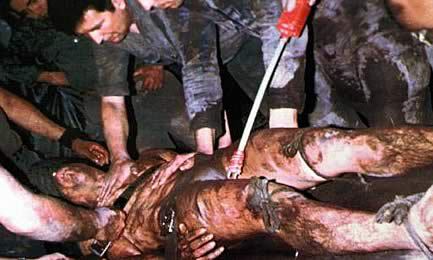
When a Government is engaged in fighting a war or against terrorism,it becomes impossible not to resort to third degree when a suspect is interrogated, in the larger interest of the country.
But it is also possible that this is likely to be misused.
As to the non provision of adequate protection in the Constitution against wrong judgements enough provision for Appeal have been provided..
Judgements , in the final analysis are subjective and depends on the interpretation of the Law, which again is conditioned by one’s dispositions.
In this case an action has been proposed and is rejected.
This may mean anything, that the action has been contemplated or the establishment had been very humanitarian in rejecting the proposal.
Ultimately every thing boils down to this-whether the individual has done what he had thought as Right with the available facts at that point of time.
Civil Rights people forget that those affected/ killed by the accused also have Civil Rights.
Society has a right to defend itself.
Story:
– A six-year-old memo from within the George W. Bush administration that came to light this week acknowledges that White House-approved interrogation techniques amounted to “war crimes.” The memo’s release has called attention to what has changed since President Barack Obama took office, but it also raises questions about what hasn’t.
The Bush White House tried to destroy every copy of the memo, written by then-State Department counselor Philip Zelikow. Zelikow examined tactics like waterboarding — which simulates drowning — and concluded that there was no way they were legal, domestically or internationally.
“We are unaware of any precedent in World War II, the Korean War, the Vietnam War, or any subsequent conflict for authorized, systematic interrogation practices similar to those in question here,” Zelikow wrote. The memo has been obtained by George Washington University’s National Security Archive and Wired’s Spencer Ackerman.
On his second full day in office, President Barack Obama formally disavowed torture,banning the types of techniques Zelikow had objected to so strongly in his memo.
But while Democrats are using the memo as evidence of a new post-torture era under Obama, human rights activists, civil libertarians and opponents of excessive secrecy say they see many ways in which the country’s moral compass is still askew — and in some ways even more so than before.
“If your baseline is the Bush years, it’s night and day,” said Tom Blanton, director of the National Security Archive. “If your baselines are a set of first principles, as the ACLU calls for, or as us openness advocates call for, then your situation is: Is the glass half full or the glass half empty?”
Obama has refused to pursue legal action against those who may have engaged in law-breaking under his predecessor’s watch — saying he prefers to “look forward instead of looking backward.” To some, this indicates there is little assurance that the U.S. won’t torture again in the future.
“The administration has clearly disavowed torture, and that is an important and welcome thing,” said Jameel Jaffer, a national security expert at the American Civil Liberties Union.
“But they’re steadily building a framework for impunity.”
When it comes to issues like warrantless surveillance, “continuity is the rule and not the exception and in fact in some very important areas this administration has gone even farther than the Bush Administration did,” Jaffer said.
Most alarming, says Jafeer, is the issue of the targeted killing of American citizenswho are terrorism suspects.
Jaffer said the idea that the government can mark an American for death without any judicial oversight is something the framers of the Constitution “would have found totally foreign to the project they were engaged in.”
“I think there are many Democrats out there who are quiet because they trust President Obama,” Jaffer said. But, he added, “there’s no doubt that the power we’re giving President Obama will be available to a future president.”
Jaffer noted that another way things may be worse today than during the Bush era is that at least back then, many people thought things would change dramatically once Bush left office, and that his actions wouldn’t establish legal precedents.
“We didn’t worry so much about that because the Bush Administration was seen as an outlier and an aberration, and the Bush precedent wouldn’t have been seen as weighty,” Jaffer said.
http://www.huffingtonpost.com/2012/04/06/torture-memo-bush_n_1408612.html?ncid=edlinkusaolp00000009