Tag: Vedic period

  • Vedic Practices in Islam Podcast

    Vedic Practices in Islam Podcast

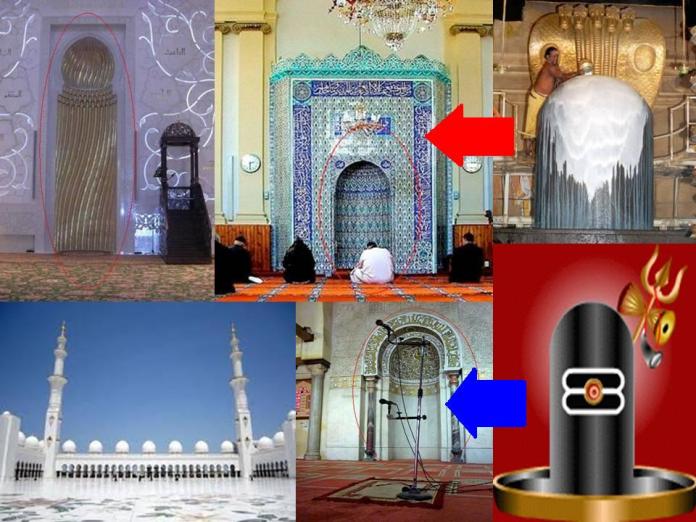
    Above is the Video showing Shiva Linga in Mecca.

    This was taken surreptitiously.

    I received it.

    I have written on the presence of Sanatana Dharma in pre Arabic period in the Middle East, how Saptha pathi, the Marriage vow was present there, Lord Murugan'(Subrahmanya, Karthikeya ) Tribe, the Peacock tribe is among the Yazidi and OM when flipped is 786 and more.

    It is a known fact that Muslims plundered the kingdoms they have conquered and carted away valuables, including Idols , calling the Idol worshipers as ‘kafirs’

    I am reproducing some photographic evidence.

    The joke is that both Islam and Christianity which mock at Hinduism for worshiping Gods as Idols in the form of Man and animal (Hanuman,Varaha, Narasimha) have now ended up prayinga Stone(kaaba) and Symbol for addition, The Cross!

    Now there is evidence that the Muslims carted a Shiva linga and had it installed it in Mecca and it is worshiped.

    Shiv Linga in Mecca.

    Muslims Worship Shiv Lingam At Mecca Masjid Al Haraam Says Islamic Site,

    Prophets Uncle wrote Siva Sthuthi, A Prayer On Lord Shiva,

    Sapthapathi of the Marriage ceremony of the Hindus and Navagrahas in Arabia, Listen to the Podcast.

  • Indus Valley Civilization Dravidian

    Indus Valley Civilization Dravidian

    ..The term Dravidian coined by Robert Caldwell,who was a Christian Missionary with the Agenda of propagating Christianity much like Mueller has played/is playing havoc in understanding the ancient History of India.

    The term Dravida was used by the Vedic texts to indicate a group of people living south of the Vindhya Mountains,Caldwell used this term to indicate an Ethnic group and paved a way to divide India on the bass of Ethnicity.

    Then came the sophisticated attempt of dividing my proposing Aryan Invasion theory,which now stands discredited.

    Please read my post The Fraud called Aryan Invasion.

    While Max Mueller ,another well masked missionary took the route of planting deliberate misinterpretation of Vedas,though he did some good job,to confuse ancient Indian History(please read my articles on Max Mueller),Robert Caldwell took the Tamil Language to distort History by paving the way for misinformation about Tamils,Dravidas and Sanatana Dharma.

    Indus valley time chart.image.
    Indus valley Timeline

    This has made historians running in circles.

    If one accepts Aryan Invasion Theory,you have to accept that there was no presence of Vedic Dharma in the south;there were animosities between the Arynas and the Dravidas:the culture of these two were mutually exclusive;you can not explain the advanced culture in the South nor can you account for the numerous archeological finds that indicate a close connection between the two:you find it to date Kings and Eras.

    But facts reveal themselves if one takes India as a unit refer to literature of All Indian Languages and foreign  literary references about India from Plato,Strabo and others.

    The facts.

    Rama’s ancestor was A Dravidian and ruled Dravida Kingdom.

    Ravana was from the south and was a Dravida.

    Shiva worship preceded in the Dravida Desa much before the Vedic period.

    Valmiki,who compiled/composed Ramayana,was a Tamil poet.

    So were Sage Agastya ,Parashurama,Gautama,Rishyasrunga….

    Rama’s ancestor Sagara of Kosala Kingdom married a Dravidian princess.

    Krishna attended Tamil Sangam.

    Krishna,Arjuna married Pandyan Princesses and had children.

    Sahadeva and Balarama visited South in their pilgrimage.

    Madurai Meenakshi’s father Malayathdwaja Pandyz fought along with Pandavas in the Kurukshetra battle of Mahabharata.

    Chera king Perunchotru Udiyan Neduncheralaathan provided food for both the Pandava and Kaurava armies during Mahabharatha war.

    Kulothunga Chola’s son in law built Konark Sun Temple.

    Rama,Sita and Hanuman ,among others of Ramayana visited many Shiva and Vishnu temples in the south..

    List is endless.

    Now more evidence.

    Tamil Brahmi script was found in Saraswathi valley.

    Tamil King Sibi,ancestor of Rama ruled from the north,where he had his second capital.

    He built the Thiruvellarai Temple,near Srirangam,Tamil Nadu for Vishnu as Pundarkaksha.

    Tamil is found among the Brahui people in NWFP area even today.

    The Indus Valley civilisation (2,600-1,900 BCE) located both in Paistan and India is often identified as having been Dravidian.Cultural and linguistic similarities have been cited by researchers Henry Heras, Kamil Zvelebil, Asko Parpola and Iravatham Mahadevan as being strong evidence for a proto-Dravidian origin of the ancient Indus Valley civilisation.The discovery in Tamil Nadu of a late Neolithic (early 2nd millennium BCE, i.e. post-dating Harappan decline) stone celt allegedly marked with Indus signs has been considered by some to be significant for the Dravidian identification.….

    Yuri Knorozov surmised that the symbols represent a logosyllabic script and suggested, based on computer analysis, an underlying agglutinative Dravidian language as the most likely candidate for the underlying language.Knorozov’s suggestion was preceded by the work of Henry Heras, who suggested several readings of signs based on a proto-Dravidian assumption.….

    Linguist Asko Parpola writes that the Indus script and Harappan language are “most likely to have belonged to the Dravidian family”. Parpola led a Finnish team in investigating the inscriptions using computer analysis. Based on a proto-Dravidian assumption, they proposed readings of many signs, some agreeing with the suggested readings of Heras and Knorozov (such as equating the “fish” sign with the Dravidian word for fish, “min”) but disagreeing on several other readings. A comprehensive description of Parpola’s work until 1994 is given in his book Deciphering the Indus Script’

    https://en.m.wikipedia.org/wiki/Dravidian_people

    https://en.m.wikipedia.org/wiki/Vedic_period

    https://en.m.wikipedia.org/wiki/List_of_Rigvedic_tribes

    Images credit.

    http://www.crystalinks.com/induscivilization.html

    There are  33 Vedic tribes listed in the Rig Veda.

    Their presence and dispersal was towards the north,north east of India,Persia and Russia.

    One has to account for the presence of Sanatana Dharma in the Far east  ,extending to Australia and the spread  in Europe,Africa,Americas and Mesoamericas.

    This was the work of  Dravidians at first and later by the Vedic people.

    References and Citations. wiki,provided at each block quote.

    Reference Books.

  • Vasishtas Fourteen Dravidian Tribes Greeks Chinese Huns

    As one researches Indian history , one finds innumerable references to Yavanas(Greeks),Sakas, Nagas,Hunas….

    While we dig deep we find these groups listed as tribes of Bharatavarsha.

    The Pashupati seal from the Indus Valley Civilization.image,jpg
    The Pashupati seal from the Indus Valley Civilization. 2600–1900 BCE

    These references are found from the Rig Veda , the earliest  text of the world and these are repeatedly mentioned in the Ramayana, Mahabharata, Eighteen Puranas, Tamil Sangam Classics, Kalidasa’s Harivamsa and in Kalhana’s Raja Tharangini, among other texts belonging to other Regional languages of India.

    I am providing a sample list and a link to my article on the Vedic Tribes of India.

    https://ramanisblog.in/2015/06/19/tamils-vedic-tribes-yadus-turvasas-rig-veda/

    I have found some curious facts.

    1. Sage Vasshista though listed as the Royal Priest of the Ikshvaku, the Solar Dynasty to which Lord Rama belongs to i mentioned prominently during the period of Dasaratha and Rama and briefly during the period of Ikshvaku when he founded the Dynasty’ Vashista does not find a detailed mention from the period of Ikshvaku and Dasaratha.

    The reference to Vashista along with Ikshvaku is found in the Bhagavatha Purana where it is mentioned that Ikshvaku left the Dravida Desa, South of Vindhya mountains for Ayodhya from where he founded his dynasty.

    He left for Ayodhya because of a Tsunami referred to in detail by the Puranas and Tamil classics.

    The great Flood is mentioned in all ancient texts both religious and non religious.

    Other than these  references  Vashista is missing in the texts.

    Next we hear of him as having accompanied Shiva  to compose the Rig Veda in the Arctic.

    2.We find Sage Agastya moving over to South on two occasions, one at the time of Shiva Uma wedding and again to lead 71 Families out of Dwaraka when Tsunami struck after the Mahabharata War to the south of Vindhyas,

    Please check my articles on this and Agastya’s date has been validated by Star Canopus.

    3.Parashurama settled families in the south from the north.

    Manu left for the north from the South, which means that there has been a civilization before he left.

    There are references  in the Sumerian Kings List to Dasaratha, Rama and Bharatha s Kings of Sumeria.

    Sumerian texts also mention that Rama aligned with  Horus, son of Osiris.

    Rama Atlantis War Kavatam periplus Port Window of Lemuria

    As explained in these articles, there seems to have been Four major civilizations then.

    Rama’s Empire,

    Atlantis Empire,

    Uighur Empire and

    Lemurian Empire.

    Of these Uighur was not very advanced and Lemuria which had been on the wane was trying to recoup.

    They were suppressed by the Atlantis people.

    In the Atlantis, Osiris’ son Horus entered into an alliance with Rama to defeat Seth who was trying to become independent in the Sumerian valley.’

    Ramas war against Atlantis

    So there was a civilization in south before Manu left for Ayodhya from the Dravida Desa.

    Then Viswamitra reference is found in the Ramayana and other Indian texts and also the life of Nala and Damayanti and these three ante date Rama.

    Rama’s ancestor Sibi fought against the Dravida tribes and built a temple for Vishnu  at Thiruvellarai, near SriRangam in Tamil Nadu and this temple is older than Srirangam.

    Then there is a detailed  description of the battle between Viswamitra and Vasishta when the former tried to take away the Cow Nandini from Vashista.

    The concept of taking away the Cattle is a common to both the Tamil  and Vedic Culture.

    In Virata parva of Mahabharata, Duryodhana tries to take away the cattle from Virata and the Pandavas fought against him along with Virata.

    The tribes that aligned with Vashista against Viswamitra are,

    ‘Mahabharata links the origin of Dravidas with sage Vasistha. Viswamitra, a king in the Ikshwaku clan, attacked the cow of Vasistha. Then many armies emerged for the protection of that cow and they attacked the armies of Viswamitra. Cow symbolizes land, in ancient Indian scriptures. Thus this war was fought with the tribes allied with Vasista for their own land. Other tribes that were mentioned along with the Dravidas in this incident were Sakas, Yavanas, Savaras, Kanchis, Paundras and Kiratas, Yavanas and Sinhalas, and the barbarous tribes of Khasas, Chivukas, Pulindas, Chinas and Hunas with Keralas, and numerous other Mlechchhas. (1,177)…

    The Indus Valley civilisation (2,600-1,900 BCE) located both in Pakistan and India is often identified as having been Dravidian. Cultural and linguistic similarities have been cited by researchers Henry Heras, Kamil Zvelebil, Asko Parpola and Iravatham Mahadevan as being strong evidence for a proto-Dravidian origin of the ancient Indus Valley civilisation.[The discovery in Tamil Nadu of a late Neolithic (early 2nd millennium BCE, i.e. post-dating Harappan decline) stone celt allegedly marked with Indus signs has been considered by some to be significant for the Dravidian identification.

    Yuri Knorozov surmised that the symbols represent a logosyllabic script and suggested, based on computer analysis, an underlying agglutinative Dravidian language as the most likely candidate for the underlying language. Knorozov’s suggestion was preceded by the work of Henry Heras, who suggested several readings of signs based on a proto-Dravidian assumption.

    Linguist Asko Parpola writes that the Indus script and Harappan language are “most likely to have belonged to the Dravidian family”.Parpola led a Finnish team in investigating the inscriptions using computer analysis. Based on a proto-Dravidian assumption, they proposed readings of many signs, some agreeing with the suggested readings of Heras and Knorozov (such as equating the “fish” sign with the Dravidian word for fish, “min”) but disagreeing on several other readings. A comprehensive description of Parpola’s work until 1994 is given in his book Deciphering the Indus Script’

    I Postulate that,

    There was a Dravida Civilization in the South before or started with Manu in the south of Vindhyas,

    The tribes of Dravidas were left behind by Manu when he left for Ayodhya,

    Sage Vasista stayed in the South,

    Later when Viswamitra banished his sons to the south, Dravida civilization was in existence during the Ramayana period,

    Dravidians were called as Dasyus because of their way of Life was different from Sanatana Dharam though they followed the Sanatana Dharma.

    These Dravidian tribes included the ancestors of Greeks, other European tribes, Chinese and Huns.

    I have written on the presence of  lord Shiva in the south much earlier to vedic period.

    I shall explore further and write on the location and dispersal and seeming acrimony with the vedic people, the reasons and Shiva’s Travels throughout the world,

    References and citations.

    https://en.wikipedia.org/wiki/Dravida_Kingdom#Dravida_listed_in_the_ancient_Indian_.28Bharata_Varsha.29_Kingdoms

    https://en.wikipedia.org/wiki/Dravidian_people#Ancestral_components

    Manu Dravida

    Pasupathy Seal Image credit.

    By unknown Indus Valley Civilization sealmaker from Mohenjodaro archaeological site – http://www.columbia.edu/itc/mealac/pritchett/00routesdata/bce_500back/indusvalley/protoshiva/protoshiva.jpg, Public Domain, https://commons.wikimedia.org/w/index.php?curid=9325528

  • Beef Eating Allowed in The Vedas Mahabharata?

    There has been reports of a Man belonging to Muslim community being beaten by a mob for eating Beef.

    In this connection I received a mail  as follows.

    ‘I saw this post in FB.  Though I do agree that lynching someone for suspecting eating of beef is quire unacceptable.  But the quotes in the post, seems to take a distorted view of our scriptures.  Would you pl enlighten on this topic ?’

    The mail detailed quotes from the Mahabharata and the Upanishads that people, even rishis wee eating beef ding the Sanatana dhama period.

    My view is that it looks that people were eating meat during the Vedic period.

    I have provided  quotes which indicate meat-eating and those that prohibit it.

    The explanations trying to explain away beef eating seems to me laboured and lack conviction.

    Cow Being worshiped. Cow Being worshiped.

    Another point often made in this connection is that the animal slain in the Yagnya were given life , they reached Heaven.

    Bt the point is they were slain!

    On consideration it looks to me that people were eating meat/beef and later it was prohibited.

    A society has all sorts of people, some good, some bad and some indifferent.

    One should remember that Vedic people were also humans  and were open to Human foibles.

    We had Rama and Ravana;Kishna and Kamsa, Sakuni, Yudhishta and Duyodhana and Duchchatana.

    Mahabharata and Ramayana are facts , Valmiki and Vyasa ecoded facts.

    Had they wanted they could have painted Rama without blemish(killing Vali) , Krishna with out His Machiavellian schemes to win the Mahabharata War.

    They portrayed society as it was.

    As they people rose spiritually and found higher values they changed their Lifestyle and values.

    Just as condemning everything modern is wrong, it is equally incorrect to say that whatever the Vedic people did was right.

    And our mission should be to take what is Right in relation to Lifestyle  and advanced scientific concepts.

    And savour the treasure called Hinduism…

    The path to Realization as explained by the Upanishads.

    Cow worshiped , Beef eating prohibited in Vedas.

    Aghnyeyam saa vardhataam mahate soubhagaaya

    Rigveda 1.164.27
    Cow – The aghnya – brings us health and prosperity

    Suprapaanam Bhavatvaghnyaayaah
    Rigveda 5.83.8
    There should be excellent facility for pure water for Aghnya Cow

    Yah paurusheyena kravishaa samankte yo ashwena pashunaa yaatudhaanah

    Yo aghnyaayaa bharati ksheeramagne teshaam sheershaani harasaapi vrishcha
    Rigveda 10.87.16

    Those who feed on human, horse or animal flesh and those who destroy milk-giving Aghnya cows should be severely punished.

    Vimucchyadhvamaghnyaa devayaanaa aganma
    Yajurveda 12.73
    The Aghnya cows and bulls bring you prosperity

    Bhagavata Purana:

    “Those who are ignorant of real dharma and, though wicked and haughty, account themselves virtuous, kill animals without any feeling of remorse or fear of punishment. Further, in their next lives, such sinful persons will be eaten by the same creatures they have killed in this world.” (Bhagavata Purana 11.5.14)

    Beef eating in Vedas.

    Rigveda (10/85/13) declares, “On the occasion of a girl’s marriage oxen and cows are slaughtered.”
    Fact: The mantra states that in winter, the rays of sun get weakened and then get strong again in spring. The word used for sun-rays in ‘Go’ which also means cow and hence the mantra can also be translated by making ‘cow’ and not ‘sun-rays’ as the subject. The word used for ‘weakened’ is ‘Hanyate’ which can also mean killing. But if that be so, why would the mantra go further and state in next line (which is deliberately not translated) that in spring, they start regaining their original form.

    How can a cow killed in winter regain its health in spring? This amply proves how ignorant and biased communists malign Vedas.
    Claim: Rigveda (6/17/1) states that “Indra used to eat the meat of cow, calf, horse and buffalo.”

    Fact: The mantra states that brilliant scholars enlighten the world in the manner that wood enhances the fire of Yajna. I fail to understand from where did Avtar Gill and his friends discover Indra, cow, calf, horse and buffalo in this mantra!”

    Narada said, ‘Rantideva, the son of Srinjaya, we hear, fell a prey to death. That high-souled king had two hundred thousand cooks to distribute excellent food, raw and cooked, like unto Amrita, unto the Brahmanas, by day and by night, who might come to his house as guests. 1 The king gave away unto the Brahmanas his wealth acquired by righteous means. Having studied the Vedas, he subjugated his foes in fair fight. Of rigid vows and always engaged in due performance of sacrifices, countless animals, desirous of going to heaven, used to come to him of their own accord. 2 So large was the number of animals sacrificed in the Agnihotra of that king that the secretions flowing from his kitchen from the heaps of skins deposited there caused a veritable river which from this circumstance, came to be called theCharmanwati3 He, incessantly gave away nishkas of bright gold unto the Brahmanas, ‘I give thee nishkas.’ ‘I give thee nishkas,’ these were the words incessantly uttered by him. ‘I give thee,’ ‘I give thee’ saying these words he gave away thousands of nishkas. And once again, with soft words to the Brahmanas, he gave away nishkas. Having given away, in course of a single day, one crore of such coins, he thought that he had given away very little. And, therefore, he would give away more. Who else is there that would be able to give what

    p. 130

    he gave? The king gave away wealth, thinking, If I do not give wealth in the hands of Brahmanas, great and eternal grief, without doubt, will be mine.’ For a hundred years, every fortnight, he gave unto thousands of Brahmanas a golden bull into each, followed by a century of kine and eight hundred pieces of nishkas. All the articles that were needed for his Agnihotra, and all that were needed for his other sacrifices, he gave away unto the Rishis, including Karukas 1 and water-pots and plates and beds and carpets and vehicles, and mansions and houses, and diverse kinds of trees, and various kinds of viands. Whatever utensils and articles Rantideva possessed were of gold. They that are acquainted with the history of ancient times seeing the superhuman affluence of Rantideva, sing this song, viz., ‘We have not seen such accumulated treasures even in the abode of Kuvera; what need be said, therefore, of human beings?’ And people wonderingly said, Without doubt, the kingdom of Rantideva is made of gold. 2 On such nights, when guests were assembled in the abode of Rantideva, one and twenty thousand kine were sacrificed (for feeding them). And yet the royal cook adorned with begemmed ear-rings, had to cry out, saying, ‘Eat as much soup as you like, for, of meat, there is not as much today as in other days. Whatever gold was left belonging to Rantideva, he gave even that remnant away unto the Brahmanas during the progress of one of his sacrifices. In his very sight the gods used to take the libations of clarified butter poured into the fire for them, and the Pitris the food that was offered to them, in Sraddhas. And all superior Brahmanas used to obtain from him (the means of gratifying) all their desires. When he died, O Srinjaya, who was superior to thee in respect of the four cardinal virtues and who, superior to thee was, therefore, much superior to thy son, thou shouldst not, saying, ‘Oh, Swaitya, Oh, Swaitya,’ grieve for the latter who performed no sacrifice and made no sacrificial present.’”


    Footnotes

    129:1 The Bengal reading of the second line of the second verse is vicious. At any rate, the Bombay reading is better.

    129:2 Animals slain in sacrifices are believed to go to heaven.

    Citations.

    http://www.sacred-texts.com/hin/m07/m07064.htm

    http://www.thespiritualscientist.com/2012/01/do-the-vedic-literature-allow-meat-eating-did-hinduism-adopt-vegetarianism-from-buddhism/

    http://agniveer.com/no-beef-in-vedas/

  • Seven Rivers Russian Veda Book Of Veles Hinduism in Russia

    Russia is close to Indian thoughts.

    I have written on the fact that the Rig Veda was composed in Russia, under the guidance of Lord Shiva, by  Vasishta.

    Lake Baikal is the Vaikanasa Theertha.

    Russia was called Sthree Varsha, ruled by women.

    Krishna’s son Pradhyumna’s city was in Por Baijn, Siberia.

    Narada’s Mountain Narodnaya is Narada’s Mountain in the Urals.

    Arkaim was Rig Vedic Mandala City.

    Please read m Posts  on each of these, filed under Hinduism.

    There is more!

    There is The Book of Veles considered to be the Russian Vedas.

    There is a view that this document is a forgery.

    But the other evidences are overwhelming.

    There is a refernce of Seven Rivers.

    Zhetysu (Kazakh: Жетісу, pronounced [ʒi̯ɘtɘsʊw] meaning “seven rivers”; also transcribed Zhetisu, Jetisuw, Jetysu, Jeti-su, Jity-su,Жетысу, Джетысу, etc.) is a historical name of a part of Central Asia, corresponding to the South-Eastern part of modern Kazakhstan. It owes its name, meaning “seven rivers” (literally “seven waters”) in Kazakh, to the rivers which flow from the south-east into Lake Balkhash.’

    Baikal as I mentioned is the Vaikhanasa Theertha.

    The Seven Sacred Rivers f the Hindus are,

    Ganges,

    Yamuna,

    G0davari,

    Sarsvati,

    Narmada,

    Sindhu,

    Kaveri.

    Gange ca Yamuneschaiva Godavari Sarasvati,

    Narmadhe Sindhu Kaveri Jalesmin Sannidhim Kuru.

    (Kalas Mandhiram)

    And indeed the ancient faith of the Slavs and the Rus from ancient times, long before the Baptism of Russia, was called Orthodoxy. Russian called themselves Orthodox, for the glory of rules to follow the Path of rules. She also was named Righteous faith, for the Slavs but know the truth, know the primordial Vedas, the ancient Vedas, the sacred legends about the origins of the Vedic faith, the former first faith almost all nations of the world.

    The books from the collection of “Russian Veda” and, above all, in the “Book of Veles,” says twenty thousand years, during which time was born, died and revived Russia. The books tell of ancient ancestral home, the land where generations born Russian, the progenitors of various kinds…

    Book Of Veles, Russia.jpg Book Of Veles, Russia

    Today, one looks healthy forces of society uniting Russian idea of the experience of generations of Russian national tradition is thought to be the only possible way for his country. Mental health of a nation can find, just leaning against the net source of national spirit, a prisoner in the great Russian language, songs and epics, in the tradition of old, stored in. Is it possible to grow up to the sky, with no roots?
    What exactly are the Slavic tradition now?
    Vedism or pravedizm — is the oldest monotheistic faith, that is, the belief in the existence of God, spiritual knowledge, handed down to us in the sacred texts, in the form of folk Orthodox tradition in the form of oral tradition.
    If we turn to the original meaning of the word FAITH, contained in the ancient runic texts, we get the following interpretation:
    FAITH — modern sounding ancient image of a two runes:
    1. Runa “Veda” — means the Veda of reference, ie the ability to come to know the Divine Wisdom of God, and having become slaves of the Most High, to tell it to others.
    2. Fleece “RA” — means the Sun, Light or Light of Truth of God.
    So then faith — is Shining the Light of Wisdom and Truth of God.
    Today, on the revitalization of the old faith and the work of many, many of our fellow citizens.
    Now the rules get in the path of many. In Russia today, there are already hundreds of Vedic communities, reviving the ancient faith, ancient knowledge, rituals and martial arts.
    So who is now among those who direct their efforts to revive the ancient Vedic culture and Vedic Knowledge? Even today, these people, united in various community quite a lot. And every day in Russia, they are becoming more and more.

    You can just give some notation these directions:
    Orthodoxy — the glorification of “rules” — the spiritual world of God and His children Grandparent — light Slavic Gods and Goddesses.
    Rodnoverie — belonging to the Faith and the genus in all its forms: from the Almighty, in the images of Rod-Grandparent and Virgin, to the earthly father and mother. This contains the notion that this belief — native, not foreign.
    Vaishnava — Vaishnava worship, praise and spiritual flock to God in the image of Vishnu (elevated) and Krishna (Kryshen).
    RUSVEDIZM — anastasiytsev movement, followers of Anastasia was, a book Megre ancient Vedic roots of Slavic civilization.
    Agni Yoga — followers of Roerich, by following the Vedic knowledge disclosed Roerich in his writings.
    Vedic culture — a phrase from the concepts of “Veda”, “Cult”, ie, worship, praise and “Ra”. That is, it is worship, worship Shining Light of Wisdom and Truth of God.
    Thus, the different communities call this faith in different ways, but all agree on common definitions — “Vedic culture” and “Veda”, because they are found in all of these names.

    ..

    The most famous books of Vedic religion of India — the Vedas. Four of them. Rig Veda — “Veda hymns,” Sama-Veda — “Veda chants” Yajur Veda — “Veda of sacrificial formulas” and Atharva Veda — “Veda spells.” Later, the Vedas were composed commentaries — hundreds of philosophical treatises: Brahmins Samhita, Upanishads and Aaranyaka.
    Additional Vedic literature of India — is the Mahabharata, the Ramayana and the Puranas. Heroic poem Mahabharata Indians revered as the fifth Veda, it is the greatest poem in the world, including one hundred thousand quatrains. In fact, the Mahabharata is a separate literature (the famous Bhagavad-Gita — the culminating part of the Mahabharata).
    Ramayana — is a poem about an ancient hero and king of India Rama, the incarnation of God. The Puranas are a collection of stories of the incarnations of God, the life of the demigods.

    Zoroastrian literature of Ancient Iran represented primarily Avesta, which has four parts: Yasnu (“worship”), Vispered (“all of the major head”), Videvdat (“the law against the demons”) and Yashty (“Hymn”). It was mentioned only sacred book of the contemporary denominations, not less extensive literature provide archaeological and ethnographic research in various countries of the East. Well as more recent works, based on the Unreached to us priestly books (eg, “Shah-Name” poet Ferdowsi).
    And it would be wrong to assume that all of these texts are not related to the Russian Vedic tradition. On the contrary. Many of these texts tells of the lands lying to the north of India and Iran. This important and very ancient land description single Vedic civilization that existed in ancient times, and is revered and honored ancestral Aryans, the source of the Faith and Vedic Hindus and Zoroastrians.
    Consideration should be given community of many texts, myths and stories of Russian and other Vedic traditions. Texts can be placed next Russian folk songs, spiritual poetry and similar texts of Indian and Iranian Vedic literature.
    Compare these things will inevitably lead to the conclusion that the knowledge preserved in Russia and songs which have as their basis the same roots of Vedic culture.
    The great spiritual heritage of Russia Vedic rightly be placed next to the living tradition of Vedic Eastern countries.
    Ancient songs and tales in the oral tradition of Russia is well preserved. They are poetic, are available. Often Russian tradition sets forth the ancient song, very much loved by the people and not distorted by time. You can call the revered Old Believers “Book of Doves,” “Book of Animals”, “secret book”, the “Golden Book” and many other popular books.
    A complete set of Slavic folk songs, tales, fairy tales and legends, spiritual poems — thousands of volumes. They contain the same reflection original Vedas.
    In addition to thousands of volumes of Slavic folklore Russian Vedic literature is also presented Ancient Texts. First of all — the “Book of Veles”, then — “Boyan Anthem” and “The Tale of Igor’s Campaign”. Already now, monuments enough to talk about the great Russian Vedic literature and literary culture.

    http://survincity.com/2010/12/who-are-russian-went-from-russian-land/

    http://survincity.com/2011/05/vedas-and-vedic-russia

    https://en.wikipedia.org/wiki/Zhetysu