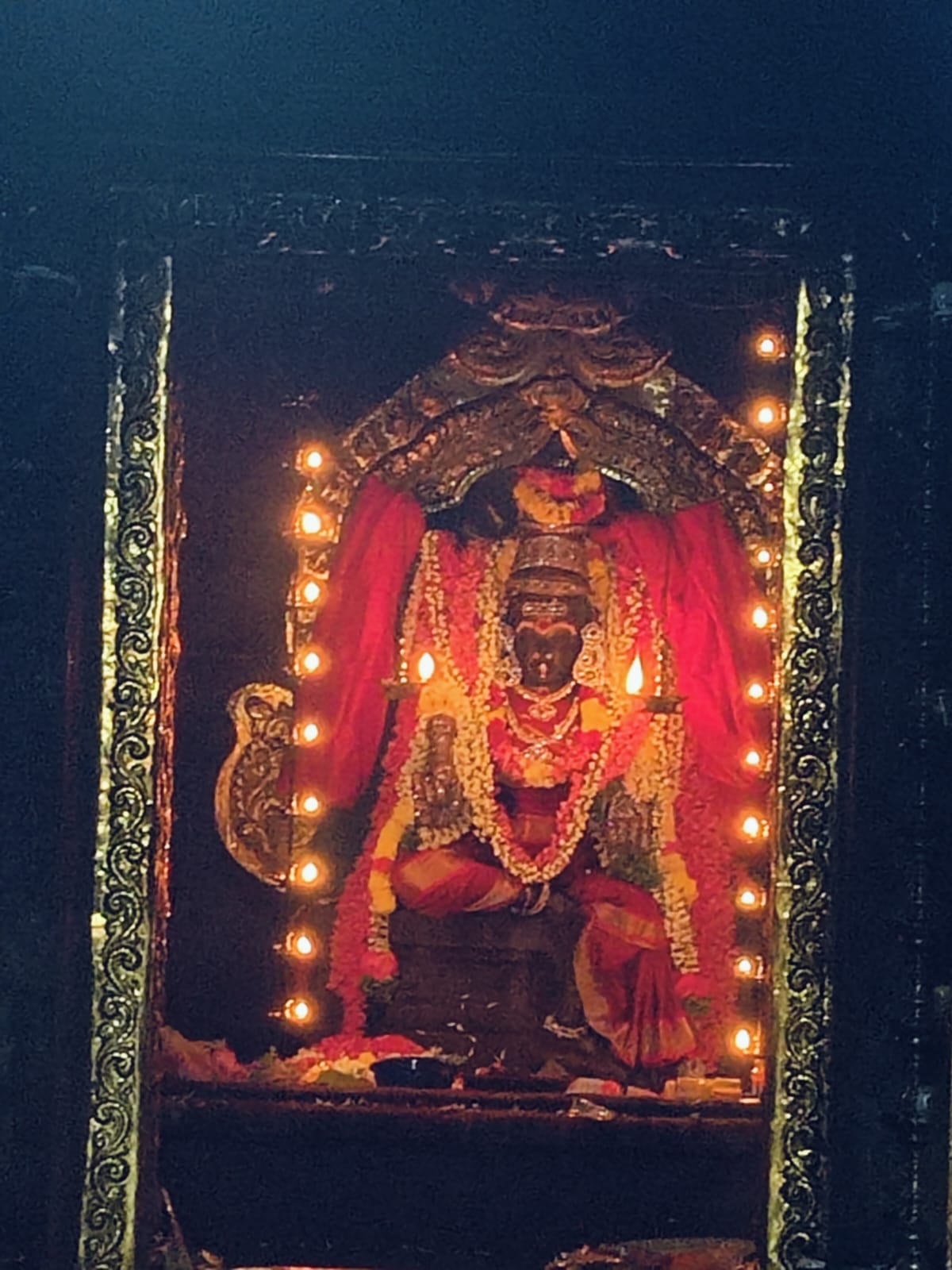
Panchasthavi is a text on Devi which expresses the joy of Devi,Sri Vidya Experience. The Anubhuti of Devi is Indescribable. One has to Experience It. This happens,by Her Divine Grace,hen Sath,Being,IS,Siva is Unified with Consciousness,Chit,Devi. It is Not really a Unification for they have never been separated; they have been as The River and It’s Bed, Word and meaning. It is that our Chith which is tainted , perceives them differently.
When that ignorance is destroyed and knowledge dawns, Ananda Bliss is the consequence.
Outpouring of the Experience forms the Panchasthavi.
Adi Shankaracharya heard the Panchasthavi being changed by a Kashmirii pandit and was influenced and inspired to compose the Soundaryalahari.
The author of Panchasthavi is not known. However, some research indicates it was Lalla Bhatta of Kashmir. By goings through the lines, one can say definitely that it is not by by Kalidasa as his style is missing.
Panchasthavi is a profound text dedicated to Devi, expressing the joy of Sri Vidya experience. It emphasizes the indescribable Anubhuti of Devi and the unification of Siva and Devi through her divine grace. The text beautifully describes the consequence of destroying ignorance and attaining knowledge as the bliss of Ananda. It is believed that the outpouring of this experience led to the creation of Panchasthavi.
The text consists of five parts:
Amba Sthava
Laghu Sthava
Charcha Sthava
Ghata Sthava
SakakaJananai Sthava
The author of Panchasthavi is not definitively known, but there are indications that it might be attributed to Lalla Bhatta of Kashmir. Although it has been speculated that the renowned poet Kalidasa could be the author, the absence of his distinct style suggests otherwise.
You can explore the text further by accessing the full content of Panchasthavihere. Additionally, the app Vaidika Vignanam also offers the opportunity to read the full text, providing deeper insights into this profound work.
ऐंद्रस्येव शरासनस्य दधती मध्येललाटं प्रभांशौक्लीं कांतिमनुष्णगोरिव शिरस्यातन्वती सर्वतः ।एषासौ त्रिपुरा हृदि द्युतिरिवोष्णांशोः सदाहः स्थितात्छिंद्यान्नः सहसा पदैस्त्रिभिरघं ज्योतिर्मयी वाङ्मयी ॥ 1 ॥या मात्रा त्रपुसीलतातनुलसत्तंतूत्थितिस्पर्धिनीवाग्बीजे प्रथमे स्थिता तव सदा तां मन्महे ते वयम् ।शक्तिः कुंडलिनीति विश्वजननव्यापारबद्धोद्यमाःज्ञात्वेत्थं न पुनः स्पृशंति जननीगर्भेऽर्भकत्वं नराः ॥ 2 ॥दृष्ट्वा संभ्रमकारि वस्तु सहसा ऐ ऐ इति व्याहृतंयेनाकूतवशादपीह वरदे बिंदुं विनाप्यक्षरम् ।तस्यापि ध्रुवमेव देवि तरसा जाते तवानुग्रहे– लघु स्तवःRead full text in
Sri Vidya is unique in Hinduism as it has the rare distinction of combining Mantra and Tantra Shastras.
It also includes Yoga.
Sri means Prosperity and Plenitude.
Vidya is Knowledge.
Sri Vidya is that which grants Knowledge and Prosperity or Knowledge of Prosperity.
As Knowledge that liberates the Soul, it has no equal.
The special feature is that Sri Vidya grants both prosperity and Liberation here and in the after Life, nay, also Liberates one from the cycle of births and deaths.
In two short phrases Lalitha Sahasranama describes Goddess Lalitha as .Bhaktha Sowbhagyadhaayini’
One who grants every thing for the welfare of Her Devotees.
She is The Universal Mother.
The Lalitha Sahasranama begins addressing the Goddess as The Mother , Mother of Prosperity,
“Sri Matha, Maharajne’
As Knowledge of Prosperity Sri Vidya it gives scope for prosperity in this world through Saguna Upasana and for Beyond by Nirguna Uapasana.
Sri Vidya combines Gnana, Bhakti, Karma and Raja Yoga and synthesizes them in one format.
It also provides for Dualism,Dwaita and Advaita in worship.
As a Devotee if one worshps the Devi as different from the Self, it becomes Dwaita.
When Sri Vidya is practiced as the raising of Kundalini through the Chakra in the Human Body it becomes Yoga.
In Kunḍalini yoga, one realizes divine consciousness through the activation of the hidden energy of Kunḍalini.
There are six centers (cakras) in the spinal channel. Kunḍalini is said to be initially coiled up at mulādhara.
She is the Mother. She passes through these six from mulādhara at the bottom of spine to ajna at the forehead, then to the crown of the head (sahasrāra) where individual consciousness fully unites with cosmic consciousness.
When you concentrate on the Unity of Shiva and Shakti, it Unites Shaiva and Shakta.(Aikyaanusnathaanam)
When one meditates on the Devi as an expression of the Universal Self, Brahman, it is Advaita.
As the mantras are mystically locked, it is Mantra Shastra.
Sound is produced through contact, vibration and obstruction.
This is called āhata. However cosmic hiss if one can hear is eternal and existent.
This is called Anāhata. It is not produced by us but only heard.
A yogi can hear this.
In sādhana one makes the sound oneself (by doing mantra japa), in a rhythm, resonant with the vibrations of his nādis and his breath.
Through this one will be able to discover the deeper vibration.
This way of merging individual with cosmic is called mantra yoga.
Mantra is said to be the sound-form of Devata (god-form).
One realizes Devata through the chanting of mantra in mantra yoga.
Mantra yoga concentrates on nada (sound) to strike rhythm between individual and cosmic vibration, to activate the right nādis, to expose one into the cidākāsa or daharākāsa (causal space).
Śabda (sound) is the tanmatra (subtle attribute) of mahābhuta (primal element) ākasa (space)
It practices Geometrical Worship, Sri Chakra, it becomes a Tantra Shastra.
As Laya Yoga.
Meditation is the means in laya yoga. One controls mind through the control of breath, so that full concentration is possible in meditation.
Through meditation, one’s consciousness merges in the object of meditation and one realizes Atman.
The state, in which the difference between the one who meditates the act of meditation and the object of meditation dissolves, is called samādhi or sāyujya.
One also observes during meditation one’s own being, the different sheaths of consciousness.
There are five kosas or sheaths of consciousness of being – annaMāya (physical), prānaMāya (vital-life), manoMāya (mental), vijnānaMāya (intellect-knowledge) and ānandaMāya (causal – blissful).
The first is gross, next three constitute subtle and the fifth causal being.
The causal being is Īśvara who resides in all beings, along with Māya His consort. She veils the unmanifest form of the divine, Brahman.
The Mother is MahāMāya, who covers the world with veil of ignorance and lifts the veil out of grace, causing the entire play of creation.
This is the cosmic sport She does for the Lord, Her līla. Her play, action can be seen in karanākāsa the causal space.
She is the moon of that space, and is called Cidākāsa candrika.
Sources for Sri Vidya.
The Tantric texts like Rudra Yamala expound ŚrīVidyā. Khadgamāla Stotra, is the map and worship of Śrī Chakra
.Besides there are several Śrī Kula texts in the oral traditions, either as compilations or as part of the mantra Śāstra texts like Mantra Mahodādhi, Mantra Mahārnava and Śāktā texts.
The Devi (mother Goddess) killed Madhu and Kaidabha as Vishnu Maya (Thamasic-base), killed Mahishasura as Lakshmi (Rajashic form-materialistic) and killed Shumbha and Nishumbha in the form of Goddess Saraswathi (Sathvic-spiritual).
All the three are combined in this Stotra.
It consists of Chapters 74 to 86 (13 chapters) of the Markandeya Purana and has 700 stanzas.
Manikyamba devi also considered as Kula devata of vesyas.
On every Ekadasi day Lord Bhimeswaraswamy and Manikyamba devi ekanta seva will be performed. Eight slokas will be sung by priests regarding Manikyamba devi and Bhimeswaraswamy and their romantic love story.Fridays also important days to worship Manikyamba devi. Kumkumarchana will be done in Fridays.
You must be logged in to post a comment.