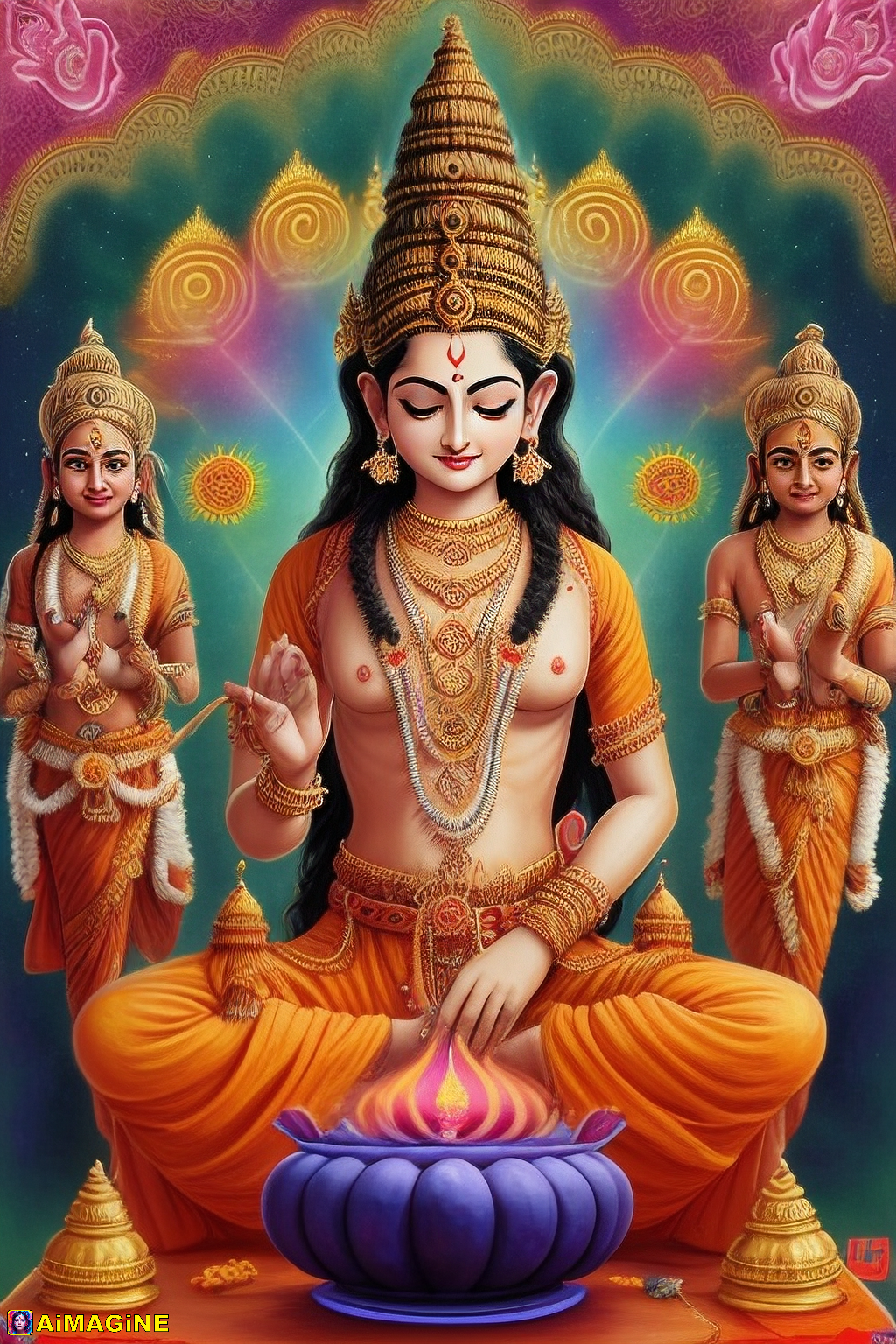
Tag: Devi worship

  • Exploring the Divine: The Practice of Devi Upasna

    Exploring the Divine: The Practice of Devi Upasna

    In the vast landscape of Hindu spirituality, Devi Upasna holds a special place. Devi, meaning “Goddess” or “Divine Mother,” represents the feminine cosmic energy, often personified as various goddesses like Durga, Kali, Lakshmi, Saraswati, and many more. Devi Upasna, or the worship of the Goddess, is a profound spiritual practice that enables individuals to connect with the divine feminine and experience the boundless power, grace, and love she embodies. In this blog, we will delve into the essence of Devi Upasna and explore its significance in the spiritual journey.

    1. The Divine Feminine: The concept of the divine feminine is deeply rooted in Hindu philosophy. Devi represents the nurturing, compassionate, and creative aspect of the cosmos. Unlike traditional patriarchal views, Devi Upasna recognizes and honors the inherent strength and beauty of women, while also emphasizing the balance between masculine and feminine energies within each individual. By embracing the divine feminine, Devi Upasna invites practitioners to awaken their own inner power and tap into the universal source of energy.
    2. Methods and Rituals: Devi Upasna encompasses a wide range of practices and rituals, each with its own unique significance. These rituals may include reciting sacred mantras, performing elaborate puja (ritual worship), meditating on the form of the Goddess, or participating in devotional singing and dancing. The purpose of these practices is to create a sacred space where one can establish a deep connection with the Goddess and invoke her divine presence within oneself.
    3. Symbolism and Archetypes: Goddesses in Hindu mythology embody different qualities and archetypes, representing various aspects of the divine feminine. For example, Durga symbolizes courage and protection, Kali embodies transformation and liberation, Lakshmi represents abundance and prosperity, and Saraswati signifies wisdom and knowledge. Understanding the symbolism behind these goddesses can help practitioners align with specific qualities and seek guidance from the corresponding archetype on their spiritual journey.
    4. Devotion and Surrender: Devotion plays a central role in Devi Upasana. It is the heartfelt surrender and love towards the Goddess that allows practitioners to transcend their limited ego and merge with the divine. Devi Bhakti, or devotion to the Goddess, is not merely an external expression but a deep inward journey of self-discovery and connection. Through sincere devotion, one can cultivate a profound relationship with the Goddess and experience her grace and blessings in all aspects of life.
    5. Empowerment and Transformation: The practice of Devi Upasna offers immense potential for personal growth and transformation. By aligning with the divine feminine, individuals can tap into their innate strength, intuition, and creativity. Devi’s energy empowers practitioners to overcome obstacles, face challenges, and embrace their true potential. Moreover, Devi Upasna fosters a sense of interconnectedness, compassion, and reverence for all beings, fostering a harmonious and balanced existence.To sum up, Devi Upasna provides a sacred pathway for seekers to connect with the divine feminine and embark on a transformative spiritual journey. It is a practice that celebrates the power, beauty, and wisdom of women while reminding us all of the essential balance between masculine and feminine energies. Through devotion, rituals, and deep introspection, practitioners can cultivate a profound relationship with the Goddess, experience her divine grace, and embody her qualities in their daily lives. May Devi’s blessings inspire us to embrace our true nature and walk the path of love, compassion, and self-realization.

    Join 4,576 other subscribers

    Sri Lalitha Sahasranama Classes Online

    Sri Vishnu Sahasranama Classes Online

    Soundaryalahari Classes Online

    Abhirami Andhadhi

    Classes in Tamil English

  • Female Beeja Mantra  Beejaksharas  Part 1

    Female Beeja Mantra Beejaksharas Part 1

    I have written a couple of articles on Mantras ,Mantra an Overview,Mantra side effects,Why many Mantras for the same problem in addition to Mantras for specific problems.

    Mantra is sound which can not be transcribed.

    The sounds are to be heard.

    However Sanskrit Language has them in written form.

    As these sounds are mystically locked, they are to be intoned correctly.

    Mantras are of three genders.

    Male, Female and Neuter.

    Beeja Mantras

    Devi represents the feminine force. There are two beejas that represent Stri sakti – “ee” and “aa”. But more so, “ee”. Some of the names of Devi like Vamakshi refer directly to “ee” beeja. That is why Sri Suktam praises the mother as “eem”, apart from “sreem”. Sri Sukta is a part of RigVeda Khila, and not the core samhita. And unlike Samhita we can see the Mantra sastra and beejas being directly mentioned.

    As Saktas take pride in saying, “i” in “Siva” is said to be Devi, without who the Lord is a corpse. This follows directly from the beeja for Sakti being “ee”. This is also why Vaishnavas take pride in saying that worshiping Vishnu is equal to worshiping Devi and Siva together: Hara + “i” = Hari. However, both Hara, Hari seem to be derived from the Bhuvaneswari beeja “Hreem”.

    Bhuvaneswari is the primal model of Sakta, with Vedic origin. She is the Aditi of Veda, the Mother of Aditya loka. This is also how She is a sibling of Vishnu/Aditya. Bhuvaneswari is the Mother and ruler of all the worlds. But by Bhuvaneswari beeja one means the one that corresponds to Aditya loka.

    “Hreem” beeja can be found in the earliest of Vedic literature. Purusha Sukta of Rig Veda says “Hreesca te Lakshmeesca patnyau” – “hreem” and Lakshmi (sreem) are the wives of Purusha. Hreem is also called lajja beeja.

    Shall write in detail.

    Though there are general Mantra for prosperity, welfare,issue specific Mantras are to be decided based on the individual’s disposition, Swabhava analysed critically.

    And this can be done by a Guru who would initiate and sets down procedures for chanting.

    And  Guru shall reach out to you if you are a passionate Seeker.

    He shall not demand anything from you and will accept what you offer.

    You need to offer to the Guru what you can for nothing should be accepted free  it binds you in Karma.

    Here I list some Beeja Mantras for academic information.

    I shall be writing on the Beeja Mantras hidden in Mantras and Slokas including the Soundrylahari and Lalitha ahranma

    Some beeja Mantras, however, may be chanted without  guru but taking Subrahmanya/Shiva/Krishna as Guru.

    devata (divinity) in different forms. An uttered Mantra is the manifestation of a more subtle sound while Mantras themselves are forms of Kundalini. Mantras may be male, female or neutral. Female Mantras are called Vidyas.

    By Mantra the sought-for (Sadhya) Devata appears, and by Siddhi therein has vision of the three worlds. As the Mantra is in fact Devata, by practice thereof this is known. Not merely do the rhythmical vibrations of its sound regulate the unsteady vibrations of the sheaths of the worshipper, but therefrom the image of the Devata appears.” (op cit) Mantras are masculine (solar), feminine (lunar) or neuter. A female Mantra is called a vidya, which means knowledge, while solar and neuter forms are called Mantras. Mantras are only such if they were first revealed by a rishi or seer. Only then do they have life, according to the tradition. A Mantra can only work if it is received from a guru who has, herself or himself, received it in an unbroken line from its first rishi. There are, however, exceptions to this, according to some tantras which prescribe methods of purification for Mantras received in dream. And, according to Mahachinachara, the Kali Mantra does not rely on the very elaborate rules usually found in the Tantras…

    Some Beeja Mantras and Devathas.
    Some Beeja Mantras.

    In describing Mantras, the different tantrik texts always give their origin or rishi as well as the metre to pronounce them. While a Mantra is divinity in sound form, a yantra is the same in geometrical form and an image the devata in gross form’

    (Sir John Woodroffe’s collection of essays, Shakti.

    Source,References and citations.

    http://www.astrojyoti.com/bijamantras.htm

    http://www.hindupedia.com/en/Some_Primary_Mantra_Beejas#Kamaraja_Beeja

    http://www.yogicastrology.com/articles/yoga/mantras.shtml

    Join 4,576 other subscribers
  • How To Invoke Shiva in Devi Worship

    How To Invoke Shiva in Devi Worship

    Recently I was asked by a reader in Twitter how to add in Shiva in Devi worship , especially in Devi Tantra Sadhana.

    Shiva is included in Shakti.Shiva is Jada and Devi is Shakti and only when they are together, they become effective.

    Shiva is the Inert principle and Devi is the Driving Force.

    This does not mean one is powerless. Shiva and Shakti are like word and meaning, one is not complete without another. Trying to argue one is higher than the other is not the path of the Sadhaka, Practitioner.

    Wherever Shiva is present Devi is there and wherever Devi is present Shiva IS.

    Therefore, there is no necessity of specially invoking Shiva in Devi Upasna.Shiva is embedded and present Devi Upasna.

    For more on this and on Japa,Parayana and signs of Mantras helping spiritual evolution of a Sadhaka, watch the video.

  • Perfect Sri Chakra By Adi Shankaracharya Sringeri

    Perfect Sri Chakra By Adi Shankaracharya Sringeri

    The Sri Chakra of Devi is perfect synchoronization of Universal Reality and the Individual Soul.

    The Advaita system propounded Adi Shankaracharya,based on the Mahavakyas of the Vedas define Reality as Brahman .

    It is is beyond Attributes.

    It is beyond senses and a Noumenon.

    It is Absolute with no reference to relate to.

    The Individual Soul,Jiva is but a part of Brahman.

    It is not separate,different from Brahman.

    The individual soul,the world of Names and Forms are illusory in the sense that they are Relative.

    The Individual Soul and the world of Names and Forms is because of Illusion.

    This Illusion,at the Individual level is Avidya,Nescience,absence of Absolute Knowledge or loosely put Ignorance.

    At the Universal level it is,Called Maya.
    The Reality ,Brahman is the emobodiment of Being,Consciousness and Bliss.

    SAT,CHIT,ANANDA.

    Once ignorance,Avidya is removed the false ,Relative knowledge gives way to Absolute Knowledge,Brahma Gnana,when the Individual soul becomes aware of its original state,that of Reality,Brahman.

    This,in short,is Advaita.

    As it is impossible for the human mind to concentrate on mere principles,Hinduism,as a first step,recommends Personal God.

    To facilitate the process of integrating the Universal Soul with the Individual soul,four tools are suggested.

    1.Gods/Goddesses.

    2.Sounds in the form of Mantras

    3.Geometrical shapes and

    4.Combination of Sound and Geometrical shapes,Mantra and Yantra,which form Tantra.

    One of the most effective Yantra is Sri Chakra of Devi.

    For details of Sri Chakra,google sri yantra+ramanan50.

    Sri Chakra and OM are interchangeable.

    Adi Shankaracharya established Sri Chakra invmany places,including Kolluru and Sringeri.

    The perfect Sri Chakra can be found at Sringeri,the Mutt established by Adi Shankaracharya.

    The ancient temple of Sri Sharada, the presiding deity of Sringeri has a glorious history that begins with the setting up of the Dakshinamnaya Peetham by Sri Shankara Bhagavatpada. Originally it was an unpretentious shrine with the Murti of Sharada made of sandalwood, installed over the Sri Chakra that Sri Adi Shankara carved on a rock. Subsequently Sri Bharati Krishna Tirtha and Sri Vidyaranya had a temple built in the Kerala style, with timber and tiled roof. Sri Bharati Krishna Tirtha substituted the sandalwood idol with the present golden idol.

    Sri Sacchidananda Shivabhinava Nrisimha Bharati raised the present structure in granite with polished granite walling round the sanctum and Sri Chandrasekhara Bharati consecrated the new temple in May 1916. Sri Abhinava Vidyatirtha made several improvements in the temple. The Mahamandapam has huge stone pillars exquisitely carved with deities like Durga, Raja Rajeshwari, Dwarapalakas and Devis which are all sculpted according to the Shilpa Sastras practised in Tamilnadu.

    Sanctified by the worship of an unbroken succession of Acharyas of the highest purity, loftiest devotion and unsurpassed mantric powers, the Murti of Sri Sharada radiates grace and blessings.’

    Reference and citation.

    https://www.sringeri.net/temples/sri-sharadamba

  • How Sri Yantra Was Created

    Sound , language and Self Realization are intricately connected in Hinduism.

    While the Reality is a principle beyond qualities, names and forms God concept has been advocated to ensure that the Mind has an object to concentrate upon in the path to Realization.


    Sri Chakram.jpg
    Sri Chakram.

    Please read my post God has names and forms Yes and No.

    Sound/Vibrations are basis of creation.

    Universe is born of Motion.

    One may never determine which precedes the other, sound or vibration, one may never know.

    The Sri Chakra of Devi.The Devi's Sri Chakra.iamge.jpg
    Sri Chakra

    Consciousness which is beyond Space and Time is linked to sound in effort to realize itself, that is Self.

    While Consciousness  can communicate and commune with Reality at the highest level, at the rudimentary level it communicates through sound and vibrations.

    Realizing this Hinduism has arrived at three levels from here the sound originates in the Human Body.

    From the Mouth, as in A,

    From the Throat, as in U, and

    From the pit of the stomach, as in M.

    Correct sound of these letters may be found when one pronounces the Sanskrit script.

    These primordial sounds of A, U and M are combined and the resultant Sound Om or AUM is the vital basic Mantra of Hinduism.

    No Mantra is complete with out these three sounds.

    In some Mantras these sounds though invisible are embedded in Mantras and stotras by Great Acharyas.

    Soundaryalahari By Adi Shankaracharya contains the 51 Bheejaksharas, the Seed sounds of Devi , they are embedded in the text though it is invisible.

    Each God is assigned specific numbers of letters, called Aksharas,

    Interesting to note that Akshara, loosely translated as Letters means Limitless, therby signifying the power of sound produced by each letter.

    Shiva is assigned five,

    Vishnu Twelve,

    Subrahmanya Six  and

    Devi 15/51.

    These letters when intoned correctly form the Geometrical shape of Yantra.

    OM produces Sri Yantra.

    Please read my article on this.

    How the Devi’s Yantra is produced?

    Ho did it evolve?

    Lalita Devi in Sri Pura.jpg
    Lalita Devi in Sri Pura.

    ‘Formation of the Shri Yantra

    The creation of the Shri Yantra is described in the Yogini Hridaya (Heart of the Yogini Tantra), which still does not exist in an English translation, as far as we are aware. This is said to be the second part of the Vamakeshvara Tantra.

    “From the fivefold Shakti comes creation and from the fourfold Fire dissolution. The sexual union of five Shaktis and four Fires causes the chakra to evolve. O Sinless One! I speak to you of the origin of the chakra.

    “When she, the ultimate Shakti, of her own will (svecchaya) assumed the form of the universe, then the creation of the chakra revealed itself as a pulsating essence. From the void-like vowels with the visarga (:) emerged the bindu, quivering and fully conscious. From this pulsating stream of supreme light emanated the ocean of the cosmos, the very self of the three mothers.

    “The baindava of the chakra has a triple form, dharma, adharma and atma, and matri, meya and prama. The chakra of nine yonis is the great mass of consciousness bliss and is the ninefold chakra and the nine divisions of the mantra.

    “The baindava is placed on a dense flowery mass and is the Chitkala. Similarly, the ambika form of eight lines is the circle of the vowels. The nine triangles quiver forth the effulgent form of 10 lines. The Shakti, together with her surrounding nine blossomed forth the 10 trikonas. The second quivering form of 10 lines has Krodhisha as first of the 10. These four chakras, of the nature of light, create the 14-fold form, the essence of perception.” — Yogini Hridaya, I 6-16.

    At the very heart of the bindu or centre of the Shri Yantra is that which caused it to emanate. This is Kamakala, consisting of the three bindus or potentials. One is red, one is white, and one is mixed. The red bindu is ova, the white bindu semen, and the mixed bindu the union of Shiva-Shakti, the individual as potential Shri Cakra.

    Father and Mother are represented in Shri Vidya by two limbs or aspects of Lalita known as Varahi and Kurukulla. The semen of Varahi, the father-form, gives four alchemical dhatus to the child. The ova of Kurukulla, the mother-form, gives five dhatns to the child. Consciousness enters via orgasm. The three bindus, collectively known as Kamakala (digit of sexual desire), are the root potential of sun, moon and fire. It is like sun and moon coming together in an eclipse, or the seed from which the plant human being grows.

    Varahi’s four alchemical dhatus are known as the four fires. Kurukulla’s alchemical dhatus are known as the five saktis. The combination of these five saktis (downward pointing triangles) and four fires (upward pointing triangles), forms the complex figure in the centre of Shri Cakra.

    Varahi’s four fires are the 12 (3 x 4) sun Kalas, 12 sidereal constellations. Kurukulla’s five triangles are the 15 (5 x 3) Kalas of the moon, 15 lunar days. The complete individual grows within nine months to be born as a Shri Yantra or plant. The flowering of this plant is shown by the 24 petals of the yantra. The above all gives rise to the familiar shape of the Shri Yantra. The yantra is usually arranged in one of two forms. In the Bhuprastara, it is two dimensional and laid flat, usually facing the east, but sometimes the north, depending on the practice. The Meruprastara has the yantra in a pyramidal form. Unless the yantra be decorated with the appropriate bija and other mantras, it is worthless. It is also dead unless it is installed with life and the individual doing the puja is initiated into one of the lines (parampara).
    “The baindava is placed on a dense flowery mass and is the Chitkala. Similarly, the ambika form of eight lines is the circle of the vowels. The nine triangles quiver forth the effulgent form of 10 lines. The Shakti, together with her surrounding nine blossomed forth the 10 trikonas. The second quivering form of 10 lines has Krodhisha as first of the 10. These four chakras, of the nature of light, create the 14-fold form, the essence of perception.” — Yogini Hridaya, I 6-16.
    At the very heart of the bindu or centre of the Shri Yantra is that which caused it to emanate. This is Kamakala, consisting of the three bindus or potentials. One is red, one is white, and one is mixed. The red bindu is ova, the white bindu semen, and the mixed bindu the union of Shiva-Shakti, the individual as potential Shri Cakra.

    Father and Mother are represented in Shri Vidya by two limbs or aspects of Lalita known as Varahi and Kurukulla. The semen of Varahi, the father-form, gives four alchemical dhatus to the child. The ova of Kurukulla, the mother-form, gives five dhatns to the child. Consciousness enters via orgasm. The three bindus, collectively known as Kamakala (digit of sexual desire), are the root potential of sun, moon and fire. It is like sun and moon coming together in an eclipse, or the seed from which the plant human being grows.

    Varahi’s four alchemical dhatus are known as the four fires. Kurukulla’s alchemical dhatus are known as the five saktis. The combination of these five saktis (downward pointing triangles) and four fires (upward pointing triangles), forms the complex figure in the centre of Shri Cakra.

    Varahi’s four fires are the 12 (3 x 4) sun Kalas, 12 sidereal constellations. Kurukulla’s five triangles are the 15 (5 x 3) Kalas of the moon, 15 lunar days. The complete individual grows within nine months to be born as a Shri Yantra or plant. The flowering of this plant is shown by the 24 petals of the yantra. The above all gives rise to the familiar shape of the Shri Yantra. The yantra is usually arranged in one of two forms. In the Bhuprastara, it is two dimensional and laid flat, usually facing the east, but sometimes the north, depending on the practice. The Meruprastara has the yantra in a pyramidal form. Unless the yantra be decorated with the appropriate bija and other mantras, it is worthless. It is also dead unless it is installed with life and the individual doing the puja is initiated into one of the lines (parampara).

    Source of the quote,

    http://www.shivashakti.com/tripura.htm