Tag: Dasaratha

  • Dasaratha Had Sons other Than Four,In Sumeria Mittani Kings List?

    Dasaratha Had Sons other Than Four,In Sumeria Mittani Kings List?

    While checking up the spread of Sanatana Sharma, I stumbled upon facts ,which though initially seemed at variance with Indian texts,deeper study has proved that the information provided by Indian texts are in agreement with foreign sources.

    Only after such verification, I write.

    But one information, I am unable to reconcile.

    That is Ramayana.

    Rama’s Empire extended throughout the world and his sons were found in the far east and northwest of India.

    Rama”s legacy is found in abounds in Iraq and the middle east.

    The issue I am facing is that while names of Ramayana,Bharata( not Rama’s brother,but Dushyanta’s son) and Dasaratha are found in the Sumerian Kings List,and names of Dasaratha,Parashurama are found in the Kings List of Mittani.

    But the progenies’ names of Rama are not found,though the names in these Kings Lists after Dasaratha are of Sanskrit origin .

    But Bharatha,Lakshmana and Shatrugna do not find a place in these lists,though Rama’s son Lava founded the present day Lahore in Pakistan.

    I am unable to find mention of any sons of Dasaratha,other than Rama,Lakshmana,Bharatha and Shatrugna.

    So if Dasaratha,spelled as Tusharatta in these Kings Lists,who were Dasaratha’s successors in Sumerian and Mittani Empire?

    Names of the sons of Ramayana,Lava and Kusa are not found ,either.

    Could it be that the Kings of Sumerian and Mittani are the children of Bharatha,Lakshmana,Shatrugna?

    Or the sons of Dasaratha, through his consort other than Kausalya,Kaikeyi and Sumitra?

    According to Hindu Sharma,A King can not anoint a son not through Queens.

    Is it that Dasaratha gave away these far lands to his console’s son?

    Though it is stated that Dasaratha married 60,000 wives to avoid the wrath of Parashurama,Valmiki records the 350 wives of Dasaratha.

    Valmiki Ramayana, Ayodhya Kanda, Chapter 34, Verse 10

    Dasaratha said to Sumantra,
    “Oh, Sumantra! being all my wives, who are here. Surrounded by all of them, I want to see the virtuous Rama.”
    (‘who are here’ means available at the capital city then)
    Valmiki Ramayana, Ayodhya Kanda, Chapter 34, Verse 13:
    अर्ध सप्त शताः ताः तु प्रमदाः ताम्र लोचनाः |
    कौसल्याम् परिवार्य अथ शनैः जग्मुर् धृत व्रताः || २-३४-१३
    “ardha sapta shataah taah tu pramadaah taamra locanaah |
    kausalyaam parivaarya atha shanaih jagmur dhrita vrataah ||” 2-34-13
    atha= thereafter; taah= those; ardha sapta shataah= THREE
    HUNDRED AND FIFTY pramadaah= women; dhritavrataah= steadfast in their vow (of devotion to their husband); taamra lochanaah= having red eyes; parivaarya= encircling; kausalyaam= Kausaly; jagmuh= went; shanaih= slowly.
    ‘Encircling Kausalya, three hundred fifty women, steadfast in their vow (of devotion to their husband), with their eyes reddened, went there slowly.’
    (ii) Valmiki Ramayana, Book II : Ayodhya Kanda, Chapter (Sarga) 39, Verse 34 & 35:
    Rama said to Queen Kausalya, His mother,
    “Oh, mother! You do not grieve. You look after my father. The end of exile will come rather soon.”

    Dasaratha wives 3,350,60,000

    Scholars may clarify whether Dasaratha had any more sons than the four.

    Kings List Sumerian.image
    Rama in Sumerian Kings List

    I have posted an article that Lord Rama and Bharata’s names are found in the Kings List of Sumerians chronicling their Kings.

    Not only Rama and Bharata, but the names of other Hindu Puranic figures find a place in the Kings List.

    The Names found are,

     Indra,Pururavas,Dasaratha,Parashurama,Satyavrata,Iksvahu,Kakusha,Janaka,Vasishta, Janamejaya,Dushyanta(Father of Bharata,after whom India is named as Bharatavarsha),Rishis Gautama,Dundhu,,Muchukunda,Drupada,Harischandra,Sagara,Bhagiratha, Lava, Kusha(Rama’s sons),Aja and Raghu(Rama’s ancestors),Pundarika,

    Curious enough ‘ all of them belong to Solar Dynasty mentioned in Puranas.

    Sumerian Kings List

    Mittani Kings List. Source. https://en.m.wikipedia.org/wiki/List_of_rulers_of_Mitanni


  • Rama’s Sister Shanta Born 4449 BC,Abandoned By Dasaratha?

    Rama’s Sister Shanta Born 4449 BC,Abandoned By Dasaratha?

    I came across an article in a respected site that Shanta,Lord Rama’s Elder sister,Dasaratha’s daughter through Kausalya Rama’s Mother) was abandoned by Dasaratha and hence Kausalya was miffed with him.

    The article seems to have been influenced by A popular TV Serial.

    Here are the excerpts.

    The Mystery of Shanta- Lord Rama’s sister

    Of the two legendary Indian mythologies, Ramayan enjoys a priestly following amid Hindu community. Surrounded by some startling facts including that it is written by once a dacoit-turned-sage Valmiki, and written partly on the basis of what Sita explained to him, it makes Ramayan ev

    en more mystifying.

    Shanta in Ramayan

    There have been quite a few instances when not every part of story of this epic mythology was put forth for the audience to see, sometimes certain characters were kept in low limelight to highlight the importance of others. Like that of Shanta, King Dashrath’s first born; even the narration around her birth and abandonment were kept low, until only recently a popular TV show hinted to unfold a mysterious character in epic Ramayan.

     King Dashratha and Queen Kausalya were blessed by their first born, a daughter, who they named Shanta. She was the epitome of poise, peace and harmony. She grew up to be a beautiful princess with qualities of a warrior. But, King Dashrath longed for a son, to continue his reign.


    Dasharatha’s wives- Kausalya, Sumitra and Kaikeyi

    He married Sumitra and Kaikeyi with an intention to bear a son, a ruling prince for Ayodhya. But, years went by and Ayodhya never received good news of their awaiting wish to see a prince.

    Rishi Vibhandak and Urvashi

    With guilt abiding within him, King Dashrath visited Sage Vashishta to seek an answer to his miseries. Vashishta told him about Sage Vibhandak, whose strict penance to achieve great power scared Lord Indra. Thus, he ordered a celestial paramour Urvashi to intervene his yogic activity.

    Rishi Rishyasringa

    As a result of which Sage Vibhandak got distracted, and his alliance with Urvashi bore him a son Sage Rishyasringa. Vibhandak pledged to raise his son alone in an isolated society, with no mention of womenfolk or even their existence.

     King Dashratha was informed that if only a woman with great power could manage to bring Rishyasringa into a family world, then the Putrakameshti Yagya performed by him could bear the former sons.


    Marriage of Shanta and Rishi Rishyasringa

    Dashratha, out of desperation and helplessness abandoned his daughter Shanta and asked her to bring Sage Rishyasringa. She followed her father’s order and, despite Queen Kausalya’s plea to stay back, Shanta gave up princely life and went to live with Rishyasringa.

       https://www.speakingtree.in/allslides/why-king-dashrath-abandoned-his-daughter-and-lord-ramas-sister-shanta/369981

    Sage Rishyasrunga,at the request of Dasaratha performed the Putrakameshti Yaaga to beget sons and Dasaratha was blessed with four sons,Ramayana,Bharathanatiyam,Lakshmana and Shatrugna.

    Valmiki Ramayana is the authority for Ramayana.

    Here is what Valmiki Ramayana says,

    ‘ ikSvaakuuNaa.m kule jaato bhaviSyati sudhaarmikaH |

    naamnaa dasharatho naama shriimaan satyapratishravaH || 1-11-2

    2. ikshwaaknaam= in Ikshwaku; kule+jaato= dynasty, born in; su+dhaarmikah= very virtuous one; naamna= by his name; Dasaratha; naama= named; shreemaan= resplendent one; satyapratisravah= truthful to his vow.

    ” A king named Dasaratha will be born into Ikshwaku dynasty who will be very virtuous, resplendent and truthful to his vow.” [said Sanat Kumara, the Sage] [1-11-2]

     a~nga raajena sakhyam ca tasya raaj~no bhaviSyati |

    kanyaa ca asya mahaabhaagaa shaa.ntaa naama bhaviSyati || 1-11-3

    3. angaraajena= with the king of Anga; sakhyam= friendship; tasya+raajno= to that, king [to Dasaratha]; bhavishyati= will happen; kanyaa=daughter; cha+asya= also of him [King of Anga]; mahaabhaagaa= great women; Shanta; naama= named one; bhavishyati= will born.

    ” King Dasaratha will befriend the king of Anga and he, the King of Anga will beget a great girl named Shanta. [1-11-3]

     putrastu so~Ngaraajasya romapaada iti shrutaH |

    tam sa raajaa dasharatho gamiSyati mahaayashaaH || 1-11-4

    4. putrastu= son of; sah= him [ Anga, the king of Anga]; Romapaada; iti+shrutah= thus heard; tam= to him; sah+raajaa= that king; Dasaratha; gamishyati= goes; mahaayashah= the well renowned.

    The son of King Anga [the original king of Anga kingdom after whom the kingdom is named] will be known as King Romapaada and to him goes the well renowned King Dasaratha. [1-11-4]

     anapatyo.asmi dharmaatman shaa.ntaa bhartaa mama kratum |

    aahareta tvayaa aaj~naptaH santaanaartham kulasya ca || 1-11-5

    5. anapatyah= childless; asmi= I am; dharmaatman= Oh! Righteous One; Shaantaa+bhartaa= Shanta’s husband; mama+kratum= my, Vedic ritual; aahareta= shall preside over; twaya= by you; aajсpta= be instructed; santaanaartham= cherishing children; kulasya+cha= for dynasty also.

    [Then King Dasaratha says to King of Anga] “Oh! Righteous One, I am childless and hence I intend to perform a Vedic ritual. Shantaa’s husband [Sage Rishyasringa] shall preside over that Vedic ritual that enhances my dynasty, at your instruction. [1-11-5]

     shrutvaa raaj~no.atha tat vaakyam manasaa sa vici.ntya ca |

    pradaasyate putravantam shaa.ntaa bhartaaram aatmavaan || 1-11-6

    6. shrutvaa= having heard; rдjnah= King’s, Dasaratha’s; tad+vaakyam= those words; manasaa= heartily; vichintya= considered; cha= also; pradaasyate= will give, will allow; putravantam= one who endows children by his boons; Shaanta+bhartaaram= Shanta’s husband; aatmavaan= that benevolent soul.

    ” That benevolent soul, [Romapaada, the king of Anga] on hearing those words of King Dasaratha, considers heartily and he gives away [will allow] Shanta’s husband, [i.e., his son-in-law, Sage Rishyasringa] one who endows progeny with his boons [to go along with King Dasaratha.] [1-11-6]

     shaa.ntaa tava sutaa raajan saha bhartraa vishaam pate |

    madiiya nagaram yaatu kaaryam hi mahadudyatam || 1-11-19

    19. shaantaa= Princess Shantaa; tava+sutaa= your, daughter; raajan= Oh! King; saha= along with; bhartraa= her husband; vishaampte= Lord of subjects; madeeya= my own; nagaram= city; yaatu= may go over; kaaryam= a deed, the ritual; hi= verily[because]; mahat= great one; udyatam= is contemplated[by me].

    ” Oh! King, the Lord of Subjects, Princess Shaanta your daughter, along with her husband Sage Rishyasringa may go over my city Ayodhya, as I contemplate [to perform] a great Vedic ritual, which is great deed. ” [Said Dasaratha] [1-11-19]

     Reference and citation.

     http://www.valmikiramayan.net/bala/balaitrans11.htm

    There no evidence that Shanta was Dasaratha’s Daughter,according to Valmiki.

    However, Sri.B.G.Kanuja,in his book Immortal Love of Ramayana, writes that Shanta was Dasaratha’s Daughter and was given in adoption to Romapada.

    She was born on 12th March,4449 BC.

    He quotes Valmiki Ramayana ,Canto 9 (?),Sloka 12?

    I am unable to find the reference.

    Scholars may clarify.

    And there is no evidence Dasaratha abandoned her.


    https://books.google.co.in/books?id=zHgW9SezCqoC


    “> https://books.google.co.in/books?id=zHgW9SezCqoC&lpg=PA48&dq=shanta%2Cramayan&pg=PA48&output=embed

  • Why Rama Uses Brahmin Rishis In Gotra Pravara

    I had written on the Gotra and the Pravara of Lord  Rama.

    He recites the names of Brahmin Rishis as his ancestors in His Pravara.

    Lord Rama was a Kshatriya.

    Why?

    Rama with Kodanda,Bow.jpg
    Lord Rama

    Lord Rama’s Gotra/Pravara is this.

    Yajur vEDa Saakhaa adhyaayinE, VaasishTa, MaitraavruNa KouNDinya trayaarishEya Prvaraanvita, VasishTa


    GotrOdbhavaaya, Tribhuvanaadheesaaya, AkhilaaNDa kOti BrahmaaNDa naayakaaya, Tattva ateetaaya, Sat chit Ananda

    moortayE, Soorya Vamsa Paavanaaya, Akhila jagad aananda kaarakkaya, Ksheeraabdi VaasinE, SaraNaagata vatsalaaya,

    Kousalyaananda Vardhanaaya, ThaTakaa ThaaTakEyaantakaaya, Sree Paada rENu paalita Goutama kaLatraaya, Parama

    Bhaagavata architaaya, khaNDeekrita tripura chaapaaya, Saadu jana nivaasa vrukshaaya,LakshmaNa agrajaaya, Sreevatsa


     Koustuba  haara - kanaka kEyooraadi DivyaabharaNa bhooshitaaya, Vaijayantee Vanamaala sObitaaya, Ikshvaaku Vamsa


    Udbhavaaya, Naabhaaga VarmaNa: naphtrE, Aja Mahaaraaja VarmaNa: poutraaya, Dasaratha Mahaaraaja VarmaNa: putraaya,


    Sree Raamachandra VarmaNE Saakshaat NaaraayaNa svaroopaaya varaaya'

    Pravara of Lord Rama

    Now Lord Rama was a Kshatriya.

    Yet we find that He uses the Brahmin Rishis as his ancestors as His Pravara!

    Why?

    Gotra is derived from two sources.

    One is ancestors an another is the  Guru Shishya Parampara, Preceptor Disciple Lineage.

    That is one type uses the ancestors an the other uses the Guru of his family.

    The Ancestors are used tin Gotra/Pravara by the Brahmins.

    They do not use the Guru, except in some cases, like Viswamitra as he was by birth a Kshatriya and later became a Brahmin because of Knowledge.

    His original Name was Kausika when he was a King.

    When he became a Brahma Rishi, he was called Viswamitra and there is Kausika nd Viswmitra and Kausika Gotra.

    The offspring he sire when he was a king Kausik use the Kausika and after he became a Brahmin, those offspring use Viswamitra Gotra.

    Other communities like Kshatriya, Vaisya and Sura normally use their family priests, Guru’s Gotra for they considered Gurus as spiritual Fathers.

    Lord Rama chose a middle path thus,

    Yajur vEDa Saakhaa adhyaayinE, VaasishTa, MaitraavruNa KouNDinya trayaarishEya Prvaraanvita, VasishTa''

    Translation.

    He belongs to the Pravara consisting of three Rishis viz., VasishTar, MaitraavaruNar and


    KouNDinyar; He is born in the VasishTa Gotra

    GotrOdbhavaaya,  ( Guru Prampara)...


    Ikshvaaku Vamsa

    Udbhavaaya, Naabhaaga VarmaNa: naphtrE, Aja Mahaaraaja VarmaNa: poutraaya, Dasaratha Mahaaraaja VarmaNa: putraaya, (ancestors)

    Translation.


    He belongs to Ikshvaaghu Vamsam: He is the Great grandson of Naabhaaga Mahaaraaja Varma; He is the


    grandson of Aja Mahaaraaja Varma; He is the son of Dasaratha Mahaaraaja Varma; He is Sree Ramachandra Varma;'

    Note how meticulously he uses the term Varma , indicating  that He is a Kshatriya.

    Brahmins must use the term Sarma, Kshatriyas Varma and Vaisyas Gupta after their Names in Pravara.

    Thus Rama does not make  a mistake when He uses the Brahmin Rishis in His Pravara.


  • Hindu Kings Of Iraq Turkey Syria Lebanon Egypt Italy Mitanni Empire

    I have written about the Mitanni People and the Mitanni Empire.

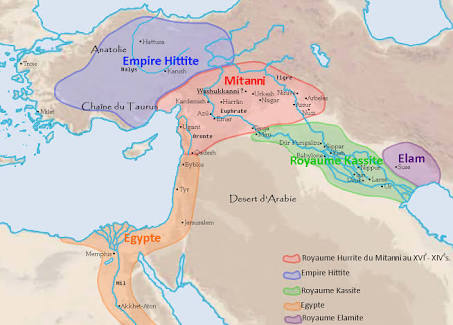
    The Mitanni Empire covered what is now known as Iraq, Turkey Syria, Lebanon,Egypt and included Italy.

    They were the ancestors of these people.

    Mitanni were the ancestors of the Egyptians as well.

    Mittani Empire.png Mittani Empire. “Near East 1400 BCE” by User:Javierfv1212 – http://en.wikipedia.org/wiki/File:Near_East_1400_BCE.png. Licensed under CC BY-SA 3.0 via Wikimedia Commons – http://commons.wikimedia.org/wiki/File:Near_East_1400_BCE.png#/media/File:Near_East_1400_BCE.png


    ‘These Kings and even a Roman Emperor sported Thiruman, The Vaishnavite marks on their Body.


    The Sun King Akhenaten of Egypt who ruled between 1352-1336 BC was a son-in-law of Tushratta, the Mitanni king. The name Tushratta has been recorded in the Hittite cuneiform script.


    Some have suggested that the Sanskrit origin of Tushratta is Dasaratha, a few others that it is Tvesaratha (having splendid chariots), a name which is attested in the Rigveda.

    “The first Mitanni king was Sutarna I (good sun). He was followed by Baratarna I (or Paratarna great sun), Parasuksatra(ruler with axe),…. Saustatar (Sauksatra, son of Suksatra, the good ruler), Artadama (abiding in cosmic law)..Tushratta (Dasaratha), and finally Matiwazza (Mativaja, whose wealth is thought) during whose lifetime the Mitanni state appears to have become a vassal to Assyria”. Subhash Kak traces the ‘arna’ syllable in the names of the kings to ‘araNi’ (अरणि) meaning ‘sun’…

    (Akhenaten, Surya, and the Rigveda’, Prof Subhash Kak (an Indian American computer scientist, previous Head of Computer Science Department, Oklahoma State University)

    A number of Indo-European sounding words have been identified in the cuneiform documents of the Mitanni kingdom (1500-1200 BC). In addition to nouns and adjectives with parallels in Sanskrit this Hurrian speaking kingdom had kings with Indo-Aryan names and two documents even list the main Gods of the Indian pantheon….”


    The kingdom of the Mitanni Indo-Iranian dynasty that ruled in the land of the Hurrians was in the upper Euphrates-Tigris basin – land that is now part of northern Iraq, Syria and south-eastern Turkey.

    At its greatest extent (for a brief period at the height of its dynastic power), Mitanni territory extended to the Mediterranean coast and into northern Assyria / Mesopotamia, it’s south-eastern neighbour.

    Mitanni’s north-western border with theHattian kingdom of the Hittites was fluid and constantly subject to aggression except when the two rivals concluded a peace treaty – one that invoked the Indo-Iranian pantheon of Mitra, Varuna, Indra and the Nasatyas – but also one that marked the decline of the Mitanni kingdom and a decrease in size. The Mitanni and Hittites were closely related. The Hittites used the Hurrian language extensively in their inscriptions. They also shared in the development of the light chariot whose wheels used spokes .

    The Hurrian lands are today a part of Greater Kurdistan….


    Despite Tusratta’s problems, he was not beyond offering his daughter Tadukhipa in marriage to the King Amenhotep III of Egypt for a large quantity of gold. The tablet seen to the right is a letter from Tusratta to Amenhotep in which he asks for “gold in very great quantity” as a bride price, supporting his request with the comment, “Gold is as dust in the land of my brother.”

    The beleaguered Tusratta was then murdered by his son in a palace coup. Tusratta’s other son, Prince Shattiwaza, fled Mitanni and was eventually given sanctuary by the Hittite King Suppiluliuma with whom he concluded a treaty c. 1380 BCE, which we know as the Suppiluliuma-Shattiwaza Treaty (discovered in 1907 CE in Hattusa, near present-day Bogazkale(Boğazkale, formerly Bogazköy) in north-central Turkey. In the treaty, the Hittite King Suppiluliuma agreed to assist Shattiwaza gain the Mitanni throne and invaded Mitanni. The Hittites captured the Mitanni capital Wassukanni after a second attempt and installed Shattiwaza as a vassal king.

    The Suppiluliuma-Shattiwaza Treaty is a source of considerable information about the Mitanni. In addition, it gives us some astonishing information about the religious practices of the Mitanni for it invokes the Indo-Iranian pantheon of asuras and devas Mitras(il) (Mitra), Uruvanass(il) (Varuna), Indara (Indra) and theNasatianna (Nasatyas) (Ashwins).

    Following the capture of Wassukanni, the Hittites installed new rulers in Mitanni towns while the Assyrians regained control of the territory they had lost to the Mitanni. Tusratta was killed and his son Shattiwaza became a vassal of the Hittite Suppiluliuma (c.1344 – 1322 BCE). At the same time, the rebellious Artatama became a puppet king of a reborn Assyria, led by king Assur-Uballit I (1364-1328 BCE). Wassukanni was sacked again by the Assyrian king Adad-Nirari I around 1290 BCE, after which very little is known of its history.

    In our page on the Hittites, we note:
    “In the Bogazkale archives, native Hurrian is used frequently for a wide range of non-official texts such as those on rituals and even the Epic of Gilgamesh – more so than native Hattian. Native Hurrian texts have been found throughout the region. One such text dated to 1750 BCE was found at Tell Hariri (ancient Mari), a Middle Euphrates site, and another at Ras Shamra (Ugarit) on the Syrian coast indicating Hurrian i.e. Mitanni influence in the region preceded the rise of Hittite power. A similar language to Hurrian is the language of Urartu located to the west of the Hittite lands at the headwaters of the Euphrates and around Lake Van. According to the literature (cf. The Hittites by O. R. Gurney, Penguin Books 1981), The Hurrians were migrants to the Upper Euphrates and Habur basin from the Elburz Mountains east across the Taurus Mountains from about 2300 BCE onwards.”

    The Mitanni name for chariot warriors was maryanna or marijannina, a form of the Indo-Iranian term marya meaning ‘young man,” used in the Rig Veda when referring to the celestial warriors assembled around the Vedic deity Indra.The Mitanni were famed charioteers. They are reported to have spearheaded the development of the light war chariot with wheels that used spokes rather than solid wood wheels like those used by the Sumerians.

    Tushratta's letter to Amenhotep III of Egypt Amarna from Tell el-Amarna. Housed at British Museum WAA 29791.jpg Tushratta’s letter to Amenhotep III of Egypt Amarna from Tell el-Amarna. Housed at British Museum WAA 29791
    The Hittite archives of Hattusa, near present-day Bogazkale contained what is the oldest surviving horse training manual in the world. The elaborate work was written c. 1345 BCE on four tablets and contains 1080 lines by a Mitanni horse trainer named Kikkuli. It begins with the words, “Thus speaks Kikkuli, master horse trainer of the land of Mitanni” and uses various Indo-Iranian words for horse colours, numbers and names. Examples are:

    assussanni a form of the Sanskrit asva-sani meaning ‘horse trainer’,
    aika wartanna meaning one turn (cf. Vedic Sanskrit ek vartanam),
    tera wartanna meaning three turns (cf. Vedic Sanskrit tri vartanam),
    panza wartanna meaning five turns (cf. Vedic Sanskrit panca vartanam),
    satta wartanna meaning seven turns (cf. Vedic Sanskrit sapta vartanam), and
    navartanna meaning nine turns (cf. Vedic Sanskrit nava vartanam).
    [Regrettably, writers do not mention the Old Iranian equivalents.]

    A Hurrian text from Yorgan Tepe also uses Indo-Iranian words to describe the colour of horses, words such as babru for brown, parita for grey, and pinkara for a reddish hue.

    The Kikkuli manual for training chariot horses highlights the links between the Mitanni and Hittites. Even though they were rivals at times, the two groups also collaborated frequently. The fact that the Hittites employed a Mitanni as a master trainer of horses may indicate that it was the Mitanni who were the regional experts in horse training especially for military purposes (in a manner similar to the Sogdians in the East) and that the Mitanni in turn had brought the expertise with them in their migration westward.

    The methods used in the Kikkuli method enabled horses to be trained without injury. The text detailed a 214-day training regime using interval training and sports medicine techniques such as the principle of progression, peak loading systems, electrolyte replacement, fartlek training, intervals and repetitions and was directed at horses with a high proportion of slow-twitch muscle fibres. the Kikkuli horses were stabled, rugged, washed down with warm water and fed oats, barley and hay at least three times per day.

    Kikkuli’s interval training technique stressed the leading of horses at a trot, canter and gallop, before subjecting them to the weight bearing stress of a rider, driver or chariot. Workouts sometimes numbered three a day with scheduled rest days. Kikkuli’s interval training contained three stages – the first two for developing strong legs and a strong cardio-muscular system, and the third for increasing neuromuscular conditioning. His workouts included brief recoveries to lower the heart rate. Swimming was also included in intervals of three to five sessions, with rest periods after each session. The horses were also subject to warming down periods and the method’s example of cantering included intermediate pauses to lower the heart rate partially and as the training advanced the workouts included intervals at the canter.

    Mitanni Indo-Iranian Names

    The names of the Mitanni kings and their capital city were of Indo-Iranian origin. For instance, Tueratta was a form of the Indo-Iranian Tvesa-ratha meaning ‘Possessor of a Chariot’. The name S’attuara was a form of Satvarmeaning ‘warrior’ and the name of the Mitanni capital Wassukanni, was a form of Vasu-khani meaning ‘wealth-mine’.

    The names of proto-Indo-Iranian dieties are also found to form the names of the Kassite rulers of Babylonia.

    Arta

    Several Mitanni names contained the Old Persian term arta, a derivative of asha via arsha, meaning cosmic order and truth (arta transforms to the Sanskrit r’ta). Arta is found used in Old Persian Achaemenian names (e.g. Artakhshassa c.450 BCE) and in the Sogdian Avesta as well. Asha is the central ethical concept of the Avesta.

    Philologists trace the Mitanni names to the Vedic equivalents. For instance, they note that the royal name Artatama was a form of the Indo-Iranian R’ta-dhaanman meaning ‘the abode of rta’, and the name Artas’s’umara was a form of Rta-smara meaning ‘remembering r’ta’.

    However, for some reason, none of the writers that we have come across link the name to their Old Iranian or Old Persian equivalents – equivalents that will be closer to the Mitanni names as we have demonstrated with the use of arta above.


    Reference and Citation.

    http://www.heritageinstitute.com/zoroastrianism/ranghaya/mitanni.htm#dynasty

  • Ravana Abducted Rama’s Mother Kausalya. Valmiki

    This might b news to people who may not be aware of the many versions of Ramayana, some of them by Valimiki himself.


    It is said that there are Sata Koti, 100 Crore Ramayanas, probably meaning innumerable-I am not confident of stating this, there might be even this number as many!


    Valmiki, not being satisfied  with The Ramayana we know he had written wrote some more Ramayan where he narrated more incidents from the Ramayana and about the character of Rama.

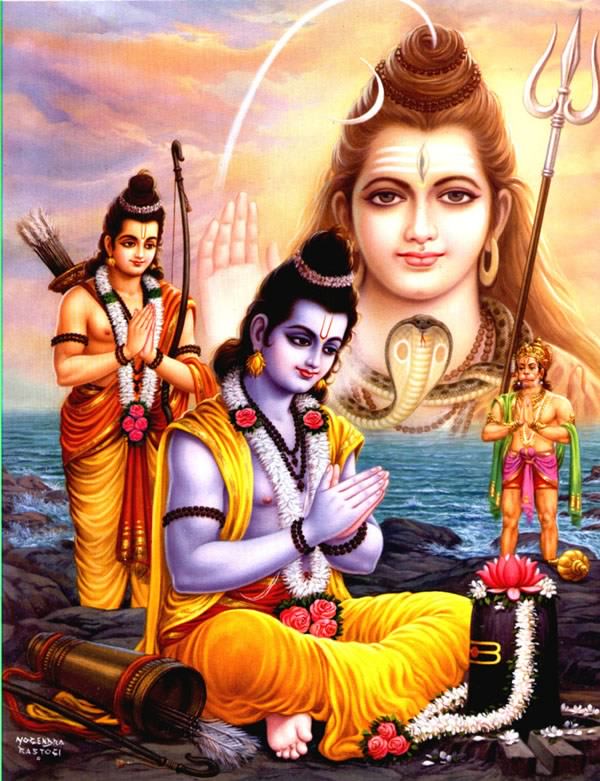
    Lord Rama.jpg
    Lord Rama.


    Ananda Ramayanam (12,252 slokas), 
    Adyatma Ramayana is said to be part of the Satakoti Ramayanam.  
    Ananda Ramayanam was written by Sri Valmiki himself.  
    
    It is believed that  Sri Valmiki felt sad that he left out some important details of Sri Rama's 
    life in his original work, and wrote Ananda Ramayanam to get peace 
    of mind.  
    
    There are 9 kandams in Ananda Ramayanam:
    
    1. SAra KAndam  (has the sAram or the juice of Rama charitam)
    2. YAtrA KAndam (Sri Rama's yAtras after His pattAbhishekam)
    3. YAga KAndam  (Sri Rama's asvamedha yAgam)
    4. VilAsa KAndam (Sri Rama's and Sita's daily life)
    5. Janma KAndam  (Birth of Lava and Kusa)
    6. VivAha KAndam (Weddings of Sri Rama's and his brothers' sons)
    7. RAjya KAndam  (fights with other asuras, expansion of kingdom, rajya pari-
                      palanam)
    8. ManOhara KAndam (slokas, Rama nama mahima etc.)
    9. Poorna KAndam   (Sri Rama and others leaving for Sri Vaikuntam).
    
    Here is the narration about Kausalya, Rama's mother being abducted by Ravana.
    
    This reminds of the indent involving Kamsa, Devaki and Vasudeva, when kamsa imprisoned Devaki and Vasudeva, to ensure that Lord Krishna  was not born!
    
    The narration by Valimiki about Kausalya does not contradict or affect the Ramayana as we know.
    
    
    Stories from Sara Kandam - Chapter 1:
    
    1.1 Story about Dasaratha and Kausalya:
    
    Valmiki's original Ramayana starts with Dasaratha ruling Ayodhya as a great
    king and desiring to do asvamedha yaga with his wives (Balakandam 5-8 sargas).
    Ananda Ramayanam goes many years prior to that and starts with Dasaratha and 
    Kausalya's marriage.
    
    It is the time when Dasaratha's marriage with Kausalya is being fixed.
    Dasaratha is enjoying himself on the Sarayu river in a boat.  
    
    Ravana calls for Brahma and asks Him who will cause his (Ravana's)
    death.  Brahma tells him that Lord Narayana will be born to Dasaratha 
    and Kausalya as Rama and will kill Ravana.  He also tells him
    that Dasaratha and Kausalya are going to be married in 5 days.
    
    Ravana gets on his pushpaka vimana with several asuras and goes to Ayodhya,
    fights with Dasaratha and breaks the boat Dasaratha is in.  Dasaratha and
    Sumantra somehow escape holding on to a piece of the boat and float down 
    the Sarayu river, reach the Ganges and eventually the ocean.
    
    Ravana proceeds to fight Kausalya's father (the Kosala king) and abducts 
    Kausalya. On the way to Lanka, he decides to hide Kausalya in a safe 
    place and leaves her in the custody of a shark, after placing her in a 
    box.  The shark carries the box in its mouth.  Sometime later, the 
    shark happens to encounter another shark. It places the box in a nearby 
    island and starts fighting.  In the meantime, Dasaratha and Sumantra, who 
    are floating in the ocean, discover this box and open it.  They are 
    surprised to see Kausalya.  Dasaratha marries Kausalya immediately in 
    gandharva vivaha fashion and all the three stay put in the box, exchanging 
    stories. The shark carries the box again into the ocean.
    
    Ravana calls Brahma and boasts that he has killed Dasaratha and abducted 
    Kausalya.  Brahma laughs and tells him that they have already been married.
    The angered Ravana calls for the shark and opens the box; out come the 
    three people. The scared Ravana tries to kill them with his sword.  Brahma tries
    to console him saying, " You put only one girl in the box and now she has
    become three.  Is it not possible that many more will be coming out of the box?
    Rama could be one of them.  Just close the box and send it to Ayodhya".
    
    So, Ravana asks his servants to leave the box near Ayodhya.  The box is 
    discovered by the people of Ayodhya.  The Kosala king gives his daughter,
    Kausalya, in marriage to Dasaratha in a formal ceremony.
    
    Thus ends this episode with a happy ending, as will be the characteristic of
    most events in Ananda Ramayanam.
    
    1.2 Story behind the two boons given to  Kaikeyi:
    
    Valmiki's original Ramayanam version:
    
    Once, Dasaratha helps the Devas in their fight with asuras. Dasaratha 
    takes Kaikeyi with him.  Valmiki Ramayanam - Ayodhya Kandam -
    9th sargam sloka 16 states that Kaikeyi takes Dasaratha away from the 
    battlefield when he becomes tired and swoons in his chariot.  She attends to 
    him and gets him back to good health.  Dasaratha subsequently wins the war
    with the asuras. The pleased Dasaratha grants her two boons, which she
    chooses to use later.  
    
    Ananda Ramayanam gives a different story.
    
    During the Deva-asura fight, the stick or support that holds the wheel to
    the chariot, breaks in Dasaratha's chariot and the chariot is about to
    collapse.  Kaikeyi places her left hand in the place of the wheel-holder, 
    in order to help her husband proceed without interruption.  Finally, Dasaratha 
    is victorious and being pleased with Kaikeyi's help, grants her two boons.Connected to this story is the following anecdote about Kaikeyi:Once, Kaikeyi, when she is very young, makes a paste out of coal and applies
    it on the face of a sage, for fun.  He curses her saying "later in life,
    you will be put to shame - no one would like to see your face even".  Kaikeyi
    gets scared and brings a stick to him, so he can punish her.  The pleased
    sage grants a boon - " you left hand will be as strong as iron and will
    never fail in any instance".  "
    
    Citation.
    
    http://www.ramanuja.org/sv/bhakti/archives/apr97/0052.html
    
    Image Credit.shirdisaibaba100.blogspot.com