There are three issues(?), which a Non Hindu uses to pick on Lord Krishna and uses them to discredit Hinduism and Lord Krishna.
1.Lord Krishna was with many a woman for pleasure,Rasa Kreeda,
2.Lord Krishna had 16,000 wives and
3.Lord Krishna won the Mahabharata War by unfair means and he advocated killing.
Krishna himself answers to His ways in the conduct of the Mahabharata War in Bhagavad Gita.( if one can understand what He says, for it is very subtle)
On his 16000 wives I shall be posting an article.
Rajasa Kreeda, Being with Many women.
Rasa Krida is also called as Rajasa Krida, for the quality of Rajasa, Passion is in play here.
The reference to this appears in the Bhagavatha Puran, Cahpters 29 to 33.
The meaning of the Term Rasa Krida’ is Sport of Dance.
Dance sport ,Rasa Krida of krishna
Lord Krishna had the Women’s dress confiscated while they were taking Bath and they remained naked.
They ere then observing the Kathyayanai Vrata.
Lord Krishna started playing the Flute.
The women wanted to proceed to wheer Krishna was playing the Flute , did not find their clothes.
They found Lord Krishna had their clothes in the bow of Tress.
They covered their Breasts with hands , keeping themselves in Water asked Krishna as to how He could do this to them, who have surrendered themselves to Him.
Lord Krishna replied.
You should not have taken Bath without clothes, especially when you are observing the Kathyayani Vrata.
(Hinduism enjoins one to have at least a piece of cloth to cover private parts while taking Bath)
If you had surrendered to me,you should have come to me to claim the clothes with out clothes.
This indicates that you have more attachment to the Human Body than the Love for God.
How do you expect to liberated when you have attachment to Body, Dehabhimana,Dehatma Buddhi‘?
The women realized their mistake, raised both their hands and worshiped Him.
Lord Krishna had their Clothes restored to them
At no place is it mentioned that Lord Krishna was sexually disposed to these Gopikas.
The instance is to demonstrate Bhakti, Saranagathi, and Non attachment.
‘I have taught you that which is the secret among secrets.
Are your doubts dispelled?
Are you clear in your Mind?
Now that you heard Me, think according to your disposition, choose what is Best for you and follow'( Chapter 18)
Hinduism prescribes many a Route to realize God.
1.The Path of Physical and Spiritual exercise, Raja Yoga,
2.The Jnana Yoga, The Path of Knowledge,
3.The Karma Yoga, The Path of Action , and
4.The path of Devotion, Bhakti Yoga.
Any of these may be followed.
It depends on one’s dispositions, Svabhava.
All the three Acharyas , Adi Shankara, Ramanuja and Madhvacharya take their premise from the three Mahavakyas,
‘Aham Brahma’ I Am Brahman, Reality.
‘Tat Tvam Asi’,You are That.
Soham Asmi ‘He is That.
Interpretations of these Acharyas differ.While Shankara advocates Non Dualism, Ramanuja, The Qualified Non Dualism and Madva Dualism.
I had an interesting discussion with Sri Abhinava Vidyatirtha Swamiji of Sri Sringeri Mutt, who is my Guru, about 40 years back.
I asked him that if The Veda is the Ultimate Authority, and if all the three Acharyas have taken the same three Mahavakyas to found their systems, why there is a difference in their conclusions?
He replied,
Acharyas know that the dispositions of the Individuals vary.
You will be able to follow things that suits your Nature.And as the Vedas say the Truth is One, but it is spoken of as Many’
(Ekam Sat Vipra bahudha vadanti)
Therefore the Acharyas have provided different approaches to reach God.
One may follow any of these.
There is no question of what is Right and What is Wrong.
That is left to reason, which is useless in Spiritual Development.
You follow what suits you and do not bother.
You are here to realize Brahman, not to prove One is Right and another is wrong”
Of these three approaches, Vaishnavism places importance on The Bhakti Yoga. The Path of Devotion.
The path of devotion is the total surrender to God.
Ramanuja systematized the Bhakti Yoga and popularised the Pancharatra system.
What is Pancharatra?
Pāñcarātra are VaishnavaSanskritAgamic texts.[1] Literally meaning five nights (pañca: five, rātra: nights),[2] the term Pancharatra has been variously interpreted.[3] The term has also been attributed to the Shatapatha Brahmana 12.6 wherein Narayana performed a sacrifice for five nights and became a transcendent and immanent being.[2][4] The Pancharatra Agamas constitute the most important texts of the Srivaishnava Sampradaya of Ramanuja.[4] The Pancharatra Agamas are composed of more than 200 texts;[3] with various suggested time periods of composition; including the 3rd century BC,[5] and a period between 600 AD to 850 AD.[3]
The Reality is both with and devoid of Attributes. Nirguna Brahman and Saguna Brahman
To realize the Nirguna Brahman, one has to go through the Saguna Aradhana.
This Saguna Aradhana is systematised for the Vaishnavites in the Pancharatra.
This is practiced by the Thengaliyar Sect in South India.
While total surrender to God is enough for the Thengalai Traditions, the Vadagalai traditions state that Effort for Realization(through His Grace, in the form of Guru) is also essential
Now onto Pancharatra.
Purusha is the Cosmic Being and the Purusha Sooktham describes the Evolution of the Universe.
The Narayana Sooktam is about Narayana, the Manifestation of the Purusha.
Vishnu Sooktam is about the manifestation of Vishnu, in his incarnation, which changes in every Aeon, as the Protector.( Vishnu is from the word, Jishnu , the one who supports)
In the Pancharatra, Vasudeva( The Dwadasa nama of Lord Narayana),
“Vasudeva, characterized by the six gunas, is sometimes called the first Vyuha. From Vasudeva emanates Sankarshana in whom jnana and bala alone get manifested. From Sankarshana comesPradyumna to whom belong aishvarya and virya. From Pradyumna emanates Aniruddha to whom shakti and tejas appertain.
As we have seen, the Pancharatra thinkers were very much particular in safeguarding and preserving the purity and unchanged nature of the transcendent Supreme Being. From that point of view, the chief merit, and hence its primary significance, is that it is such a process of emanation in which the Supreme Being remains unaffected and unchanged in all the five-fold manifestations.’
This aspect is that of the Apara Vasudeva, creating and simplifying things for the Devotees .
Avatara Manifestation
Closely connected with the doctrine of vyuhas, is the next manifestation of God, named as vibhava (manifestation) or avatar (descent). The only supreme being the Pancharatra philosophers knew about was the Transcendent One, who was not in any way directly related to the world. Therefore, the Samhitas explicitly describe the avataras as either all springing from Aniruddha, or some from Vasudeva and the rest from the other three vyuhas. One should not be mistaken here in assuming that the Supreme Being himself takes avatara. This is a puranic conception. The Pancharatra Samhitas nowhere maintain that the Supreme Being, laying aside its transcendent, unmoving nature assumes these finite forms. This is impermissible by the premises of the system. The Supreme Being is merely a spectator with an attitude of passivity and indifference. It cherishes no attachment to the mundane world, and it is beyond its nature to do so.
Antaryamin Manifestation
The fourth manifestation is the Antaryamin avatara, which is Aniruddha as the ‘Inner Ruler’ of all souls. It is a mysterious power seated in the ‘lotus of the heart’. Here again it should be noted that this is not a manifestation of the Supreme Being, but only of Aniruddha, one of the vyuhas.’
This approach does not really alter the essentials of the Vedas or the Attributes of the Reality.
Look at the word used,
‘Vyuha’ Strategy.
This is a strategy to realise God hood or reach the feet of the Lord.
Six Aspects of Surrender.
Surrender to god is one of the core teachings of Pancharatra. The six aspects are explained below in brief:
i) Atma-nikshepa or nyAsa – placing oneself completely and directly under God’s care. This involves giving up independent ownership in matters of actions or fruits thereof. This in fact is the real SaraNAgati. The subsequent five are to be regarding as assisting this. The obstacle to nyAsa is phalepsA or the desire for mundane benefits,which should therefore be avoided.
ii) kArpaNya – This refers to absolute humility bordering on lowliness and honest awareness of one’s own natural ignorance, impurity etc., partly because of stains acquired through countless births. We all know the enormous feeling of kArpaNya that our AzhvArs have expressed through their compositions. This leads to ridding the arrogance that one may have because of parentage, learning, wealth, etc., and to get the sense that without the aid of Godhead, whatever we undertake on our own is bound to fail. The enemy for kArpaNya is the feeling that one is free, independent,and competent to do whatever he likes (sva-svAtantryAvabodha).
iii) mahA-viSvAsa – irrepressible and great faith in Godhead. Involves the understanding that God is the benefactor of all beings, and His compassion is always and readily available. The firm conviction that He will not fail to protect us is ‘viSvAsa’. This by itself is capable of eradicating all sins.
iv) goptR – The deliberate choice of bhagavAn SrIman nArAyaNa as the sole Protector. Even when it is granted that anyway He is the sole protector, lakshmI-tantra points out that what is involved in this a’nga is the conscious and mindful selection of Him, the acknowledgment that we need protection, and that He and only He can protect us.
v) prAtikUlya-vivarjana – giving up whatever is antagonistic to any of His creations or to Him. A devotee must realize that all beings are like himself.
vi) AnukUlya-niScaya – The resolve to do good to all beings. The realization that all beings are in actuality the body of God, and the resolve to live in accordance with the will of God. Ahirbudhnya samhitA gives a beautiful illustration of SaraNAgati using a passenger who wants to cross a river in a boat. It is the passenger’s responsibility to go and sit in the boat, and that is the end of his responsibility; the job or rowing the boat is not his, but that of the boatman (in this case God Himself).
Six aspects of surrender are described in many PancarAtra samhitas such as Ahirbudhnya Samhita, Lakshmi Tantra etc., thought the order of importance may vary. Lakshmi Tantra give the following:
Thus the order of the limbs given in Lakshmi Tantra is: Anukūlya Samkalpam, Prātikūlya Varjanam, Mahā Viṣvāsam, Goptṛtva VaraNam, Atma Nikshepam, and kArpaNyam. In Ahribudhnya Samhitā, the order given is: Atma Nikshepam or Nyāsam, KārpaNyam, Mahā Viṣvāsam, Goptṛtvam, Prātikūlya Varjanam, and Anukūlya Sampakpam. Svāmi Deṣikan has addressed these confusions in his Nyāsa VimSati (Slokam 12), and concludes that those who know Prapatti Sāstra well agree that there are five anga-s to Prapatti, and the different positions taken in respect of the number and sequence of importance etc. of the aspects of Prapatti really say the same thing in the end (sarva vākya eka kaNThyam).
Atma Nikshepam or nyāsam is considered the main ingredient of Prapatti – the conviction that one’s own effort in attaining Him will not bear fruit, and placing oneself directly under His care and giving up ownership of one’s own protection or the benefits from any actions to Him. The other five are then the limbs for Nyāsa, that are of equal importance as conveyed to us by Svāmi Deṣikan. Thus, for performing surrender or Atma Nikshepa or Nyāsam, one needs absolute humility (KārpaNyam), Anukūlya Samkaplam, Prātikūlya Varjanam,
Namo hiranyabahave senanye dishan cha pataye namo
namo vrikshebhyo harikeshebhyah pashunam pataye namo
namah saspijncharaya tvishhimate pathinam pataye namo
namo babhlushaya vivyadhineannanam pataye namo
namo harikeshayopavitine pushhtanam pataye namo
namo bhavasya hetyai jagatam pataye namo
namo rudrayatatavine kshetranam pataye namo
namah sutayahantyaya vananam pataye namo namah
Namo rohitaya sthapataye vrikshanam pataye namo
namo mantrine vaanijaya kakshanam pataye namo
namo bhuvantaye varivaskritayaushhadhinam pataye namo
nama uchchairghoshhayakrandayate pattinam pataye namo
namah kritsnavitaya dhavate satvanam pataye namah
3rd Anuvaka
Namah sahamanaya nivyadhina avyadhininam pataye namo
namah kakubhaya nishhangine stenanam pataye namo
namo nishhangina ishhudhimate taskaraanaam pataye namo
namo vajnchate parivajnchate stayunam pataye namo
namo nicherave paricharayaranyanam pataye namo
namah srikavibhyo jighasadbhyo mushhnatam pataye namo
namo asimadbhyo naktam charadhbhyah prakrintanam pataye namo
nama ushhnishhine giricharaya kulujnchanam pataye namo namah
Namo ishhumadhbhyo dhanvavibhyashcha vo namo
nama atanvanebhyah pratidadhanebhyashcha vo namo
nama ayachchhadhbhyo visrijadbhyashcha vo namo
namo asyadbhyo vidhdhyadbhyashcha vo namo
nama asinebhyah shayanebhyashcha vo namo
namah svapadbhyo jagradbhyashcha vo namo
nam stishthadhbhyo dhavadbhyashcha vo namo
namah sabhabhyah sabhapatibhyashcha vo namo
namo ashvebhyoashvapatibhyashcha vo namah
Anuvaka 4
Nama avyadhinibhyo vividhyantibhyashcha vo namo
nama uganabhyastrihatibhyashcha vo namo
namo gritsebhyo grutsapatibhyashcha vo namo
namo vratebhyo vratapatibhyashcha vo namo
namo ganebhyo ganapatibhyashcha vo namo
namo virupebhyo vishvarupebhyashcha vo namo
namo mahadbhyah kshullakebhyashcha vo namo
namo rathibhyoarathebhyashcha vo namo
namo rathebhyah rathapatibhyashcha vo namo
namah senabhyah senanibhyashcha vo namo
namah kshattribhyah sangrahitribhyashcha vo namo
nama stakshabhyo rathakarebhyashcha vo namo
namah kulalebhyah karmarebhyashcha vo namo
namah pujnjishhtebhyo nishhadebhyashcha vo namo
nama ishhukridbhyo dhanvakridhbhyashcha vo namo
namo mrugayubhyah shvanibhyashcha vo namo
namah shvabhyah shvapatibhyashcha vo namah
Anuvaka 5
Namo bhavaya cha rudraya cha
namah sharvaya cha pashupataye cha
namo nilagrivaya cha shitikanthaya cha
namah kapardine cha vyuptakeshaya cha
namah sahasrakshaya cha shatadhanvane cha
namo girishaya cha shipivishhtaya cha
namo midhushhtamaya cheshhumate cha
namo hrasvaya cha vamanaya cha
namo brihate cha varshhiyase cha
namo vriddhaya cha samvridhdhvane cha
Namo agriyaya cha prathamaya cha
nama ashave chajiraya cha
namh shighriyaya cha shibhyaya cha
nam urmyayacha vasvanyaya cha
namah strotasyaya cha dvipyaya cha
Anuvaka 6
Namo jyeshhthaya cha kanishhthaya cha
namah purvajaya chaparajaya cha
namo madhyamaya chapagalbhaya cha
namo jaghanyaya cha budhniyaya cha
namah sobhyaya cha pratisaryaya cha
namo yamyaya cha kshemyaya cha
nama urvaryaya cha khalyaya cha
namah shlokyaya chavasanyaya cha
namo vanyaya cha kakshyaya cha
namah shravaya cha pratishravaya cha
Nama ashushhenayacha shurathaya cha
namah shuraya chavabhindate cha
namo varmine cha varuthine cha
namo bilmine cha kavachine cha
namah shrutaya cha shrutasenaya cha
The discussion among people who call themselves as Devotees of Kanchi and Sringeri is disgusting.
Kanchi adherents say that Sringeri Acharya travels by Car, ostentatious and does precious little for the Community.
On their part ,Sringeri Mutt followers say that Sri.Adi Sankara did not establish a Mutt at Kanchi at all as there can be one South Mutt and that’s Sringeri.
It is also added that Kanchi gets into unnecessary controversies that do not befit the Offices of an Acharya, much like the Pope.!
Kanchi retorts that Sringeri is the Asthana Peda of The Mysore Maharaja and Kanchi is for the common man!
Sringeri quotes JayendraSaraswati Episode and Kanchi had to squirm .
Are these people real Devotees, who are after the Truth and Realisation?
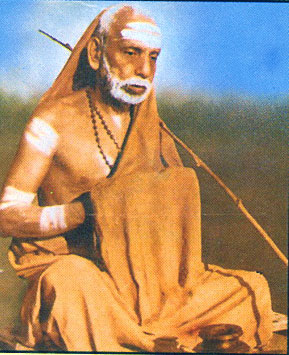
Kanchi Periyava.
Let’s get the facts .
True that there is no historical evidence that the Kanchi Mutt was established by Adi Shankaracharya direct.
So what?
If some want to get a vicarious pleasure in criticising Kanchi , Be it.
On their part ,Kanchi need not attempt to justify the Petam by trying to twist History.
Kanchi Periyava is an incarnation of Compassion and a reflection of what a Real Sanyasi should be.
He advised Arthur Osbourne , who had come to ask him to accept him as his Disciple hie advised him that his Guru is Ramana Maharishi;he will return dissatisfied with him at the first instance and later become Ramana’s ardent Devotee.(Osbourne records this.I have posted on this)
As to Sringeri the dignity and the beauty of the Pooja of the Swamiji is to be felt to believed.
Sri Abhinava Vidyatheertha,Sringeri.
Contrary to what people think he was/ is very pragmatic.
His approach to the Duty of Sannyasa is ‘Perform duties as a Sanyasi by Poojas and Bhashans and leave the Empirical to the worldly.
“He Is There’
Not many people know how humble and Gracious he is.
I had an argument(!?) with him (Abhinava Vidyatheertha) on the interpretation of a sentence in The Vedas and was down right rude.
He sent for me latter , explained me(where he told me I was Right!) and taught me Vedas for about eight long years( though I attended intermittently)
When I went to seek a Darshan of Kanchi Periyava for the first time, he picked me from the Crowd(( I do not believe in getting recommendation in having Darshan in Temples or The Acharyas) and said’
” you are learning from the Sringeri Periyava, make sure you follow what he says”
He had no chance of knowing this.
This the mutual respect these great souls had for each other.
Our goal is Realisation and we are not qualified to comment on these Sages.
Let me quote Excerpt for MahaPeriyava site;
Sringeri Periyava said about Mahaperiyava::
Mahaperiyava speaks highly about Sringeri Periyava’s thapas::
Below is what Sringeri Periyava advises to all – I can’t agree anymore.
Last but not the least, Mahaperiyava admits that Kanchi Vs Sringeri is not going to end anywhere sooner…




You must be logged in to post a comment.