Tag: Yoga Sutra

  • Meditate On Eyes Not On Centre of the Forehead Siddhas

    Meditate On Eyes Not On Centre of the Forehead Siddhas

    Where does one concentrate while meditating? In the initial stages, one may keep both eyes open and concentrate on an Idol of his choice,A photo,Or The flame of a Lamp. At an advanced, next level, one is asked to close one’s eyes, as it would shut down external Stimuli. And where to concentrate?

    Many concentrate on the spot in by the two eyebrows, the centre of the forehead where Hindus kero their caste mark or Kumkum. This part is associated with Ajna Chakra.Some advice the tip of the nose,while keeping the eyes open as well as keeping them closed( While performing Sandhya vandhana, Pranayama is performing by looking at the top of the nose or both eyes closed)

    I have noticed that this practice is disturbing , makes eyes watery.Even while eyes are closed , if you concentrate either in between the eyebrows or at the top of the nose, your eyeballs roll-up,though your eye lids are closed. I had this doubt for quite sometime whether there is any other interpretation.

    Siva being the Adi Yogi and the most authentic texts are Thirumandihram by Thirumoolar,which pre dates Patanjali, Agastya’s works I was meaning to check them and also the works of Siddhas.

    A Facebook group Siva Sambho in Tamil has provided me the answer. I studied the verses and am convinced that the spot to concentrate ,with eyes closed, is the Pupils of the eyes or pupil of one eye.

    Tamil texts by Siddhas mention this. Agasthya says that ‘Do not go after the Center of the eyebrow,( Your ) Eyes are Full of Divine Light and the tip of the nose is The End( that it is the End, I am unable to decipher). What is clear is one should concentrate on the eyes , specifically Pupils of the eyes 👁️ for through the eyes are seen the Light and eyes are the expressions of the Soul and concentrating on them leads to Inner Light.

    Thirumoolar says to keep your gaze or attention at the center of the Nose.This seems to indicate the eyes again as when you convey on the Centre of the nose,with your eyes closed, you will find that you are looking at your eyes internally. Here the physical Eyes,which are Karmendriya are not referred to. It the Eye as Gnanendriya is pointed out . It the process and awareness of Seeing knowledge of Seeing.

    One must see follow the Inner Light in the eyes, follow it to the heart while meditating.

    புருவ மத்தி என்பது எது?


    நமது சித்தர்கள் யோகசாதனமுறையை விளங்கும் போது.மனதை புருவ மத்தியில் நிலை நிறுத்துங்கள் என்று கூறுவர்..

    புருவமத்தி எது என்று சாதரணமாக யாரிடம் கேட்டாலும் “புருவமத்தி” என்று நாம் நெற்றியில் பொட்டு வைக்கும் இடத்தை கூறுவர்.

    இன்று பல யோகா மையங்களும் இதையே தான் கூறுகிறது. புருவமத்தி என்றால் பொட்டு வைக்கும் இடமா என்றால் அது தான் இல்லை? சிறிது சிந்தித்து பார்த்தால் இது புலப்படும்.

    அதற்கு முன் அவ்வையார் கூறும் இந்த பாடலை நினைவில் கொள்ளுங்கள் ” “தேவர் குறளும் திருநான் மறை முடிபும் மூவர் தமிழும் முனி மொழியும் – கோவை திருவாசகமும் திருமூலர் சொல்லும் ஒரு வாசகம் என்று உணர்”

    திருக்குறள் நான்கு வேதங்கள் தேவாரம் அகத்தியர் முதலான சித்தர் பாடல்கள் திருவாசகம் திருமந்திரம் இவை அனைத்தும் உரைப்பது ஒரு வாசகம். மெய். உண்மை. சத்தியம். மெய்பொருள். ஆக அணைத்து ஞானிகளும் ஒரே இடத்தில் தான் தியானம் செய் என்று கூறியிருப்பார் என்று தெளிவாகிறதல்லவா.

    சரி முதலில் புருவ மத்தி எது என்று நாம் சிறிது சிந்திப்போம்? நாம் பொட்டு வைக்கும் இடம் இரு புருவங்களிடையே உள்ளது. ஞானிகள் இரு புருவ மத்தி எனக் கூறவில்லையே?! புருவ மத்தி என்று ஒருமையில் தானே கூறினர். ஒரு புருவம் அதன் மத்தி என்று ஒன்றும் இல்லை, அதன் கீழ் இருப்பது கண்.

    இப்படி சிந்திக்க வேண்டும். யூகிக்க வேண்டும். புருவ மத்தி என்று சொன்னார்களே அதன் கீழ் உள்ள கண்ணை பற்றி தானே சொல்லியிருப்பர்.

    நாம் சிந்தித்ததை….. சித்தர்கள், ஞானிகள் பாடல்கள் கொண்டு பார்போம். எல்லா சித்தர்களும் , ஞானிகளும் நாம் தியானம் செய்ய வேண்டிய இடம் புருவ மத்தியான கண்ணே என்று நேரடியாகவும், பரிபாசயாகவும் கூறிபிட்டுள்ளனர்.

    அதில் சிலவற்றை இதில் பார்போம்.

    “புருவ மத்தி எதென்றக்கால் பரப்பிரம்மமானதோர் அண்ட உச்சி” . – சித்தர்

    காகபுசந்தர். புருவமத்தி பரப்பிரம்மமான அண்ட உச்சி. அண்டம் போல் அழகான பூமி போல் அழகான கண்மணி, உச்சி என்றால் கண்மணி மத்தியாகும். அது பரப்பிரம்மமானது. அதாவது ஒளியானது புருவமத்தி கண்மணி மத்தியிலுள்ள ஒளி.

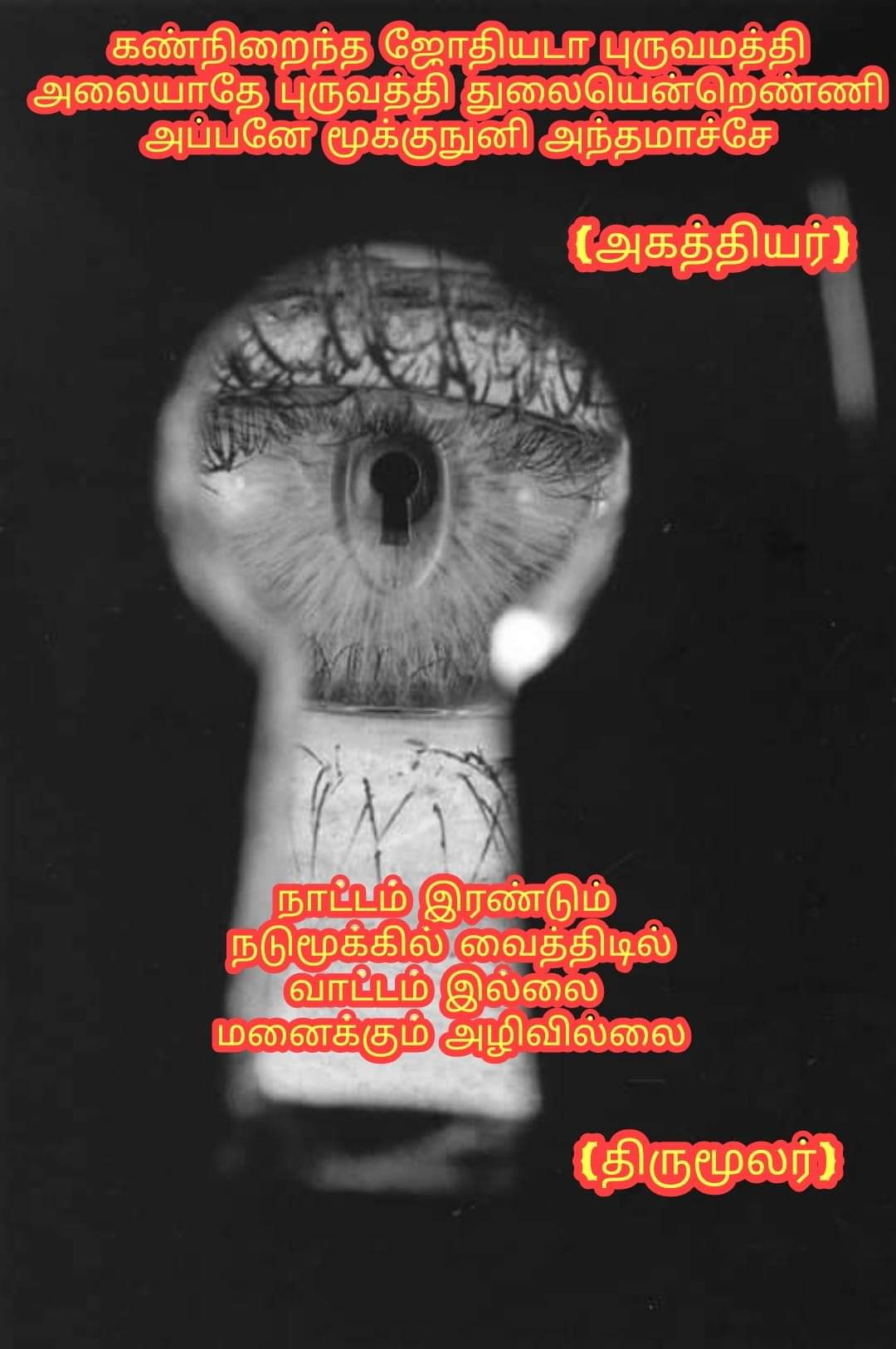
    கண் நிறைந்த ஜோதியட புருவமத்தி

    அலையாதே புருவமத்தி துலையென்றெண்ணி

    அப்பனே மூக்கு நுனி அந்தமாச்சே – அகத்தியர்

    கண்ணில் நிறைந்த ஜோதியே (அ ) ஒளியே புருவமத்தி என்று தெளிவாக அகத்தியர் பெருமான் நமக்கு உரைக்கிறார்.

    வள்ளல் பெருமான் புருவம் கண் என்று தெளிவாக கூறிவிட்டார்.

    “கையற விலாத நடுக்கண் புருவபூட்டு கண்டு களி கொண்டு திறந்து உண்டு நடு நாட்டு.” என்று வெட்ட வெளிச்சமாக்கி விட்டார். “நடுக்கண் தான் புருவபூட்டு” இதற்கு விளக்கமும் வேண்டுமோ. மேலும் வள்ளலார் தான் இரு கண்களாலும் செய்த பெரும் தவத்தை தானே வியந்து போற்றுகிறார்.

    “என்னிருகண் காள்உமது பெருந்தவம்எப் புவனத்தில் யார்தான் செய்வர்”

    தன் கண்ணில் தான் தானும் தவம் செய்தேன் என்று வள்ளலாரே குறிபிடுகிறார்: இதை திருமூலர் திருமந்திரத்தில் பரிபாசையாகவும், நேரடியாகவும் குறிபிடுகிறார்: “நாட்டம் இரண்டும் நடுமூக்கில் வைத்திடில் வாட்டம் இல்லை மனைக்கும் அழிவில்லை"

    இங்கு திருமூலர் நமது நாட்டம் நடுமூக்கில் வைக்கணும் என்கிறார். ஒரு சித்தர் புருவமத்தி என்றார், இங்கு திருமூலர் நடுமூக்கு என்கிறார். எது சரி.

    அவ்வை பிராட்டி கூறிய முதல் பாடலை நினைவு கொள்ளுங்கள்.

    நடுமூக்கு – இது பரிபாசை. ஞானத்திற்கு பொருள் காணனும்.! மேலோட்டமாக பார்த்து மூக்கு என்று ஏமாந்து போகாதீர். மூக்கை பார்த்து மோசம் போனவர் ஏராளம்.

    இதன் விளக்கம் என்ன?

    தண்ணீர் ஊற்றும் பாத்திரம் உண்டல்லவா அதில் நீர் வரும் பகுதியை மூக்கு என்று தானே சொல்வோம்.

    நமக்கு கண்ணீர் வரும் கண்ணே மூக்கு அதன் நடுபகுதியே ஊசிமுனை துவாரம் உள்ளதாகும் அதனுள் தான் ஊசிமுனை அளவு ஜோதி உள்ளது! இதில் தான் நம் நாட்டம் இருக்க வேண்டும். கண் என நேரடியாக சொல்லாமல் நடுமூக்கு என்றது நாம் சிந்தித்து தெளிய வேண்டும். குரு மூலம் உபதேசம் பெற்று தெளிய வேண்டும் என்பதற்காக. தான். மேல் கூறிய விளக்கத்திற்கு சான்று மற்றும் ஒரு திருமந்திர பாடலே

    “நாட்டத்தை மீட்டு நயனத் திருப்பார்க்குத் தோட்டத்து மாம்பழந்தூங்கலு மாமே”

    நயனம் என்றால் கண். இதற்கு மேலும் விளக்கம் தேவை இல்லை.

    மற்றுமொரு பாடல் திருமந்திரத்தில் இருந்து. தவம் எப்படி செய்ய வேண்டும் என்று கூறும் பாடல். இப்பாடலை படிக்கும் முன் “உடலில் உயிர் எங்கு உள்ளது “என்று இந்த லிங்கை படித்த பின் பார்க்கவும்” “நெற்றிக்கு நேரே புருவத் திடைவெளி உற்றுற்றுப் பார்க்க ஒளிவிடு மந்திரம் பற்றுக்குப் பற்றாய் பரம – னிருந்திடம் சிற்றம் பலமென்று சேர்ந்துகொண் டேனே”

    நெற்றிக்கு நேரே புருவத் திடைவெளி இதை நாம் உற்று உற்று பார்க்க வேண்டும். கிணற்றை உற்று பார்த்தான் என்றால் கிணற்றில் உள்ளே பார்த்தான் என்று தானே பொருள்.

    நெற்றிக்கு நேரே புருவத்திடைவெளி உள்ளே இரு கண்களும் உள்ளே போய் சேருமிடம் நம் ஆத்மஸ்தானம். அதை தான் உற்று உற்று பார்க்க ஒளி விட்டு பிரகாசிக்கும் என திருமூலர் சொல்கிறார்.

    அது தான் ஒளி தான் மந்திரம். அந்த நம் ஜீவஸ்தானம் தான் பரமன் இறைவன் இருக்குமிடம். நம் உயிரை பற்றி உடலை பற்றி இருக்கும் இடம். அதுவே சிற்றம்பலம் கோயில் என தெரிந்து கொண்டேன்.

    நம் கண்மணியை பற்றியிருக்கும் ஒளி உள் ஒளி அம்சம். கண்மணி ஒளி வழி உள்ளே புக வேண்டும். குரு மூலம் உபதேசம், தீட்சை பெற்று கண் ஒளியை பற்றி உள் போக வேண்டும்.

    இதுவே ஞானம். கண்ணை மூடி கொண்டு உற்று உற்று என பார்த்தாலும் மாயை தான் விளையாடும். கண்ணை திறந்து கண்மை ஒளியோடு போ.

    மேலும் பல ஞானிகள் புருவமத்தியான கண்ணை இருதயம் என்பர். இருதயம் என்பதை பிரித்து பாருங்கள் இரு+ உதயம் . நம் உடலில் வலது கண் சூரியன், இடது கண் சந்திரன், ஆக இதை தான் இந்த சூரிய , சந்திர உதயத்தை தான் இரு உதயமாக (இருதயமாக) கூறி உள்ளனர் ஞானிகள்.

    இதை சிவவாக்கியர் எந்த ஒளிவு மறைவுமில்லாமல் கூறி உள்ளார்.

    “வலது கண் சூரியன் இடது கண் சந்திரன்”

    கீதையிலும் கிருஷ்ண பகவான் “மந்திரங்களில் நான் காயத்ரி” என்கிறார். காயத்ரி மந்திரத்தின் சாராம்சம் “கடவுளின் ஒளியை தியானிப்போமாக என்பதே.

    Right Eye represents Sun,Left, Moon.The flowering of these two is Heart.- Siva Vaakiyar- Siddha.

    ” கண்ணன் என்ற தமிழ் வார்த்தை நம் உடலில் இறைவன் துலங்குவதை குறிக்கும். கண் + அவன் = கண்ணன்.

    Sri Krishna is called Kannan. It means He is Eyes

    ஆகா இந்த கண்ணனை – கண் ஒளியை தான் நாம் தியானிக்க வேண்டும். இப்படி அனைவரும் கூறுவது ஒன்றைத்தான்…

    Tamil text quoted is from Facebook group post Siva Sambo .https://www.facebook.com/groups/471697570143349/permalink/919565142023254/

  • More Detailed Yoga Jabala Darsana Upanishad

    Yoga Sutra of Patanjali,speaks of Eight Limbed Yoga,Ashtanga Yoga.

    They are ,

    Yama,

    Niyama,

    Asana,

    Pranayama,

    Dhyana,

    Prtathyaahaara,

    Dharana and

    Samadhi.

    Patanjali is not the founder of Yoga.

    He codified the practices of Yoga.

    Vedas speak of Yoga very subtly.

    The obejective of Human Life is to realize the Self.

    This is possible only when one can control and channelize the thoughts in the effort to control Chitta,which exists at a higher level than thoughts.

    Patanjali describes ,in the first Sutra of his Yoga Sutra,

    ‘Yogaha,Chitta vruthi nirodhdha’

    The cessation of the modification of Chitta is Yoga,Communion.

    For more on this,please read my articles on Yoga Sutra.

    By limiting the Thought waves, Consciousness is controlled through Breath Control.

    Breath Control is described by Patanjali under Pranayama.

    All the steps of Yoga are to be followed in the order described by Patanjali.

    I have listed them in the order at the beginning of this article.

    Performing Yoga in any other manner,like doing Pranayama or the so called Meditation without going through Yama ,Niyama etc. Is not Yoga.

    It might appear to produce results, but would harm,in the long run,physically and spiritually.

    Packaged Yoga to suit masses is injurious.

    I have written that the effort in Yoga is to control Chitta through these steps of Patanjali.

    The process of controlling Chitta direct through Breath control is callled Vaasi Yoga and Lord Shiva was the First to practice it.

    The process of Vaasi Yoga is Shiva.

    Read Vaasi backwards,it is,Shiva.

    Please check my detailed article on this.

    There is an Upanishad in the,Sama Veda dedicated to Yoga process.

    This was taught bt Lord Dattatreya to Sage Sankrithi.

    This is the Jabali Darshana Upanishad.


    Jabala Darshana Upanishad, Translation by Sri.P.R.Ramchander.

    Om ! Let my limbs and speech, Prana, eyes, ears, vitality
    And all the senses grow in strength.
    All existence is the Brahman of the Upanishads.
    May I never deny Brahman, nor Brahman deny me.
    Let there be no denial at all:
    Let there be no denial at least from me.
    May the virtues that are proclaimed in the Upanishads be in me,
    Who am devoted to the Atman; may they reside in me.
    Om ! Let there be Peace in me !
    Let there be Peace in my environment !
    Let there be Peace in the forces that act on me !

    God Dattatreya is the reincarnation of the four armed Vishnu and he is the ruler of the world. Sankrithi is a great devotee and a sage and is an expert in yoga and also a disciple of Dattatreya. He approached his teacher (God Dattatreya) with humility and with folded hands, when his teacher was alone and requested him, “Oh God, please tell me about the science of yoga which has eight branches and five different sthanas (places) by knowing which I will attain salvation. Dattatreya told him, “Hey Sankrithi, I shall tell you about Yoga which has eight branches. The eight branches are Yama, Niyama, Aasana, Pranayama, Prathyahara, Dharana, Dhyana and Samadhi.

    Yama which is the first is the practice of non-violence, truth, non possession of properties of others, celibacy, mercy, honesty, patience, stability, food discipline and cleanliness. 1

    Niyama is the ten aspects of penance, joy, orthodoxy, charity, worship of god, hearing of philosophy, fear for bad actions, clear intellect, chanting and austerities. 2

    The nine important Asanas (sitting positions) are Swasthika (Swastika), Gomukha (cows face), Padma (lotus), Veera (valorous), Simha (lion), Badra (safe), Muktha (free), Mayura (peacock) and Sukha (pleasant). Oh sage, that position, whatever it may be but which makes you comfortable and gives you courage to undertake Yoga is called Sukhasana. People who do not have strength to take up other positions can use that. Victory in the seating position is like victory over the three worlds. Once the Asana is fixed, one should practice Pranayama.  3

    Either in the top of the mountain or by the shore of the river or under a Bilwa tree in the forest, after choosing a clean place which is acceptable to the mind and after establishing a place to do tapas (Asram), sit in the Asana which is most familiar facing either east or north. Then sit with the body neck and head in a straight line, cover the face and concentrate the vision with best possible attention on the nectar flowing from the fourth state of the moon like dot at the end of the nose. Draw the air inside using the lungs, store it in the stomach, meditate on the flame of fire inside the body and then shift meditation to the root of fire with its sound and dot. Then the intelligent one will exhale and draw the Prana using Pingala (Nadi which is tawny and is on the right side of Sushumna Nadi) and meditate on the Agni Bheeja. Again he has to exhale and inhale again in the middle using the Ida (Nadi which is pleasant and is on the left side of Sushumna). One should have to live in a secret place practicing this exercise six times for 3-4 days or 3-4 weeks at dawn, noon and dusk. This would help him to clean up the Nadis. Slowly symbols will start showing up. Body will become light, the fire in the stomach will burn well and the voice would become clearer. These are the symbols of Siddhi (getting mastery). Till you see this, you have to practice. 4

    Now I will tell you about Prathyahara. To use force and divert the sensory organs which normally travel according to their nature is Prathyahara. Those who know Brahma say that seeing whatever we see as the form of Brahman is Prathyahara. Prathyahara also is doing clean or unclean acts as those belonging to Brhaman. Further doing daily religious activities after dedicating them to God and similarly doing the activities which we desire is also Prathyahara. Apart from this inhaling air (oxygen) and stopping it in different places is also Prathyahara. The wise man would sit in Swasthikasana, draw his breath till it fills up from head to toe and hold it in two feet, mooladhara, stomach, middle of the heart, bottom of the neck, jaw, middle of the eyelids, forehead and at the top of the skull. Then he should leave out the belief that the body is oneself and make that thought as nirvikalpa and merge it with Paramatma. The experts in Vedanta say that this is true Prathyahara. There is nothing that cannot be attained by those who practice like this.  5

    Now I will tell you about the five types of Dharana (holding steady – a stage in meditation – here we try to hold on what we are mediating upon without wavering). In the sky which is in the middle of the body, Dharana of the sky outside should be made. Similarly in the breath, Dharana of air outside should be made. In the fire in the stomach, Dharana of the fire outside should be made. In the fluid aspects of the body, Dharana of the water outside should be made. In the earthy aspects of the body, Dharana of the earth outside should be made. Sage, also it is necessary to chant the pancha bhootha mantras viz., Ham, Yam, Ram, Vam and Lam. It is said that this very great Dharana destroys all sins. In the body up to the knee is the aspect of the earth, from there till hip it is the aspect of water, up to the heart is the aspect of fire, up to middle of eyelids is the aspect of air and then up to the middle of the skull is the aspect of the sky. In the aspect of earth Brahma has to be placed, in the aspect of water Vishnu should be placed, in the aspect of fire Rudra should be placed, in the aspect of air Iswara should be placed and in the aspect of sky, the Sadashiva should be placed. Hey great sage, I will also tell you another Dharana. In the Jeevatma, that lord Shiva who rules over everything and is the personification of wisdom should be placed. To get rid of all sins, the wise man should suppress the gods like Brahma in the causative self, and place the Avyakta (that which is not clear) which is formless and which is the root cause inside the entire soul with the chanting of pranava. He should control the sensory organs by mind and should merge them with the soul. 6

    I will now tell you about Dhyana (meditation) which destroys sorrow. Dhyana should be done of that Maheswara, who is the medicine for problems arising out of birth, who is the discipline and fundamental basis of the world who is of the form of Para Brahma, who has the masculine power upwards, who is of the form of the world, who is Virupaksha, and who is the head of all yogis as “I am He”. Then continue to do Dhyana of him who is beyond the reach of meditation, who is the personification of Sachidananda Brahman and who is soul in person as “I am He” for attaining salvation. In the mind of that great Purusha who practices like this, the science of Vedanta would automatically appear. There is no doubt about it.  7

    Now I will tell you about Samadhi (deep meditative state)  which destroys the ills of birth and death. Samadhi is that state in which there is knowledge that Jeevatma and Paramatma are one. Atma (soul) is filled all over for ever and does not have motion or stain. Though it is one, due to the effects of illusion, it appears as different objects. Really there is no difference between these so called objects. When one sees all objects within himself and him as a part of all objects, He attains Brahman.  When one drowns himself in Samadhi and does not see different objects as different , then he attains the single aim of salvation. When he sees only the true soul and the entire world appears as an illusion to him and he is cured of all sorrow.

    Thus advised by Lord Dattatreya the sage Sankrithi fully lost all his fear and attained that blissfull state, deep in himself.

    Om ! Let my limbs and speech, Prana, eyes, ears, vitality
    And all the senses grow in strength.
    All existence is the Brahman of the Upanishads.
    May I never deny Brahman, nor Brahman deny me.
    Let there be no denial at all:
    Let there be no denial at least from me.
    May the virtues that are proclaimed in the Upanishads be in me,
    Who am devoted to the Atman; may they reside in me.
    Om ! Let there be Peace in me !
    Let there be Peace in my environment !
    Let there be Peace in the forces that act on me !

    Citation. http://www.arunachala-ramana.org/upanishads/jabala_darsana_upanishad.htm

  • Four Tools To Remove Negative Thoughts Yoga Sutra 1.33

    Indian Philosophy distinguishes three aspects,

    Between Brain,Mind,Intellect.

    The Brain,the physical organ receives the signals,Stimulii.

    At the this level what is received remains as raw Data.

    The Mind,Manas,ascribes file folders  like agreeable,disagreeable,the Genus the Stimuli belongs to.

    It does not go further,excepting associating the Stimuli with Emotion.

    But is Buddhi,this can be translated roughly as Intellect ,passes judgement by assigning Labels such as Correct,Incorrect,factual judgements ;Right or Wrong ,Moral Judgement.

    How and why Buddhi behaves the way it does?

    It is because of Chitta,which is Consciousness.

    The Individual Consciousness is,till it Realizes its Identity with the Universal Reality,Brahman,is tethered to Swabhava,one’s natural disposition and Karmaphala,fruits of actions.

    More of this later.

    As Yoga is the effort to effect Union of the Individual Consciousness with the Universal One,the Chitta is to be corrected,purified.

    The reflections in the Chitta,when it is not fully Realized,is conditioned be downstream Data from Intellect,Mind.

    This Data has to be properly reflected upon.

    The negative inputs gathered as explained in the earlier Sutras are to be handled by the following four tools.

    Friendship,

    Mercy,

    Gladness, and

    Indifference.

    Patanjali Yoga Sutra 1.33.image
    Patanjali Yoga sutra1.33

    Swami Vivekananda explains thus,

    ‘maitreekarunamuditopekshanan
    sukhaduhkhapunyapunyavishayanan
    bhavanatashchittaprasadanam’

    Friendship, mercy, gladness, indifference, being
    thought of in regard to subjects, happy, unhappy,
    good and evil respectively, pacify the Chitta.
    We must have these four sorts of ideas. We must have
    friendship for all; we must be merciful towards those that are
    in misery; when people are happy we ought to be happy, and
    to the wicked we must be indifferent. So with all subjects that
    come before us. If the subject is a good one, we shall feel
    friendly towards it; if the subject of thought is one that is
    miserable we must be merciful towards the subject. If it is
    good we must be glad, if it is evil we must be indifferent.
    These attitudes of the mind towards the different subjects that
    come before it will make the mind peaceful. Most of our
    difficulties in our daily lives come from being unable to hold
    our minds in this way. For instance, if a man does evil to us,

    instantly we want to react evil, and every reaction of evil shows that we are not able to hold the Chitta down; it comes out in waves towards the object, and we lose our power. Eve

    Every reaction in the form of hatred or evil is so much loss to the
    mind, and every evil thought or deed of hatred, or any thought
    of reaction, if it is controlled, will be laid in our favour. It is
    not that we lose by thus restraining ourselves; we are gaining
    infinitely more than we suspect. Each time we suppress
    hatred, or a feeling of anger, it is so much good energy stored
    up in our favour; that piece of energy will be converting into the higher powers.

    Related. https://ramanisblog.in/2017/03/12/solution-to-overcome-confusion-yoga-sutra-1-32-samadhi-pada/

  • Solution To Overcome Confusion Yoga Sutra 1.32 Samadhi Pada

    The obstacles,as listed by Patanjali in earlier Yoga Sutras from 1.21 to 1.31,totalling 9 and another 3,can be overcome says Patanjali in Yoga Sutra 1.32.

    Human Mind,by nature receives many Stimulii,at the same time.

    It is the disposition of the individual on the one hand and the environment in which he grows up,which clouds one’s Mind,the other.

    Multitude of Thoughts ,most of them occurring at the same time creates a conflict of Ideas.

    It might be the clash of ideas,or the value system one has /been exposed to or merely the presence of totally contradicting ideas or overlapping ideas.

    This,essentially,is because of the Perception one has of Objects and the ideas he forms of them.

    The Object,we observe first ,as Fact.

    Then our association of Ideas make us link the Object to various Objects we have perceived earlier and our impressions of it and the pain or pleasure it has caused us.

    This Conditioned Perception,though we are not aware of it,determines our present Perception.

    This is the cause of Prejudice.

    And also our failure to distinguish Fact from Impression.

    This is the cause for clash of ideas,confusion,indecision,incorrect judgement and finally inaction.

    This has been addressed by Lord Krishna in the Second Chapter of The Bhagavad Gita,in the form of Karma Yoga.

    Patanjali,in Yoga Sutra 1.31, addresses this issue thus,

    Yoga sutra verse 1.32
    Yoga Sutra .1.32 of Patanjali

    32. तत्प्रणतषधेाथभय

    ए्कतत्त्वाभ्यास् ॥ ३२॥
    tatpratishedhartham ekatattvabhyasah
    To remedy this practice of one subject (should be
    made).

    (Translation by Swamy Vivekananda)

    The inability to Perceive the Reality as One,says Yoga,is the cause for these conditions and he sets forth remedial measures to overcome this.

    This will be explained in the forthcoming Yoga Sutras.


  • I Am My Great Grand Father Lord Shiva

    I Am My Great Grand Father Lord Shiva

    Lord Shiva, not to be confused with Rudra, who is an Amsa of Shiva, is called ,

    Anaadi, without a Beginning,

    Ayonija, one who does not stay in the womb.

    He, as an Avatar,appears from nowhere and disappears in a flash, unlike Vishnu, who in His avatars was born of a human being.

    Some of my researches show that Lord Shiva lived as a Human being before being elevated into Godhood, but this needs additional proof( I am working on it)

    One also finds that Parvati, Shiva’s wife is called,

    Poorvaja, beyond beginning, elder to the beginning, Poorva Plus Aja.

    Aadya. the Beginning.

    Lord Vishnu is described as

    Anaadi,

    ‘Anaadi nidhano dhatha, vidhaatha dhathuruthamaha  -Vishnu Sahasranama.

    What do the Vedas say?

    Despite the Polytheism of the Vedas, the core message is that the Reality is

    without Attributes,

    without name and Form and is a

    Principle.

    The Upanishads spend the whole text on this point.

    However, as Hinduism is aware of the fact that it is difficult for the mind to concentrate on a Vacuum, allows the worship of personal Gods as a tool for Self Realization.(Iswara)

    Patanjali speaks of this in his Yoga Sutras as Iswarapranidhaana.

    Please read my post  Does God have Name and Form

    Necessity of God in Yoga Sutra

    However one finds one God being placed ona higher pedestal than the others in Hindu texts.

    This is called Henotheism.

    This is to instill a higher degree of faith to the deity one is inclined to worship.

    So we find various gods being praised as being Superior to the others, while the Reality Brahman is without name and Form.

    As to Shiva , when compared to other Deities he is more often described as The One who is without a Beginning.

    Tamil calls Him as Piravaa Yaakaip Periyon,

    The Eldest who is Never Born.

    But as I said earlier each Purana Praises One God.

    Many mistake the birth of Rudra to that of Shiva.

    Excerpt fro Srimad Bhagavatham(SB)

    SB 3.12.4: In the beginning, Brahma created four great sages named Sanaka, Sananda, Sanatana and Sanat-kumara. All of them were unwilling to adopt materialistic activities because they were highly elevated due to their semen’s flowing upwards.
    SB 3.12.5: Brahma spoke to his sons after generating them. “My dear sons,” he said, “now generate progeny.” But due to their being attached to Vasudeva, the Supreme Personality of Godhead, they aimed at liberation, and therefore they expressed their unwillingness.
    SB 3.12.6: On the refusal of the sons to obey the order of their father, there was much anger generated in the mind of Brahma, which he tried to control and not express.
    SB 3.12.7: Although he tried to curb his anger, it came out from between his eyebrows, and a child mixed blue and red was immediately generated.
    SB 3.12.8: After his birth he began to cry: O destiny maker, teacher of the universe, kindly designate my name and place.
    SB 3.12.9: The all-powerful Brahma, who was born from the lotus flower, pacified the boy with gentle words, accepting his request, and said: Do not cry. I shall certainly do as you desire.
    SB 3.12.10: Thereafter Brahma said: O chief of the demigods, you shall be called by the name Rudra by all people because you have so anxiously cried.
    SB 3.12.11: My dear boy, I have already selected the following places for your residence: the heart, the senses, the air of life, the sky, the air, the fire, the water, the earth, the sun, the moon and austerity.
    SB 3.12.12: Lord Brahma said: My dear boy Rudra, you have eleven other names: Manyu, Manu, Mahinasa, Mahan, Siva, Ritadhvaja, Ugrareta, Bhava, Kala, Vamadeva and Dhritavrata.
    SB 3.12.13: O Rudra, you also have eleven wives, called the Rudranis, and they are as follows: Dhi, Dhriti, Rasala, Uma, Niyut, Sarpi, Ila, Ambika, Iravati, Svadha and Diksh.
    SB 3.12.14: My dear boy, you may now accept all the names and places designated for you and your different wives, and since you are now one of the masters of the living entities, you may increase the population on a large scale.’

    Now there is video that explains the birth of Shiva quoting a text which says that Shiva declared  that Brahma to be His father, Vishnu ,Grandfather and he ( Shiva) is his great Grand father.(Posted at the beginning of the Post)

    While this makes an interesting read, there is no authentic source for this.