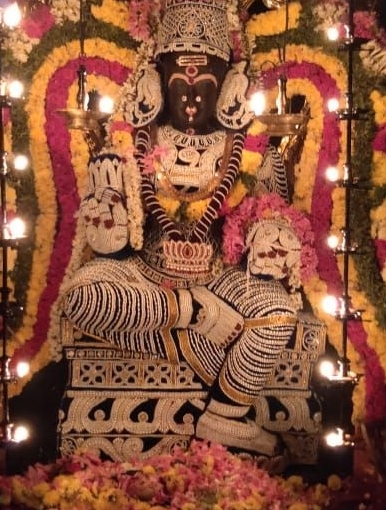
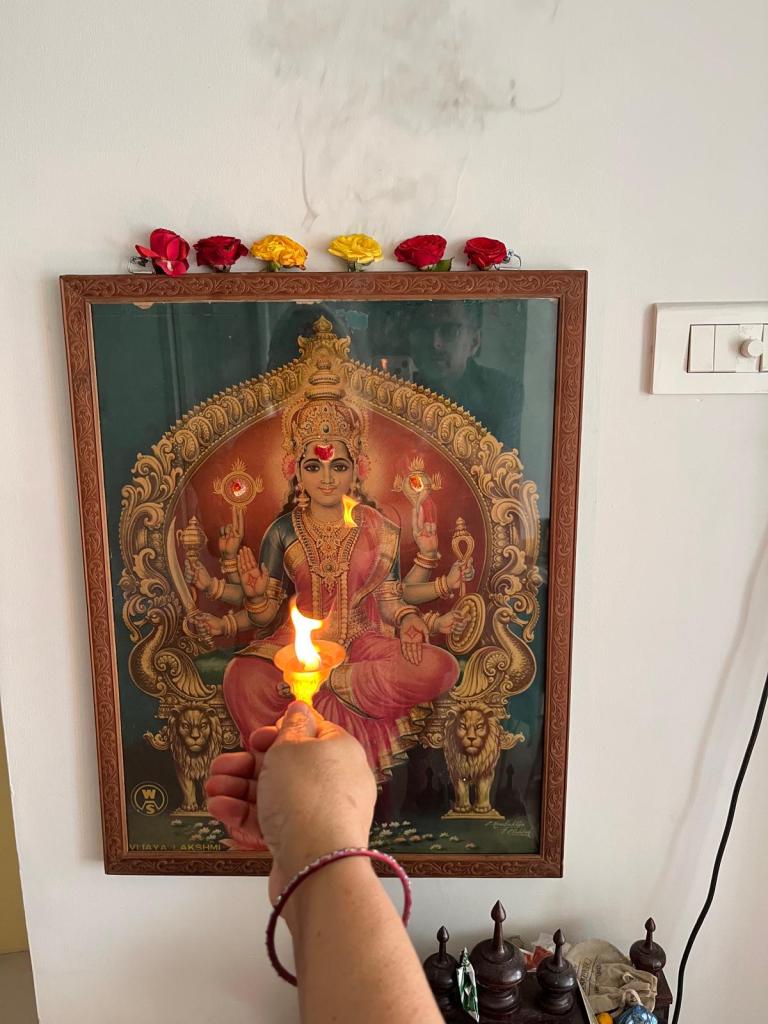
अविद्यीनामन्तस्तिमिरमिहिरद्वीपिनगरीजडानां चैतन्यस्तबकमकरन्दस्रुतिझरी ।दरिद्राणां चिन्तामणिगुणनिका जन्मजलधौनिमग्नानां दंष्ट्रा मुररिपुवराहस्य भवति ॥ ३ ॥
avidyānām antaḥ-timira-mihira-dvīpa-nagarī jaḍānāṁ caitanya-stabaka-makaranda-sruti-jharī |daridrāṇāṁ cintāmaṇi-guṇanikā janma-jaladhau nimagnānāṁ daṁṣṭrā
The dust under the lotus feet of the Divine Mother acts as a supreme remedy for four human conditions:
For the ignorant: It is like the radiant city of the rising sun that destroys the deep darkness of spiritual ignorance (avidya).
For the dull-witted or inert: It is like a flowing stream of sweet honey gushing from a cluster of celestial flowers, awakening pure consciousness (caitanya).
For the impoverished: It is like a necklace of wish-fulfilling gems (cintamani), granting ultimate wealth and prosperity.
For those drowning in the ocean of worldly life (samsara): It acts as the rescuing tusk of Lord Varaha (the divine boar avatar of Vishnu who lifted Mother Earth), saving devotees from endless rebirths.
Benefits of Chanting
Knowledge and Memory: Regular recitation is believed to enhance memory, intellect, comprehension, and grasping power, making it especially helpful for students.
Spiritual Clarity: It helps dispel mental lethargy and inner darkness, leading to higher awareness.
Word by word meaning .
- Avidyaanaam – of those who are ignorant, of those without knowledge of the Self • Antah – inside, internal, within the heart/mind • Timira – darkness, gloom of ignorance • Mihira – sun • Dweepa – island • Nagari – city • Mihira-dweepa-nagari – Like the island-city from which the sunrise appears. Just as the sun rising from an island in the sea dispels darkness, this dust is the city of the sun that dispels inner darkness
For the ignorant, it is the sunrise-city that removes inner darkness.
Line 2: Jadanam chaitanya-stabaka-makaranda-sruti-jhari • Jadaanaam – of the dull-witted, those whose intelligence is dried up like inert matter • Chaitanya – consciousness, supreme living knowledge / Chit • Stabaka – cluster, bunch of flowers, bouquet • Makaranda – honey, nectar of flowers • Sruti – flowing, gushing stream • Jhari – fountain, cascade
For the dull-witted, it is a fountain of honey flowing from the bouquet of Consciousness.
It makes their dry minds green and alive with knowledge.
Line 3: Daridranam chinta-mani-gunanika janma-jaladhau - Daridraanaam – of the poor, those in poverty • Chintamani – the wish-fulfilling celestial gem that grants all desires • Guna – string, quality • Nika – rosary, necklace, heap • Gunanika – a necklace or rosary made of gems, a heap of gems strung together • Janma-jaladhau – in the ocean of birth and death, Samsara
For the poor, it is a necklace of wish-fulfilling gems;
One Chintamani itself grants everything, but Devi’s dust is like a whole rosary of them, giving much more than asked.
Line 4: Nimagnaanam damshtra mura-ripu-varahasya bhavati - Nimagnaanaam – of those drowned, immersed • Damshtraa – tusk, fang • Mura-ripu – enemy of Mura, an epithet of Lord Vishnu / Krishna who killed the demon Mura • Varahasya – of Varaha, the Boar incarnation of Vishnu • Bhavati – becomes, is
For those drowned in the ocean of Samsara, it becomes the tusk of Vishnu as Varaha.
Just as Varaha lifted Mother Earth from the depths of Patala on his tusk after killing Hiranyaksha, Devi’s foot-dust lifts the jiva from the cycle of birth and death to liberation. 4. Overall essence in simple English
The dust from Thy feet, O Goddess:
- Is the rising sun that destroys the darkness of ignorance in devotees, 2. Is the flowing honey of Consciousness that awakens the dull-minded, 3. Is the garland of wish-fulfilling gems for the poor, 4. And is the rescuing tusk of Varaha that lifts those sinking in the ocean of worldly life.
The Essence of Soundarya Lahari — The Wave of Beauty
The Essence of Soundarya Lahari is one of the most profound works attributed to Adi Shankaracharya. It is not just a poem in praise of the Goddess; it is a complete manual of Sri Vidya, Tantra, Mantra, and Advaita Vedanta, hidden within 100 verses of exquisite devotion.
Structure of Soundarya Lahari
The text is divided into two parts:
- Ananda Lahari – Verses 1 to 41 – The Wave of Bliss
This is the most esoteric section, dealing with inner worship and metaphysics.
The core idea: Shiva without Shakti is Shava — inert. The verse 1 begins:
Shivah Shaktya yukto yadi bhavati Shaktah prabhavitum…Consciousness needs Power to act, and Power needs Consciousness to have purpose. They are inseparable. This is Advaita.
Here Shankara describes:
- The Sri Chakra: The abode of Devi, made of 43 triangles, which is also the map of the human body and the cosmos.
- Kundalini Yoga: The ascent of the Kundalini Shakti from Muladhara to Sahasrara, where she unites with Shiva.
- Mantra Shastra: The subtle sounds, the Beeja mantras – Aim, Hreem, Shreem – are encoded in the verses.
This part is to be understood and meditated upon, not just chanted.
- Soundarya Lahari – Verses 42 to 100 – The Wave of Beauty
This section shifts from the subtle to the manifest. Shankara becomes a great poet and painter.He describes the physical form of Devi — from head to toe — Keshadi Padam. Every part of her body is compared to nature, and each description serves as a meditation — a dhyana shloka.
Her eyes are like fish, her smile dispels fear, and her feet are the refuge of all worlds. The beauty is not sensual; it is divine beauty — Soundarya — that uplifts the mind from the gross to the subtle. By meditating on her beautiful form, the restless mind becomes concentrated.
Final Essence for a Sadhaka
Three teachings in one:
- Truth: The universe is the play of Shiva and Shakti. There is nothing outside Her.
- Beauty as a path: You can reach the formless through the most beautiful form. Bhakti for beauty leads to Jnana.
- Shakti is within you: The Goddess you worship outside is the same power that breathes, thinks, and loves within you. To realize Her is to realize your own Self.
That is why tradition says — Ananda Lahari gives liberation, and Soundarya Lahari provides both enjoyment and liberation — Bhukti and Mukti.
It is chanted daily not just for blessings, but because each verse is considered a mantra sadhana in itself for health, knowledge, protection, and ultimately, for union with the Divine Mother.
20,055,963 hits