
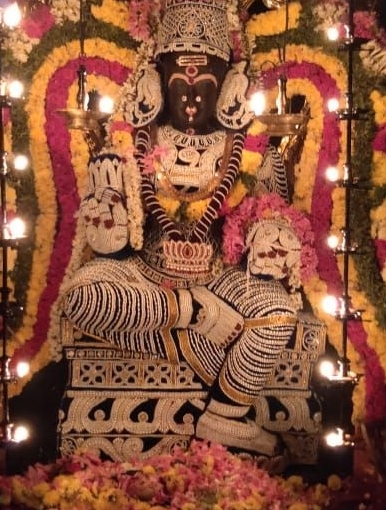

Kadamba Tree → Raja Shyamala / Matangi (Mantrini Devi)
- Associated Devata: Goddess Raja Shyamala (also known as Matangi or Mantrini, the Prime Minister to Lalitha Tripura Sundari).
- Scriptural Connection: The Sahasranama refers to Lalitha as Kadamba-vana-vasini (Dweller in the Kadamba forest). In Sri Pura, the entire Kadamba forest surrounds the inner palace and is governed by Mantrini Devi, who presides over the 64 fine arts, intellect, and speech (Vak).
- Symbolism: Shyamala is depicted with an emerald-green complexion, adorned with garlands of Kadamba flowers and playing a ruby-studded Veena.
2. Lotus (Padma) → Sri Maha Lakshmi & Sahasrara Devata
- Associated Devata: Kamala / Sri Maha Lakshmi and Lalitha Tripura Sundari herself.
- Scriptural Connection:Maha-padmatavi-samstha (She who resides in the great forest of lotuses). In Sri Vidya:
- White Lotus: Associated with Saraswati (Knowledge/Vak).
- Pink/Red Lotus: Associated with Maha Lakshmi (Wealth/Vitality) and Tripura Sundari.
- Cosmic Aspect: The Lotus represents the Sahasrara Chakra (the 1000-petaled lotus at the crown of the head), where Lalitha unites with Shiva.
- Associated Devata: Kameshvara and Lalitha Tripura Sundari holding the Sugarcane Bow (Ikshu Kodanda).
- Scriptural Connection: Manorupekshu-kodanda (Her sugarcane bow is the mind).
- Esoteric Aspect: The sugarcane stalk represents the Mind (Manas Tattva), while its sweetness signifies Ananda (Bliss). The bowstring is strung with honeybees, representing Sankalpa (Will/Intention).
- Associated Devata: Ashoka Sundari (the daughter of Parvati) and Raja Varahi (Commander of Devi’s army).
- Scriptural Connection: Champakashoka-punnaga-saugandhika-lasat-kacha.
- Esoteric Aspect: “Ashoka” literally translates to “without sorrow” (A-shoka). In Sri Vidya, Varahi removes inner fear and mental afflictions, residing near the outer forests of Ashoka trees surrounding Sripura.
- Associated Devata: Maha Lakshmi (Bilva is also known as Sri Vriksha) and Lord Shiva / Kameshwara.
- Scriptural Connection: Bilva leaves are mandatory in Sri Vidya Bilva-archana (1000 Bilva leaf offerings).
- Esoteric Aspect: The trifoliate leaf embodies the Three Shaktis:
- Iccha Shakti (Desire)
- Jnana Shakti (Knowledge)
- Kriya Shakti (Action)
- Associated Devata: The 8 Vagdevatas (Vasini, Kameshwari, Aruna, Vimala, Jayinee, Modhinee, Sarveshwari, Koulini) who authored the Lalitha Sahasranama.
- Scriptural Connection: Champakashoka-punnaga… and Navachampaka-pushpabha-nasadanda-virajita.
- Esoteric Aspect: These fragrant flowers represent refined sensory perception and sweet, flawless speech (Vak-Siddhi), governed by the Vagdevatas.
Goddess Lalitha Parameswari, also known as Lalita Tripura Sundari, is deeply connected to nature and is often envisioned as Prakruthi (nature) itself.
Her devotees frequently offer specific plants and flowers in her worship, and many are mentioned in sacred texts like the Lalitha Sahasranamam.
Key plants and flowers associated with her:·
Kadamba (Neolamarckia cadamba): This is perhaps Her most beloved tree. In the Lalitha Sahasranamam, She is called Kadambakusumapriya (“the one who is fond of the Kadamba flowers”) and Kadambavanvasini (“the one who resides in the Kadamba forest”). The tree holds profound tantric significance, symbolizing the tradition and consciousness that grows from the Goddess herself.·
Lotus (Kamalam): The Goddess is often depicted seated on a lotus, holding lotus flowers in her hand. She is called Kanja Lochana (“the Lotus-Eyed One”), and the lotus is a sacred offering that symbolizes purity and divinity.·
Red Hibiscus (Japa): Red is a powerful color associated with Goddess Lalita. Red flowers, especially hibiscus, are a popular and standard offering in Her worship.·
Champak, Ashoka, and Punnaga: These fragrant flowers are noted for their scent. She is described as having dark hair carrying the fragrance of Champak, Ashoka, and Punnaga flowers.·
Jasmine (Mallika): Along with other fragrant flowers, jasmine is mentioned as a suitable offering for the Goddess. A flower garland offering to Her is called Mallika Samarpanam.·
Turmeric (Haridra): The plant from which turmeric is derived holds great significance. Kumkum, made from turmeric, is one of the most popular offerings to Goddess Lalita. Offering turmeric itself is also a common practice.·
Betel (Tambula): The Goddess is believed to be pleased by offerings of betel leaves and betel nuts. Chewing tamboola (betel leaf with camphor) is also part of Her divine description.·
Sandalwood (Chandana): Offering sandalwood paste to the Goddess is a standard part of Her worship rituals.·
Mango (Amra): The mango tree is symbolically linked through the sugarcane bow She holds, and mango leaves are used in the Kalasha (sacred pot) during Her puja.


