Buddhism, a great Religion of India, started off as a System to overcome the excessive use of Karma Kanda of the Vedas, where he Rituals of the Vedic
system.

Mimamsa was at its apex and it followed the Rituals vigorously with the result that the Yagnas were performed excessively and sacrifice of animals was
at its peak.
At the other end were innumerable gods, Goddesses.

Karma Kanda per se is very complicated and people were fed up.
Buddhism filled in the void with its Philosophy of change , its Nireswara vada, denial of Personal God, Idol worship and its denial of Vedic Authority.
It is an irony that Buddha is being worshiped as God.
There is a temple in Nepal where Lord Shiva and The Buddha are worshiped in a Temple and in the same Image.
This is Rato Machhendranath or Matsyendranath in the southern part of the Patan Durbar Square ,Nepal.
Hindus regard him as the reincarnation of the Lord Shiva, while the Buddhists regard him as the Tantric reincarnation of Avalokiteshvara.
The Patan temple, also known as the Rato Machchhindranath Temple, is one of the oldest temple which dates back from 16th century.[2] It is one of the famous temples of the Kathmandu Valley. It lies in the southern part of the Patan Durbar Square. Each of the four well crafted wooden doors of this temple is guarded by two lion figures while the four corners of the temple are guarded by Khyah, a Yeti-like demonic figure.[1] Rato Machchhindranath spends six months of the year in this temple.
The village of Bungamati, regarded as the birthplace of Machchhindranath, is a traditional Newar town located 10 km from downtown Kathmandu.
The temple of Rato Machchhindranath is located in the heart of this village and it is known as his second home.
It is a well crafted shikhara styled temple.After the chariot festival, Rato Machchhindranath spends the next six month in this temple.
Legend od Machendranath.
When Guru Gorakhnath visited Patan, he captured all the rain showering serpents of Patan and started to meditate after he was disappointed by the locals as they did not grant him any alms on his request.

As a result, Patan faced drought for a long time.
The then king of Patan, on the advice of his advisers, invited Machchhindranath, Guru of Gorakhnath, to Patan.
When Gorakhnath learned that his teacher was in Patan he released all the rain showering serpents and went to see him.
As soon as the rain showering serpents were set free, Patan again got plenty of rainfall every year.
After that day, the locals of Patan worshiped Machchhindranath as the god of rain.
Bunga Dyah Jātrā (Devanagari: बुंग द्यः जात्रा) is a chariot procession honoring the Buddhist deity of compassion Avalokiteśvara(Sanskrit: अवलोकितेश्वर) held in Lalitpur, Nepal. It is one of the greatest religious events in the city and the longest chariot festival celebrated in the country.
Bunga Dyah is also known as Raktalokitesvara Karunamaya and Rāto Machhendranāth (रातो मछिन्द्रनाथ), and is revered as the giver of rain.
The name Rato Machhendranath means Red Machhendranath in a reference to the color of the deity’s image.
The chariot festival is held according to the lunar calendar, so the date is changeable.
It begins on the 4th day of the bright fortnight ofBachhalā (बछला), the seventh month in the lunar Nepal Era calendar.
The chariot procession was instituted to celebrate the arrival of Bunga Dyah in Nepal and the end of a devastating drought
. It was started when Narendra Deva was the king (640-683 AD).
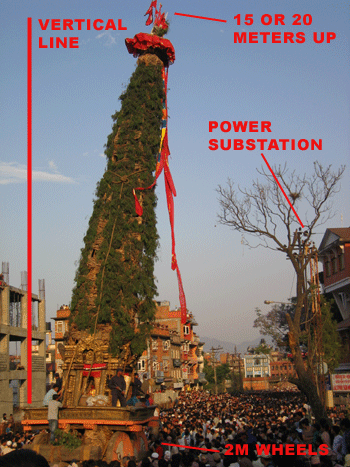
Preparations for the festival begin with the construction of a 60-foot tall chariot at Pulchok at the western end of Lalitpur.
When the chariot is complete, the image of Bunga Dyah from his temple is installed in it.
Revellers then drag the chariot through the streets of Lalitpur on a tour that lasts a month.
The chariot of Bunga Dyah is accompanied on the journey by a similar but smaller chariot of Chākuwā Dyah (चाकुवा द्यः).
The deity is another Bodhisattva and is also known as Minnāth.
The route of the chariot procession starts at Pulchok and passes through Gabahal, Hakha, Sundhara,
Lagankhel and ends atJawalakhel. As per time-honored tradition, the chariot is pulled exclusively by women on the stretch between the localities of Iti and Thati.
This part of the chariot procession is known as Yākah Misāyā Bhujyā (याकः मिसाया भुज्या).
The parade finishes at the open ground of Jawalakhel which is situated at the western side of Lalitpur.
There, the festivities conclude with the ceremony of Bhoto Jatra, the display of the bhoto, a traditional Nepalese vest.
Bhoto Jatra, which literally means “vest festival”, is the climax of the chariot procession of Bunga Dyah Jatra.
After the two chariots arrive in Jawalakhel, astrologers choose an auspicious date to hold the Bhoto Jatra festival.
On the appointed day in the presence of the head of state, a government official climbs on to the chariot and holds up a jewel-studded black vest from the four sides of the chariot so that all the people gathered around can have a look at it.
The display is a re-enactment of an event that happened eons ago.
According to legend, a Newar Jyapu farmer lost the vest which he had received as a gift from the serpent god Karkotaka Naga for doing him a favour.
One day, the farmer had come to Jawalakhel to watch the chariot pulling festival where he saw someone wearing his missing garment.
A quarrel ensued over the vest, and since neither party could prove ownership, it was agreed that the undershirt would be kept with Bunga Dyah until the rightful owner comes to claim it with adequate proof.
Since then, the vest has been shown to the public annually as a call to potential claimants to step forward.
The living goddess Kumari of Patan also arrives in Jawalakhel to observe Bhoto Jatra.
She watches the ceremony from a special rest house.
The auspicious day when the Bhoto Jatra is held is determined by astrologers, so the date is changeable.
In 2014, the vest showing will be held on 22 June.
After the festival, the chariot is dismantled and the parts are stored until it is time for the procession the next year.
RatoMachhendranath is taken to a temple in the nearby village of Bungamati, also known as the second home of the rain god.
The deity spends the next six months in that temple.
Source:
http://en.wikipedia.org/wiki/Rato_Machhendranath_Jatra_(chariot_festival)
Related articles