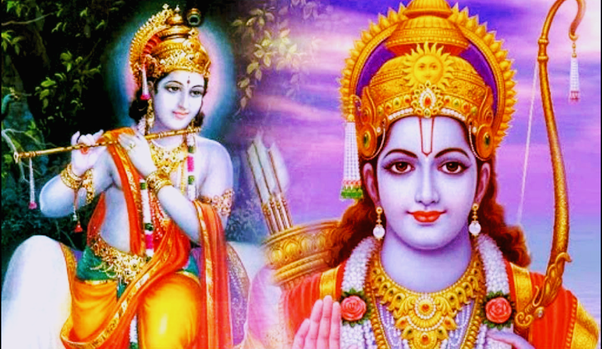
History of India starts with two Dynasties,both had sprung from Vaiwaswatha Manu.The Suryavansh,the Solar Dynasty was founded by Manu’s son, Ikshvaku , while the Chandravansh Lunar Dynasty was by Ila, daughter of Manu.So , Solar and Lunar dynasties are related by blood.
There is then the Yadava Dynasty, to which Sri Krishna belongs.The Dynasty is named after Yadu. ‘Yadu is one of the five Indian tribes (panchajana, panchakrishtya or panchamanusha) mentioned in the Rig Veda. Krishna is the descendant of Yadu from Vedic tribe’https://en.m.wikipedia.org/wiki/Yadu
An interesting fact is that Sri Rama’s ancestor, Mandhata was married to a Yadu princess.
‘Mandhatri or Mandhata (Sanskrit: मान्धातृ, Māndhātṛ), in Hindu mythology, was an Ikshvaku dynasty king and son of Yuvanashva.[1] He married Bindumati Chaitrarathi, daughter of Yadava king Shashabindu and granddaughter of Chitraratha.[2] Source. Wikipedia Mandhatri.
Thus,Sri Krishna is related to Sri Rama . Krishna’s Ancestor Chaitravathi was married to Mandhata,Sri Rama’s Ancestor.
Thus Sri Rama is related to Krishna as Krishna’s Great Aunt’s descendant ( removed by Thirty Seven generations.
Sometime back, I have written tha there is an attempt to legitimise Christianity and Islam by portraying that these religions were foreseen in the Purana.
Bhavishya Purana talks about the coming of The Prophet and Islam.
In my opinion this is an interpolation.
Please read my article on this.
Similarly there is misinformation going around that Jesus came to Himalayas,studied Yoga/Vedas ,Died in Kashmir and that the Tomb of Jesus is in Kashmir.
I have debunked this claim in my article.
However when one one examines History it is found that,
1.The Yadava tribes migrated to middle east((77 families) .
Now I have come across information that Saint Paul’s Catgedral was Krishna’s temple.
‘
St. Paul’s cathedral in London rebuilt by Christopher Wren after the great fire of London over 300 years ago still retains several pre-Christian traditions.
St. Paul’s used to be a Gopaul alias Chrisn temple…
Here are some of the proofs:
Its central altar is separated from the backside wall by a narrow perambulatory passage.
The main altar enshrines not Jesus but the eight directional Vedic cross……
The Star of Lakshmi is a special octagram, a regular compound polygon, represented by Schläfli symbol {8/2} or 2{4}, made from two congruent squares with the same center at 45° angles, and figures in Hinduism, where it represents Ashtalakshmi, the eight forms, or “kinds of wealth”, of the goddess Lakshmi.
One comes across interesting information when one researches the Indian Texts, which have been discarded by the West and accepted by the Indian Intellectuals((?)
Spread of Yadavas .Yadava Kingdom.
To me the Indian Texts are History and there is ample physical evidence to prove what has been stated in them.
They have been validated by archeology, astronomy, internal and external evidence of the west’s interpretation of Indian History.
I have written quite a few articles on the validation of Indian History, be it the Age of the Rig Veda, Rama and Krishna, Agastya, Tamil Kings, Shiva, Murugan,,the Age of Thiruvannamalai, Tirupati temples.
I have been intrigued by the worship of Aravan, son of Lord Krishna since early ages in Tamil Nadu.
There is a Temple for Aravan ,Koothaandaar Koil, near Tindivanam , about 3 hours from Chennai, where a festival is conducted years by the Third gender for Iravan.Aravan is called thus in Tamil as words starting from R is not allowed by Tamil Grammar.
And the practice of Bul fighting called Manju Virattu in Tamil from ancient times in Tamil Nadu has Krishna connection.
Bull Fighting , which is famous in Spain was started by Krishna!
And the term Eru Thazhuvudhal, that of a jilted lover embracing death by climbing a special tree, also has Krishna connection!
I shall be writing on this in detail.
Meanwhile, I came across information that Krishna’s sons expanded their Kingdom throughout India and all the Kingdoms of India descended from either Rama or Krishna.
‘The main part that Mahabharata mentions that Arjuna established the son of Kritavarma at Mrittikavati and the great-grandson of Krishna, Vajra at Indraprastha. Some Puranas mention Vajra was established at Mathura. But these two kings did survive out of the Yadava clan. The Yadava clan was not completely wiped out but it’s influence reduced considerably.
The Abhiras were becoming strong since the Mahabharata war. Their kingdom was in the Sindhu region. The control of Purus and Yadavas reduced considerably on that region after the war. The Abhiras attacked Arjuna when he was taking back the Yadava women. The Abhiras took away some of these women. If the Mahabharata had actually happened around 3000 BC, then this entry of Abhiras in the Saraswati region could very well explain the Harappan civilization which sprung around the same time. The Gupta dynasty is claimed to have sprung from these Abhiras. The Yadava kingdoms did exist, but became less in number. The one Yadava kingdom that existed was the Devagiri kingdom in Maharashtra whose rulers claim direct descent from Krishna. There still exist people with the surname Yadav in north India who claim descent from the royal Yadavas. Apart from that, Nanda, Krishna’s foster father was also included in the Yadava clan and his descendants called Nandavanshi Yadavas still exist…..”
It can be inferred from the vamshanucharita (genealogy) sections of a number of major Puranas that, the Yadavas spread out over the Aravalli region, Gujarat, the Narmada valley, the northern Deccan and the eastern Ganges valley.[10] TheMahabharata and the Puranas mention that the Yadus or Yadavas, a confederacy comprising numerous clans were the rulers of the Mathura region.[11] The Mahabharata also refers to the exodus of the Yadavas from Mathura to Dvaraka owing to pressure from the Paurava rulers of Magadha, and probably also from the Kurus”
Yadava dynasty, rulers of a 12th–14th-century Hindu kingdom of central India in what is now the Indian state of Maharashtra. Originally a feudatory of the Eastern Chalukyas of Kalyani, the dynasty became paramount in the Deccan under Bhillama (c. 1187–91), who founded Devagiri (later Daulatabad) as his capital. Under Bhillama’s grandsonSinghana (reigned c. 1210–47) the dynasty reached its height, as the Yadava campaigned against the Hoysalas in the south, the Kakatiyas in the east, and the Paramaras and Chalukyas in the north.
The Yadavas spread to me Tamil Nadu and Kerala.
The Velir Kingdoms were , at one point of time, the Major allies of Chola Kings.
I have written a number of articles on the spread of Sanatana Dharma throughout the world.
Sri Lanka,
Malaysia,
Thailand,
Laos,
Korea,
Indonesia,
Cambodia,
Vietnam,
Japan,
Philippines,
New Zealand,
Australia,
US,
South America,
Central America,
Greece,
Romania,
Turkey,
Germany,
Iran,
Iraq,
Afghanistan,
Russia,
China.
You may check my posts for each of these countries.
As I have been attempting to study the references to Sanatana Dharma through various sources, including works in other languages, I have requested Beatrix Laurens, France, (a regular reader of my posts) to suggest French references.
I am aware that French is the most suited langauge suited for Philosophy, apart from Sanskrit.
I was sure that there are bound to be references.
I was suggested a site and I have been promised more.
As I was going through the site, I chanced upon a Link that threw up interesting information about Lord Krishna.
I shall be writing on Rama Influence, sourced from the site mentioned by my friend a later as I have to study the material in-depth as it makes startling revelations.
Now,
I have been able to establish from reliable sources that.
1.Christianity was nothing new and was sourced from elsewhere.
2.There was Sanatana Dharma presence in the middle east.
3.Interesting that The Jews were the descendants of the Yadavas, Lord Krishna’s Clan.
Twenty two tribes left India after the Mahabharata War.
After the epic battle of Mahabharata, exodus from India began .
Many tribes fled from India towards the North and West.
It has come to light that one of the tribes, Ailahs fled to the middle east and the Arabs called their God as Allah, from the Sanskrit speaking tribes Ailah.
Ailas were a part of Yadavas and Pauravas who took part in the Mahabharata battle.
5.Sumerian culture’s Link with Sanatana Dharma has been dealt with in detail in my earlier Posts.
6.We have the 786 of Islam being the OM of Hinduism.
7.There was Shiva Temple in Mecca.
8.Also in Jordan, Petro Jordan Shiva temple.
9.The Greeks had a fascination for Krishna and we have many legends of Krishna in Greece and there is enough evidence to suggest that the Greeks worshiped Lord Krishna.
11.Then we have the Tamil connection to Hitti Empire, Mittani,Incas, Aztecs,Mayas.
12.The ancestors of Celts wereBrahmins.
I shall be writing on the similarities between Sanskrit and Irish Languages
Additional information has come to my notice about the Temple of Solomon( I shall be writing on this later) and about Krishna in Greece and Krishna was the God of the Greeks.
Dome of The Rock.
Abraham’s Tomb.
‘In about 1900 BC, hundreds of thousands of native Indians emptied Northern and Central India and fled to the Middle East after Krishna’s Dwarka sank under the water.( I have reservations on the date here)
..*his family together and fled either to the Middle East or to what is now Iraq. Only some gigantic natural disasters, such as earthquakes and floods could have caused such an exodus. It was at this time that the Saraisvati and the Indus changed their proper beds. The Saraisvati dried up…( Possible as Krishna’s son Pradhyumans’ city is in Russia-please refer my post on this)
The word Jerusalem is derived from Sanskrit: Yadu-Ishalayam, meaning “The Holy Rock of the Yadu Tribe.” Lord Krishna was a Yadu. The Moslems still revere this huge rock under the Dome of the Rock on Jerusalem Temple Mount.
..
Until now, I have been wondering why Krishna’s name did not appear in Jerusalem after his arrival there. Yet, the name of the king of Jerusalem,Melchizedek, the mentor of Abraham, did. I once thought thatMelchizedek was the name of a certain person. I made this mistake by thinking that a prince and a son of a Kassite king, Melik-Sadaksina, was a supernaturally endowed prince, magician and spiritual giant. I thought he had accompanied Krishna, Abraham, and Sarah to the Middle East. Later on, I came to realize that the Sanskrit word Sadhaka applies to anyone who is an adept, a magician, one possessed of supernatural powers gained by worshipping a deity or by uttering magical chants……
‘Krishna and his family probably fled to Iraq. But I’m certain that they went to Jerusalem. The word Jerusalem is derived from Sanskrit: Yadu-Ishalayam, meaning “The Holy Rock of the Yadu Tribe.”
Lord Krishna was a Yadu.
The Moslems still revere this huge rock under the Dome of the Rock on Jerusalem Temple Mount.
(The India We Have Lost,Paramesh Choudhary)
I have additionally shown in this article that the New Testament words for Jesus all refer to Lord Krishna and his holy names. The early Christians were convinced that Melchizedek was just a prior incarnation of Jesus Christ, The remains of the Nag Hammadi manuscript entitled Melchizedekseem to confirm this. Melchizedek, king of Jerusalem and mentor of his son Abraham, was none other than ancient India’s God Krishna. The early Christians thought that Jesus was a reincarnation of Krishna, for who else had the name Yesu Kristna, Isa, Krishna, etc.?”
..
..
Many people don’t understand what is meant by Joshua’s remark about “the other side of the flood.” They think he was referring to the Noachide flood. He was referring to the time when God Krishna’s Dwarka and Haran province, in today’s Gujarat, sank under water in about 1900 BC. Abraham, Sarah, and their followers escaped southward, to the coastal ports of Kalyan and Sopara (Sophir or Sauvira), in Maharashthra. From there, they sailed northward to the Middle East. Sarah (Sarsvati) embarked from the port of Kalyan. At one time, Kalyan was located closer to the coast, but is now located more than 50 miles inland. Sarasvati is the patron saint of Kalyan. The patron saint of Sophir or Sauvira was Parasu Rama (possibly a name of our biblical Abraham/Brahma).
And I took your father Abraham from the other side of the flood, and led him throughout all the land of Canaan… (Joshua 24:2-3.)
Mount Meru occupies an important part of Hinduism.
Devi Lalitha is described as sitting in the center of the Mount Sumeru, in Sri Nagara.
Sumeru Mandala Madhyastha Sriman Nagara Nayika- Lalitha Sahasranama.
The Open Secret of India, Israel and Mexico from Genesis to Revelation.
I have written a few articles on the location of Mount Meru.
Meru is found in all the middle eastern literature , along with the Lotus Motif, a special feature of Devi.
Sumerian culture’s Link with Sanatana Dharma has been dealt with in detail in my earlier Posts.
We have the 786 of Islam being the OM of Hinduism.
There was Shiva Temple in Mecca.
Also in Jordan, Petro Jordan Shiva temple.
The Greeks had a fascination for Krishna and we have many legends of Krishna in Greece and there is enough evidence to suggest that the Greeks worshiped Lord Krishna.
Then we have the Tamil connection to Hitti Empire, Mittani,Incas, Aztecs,Mayas.
I have Posts on all these ..
After the epic battle of Mahabharata, exodus from India began .
Many tribes fled from India towards the North and West.
It has come to light that one of the tribes, Ailahs fled to the middle east and the Arabs called their God as Allah, from the Sanskrit speaking tribes Ailah.
Ailas were a part of Yadavas and Pauravs who took part in the Mahabharata battle.
And this tribe did not stop here.
They proceeded further west.
And landed in Samaria.
This is in Israel’s ancient capital.
The Samarians were mainly concentrated Mt.Gerer.
We use the word good Samaritans to denote good work.
These Samaritans were of Indian origin.
Reference.
The Open Secret of India,Israel and Mexico from Genesis to Revelations by Gene Matlock.
Check out for this book and more.
You must be logged in to post a comment.