Tag: Vedanta

  • Understanding Saguna and Nirguna Brahman in Hinduism

    Understanding Saguna and Nirguna Brahman in Hinduism

    Introduction To Nirguna Saguna Sahasranama Aradhana.

    Saguna means “with attributes.” Nirguna means “without attributes.” “Saguna Brahman” describes a God with (tangible) attributes. The term “Nirguna Brahman” describes a God with no (tangible) attributes.

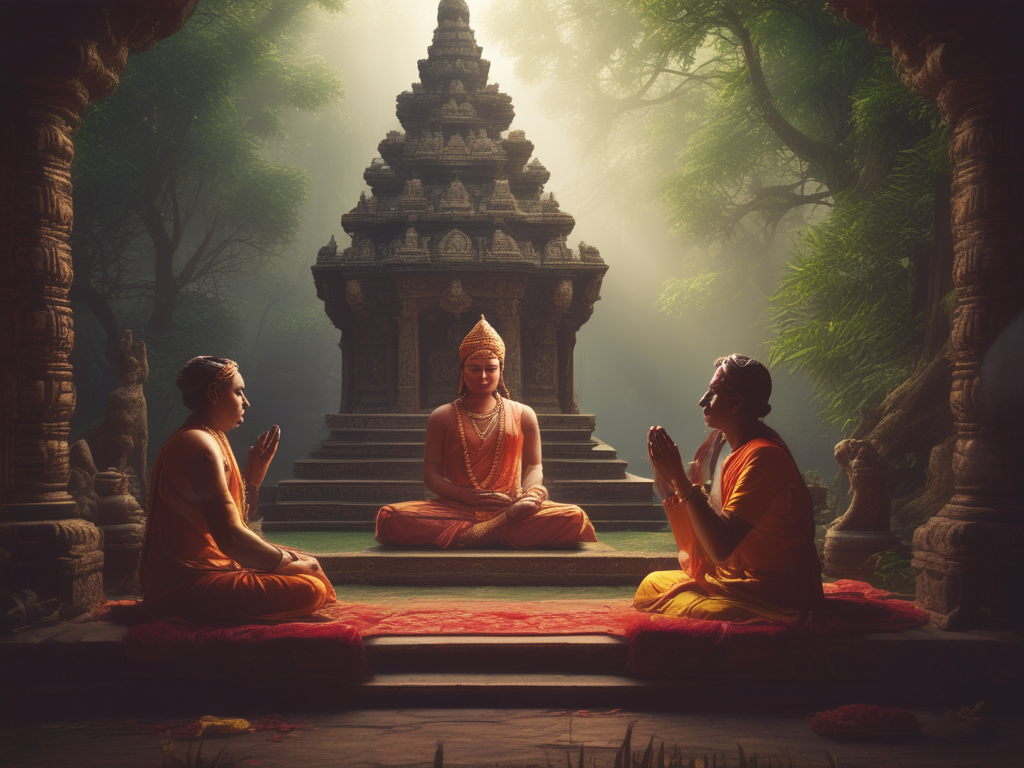
    One with Attributes, qualities,Saguna.The other Nirguna, without Attributes,Nirguna.The western thought explores the Universe through what is outside,the perceived.It is necessary to have something in us to perceive .For all we know, there may be things out there and if one does not se it or perceive it, one may never know it, aware of it.Awareness, which is the rudiment of Knowledge,, needs two things.That which is to one known and that which knows or is aware.‘We have the Mind as an instrument.We know things through the Mind.If the Mind is absent or dysfunctional, we will not know things out there or may not know them as they are.Hinduism makes further distinction.Mind is what interprets sensations and the Data received.The sensations or Data is received is through the Brain, which is just like a CPU, just receives.The job of sorting them out, collating adding value judgements is reserved for the Mind.The classification and addition of value judgments is by the Chitta that directs the mind.The Chitta is based on Human Dispositions.The dispositions of individuals vary.So what is out there varies .So logically what we perceive is not what IS but what we perceive as what IS.So Reality expresses itself in the way we want to perceive it.This is the reason why many Gods and Goddesses are found in Hinduism.Without accommodating the Mind to perceive by providing it with a Target, we can not know what is outside.Therefore knowing the limitations of the Mind, Hinduism prescribes different systems of worship.The target of worship may be an Idol, Symbol.Once the Mind gets focussed on this, it evolves to comprehend the Ultimate Reality without Attribute, Brahman.These procedures are like gradually moving from LKG to Ph.d.Once you obtain Ph.d , LKG seems to be irrational and look unnecessary.But without it, you could not have reached Ph.d level.Yet there are individuals who are equipped with dispositions to do Ph.d, that is to understand Reality without Attributes, Nirguna Brhaman.One Like Ramana MaharishiAdi Shankaracharya has provided a Stotra addressed to Nirguna Brahman which explains these.One may notice that all the Sahasranamas, Vishnu and Lalitha Sahasranamas have Saguna and Nirguna Brahma upasanas embedded in them.Lalitha Sahsranama has organised this better by allotting separate portions,like Saguna Aradhana, Nirguna Aradhana and the identification of Shiva and Shakthi in the same Text.

    Aghora Pasupatha Homa Evil Eye Protection Mukthi

    Removal of Evil eye, Protection from forces that hinder Spiritual development. Protection from Black magic,Animals. Increases self confidence and self assurance. Clarity of thought.. Above all,Mukthi and Gnana are facilitated.

    Rig Veda Inflenced Civilizations Outside India

    Date of Rig veda in Ramanisblog According to Ramanisblog, the date of the Rig Veda is subject to considerable debate, with modern scholarly estimates generally ranging between 2000 BCE to 1000 BCE[1]. However, Ramanisblog highlights that Hindu tradition considers the Vedas to be timeless and without a specific beginning[1]. Perspectives on Rig Veda Dating Ramanisblog…

    Navavarana Pooja 1 Guru Stuthi

    Following in the Ai Generated transcript of the Navavarana Pooja Mantras . Recorded and sent to my Shishyas. This is being made public so that this secret knowledge is not lost to posterity. Those who want to be initiated may contact me through mail at ramanan50@gmail.com. Also they can contact through the comment column. If…

    Brahman

    Brahman, a key concept in Hinduism, is the ultimate, unchanging reality beyond the physical world. It is described as omnipresent, infinite, and eternal. The concept of Brahman encompasses both Saguna (with attributes) and Nirguna (without attributes) manifestations. Saguna Brahman represents a God with tangible attributes, while Nirguna Brahman represents a God without tangible attributes. Understanding and realizing Brahman is central to various forms of Hindu worship and philosophical inquiry.

    In Hindu philosophy, the human mind plays a crucial role in perceiving and interpreting the external world. According to Hindu thought, the mind interprets sensations and data received from the external world, with the brain acting as a receiver. However, it is the mind that processes and adds value judgments to this information through the faculty known as Chitta, which is influenced by individual dispositions.

    Recognizing the limitations of the human mind, Hinduism prescribes various approaches to worship and spiritual practice. Different systems of worship are intended to gradually lead the mind from focusing on tangible forms, such as idols or symbols, to comprehending the ultimate reality without attributes, the Nirguna Brahman. This gradual progression is likened to the educational journey from kindergarten to obtaining a Ph.D. Individuals with predispositions for understanding the reality without attributes, like Ramana Maharishi and Adi Shankaracharya, are rare yet exemplify this profound understanding.

    It is notable that Hindu scriptures, such as the Vishnu and Lalitha Sahasranamas, incorporate both Saguna and Nirguna aspects of Brahman worship. Lalitha Sahasranama, in particular, comprehensively organizes these aspects by allocating separate sections for Saguna and Nirguna worship, acknowledging the interplay of Shiva and Shakti within the same text.

    In summary, the concept of Brahman in Hinduism encompasses both Saguna and Nirguna manifestations, reflecting the profound understanding of ultimate reality and the methods to realize it.

    Related Articles

  • Who Is Somaskanda, Manmatha God Of Lust

    There is a general confusion between Somaskanda and Skanda.


    While Skanda is identified with Subrahmanya, Muruga, (there are two opinions on this), Somaskanda is a Form of Lord Shiva with Goddess Uma and Skanda, Muruga as child along with them.


    http://www.shaivam.org/gallery/image/forms/masoma1.jpg
    http://www.shaivam.org/gallery/image/forms/masoma1.jpg

    This Form of  Shiva is the One that granted the boon of a Son to Lord Maha Vishnu.


    While praying Shiva for a child, Vishnu did not offer due respect to Uma and was cursed to the effect that Vishnu’s son, who will be born by the Grace of Shiva will be burnt to ashes by Shiva Himself.


    Manmatha was burnt to ashes during Shivas tapas, to be wakened  and be made Invisibl at the behest of rati, Manmathas’  Wife, before  Shiva’s Marriage with Uma.


    And as Vishnu did not offer due respect to Her because She is a Woman, Vishnu’ son will be inciter of Lust towards women.


    This son will be invisible without any form.


    He is Manmatha, the God Lust.


    Philosophically speaking  in the exercise of Leela of Creation  Sustenance and Destruction, attraction to women, Carnal impulse is essential.


    If every one were to practice the Highest Vedanta and be come celibate the natural process of creation will not endure.


    So desire is personified , that too by the Greatest Yogi, Shiva by His Grace through the Sustainer Vishnu.


    Lust overrides all emotions and practices and is never really destroyed,the Invisible Driving Force.

     

    So Hinduism prescribes channelling Lust and not eradication of it.


    Senses are to be controlled not to be destroyed.


    Proper channelization and  engagement in Gruhasrama lifts one spiritually.


    Gruhastrama is given priority even over Sanyaasa in Hinduism.


    Kudanthai Kaaronam Temple.Imge.jpg.
    Kudanthai Kaaronam Temple.


    Moolavar
    : Someswarar
    Urchavar :
    Amman / Thayar : Thenar Mozhial, Somasundari
    Thala Virutcham :
    Theertham : Mahamaga Theertham
    Agamam / Pooja :
    Old year : 1000-2000 years old
    Historical Name : Kudanthaikaronam
    City : Kumbakonam
    District : Thanjavur
    State : Tamil Nadu

    Lord Brahmma was much annoyed when the great flood-Pralaya- took place and was in a dilemma as from where he had to begin creation again.  He surrendered to Lord Shiva for guidance.  Lord Shiva said, “Gather sand from as many holy places as possible and mix it with nectar and make a Mayakumbam-pot.  Fill this pot with nectar and keep the creation seed – Srushti Beeja.  Place a coconut on the pot and decorate with mango leaves.  Cover the pot with threads.  Keep it on an Uri so that it does not fall on sides.  This pot would float on the Pralaya flood.  I will come there.”
     Kumba the pot fell from the Uri and floated in the pralaya flood.  A Linga appeared at the place.  Moon-Soma worshipped the Lord here, hence, Lord is praised as Someswarar.


    Sri Someswarar (Kudanthaikaronam) temple, Kumbakonam-612 001.


    +91- 435-243 0349.


    Temple information Citation.

    http://temple.dinamalar.com/en/new_en.php?id=366

    Enhanced by Zemanta
  • Vedas Wrong Throw Upaveeda Manglasutra

    I received a communication from a member of a Facebook community.


    Radha Soami Satsang Philosophy is destroying Vedic culture by luring gullible Brahmins ignorant of Vedas


    Radhasaomi
    Radhasaomi Satsang


    They look down at all hindu elements as worthless in the name of philosophy.


    please help me combat them in theory.


    My relatives are giving up hinduism plucking off sacred threads and mangala sutrams in the name of this bogus philosophy’


    The writer blogged about this.


    Brahman is considered to be the highest reality in Vedanta


    The founders of Radhasoami faith, however, came forward with a new concept. According to them, TheBrahman of Vedanta is limited to the second grand division of the creation whom they call “spiritual-material region”.


    They hold that the Brahman is not the true Supreme Being or the highest reality because he is not perfectly free from mind and matter.


    They assert that though spiritual components predominate in Brahman, there is Maya latent in the seed form and a Supreme Reality having the least admixture of Maya cannot be styled as the highest truth.


    They envisaged the highest and the first grand division of creation as the region of the true Supreme Being who is absolutely spiritual and totally free from mind and matter.


    Such a Supreme Being they have named as Radhasoami. In view of the said difference between Radhasoami and Brahman, the meaning of the word is not Krishna or the Lord of Radha. 


    A casual observer however gets confused and straightway starts interpreting it for Krishna as Farquhar did when he observed :


    “It is necessary also to realize that the real meaning of Radhasoami is Krishna as Lord of Radha (His cowherd mistress in the latest cycle of myth) that

    Soami is only a curious phonetic misspell of Swami. 


    My answer.


    These interpretations come from a half-baked understanding of the Vedas.


    From what is posted on their site, i get the impression that they may not know Sanskrit at all, let alone the Veda such is the misinterpretation.


    Nowhere does the Vedas proclaim that Brahman contains Maya or ‘ he is not perfectly free from mind and matter’,


    Brahman perse is described by the Neti Nyaya or the process of excluding things, like


    Not this, not his, neither tall nor small etc.


    It is not described by direct by positive Attributes, excepting by the Realized qualities (which we are capable of perceiving) Sat,Chit,Ananda,


    Pragyana Brahma, Sathyam Gnaam Anandham Brahma..


    May is a concept that has been used to understand the manifestation or the differentiation of the Reality to enable one to understand the Reality.


    Acquisition of Knowledge,unlike in the Western Philosophy, is a negative Concept,


    The removal of ignorance is Knowledge , not the acquisition some thing from outside as you are a Part of The Brahman which is Knowledge personified.


    You appear to be different from Brahman  because of Avidya or Ignorance.


    Avidya at the Universal level it is called Maya.


    When your basic premise is wrong , your conclusions are also equally wrong.


    As I noted earlier, the site abounds in inaccuracies down to out right lies on the Vedas.


    One may have to write a rebuttal for every sentence they have provided.


    One should never take umbrage under Lord Krishna to criticize the Vedas for Lord Krishna is The Veda and as Vyasa He compiled it.


    The philosophy of Radhasoami Satsang is either a fraud being perpetrated to fill in some one’ coffers or the ravings of  a delinquent or a clever ploy to

    discredit the Vedas or a combination of all these


    As to people discarding Upavedeeda, well it is your funeral.


    As to Mangala Sutra, it is not a concept if the Vedas.


    If some one wants to become a spiritual pervert, we can not do any thing about it.


    Vedas are not The Bible to threaten people into believing it nor Shankaracharya a Christ who is proselytizer.


    Sources.

    radhasoamisatsang


    God of my thoughts


    Enhanced by Zemanta
  • Essentials of Indian Philosophy, Review.

    Book by Professor Hiriyanna.
    Essentials of Indian Philosophy.

    Indian Philosophy is an Ocean.

    To make this appear simple is a feat and Professor Hiriyanna achieves this.

    He rightly observes that this book is an Introduction and one must read in detail.

    However, one understands the basics of Indian Philosophy and its systems and characteristics.

    It deals extensively with the Six Systems of Indian Philosophy ,Sankhya,Yoga,Nyayaya Vasisehika, Purva Mimamsa and Uttara Mimamsa(Vedanta)

    It also deals with the Nastika Systems ,Buddhism and Jainism.

    This was a recommended text for Graduates in 1967( when I studied Philosophy).

    I still read this Book often.

    For those who want an introduction to Indian Philosophy.

    The Book is without any bias or any philosophical leaning and reports texts as they are.


  • Yoga is not Hinduism.Yes and NO.

    This Statue of Shiva is Approximately 65 feet ...
    Image via Wikipedia


    Hinduism is for every one.

    It is away of Living.

    It applies to every one.

    Very term Hindu is an invention of the West to indicate people living by river Sindhu,the Indus.

    Real name of so-called Hinduism is Sanatana Dharma,that is ancient, that which is without a beginning.

    Systems were developed to uplift mankind by Seers who found certain paths that were useful and they have been conveyed to us through the Ages.

    Vedas are self-evident and have no beginning and end.

    They are Eternal Truths.

    Those that follow the authority of the Vedas are called Astikas(Orthodox); those that don’t are Nastikas(heterodox).

    Of the Astikas there are six systems

    Nyaya,Vyseshika,Samkya,Yoga,Poorva mimamsa,and Uttara Mimamsa or Vedanta.

    Of this the path of Action is enunciated in Yoga for with Active disposition(Rajas)

    Theoretical aspect is enunciated in Samkya and practical is Yoga.

    Yoga is defined by Patanjali as ‘Cessation of the modification of the Mind (Chitta‘)

    _Yogah; Chitta vritti norodhithha.

    Yoga has eight steps

    Yama,Niyama,Aasana,Pranayaama,Prathyaahara,Dhyana,Dharana and Samadhi.

    All these eight steps are be followed in that order.

    Important point is that is You should have a personal God(Iswara);it might be anything.

    Without that Yoga will do more harm than Good.

    Yoga is not a physical exercise , but a Spiritual Discipline.

    Unless these these eight steps are followed in order and you have a personal God Yoga will not be effective.

    What is now being taught by so called Gurus is nothing but a fraud on Yoga.

    Read Patnjali’s Yoga Sastra.

    Yoga in this sense belongs both to Hindus and non Hindus if they follow it correctly.

    Hinduism does not need labels;it does not need some one’s certification.

    It is for your benefit.

    Take it as it is.

    Forward Received by me..

    Sheetal Shah, an official with the Hindu American Foundation, hears a lot about the physical practice of yoga these days – but not much about its religious roots.

    So her group, which seeks to provide what it calls “a progressive voice for American Hindus,” recently mounted a “take back yoga” campaign, including appearances at conferences and attempts to raise media awareness of the practice’s Hindu origins.

    For Shah, who is the Hindu American Foundation’s senior director, yoga is primarily a moral and spiritual philosophy, a fact she says has been lost as the popularity of physical yoga has boomed in the West. “There has been a conscious De-linking between Hinduism and yoga,” in the United States and elsewhere, she says.

    Yoga is mentioned in many of the ancient Indian texts that form the basis of the religion now known as Hinduism, which claims to be the world’s oldest religion – and which is the third most-practiced faith on the planet.

    One main source of yoga philosophy is the sage Patanjali, who lived in the 2nd century B.C. and whose Yoga Sutras describe a philosophy comprising 8 limbs, one of which is the physical poses, or asanas, which are commonly referred to as yoga in the West.

    Other elements of Patanjali’s yogic philosophy are concepts like the yamas, moral vows that include chastity and nonviolence.

    Sheetal Shah of the Hindu American Foundationpractices yoga asanas in her home. She tries to incorporate yogic concepts like nonviolence into her life.

    In a yoga class offered by the Hindu Temple Society of North America in a New York temple, yoga is taught as a spiritual practice in which the physical asanas are an essential component. But the practice is supposed to lead to meditation.

    “Yoga is really a spiritual discipline,” says Uma Mysorekar, the Hindu Temple Society of North America’s president. “From its origin in Hinduism, yoga really originated from a Sanskrit word yuj, which means union.”

    That union is supposed to happen, she said, “between individual being or the soul with Paramatman,” or cosmic being.

    According to a 2008 study commissioned by Yoga Journal, there are roughly 16 million yoga practitioners in the United States. Those people spend $5.7 billion dollars a year on yoga classes and gear.

    Most of that yoga is marketed as physical exercise as a health practice. Some Sanskrit terminology is usually used, and many practitioners in a non-religious context say they sense a vaguely spiritual aspect in the activity.

    But most American practitioners wouldn’t go nearly so far as to label yoga as a religious act or even to relate it to a specific religious tradition.

    “Yoga is a great thing, no matter what style you do, how you come about it, why you come about it, what you end up with spiritually from it,” says Donna Rubin, the founder of Bikram Yoga NYC, a New York chain of yoga studios offering yoga in the style of Bikram Choudhury, a contemporary Indian yogi who now lives in Los Angeles. “So to start nitpicking or criticizing this type of yoga or that type of yoga or what it’s not doing or what it should be doing, I don’t really see the point of that.”

    Bikram yoga involves a set series of postures performed in a heated room.

    “Bikram has developed this specific series so that it’s more accessible,” said Christopher Totaro, a Bikram Yoga NYC instructor. “It’s more palatable to a wider demographic of people by pulling that religious part or separating that religious part from it.”

    Yoga students exercise at an Atlanta Hot Yoga class in Atlanta, Georgia. Classes are conducted in a room heated to around 100 degrees Fahrenheit.

    Among those that have taken up yoga in the United States are devout followers of Western religions.

    Atlanta, Georgia’s Northside Drive Baptist Church holds a weekly yoga class.

    Amanda Gregg, who instructs the class, says that she is respectful of Hinduism but argues that yoga didn’t “come from” Hinduism as much as it developed alongside the religious tradition.

    “Although Hinduism and yoga grew out at the same time of the Indian subcontinent and there are references to yoga in the Upanishads and in the Bhagavad Gita, that doesn’t mean that Hinduism has the exclusive hold on yoga,” she said, referring to sacred Hindu texts. “Sort of like Jews don’t have the exclusive hold on prayer.”

    Some churches attempt to “Christianize” yoga by adding Bible verses to the practice, but Northside Drive Baptist Church does not.

    Related.

    Is Yoga a Form of Hinduism?
    Is Hinduism a Form of Yoga?

    – Wendy Doniger


    Debates about these questions have been making headlines lately. Some American Hindus have argued that American yoga is not Hindu enough, that Hindus should “Take Back Yoga” (the label of a campaign by the Hindu American Foundation). Other Americans agree that the Hindus should take back yoga—but because yoga is too Hindu: R. Albert Mohler Jr., president of the Southern Baptist Theological Seminary, advises Christians to abandon yoga if they value their (Christian) souls, for “yoga, as a spiritual practice, runs directly counter to the spiritual counsel of the Bible.” The problem should not have been breaking news; a spoof in 2003, “Yoga: A Religion for Sex Addicts,” depicted a Christian minister who was asked, “Should Christians practice Yoga?” He replied, “Are we going to have to bring this whole thing up about Yoga again? I thought our Sunday school curriculum included lessons about the evils of everything Oriental, including Yoga!”
    But the issues involved are not trivial. Is yoga, in fact, “a spiritual practice”? More particularly, is it a Hindu spiritual practice? The word “yoga” originally meant “yoking” horses to chariots or draft animals to plows or wagons (the Sanskrit and English words are cognate). Though many yoga practitioners, particularly but not only Hindus, insist that their practice can be traced back to the Upanishads (c. 600 BCE) and Patanjali (c. 200 CE), the word “yoga” in these texts designates a spiritual praxis of meditation conjoined with breath-control, “yoking” the senses in order to control the spirit, and then “yoking” the mind in order to obtain immortality.
    Buddhist sources in this same period also speak of techniques of disciplining the mind and the body, and the word “yoga,” owing as much to Buddhism as to Hinduism, soon came to mean any mental and physical praxis of this sort. (Similar disciplines arose in ancient Greece and, later, in Christianity, a subject on which Pierre Hadot and Michel Foucault had a great deal to say). This is the general sense in which the word “yoga” is used in the Bhagavad Gita, a few centuries later, to denote each of three different religious paths (the yoga of action, the yoga of meditation, and the yoga of devotion). But these texts say nothing about the physical “positions” or “postures” that distinguish contemporary yoga. The postures developed much later, some from medieval Hatha Yoga and Tantra, but more from nineteenth-century European traditions such as Swedish gymnastics, British body-building, Christian Science, and the YMCA, and still others devised by twentieth-century Hindus such as T. Krishnamacharya and B. K. S. Iyengar, reacting against those non-Indian influences.
    So there is an ancient Indian yoga, but it is not the source of most of what people do in today’s yoga classes. Contemporary yoga traditions are a far cry both from the Upanishads and from Hatha Yoga. Most twenty-first century American yoga practitioners have more in common with a jogger than with a meditating sage; they want to relax after a hard day at the office, tighten up their abs, and reduce their cholesterol and their blood pressure; their yoga of relaxation and stretching may also involve regular enemas, a cure for back pain, a beauty regime, a vegetarian diet with a lot of yogurt (which is not etymologically related to “yoga”)–oh yes, and a route to God.
    Is yoga, then, for the mind or for the body? Is it like going to church or like going to the gym? Is it a spiritual praxis or an exercise routine? To all these questions, the answer is: yes. For some people (both in India and in America) it has been one, for others, the other, and for many, both.

    http://pastorbobcornwall.blogspot.com/2010/12/is-yoga-form-of-hinduism-is-hinduism.html