Tag: Varanasi temple

  • Leaning Temple of Rateneshwar, Varanasi

    Leaning Temple of Rateneshwar, Varanasi

    Listen to this article below.

    We have, in India, temples which are more than places of worship.There are temples,

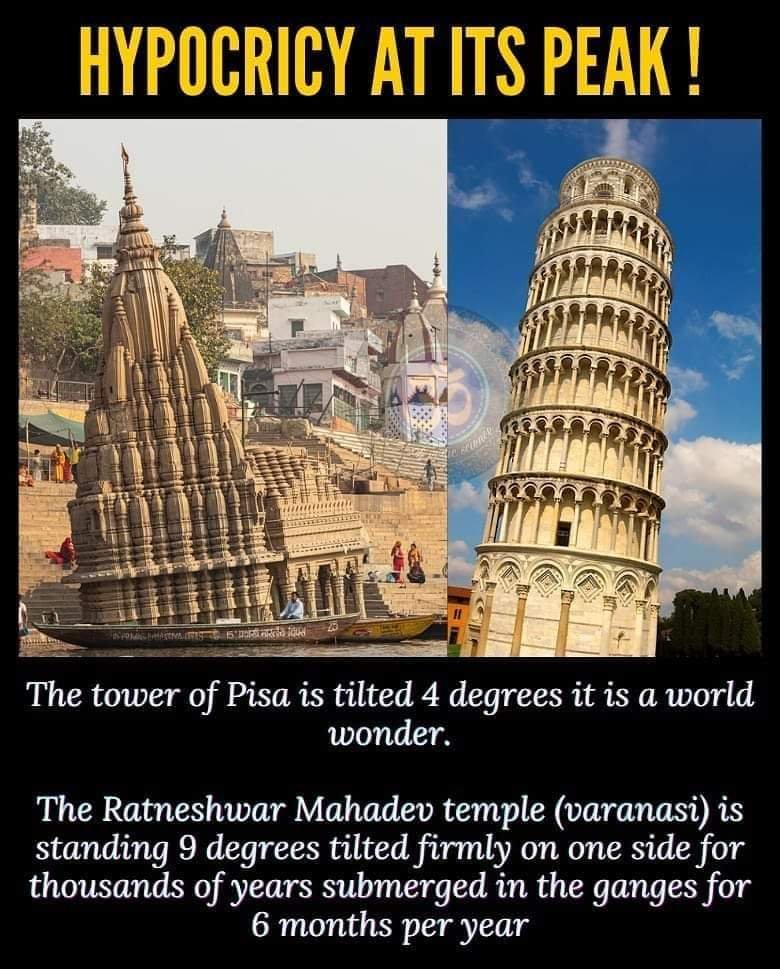
    The list goes on. Add the Raneswara temple in Varanasi.

    Ratneshwar Mahadev temple Varanasi.

    Also known as Matri-rin Mahadev or Kashi Karvat, Ratneshwar Mahadev Temple has to be one of the most photographed temples in the holy city of Banaras. An image of this temple is almost guaranteed to appear in any promotional materials about the ancient city, it is probably the most recognisable monument along the ghats for foreign visitors. The location of this temple is also a curious one. Rather than being built at a higher level and protected from the high flood waters of the Ganga during the monsoon season, it appears that the builders made a conscious decision to construct the temple in a location where for many months of the year it would be partially underwater.Today it would be all too easy to assume that the location of this temple and its leaning aspect is an anomaly, but there is plenty of evidence to suggest otherwise. Many paintings of the ghats from the early to mid 19th century depict leaning temples close to the Ganga, so it would appear that Ratneshwar Mahadev is now a lone survivor of this phenomenon. …..

    Leaning Temple of Rateneswar Varanasi India
    Rateneswar temple Varanasi. Screenshots.
    Rateneswar temple Varanasi.
    Rateneswar temple Varanasi

    We also have documentary evidence of these leaning temples. The artist William Daniell writing in The Oriental Annual in 1834 observed :

    “One of the most extraordinary objects to be witnessed at Benares and which is generally one of great curiosity to the stranger, is a pagoda standing in the river, there is nothing to connect it with the shore. The whole foundation is submerged, and two of the towers have declined so much out of the perpendicular as to form an acute angle with liquid plain beneath them….It has been surmised, and with probability, that this temple was originally erected upon the bank of the river, which then offered a firm and unsuspected foundation;..During the Winter and Spring months the water levels of the great Ganga are low enough to permit access without getting your feet wet. It’s worth a quick exploration, there’s some nice carvings that have remained in remarkably good condition considering the length of time this temple is submerged each year. Source.

    https://kevinstandagephotography.wordpress.com/2020/05/16/ratneshwar-mahadev-kashi-karvat-banaras-varanasi/

    The claim is true. The Ratneshwar Mahadev Temple is situated at Manikarnika Ghat, Varanasi. The temple has developed a nine-degree slant. It is also referred to as Kashi Karvat (Kashi is the ancient name for Varanasi and karvat means leaning in Hindi). A Times Now report said that one of the beliefs held regarding the temple is that the ‘ghat’ had collapsed and leaned backwards after not being able to withstand its weight. The temple supposedly stood straight before the 1860s. An Indian Travel Photography Blog, Kevin Standage, stated that the temple is famous for having a tilt of about nine degrees. Below are screenshots from the blog which shows the temple from varied angles:

    https://thelogicalindian.com/fact-check/ratneshwar-temple-leaning-tower-pisa-varanasi-lean-22847

    Ratneshwar Mahadev Mandir (Hindi: रत्नेश्वर महादेव मंदिर) (also known as Matri-rin Mahadev, or Leaning temple of Varanasi) is one of the most photographed temples in the holy city of Varanasi in Uttar Pradesh, India. The temple, while apparently well-preserved, leans significantly towards the back side (north-west), and its garbhagriha is generally below the water much of the year, except for a few months during the summer. The Ratneshwar Mahadev Temple is situated at Manikarnika Ghat, Varanasi. The temple has developed a nine-degree slant. It is also referred to as Kashi Karvat (Kashi is the ancient name for Varanasi and karvat means leaning in Hindi).[

    Join 4,576 other subscribers

    Leave a Reply

    https://en.m.wikipedia.org/wiki/Ratneshwar_Mahadev_temple
  • Pyramid Temple Varanasi ?

    While researching material for article on the presence of Sanatana Dharma in the Americas,I chanced upon an article which mentions Pyramid Temple at Benares, Varanasi.

    Angkorvat Aerial view. Image.
    Angkorvat Aerial view.image

    The temple was called Bidh Madhu.

    It seems to have been destroyed by the Mughals(?) In the seventh century AD.

    I am unable to get additional information on this.

    ( In the process I came across some new information about the temples destroyed by Mughals. I will be sharing it shortly.)

    I have been wondering about,

    1. Though Hindus, Egyptians and People of Central America,Mayans worshipped Sun in the days,the temples dedicated to Sun differ in design.

    Temples in India may not look like Pyramids,they do resemble Pyramids.

    2. Of twenty sacred sites around the world,seven are from Hinduism.

    One such is the fact that twenty sites in the world lie in the same Latitude and the distance between them represent the Golden Means/ Fibonacci number..’
    One such is the fact that twenty sites in the world lie in the same Latitude and the distance between them represent the Golden Mean’

    https://ramanisblog.in/2016/03/09/twenty-world-spiritual-sites-same-latitude-seven-hinduism/

    2. Benares , Varanasi is the oldest continuously Lived City in the world.

    3. Appropriate Bhagavad Gita Verse in Egyptian Pyramids.

    In one of the Pyramids, dating back to 3000 BC, a verse, from the second chapter of the Bhagavad Gita was found inscribed.

    Here it is:

    https://ramanisblog.in/2014/12/08/appropriate-bhagavad-gita-verse-in-egyptian-pyramid/

    4.Shiva Linga design in Mexico city, Vatican City.

    https://ramanisblog.in/2018/09/10/shiva-lingam-design-teotihuacan-temple-mexico-vatican-city/

    5.Temples for Gadothgaja, Hanuman are found in Central America.

    6 Chicken Itza temple resembled.Madurai Meenakshi Temple,India .

    https://ramanisblog.in/2018/09/10/shiva-lingam-design-teotihuacan-temple-mexico-vatican-city/

    7. The design of the top of Angkorvat has Sreechakra . The design of the temple A Hindu temple more inclined to be a Pyramid.

    8.Meru ,used in the worship of Devi is a Pyramid.

    Would some reader throw light on the temple of Bid Madhu at Varanasi?

    The spelling of Bidh Madhu might not be correct.

    Mrs. Zelia Nuttal (1857 -1933) Archaeologist and ethnologist has said:

    “No country in the world can compare with India for the exposition of the pyramidal cross. the body of the great temple of Bidh Madhu (formerly the boast of the ancient city of Benares…demolished in the 7th century) was constructed in the figure of a colossal cross, with a lofty dome at the center, above which rose a massive structure of a pyramidal form. At the four extremities of the cross there were four other pyramids…A similar building existed at Mathura. By pyramidal towers placed crosswise, the Hindu also displayed the all-pervading sign of the cross. At the famous temple of Chidambaram, on the Coromandel coast, there were seven lofty walls, one within the other, round a central quadrangle, and as many pyramidal gateways in the midst of each side which forms the limbs of a vast cross.”

    Reference and citation

    source: Zelia Nutall and Peabody Museum Papers volume II p. 161-162 and Proof Vedic Culture’s Global Existence By Stephen Knapp p. 252 – 253).

    http://www.hinduwisdom.info/Pacific.htm

    Image of Angorwat from

    http://crossinhindutemplearchitecture.blogspot.com/2007/08/cross-in-hindu-temple-architecture.html?m=1

    https://books.google.co.in/books?id=ybyzrkuQaUEC&printsec=frontcover#v=onepage&q&f=false