As I understand from the Ramayana, Lord Rama completed his last Journey on the earth , after the demise of Lakshmana, by entering the Sarayu River.
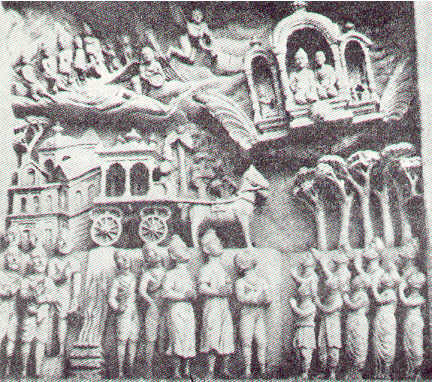
I have come across information that Rama evacuated Ayodhya from the banks of by a Pushpaka Vimana flying North.
Rama proceeded first with his Royal entourage and the people of Ayodhya followed suit.
This process took three days.
Rama and Sita in Pushpaka Vimana.
His last thoughts before boarding the craft was that of Hanuman whom he had not seen the whole day!
He advised his son Lava to rule the kingdom from Shrawasti (Sahet-Mahet ) as capital and till the period of Buddha, this place continued to be the capital of Kaushal estate. Subsequently, in the Maurya period as well this Kaushal estate (province of Magadh empire) was the capital.
The city of Kushawati, which is in the Vindhya region, was established for the rule of the other son Kush and thereafter till date it is famous as Mahakaushal…
“It has also been mentioned in the Ramayana that after Lord Sri Rama, Ayodhya would again be inhabited during the times of Rishabh.
He was the first Tirthkar of Jains and is also known as Adinath.
There are over 300 versions of the Ramayana and Valmiki himself had written many of them.
Other Religious sects of India,Buddhism and Jainism have adapted this to suit their Philosophy.
Jain Ramayana.
“Depending on the methods of counting, as many as three hundred versions of the Indian epic poem, the Ramayana, are known to exist. The oldest version is generally recognized to be the Sanskrit version attributed to the sage Valmiki.’
Lord Rama
Adhyatma Ramayana or spiritual Ramayana is extracted from the Brahmananda Purana, traditionally ascribed to Vyasa.
Vasistha Ramayana (more commonly known as Yoga Vasistha) is traditionally attributed to Valmiki.
Laghu Yoga Vasishtha, by Abhinanda of Kashmir, is an abbreviated version of the Yoga Vasistha.
Ananda Ramayana is traditionally attributed to Valmiki. While it briefly recounts the traditional story of Rama, it is composed primarily of stories peripheral, though related, to Valmiki’s narrative. These include Ravana’s abduction of Sita and Rama’s installment of the Shiva Lingam at Rameswaram.[6]
Agastya Ramayana is also traditionally attributed to Agastya.
Adbhuta Ramayana.
The Jain Ramayana in short.
“According to the Jain version of Ramayana, Dasharatha, the king of Saketa had four queens: Aparajita, Sumitra, Suprabha and Kaikeyi. These four queens had four sons. Aparajita’s son was Padma, and he became known by the name of Rama. Sumitra’s son was Narayana: he became to be known by another name, Lakshmana. Kaikeyi’s son was Bharata and Suprabha’s son was Shatrughna. Furthermore, not much was thought of Rama’s fidelity to Sita. According to Jain version, Rama had four chief-queens: Maithili, Prabhavati, Ratinibha, and Sridama. Furthermore, Sita takes renunciation as a Jain ascetic after Rama abandons her and is reborn in Heaven. Rama, after Lakshmana’s death, also renounces his kingdom and becomes a Jain monk. Ultimately, he attains Kevala Jnana omniscience and finally liberation. Rama predicts that Ravana and Lakshmana, who were in fourth hell, will attain liberation in their future births. Accordingly, Ravana is the future Tirthankara of next half ascending time cycle and Sita will be his Ganadhara.”
If one wants to know about the lands and people of the world during Sanatana Dharma, the best source, in my opinion, is the set of instructions given by Sugriva to his army of vanaras in search of Sita, who was abducted by Ravana.
He gives such detailed descriptions, ably captured by Valmiki, that one can identify the Lands even today.
I have posted on Peru where Nazca Lines resemble the Trishul of Lord Shiva,Arkaim in Russia.
In the course of his directions Sugriva directs a group of his army bound for west to search for Sita in a mountain where the sun sets.
Ancient City Arkaim.
“Sugreeva, (the ‘vanara’ commander) directs the ‘vanaras’ to go west from the Vindya mountains of India, right up to the fourth quarter of the (Arabian) sea, via a point described as ‘where the Sindhu falls into the sea’ – which may point to either where the Indus falls into the Arabian Sea at Karachi in Pakistan or to where the Narmada falls into the Arabian Sea. Sindhu is the Sanskrit name of Indus, butsindhu also means ‘river’. Going along this route, the fourth quarter of the sea would bring the Vanaras to the ‘Persian Gulf’.
Valmiki description of a coastal mountain by the name ‘Hemgiri’ – high with its peak touching the sky, and also a waterlogged mountain by the name ‘Paariyatra’ indicates that the ‘vanaras’ were probably taking a sea-side route along the Persian Gulf. Valmiki also describes a Mount ‘Vajra’, which he says shines like a diamond – possibly a reference to the peaks of what is today known as the Zagros Range.
Ancient Baghdad.
After crossing the fourth quarter of the Ocean, the ‘vanaras’ are told that they will see a structure on Mt. Chakravan, which looks like a ‘wheel with a thousand spokes’. The Ramayana says that the city or structure was built on this mountain by the ‘celestial architect’ ‘Vishwakarma. This suggest a megalithic circular wheel like structure atop a mountain…
Another option is the city of Yerevan in Armenia. Yerevan is one of the oldest continually inhabited cities of the world. Yerevan has been built and rebuilt over the ruins of older cities over the centuries – but its basic plan even today remains circular as it was in the ancient times. The city is spread out now but historically the city was located at the heart of the Armenian Highland in Kotayk canton of Ayrarat province.
The Ramayana say that a at distance of 64 ‘yojanas’ (a yojana has been taken to mean a distance of anywhere between 6 to 15 km) from this city, the Vanaras will encounter a peak by the name ‘Varaaha’. This may well be Mt. Ararat of today. Mt. Ararat is visible from Yerevan. Also, over the millennia the name ‘Chakravan’ may have distorted to ‘Yerevan’ and ‘Varaaha’ to ‘Ararat’. The Ramayana then mentions a city by the name ‘Pragjyotish’ which was the abode of the demon ‘Naraka’. Though there are no cities with a name close to ‘Pragjyotish’ in the Armenian region, but there sure is a town by the name ‘Narek’ located close to Mt. Ararat.
Another possibility is that Valmiki may have been referring to a pre-historic city, on the ruins of which Baghdad was built later. Present day Baghdad was built on the ruins of ancient Baghdad which was first built in 700 AD. But is it possible that there was a city already existing thousands of years before 700 AD and was mentioned in the Ramayana. Sketches of ancient Baghdad comes uncannily close to Valmiki’s description.
Some scholars have suggested that there is also a possibility that when the ‘vanaras’ head west and then continue their journey along a mountain range, they could be moving northwards along the Zagros and further to the Ural range. In that case, could the ancient city that the ‘vanaras’ saw be ‘Arkaim’ in the Urals. It has even been debated that ancient Arkaim was not a city at all, and that it was a weapon-storage facility!
Lord Rama, during his attempt to cross the ocean,prayed Samudra Raja, Lord of the ocean.
He did not turn up.
In a rare display anger Lord Rama sent in His arrow and it landed and parched the place it fell.
Thus was formed the Maru Desert near Jaisalmer.
The world famous three-day Maru Mahotsav is the rich and colorful Rajasthani folk culture festival held every year in February at Jaisalmer. Maru Mahotsav also known as the Desert Festival is known for its unique events such as camel race,traditional dance performance, and other cultural events of royal Rajasthan.
Ramayana says thus.
”
The valiant ocean, the lord of rivers, wearing a wreath of pearls, with his eyes resembling lotus leaves, bearing a beautiful garland made of all kinds of flowers on his head, with ornaments of refined gold, adorned with excellent jewels made of pearls from his domain, decorated with different kinds of gems and metals, resembling Himavat mountain, wearing on his broad chest a locket shedding a white luster, resembling a Kaustubha gem (adorning the blossom of Lord Vishnu) and hanging in the middle of a single string of pearls, with a multitude of waves whirled around him, encircled by the clouds and winds, escorted by rivers mainly the Ganga and Sindhu, endowed with diverse forms resembling various deities, approached Rama with joined palms, who stood with arrows in hand, addressing him first as ‘Rama!’ and spoke the following words: “O, beloved Rama! Earth, wind ether, water and light remain fixed in their own nature, resorting to their eternal path. Therefore, I am fathomless and my nature is that it is impossible of being swum across. It becomes unnatural if I am shallow. I am telling you the following device to cross me. Neither from desire nor ambition nor fear nor from affection, I am able to solidify my waters inhabited by alligators. I shall make it possible to see that you are able to cross over. I will arrange a place for the monkeys to cross me and bear with it. As far as the army crosses me, the crocodiles will not be aggressive to them.”
Then, Rama spoke to that ocean as follows: “Listen to me. This great arrow should not go in vain. In which region should it be descended?”
Hearing Rama’s words and seeing that powerful arrow, the large splendid Ocean spoke the following words to Rama: Towards my northern side, there is a holy place. It is well known as Drumatulya, in the same way as you are well known to this world. Numerous robbers of fearful aspect and deeds, having the sinful Abhiras as their chief, drink my waters there. I am not able to bear that touch of those wicked people, the evil doers, O, Rama! Let this excellent arrow with out vain be released over them there.”
Hearing those words of the high-soled Ocean, Rama released that excellent and splendid arrow towards that place as directed by the ocean. The place where the arrow, whose splendor was akin to that of a thunder and a thunder bolt, was descended by Rama- that place is indeed famous as desert of Maru* on this earth.
* Maru—Malwar in Rajastan (India)
The earth there, pierced by the dart, then emitted a sound . The waters of the penultimate subterranean region gushed forth from the mouth of that cleft. Then the hollow became known as Vrana. Water constantly seen, gushing forth from it resembled seawater. A terrific splitting sound was born in that place. Water was dried up in those cavities, as a result of hurling of that arrow by Rama. That desert of Maru became famous in the three worlds. Rama (the son of Dasaratha), a wise man and a valiant man resembling a celestial, made that cavity dried up and gave a boon to that desert of Maru. Due to granting of a boon by Rama, that desert of Maru became the most congenial place for cattle rearing, a place with a little of disease, producing tasty fruits and roots, with a lot of clarified butter, a lot of milk and various kinds of sweet- smelling herbs. Thus it became an auspicious and suitable move, bestowing these merits. While that cavity was burning, Ocean the lord of rivers spoke these words to Rama who knew all scientific treatises.”
I have been researching into the affinity between two great Languages of India, Sanskrit and Tamil.
Tamil ,recent researches indicate is about 17,000 years old and it quotes Sanskrit in its earliest works.
Sanskrit in its turn quotes Tamil!
Valmiki Maharishi
Please read my post million Year old Tamil Quotes Vedas and They quote Tamil.
References to Tamil, Tamil Culture, Tamil Kings are found in the Vedas,Puranas,Ramayana and Mahabharata.
Curiously no other language is referred to in these Sanskrit Texts.
There are references to Valmiki in Tamil.
Valmiki is referred to as Vanmiki,in Tamil the letter L and N are interchangeable under certain Grammar rules.
There is a work by Valmiki called Vanmikatpathinaaru, sixteen verses of Valmiki.
Valmiki is classified among the Siddhas along with Bogar, who installed the Idol of Lord Subrahmanya in Palani in Tamil Nadu .
One of the major differences between Valmiki as a Siddha and others Valmiki advocates the study of the Vedas, the Siddhas to Ignore and go beyond the Vedas.
”
The theme in the 16 verses of the Valmiki Sixteen is different from the themes of all other works of other Siddhas. All others praise lord Shiva as the Ultimate God who blesses one with Moksha. But Valmiki differs from them. In the very first verse of Valmiki Sixteen, he says that Shiv Shakti emerged from Vishnu, the Consort of Sri / Lakshmi.
‘சிவசக்திதிருமாலின்ரூபமாகும்.
வருமுருவேசிவசக்திவடிவமாகும்‘
This concept is radically different from the concept of other Siddhas. This is conceded by the poet Valmiki himself in subsequent verses. He mentions in the 11th verse that seeing his concept to be different, other Siddhas complained to Lord Shiva. Poet Valmiki says further, that Shiva was angry with those Siddhas only. His theme (of Vishnu being the Primary force from which Shiva- Shakthi emerged) conveyed in these poems were regarded as the key (to understand all poems of all other Siddhas.
சிவசிவா பதினெண்பேர்பாடற்கெல்லாம் திறவுகோல்வால்மீகன்பதினாறாகும்:
சிவம்பெத்த சித்தரேல்லா மென்னூல் பார்த்துச்
சிவனோடே கோள் சொன்னார் சினந்தான் நாதன்:
அவமாகிப் போகாமல் சிவனுத் தார
அருளினால் திறந்து சொன்னேன் உலகுக்காக:
நவமான நவக்கிரகம் தன்னுளேயே
நாக்கு வாய் செவி மூக்கு மத்திக்கப்பால். (11)
நாக்கு வாய் செவி மூக்கு மத்திக் கப்பால்
நடுவீதி குய்ய முதல் உச்சி தொட்டுத்
தாக்குவாய் அங்கென்ற அதிலே முட்டுத் தாயாரைப் பூசித்து வேதம் ஓது: (12)
While the other Siddhas preached to forsake Vedas, this poet Valmiki preached that people must to chant Vedas. In addition he says that Vedas should be pursued after worshiping Divine Mother.”
Valmiki, according to Tamil, wrote three works,
Ramayana in Sanskrit,
Vanmikiipathinaaru, Sixteen verses of Valmiki, and
a Poem in Puranaanooru in Tamil.
He also participated in the Tamil Sangam.
He commanded so much respect for his scholarship in Tamil , that the earliest Tamil Grammar work in Tamil, Tholkaapiyam, quotes his works, along with that of Lord Shiva as Primary Tamil Education.
Tamil was classified into Primary,Intermediary and Secondary.
This is the poem.
”
தமிழ்ச்செய்யுட்கண்ணும்இறையனாரும்,
அகத்தியனாரும்,
மார்க்கண்டேயனாரும்,
வான்மீகனாரும்,
கவுதமனாரும்போலார்செய்தனதலை”
Meaning.
The primary education in Tamil must be from the works of,
Lord Shiva,
Agasthya,
Markandeya,
Valmiki and
Gautama.
Lord Shiva is presumed to have founded the Tamil language and he presided over the First Tamil Sangam, the Conclave of Tamil Scholars.
Valmiki participated in it.
There are two temples associated with Valmiki in Tamil Nadu.
Marundheeswarar Temple, Thiruvanmiyur, Chennai, where Valmiki is worshiped.
The other temple is Ettukkudi, a Murugan Sthala where Valmiki is reported to have died and his samadhi is found there.
Siddhas speak of Valmiki in their works quite frequently and indicate he was also well versed in Medicine.
Dates of Ramayana and Sangam.
”
adding up the years of the 3 sangam periods to this last year of the last sangam at 2000 years BP, we arrive at the following years.
3rd sangam started around 1850 BC.
2nd sangam started around 5550 BC
1st sangam started around 9990 BC.”
This is in agreement with the premise that Valmiki indeed wrote in Tamil and participated in he Tail Sangam.



You must be logged in to post a comment.