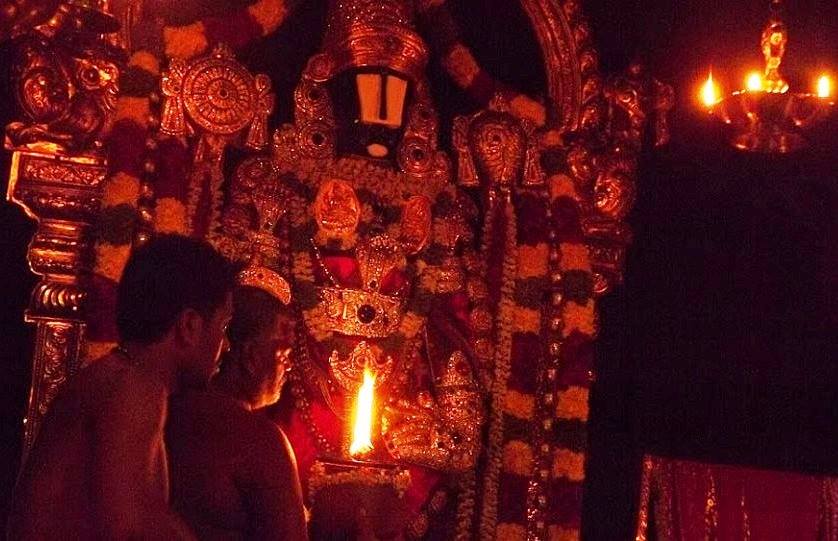
Tag: Thirupathi Balaji

  • How Tirupati Balaji temple was saved Bruce Code Munroe Sadam,Prasad

    How Tirupati Balaji temple was saved Bruce Code Munroe Sadam,Prasad

    Tirumala and Thirupathi temple of Lord Venkateswara/Balaji were administered according to Bruce Code,set by a Britisher in 1821 AD.

    The Tirumala Thirupathi Temple adminstration was with the Muslim invaders after the fall of Hindu Kingdoms in the early eighteenth century,The Vijaya Nagar Empire.

    The last Muslim ruler who controlled the Temple was the Nawab of Arcot.

    The Nawab ran into debts and the East India company took over the temple to offset the dues.

    However,the administration of the temple was taken over by the British Government during Queen Victoria’s reign,as the government felt that East India company should not run a Hindu temple.

    The Bruce code containing 42 Rules, based on the ruled laid for Puri Jagannath temple.

    Bruce’s Code is a set of rules for the management and administration of temples of Tirumala and Tirupati including the servants, enacted by East India Company in 1821 AD.

    Source. https://en.m.wikipedia.org/wiki/Bruce%27s_Code

    These were the well-defined rules formulated as a code having 42 provisions to ease the administration of temples of Tirumala and Tirupati on the basis of customs and previous usages without interfering in the day-to-day affairs

    The point of interest is as to how Bruce came to form these rules.

    Read the information below.

    Sir,I know you are in pain for several days.. I also know that you lost all your hopes of any recovery..But sir..Please listen to me and offer your prayers to Lord Sri Venkateswara of Tirumala temple..Tirumala is a Temple very near to this place and Lord Sri Venkateswara is the most powerful God in this world…Am sure He will save you from death..Trust me sir..”

    With a little curiosity in his voice and a little dazzle in his eyes this time,Le Vellian then slowly turned towards the Tea boy and said “..Thanks my dear,but what do you want me to do for that..’..

    With a smile,the Boy replied”..Thanks for taking my words sir..All that you have to do is to just offer your prayers to Lord Sri Venkateswara and request Him to heal you fully.. ”
    And now with more hope in his voice,Le Vellian asked the boy..”Okay my dear..I would certainly do..But how to offer my prayers to a Hindu God… I have never done that before..You need to help me do that..”And this time Without seeking any permission from Le Vellian,the 12 – year old mystic Hindu Boy walked with all the divine command in this world to the bedside of Le Vellian; held both his hands first; brought them close to each other…

    And later bringing them together,by creating a traditional Hindu NAMASTE posture,raised Le Vellian’s hands and turned them towards the direction wherein the most powerful Tirumala temple is located and surprising Le Vellian further,very loudly chanted holy Lord Sri Venkateswara’s most favorite sloka..“.. Vinaa Venkatesam Nanatho Nanathah.. Sadaa Venkatesam Smaraami Smaraami.. Hare Venkatesa Praseeda Praseedah.. Priyam Venkatesa Prayachcha Prayachchah. .”“.. Aham Doora Tasthe Padaam Bhoja Yugmah.. Pranamechcha Ya Gachcha Sevaam Karomi..Sakrut Sevayaa Nitya Sevaa Phalantvam.. Prayachcha Prayachcha Prabho Venkatesaa..
    Amazing was the boy to the eyes of Le Vellian that moment..After completing the chanting of the divine sloka,the Boy,still holding a much surprised Le Vellian’s hands,closed his eyes for a few moments and silently offered his personal prayers to Lord Sri Venkateswara. .

    Furthermore amazed at the command with which the Hindu boy held both his hands and also at the ease with which he had chanted the intricate Sanskrit sloka,Le Vellian slowly got up in his bed; turned both his hands that were still held in a NAMASTE posture towards the smiling mystic boy and offered him his salutations. .PEACEAfter that divine drama..

    Le Vellian who had lost all his hopes of any recovery from that near dead situation had quite miraculously regained a complete normalcy in just about a few days time..
    This miraculous recovery of Le Vellian shocked the British Army Doctors who have by then had literally written him off as a medical ‘case of complete hopelessness beyond recovery’..

    Much later,as he could not personally visit the Tirumala temple due to his job constraints, Le Vellian requested his friend,an Indian soldier by name Ramachandra Ganesh,to visit the Tirumala hill Shrine on his behalf and offer the holy Lord Sri Venkateswara what he promised to offer…EPILOGUE

    “Vinaa Venkatesam” sloka although is an integral part of Sri Venkateswara Suprabhatham, was however written and recited first by Sri Markandeya Maharshi,when He visited the Tirumala hills and offered this sloka to Lord Sri Venkateswara. .PERIOD
    In the later period,the story of Le Vellian’s miraculous recovery reached the governing authorities of the British Kingdom..In 1801,after having known the sanctity and powers of Lord Sri Venkateswara and the Tirumala Temple,the British took over the administration of the Temple from the hands of the Nawabs of Arcot for lack of discipline and misappropriation of funds in the Temple..

    Later in 1821,strictly in accordance with the norms of the Tirumala Temple,the British introduced what is called the Bruce Code..This code has 42 provisions formulated in it with well defined customs and duties meant both for the Tirumala Temple as well as for the Hindu officials working there..

    Quite surprisingly, the ruthless British,known for their iconoclastic nature,never interfered with the day to day affairs and rituals of the Tirumala Temple except taking care of it’s administration. .After that divine incident,renowned British personalities like Sir Thomas Monroe and Colonel Geo Stratten went on to become great devotees of Lord Sri Venkateswara. ..

    Information source.

    https://orangenews9.com/why-britishers-didt-plant-a-cross-in-tirumala-hills/

    Thomas Munroe drew up the deeds of the property to ensure that the property is safeguarded.

    Even today first Prasadam pf Lord Venkateswara is called Munroe’s Food( Munroe Sadam in Tamil)

  • Height of Thirupathi Balaji

    The Idol of Lord Balaji is shrouded in mystery.

    There are references that the Idol is that of Devi,Murugan.

    There are curious facts about Thirupathi.

    Thirupathi is over 2100 Million Years old.

    The temperature of the idol is at 110°F constant.

    It is rare to find more than one Idol in the Sanctum, Moolavar.

    Thirumala Hills resemble Lord Balaji’s Face.

    In Thirupathi there are Three.

    And the Height of the Idol is 9′ 9″

    Nine feet nine inches.

    There are different versions on the real and exact height of the statue of the Lord Sri Venkateswara. But considering the sculpture techniques based on Vasthu and numerics, it appears that the height of the statue of the Lord Venkateswara is 9′ 9″ (nine feet and nine inches) including the crown over the head. Further, the statue stands on a stone pedestal of 18 inches in height...
    Considering the numerological pattern “9” holds the key with regard to the size of the statue including the crown portion over the head and the pedestal height of 18 inches. These are the marked features of the statue in terms of height based on Vasthu and numerology..

    Reference and citation.

    https://www.quora.com/What-is-the-height-of-the-Tirupati-Balaji-idol/answer/Nirmalananda-Reddy-Kasivi?ch=10&share=4aff23cc&srid=pNfl

  • People Lose Eyesight Looking At Thirupathi Balaji From Behind

    Thirupathi and Balaji are intriguing.

    They are beyond reason.

    Before I proceed to narrate the relevant subject,let me add my personal experience.

    When I was around thirteen or fourteen years old,I had burning sensation in my stomach and Doctors were divided in their opinion, whether it was Hyperacidity or Ulcer.

    Ulcer was ruled out.

    Antacids were prescribed.

    Along with it I was taking Palm Juice, பதநீர்,in early mornings for over two years.

    The disease got worse to such an extent, I recall lying face down with stomach pressed down to Cement floor thinking it would cool my stomach.

    One day,my father said he would no longer consult doctors or offer any medicines.

    Instead he would leave it to Thirupathi Balaji to cure it and vowed that he would perform my Upanayana at Thirupathi.

    Within an hour I was relieved of the burning sensation.

    Never has stomach related issues from then onwards.

    Of course,my Upanayana was performed at Tirupathi..

    I had also written on why no one should set time to Him.

    Now to the issue on hand.

    It is said that no one can see the back side of Balaji.

    At those who have attempted had lost their eyesight.

    The information is credible as it comes from a descendant of Thirupathi Archakas who have been serving Him since 19th Century.

    Excerpt.

    The back side of the Venkateshwara deity has the incarnation of badrakali the Kali Swaroopa inside Vishnu that slayed Hiranyayaksha( as Govinda means a name of Varaha the wild boar form that slayed the demon) and the height of the deity is made up the height of Lord Krishna in Dwapara Yuga. There are credible stories of few people losing their eyesight when they tried acting smart by trying to worship from behind. The moola murthy Stone was cut from Sila thoranam a bunch of rocks approximately 12 crore (120 million yrs old) years old the remains you can see in Tirupati itself in the fenced park outside the bus stand.

    How am I qualified and informative enough to say this, my maternal grandfathers grandfather and his predesscors were the chief priests of Tripathi during the 19th century and before they were touching the deity and performing Brahma karma and incidentally the clan who got first respect and was holding the parivattam of the Temple devastana bestowed by the kings and later by the Brits as per the lineage’

    Source.

    Sri. Vijaya Raghavan at Quora.

    https://www.quora.com/Why-is-it-said-that-no-one-can-touch-the-back-of-the-idol-of-Shri-Balaji-of-Tirupati-Balaji-Temple/answer/Vijay-aRaghavan?ch=10&share=a6d6db4e&srid=pNfl

  • Tirupati – Tirumala 2100 Million Years Old ,Geology

    Tirupati – Tirumala 2100 Million Years Old ,Geology

    Tirupati Balaji, Venkateswara is one of the most venerated Gods of Hinduism and the temple, in Chittoor District is visited by thousands of people everyday.

    The Hindu Puranas speak of this temple as being quite old.

    This Temple in the Tirupati/Tirumala Hills is and surrounded by  Hills which are prehistoric and the Hills have the world’s most ancient natural rock Archway.

    Geologists have dated this and the information tallies with what Hindu Puranas say about the age of the Hills.

    It is about 21oo Million years old.

    Eparchaean Unconformity (Tirupati hills) is a major discontinuity of stratigraphic significance that represents a period of remarkable serenity in the geological history of the earth. It is seen at the steep natural slopes, road scars and ravines in the Tirupati – Tirumala Ghatroad in Chittoor district of Andhra Pradesh, India.[1][2]

    Antiquity of  Tirupati, Tirumala Hills, India.jpg Plaque gives brief details of Eparchaen Unconformity Image Credit.”Plaque at Tirumal hills on Eparchean Unconformity” by Nvvchar – Own work. Licensed under CC BY-SA 3.0 via Wikimedia Commons – https://commons.wikimedia.org/wiki/File:Plaque_at_Tirumal_hills_on_Eparchean_Unconformity.jpg#/media/File:Plaque_at_Tirumal_hills_on_Eparchean_Unconformity.jpg

    In 2001, the Geological Survey of India (GSI) declared the unconformity to be one of the 26 “Geological Monuments of India”. GSI’s commemoration document, published on the occasion of the 150 years anniversary celebration, provides an insight into the formation of the subcontinent, the orogeny, the paleoenvironment and the exotic collection of paleo-flora and fauna. The details provided for the Eparchaean Unconformity monument indicate that this feature forms the boundary surface between Proterozoic Nagari Quartzites andArchaean granite. The time gap between the formation of the two units is at least 500 Ma.[2]

    Naturak Archway Tirupati.jpg Natural Archway Tirupati, The assessed geological age of the rock arch is 2.5 billion years. Formation of the arch is attributed to intensified weathering and erosion of stream action that has withstood the torque of nature Image Credit.”Natural stone arch in tirumala” by Tatiraju.rishabh at English Wikipedia. Licensed under CC BY 3.0 via Wikimedia Commons – https://commons.wikimedia.org/wiki/File:Natural_stone_arch_in_tirumala.JPG#/media/File:Natural_stone_arch_in_tirumala.JPG

    Garuda hiils , Tirupathi.jpg
    Garuda hiils , Tirupathi.Million Years Old.

    At this location, the boundary is between sedimentary rocks of the Cudappah Supergroup, 1600 million years in age, and Archaean rocks comprising granites, gneisses and dolerite dykes that are more than 2100 million years old. This unconformity gives an indication of the enormous time gap in the creation of the earth’s crust.

    Tirupati Tirumala hilld.jpg
    Tirupat Hills, Balaji TempleTirupati Tirumala

    The Tirupati hills are situated at the foot of a range of hills known by several names, including ‘Seshachala’, ‘Venkatachala’ and ‘Balaji’. There are four geological units:

    (1) Archaean rocks of the eastern Dharwar Craton (the granites and gneisses)
    (2) the Eparchean unconformity (Quartzose sandstones overlying the granite with a distinct unconformity)
    (3) Puranas (a general name for Proterozoic sedimentary sequences found in a series of basins deposited on the Indian Shield; including the Cuddapah Basin)[4]
    (4) Quaternary deposits

    The Tirumala hills essentially of precambrian period are composed of sedimentary rocksquartzites and intercalated shales, which are referred to as the Nagari quartzites, which forms part of the Cuddapah Supergroup. It is a subset of the Purana rock succession that rests above the archaean rocks.[2][3][5]

    The hill ranges of the Tirumala rise to a height of 900 metres (3,000 ft) (at Tirumala) from the average height of 150 metres (490 ft) in the plains at Tirupati. The steep scarp of the ranges shows the Eparchian Unconformity’s topographic, structural and denudational features.[2][6] The sedimentary thickness of the Cudappah basin is of the order of 12 kilometres (7.5 mi), and includes volcanic sequences in the form of sills and dykes. A prominent Eparchaean Unconformity of the formation resting on the archaean peninsular gneissic complex is noted. Rocks of the Cuddapah Supergroup, and the overlying Kurnool Group, comprise the stratigraphic sequence of the basin. This feature is contiguous all along the defined Archaean-Cuddapah contact zone even though its age may vary along its traced path.[2][7]

    Access

    The location of the Geological Monument is well connected by road, rail and air routes. The nearest railhead to Tirumala hills is Tirupati. The geological monument is located 10 kilometres (6.2 mi) northwest of Tirupati town, at the 12 kilometres (7.5 mi) point on the Tirupati – Tirumala Ghat road. From Tirupati railway station the approach to the Tirumal temple is only by road, a distance of 10 kilometres (6.2 mi).[2][8] The nearest airport is located at Renigunta, about 15 kilometres (9.3 mi) away from the Tirupati city, which connects to Chennai, Hyderabad and Bangalore airports. Regular bus services (both private and government) are operated by all the states bordering Andhra Pradesh.

    Known History of the temple as per records.

    All the great dynasties of rulers of the southern peninsula have paid homage to Lord Sri Venkateswara in this ancient shrine. The Pallavas of Kancheepuram (9th century AD), the Cholas of Thanjavur (a century later), the Pandyas of Madurai, and the kings and chieftains of Vijayanagar (14th - 15th century AD) were devotees of the Lord and they competed with one another in endowing the temple with rich offerings and contributions. It was during the rule of the Vijayanagar dynasty that the contributions to the temple increased. Sri Krishnadevaraya had statues of himself and his consorts installed at the portals of the temple, and these statues can be seen to this day. There is also a statue of Venkatapati Raya in the main temple. After the decline of the Vijayanagar dynasty, nobles and chieftains from all parts of the country continued to pay their homage and offer gifts to the temple. The Maratha general, Raghoji Bhonsle, visited the temple and set up a permanent endowment for the conduct of worship in the temple. He also presented valuable jewels to the Lord, including a large emerald which is still preserved in a box named after the General. Among the later rulers who have endowed large amounts are the rulers of Mysore and Gadwal. After the fall of the Hindu kingdoms, the Muslim rulers of Karnataka and then the Britishers took over, and many of the temples came under their supervisory and protective control. In 1843 AD, the East India Company divested itself of the direct management of non-Christian places of worship and native religious institutions. The administration of the shrine of Sri Venkateswara and a number of estates were then entrusted to Sri Seva Dossji of the Hatiramji Mutt at Tirumala, and the temple remained under the administration of the Mahants for nearly a century, till 1933 AD. In 1933, the Madras Legislature passed a special act, which empowered the Tirumala Tirupati Devasthanams(TTD) Committee to control and administer a fixed group of temples in the Tirumala-Tirupati area, through a Commissioner appointed by the Government of Madras. In 1951, the Act of 1933 was replaced by an enactment whereby the administration of TTD was entrusted to a Board of Trustees, and an Executive Officer was appointed by the Government . The provisions of the Act of 1951 were retained by Charitable and Religious Endowments Act, 1966.
    
    From The Puranas.
    Sri Venkatachala Mahatmya is referred to in several Puranas, of which the most important are the Varaha Purana and the Bhavishyottara Purana. The printed work contains extracts from the Varaha Purana, Padma Purana, Garuda Purana, Brahmanda Purana, Markandeya Purana, Harivamsa, Vamana Purana, Brahma Purana, Brahmottara Purana, Aditya Purana, Skanda Purana and Bhavishyottara Purana. Most of these extracts describe the sanctity and antiquity of the hills around Tirumala and the numerous teerthams situated on them. The legends taken from the Venkatachala Mahatmya and the Varaha Purana, pertaining to the manifestation of the Lord at Tirumala, are of particular interest. According to the Varaha Purana, Adi Varaha manifested Himself on the western bank of the Swami Pushkarini, while Vishnu in the form of Venkateswara came to reside on the southern bank of the Swami Pushkarini. One day, Rangadasa, a staunch devotee of Vishnu, in the course of his pilgrimage, joined Vaikhanasa Gopinatha, who was going up the Tirumala Hill for the daily worship of Lord Venkateswara. After bathing in the Swami Pushkarini, he beheld the lotus-eyed and blue-bodied Vishnu beneath a tamarind tree. Vishnu was exposed to the sun, wind and rain and was only protected by the extended wings of Garuda. Rangadasa was astounded by the wonderful sight. He raised a rough wall of stones around the deity, and started supplying flowers faithfully to Gopinatha everyday for Vishnu's worship. One day, Rangadasa was distracted by a Gandharva king and his ladies. Consequently, he forgot to supply flowers to Gopinatha for Vishnu's worship. The Lord then revealed Himself and told Rangadasa that He had been testing the latter's continence, but Rangadasa had not been steadfast and had succumbed to temptation. However, the Lord accepted and appreciated Rangadasa's devoted service to Him till then, and blessed Rangadasa that he would be reborn as an affluent ruler of a province and would enjoy the earthly pleasures. He would continue to serve the Lord, construct a beautiful temple with a vimana and high surrounding walls, and thereby earn eternal glory. Rangadasa was reborn as Tondaman, the son of the royal couple, Suvira and Nandini. Tondaman enjoyed a pleasurable life as a young man. One day, he set out on a hunting expedition on the Tirumala Hill, and with the help of a forester, saw Vishnu under the tamarind tree. Tondaman returned home, deeply affected by the vision of Vishnu. Tondaman later inherited his father's kingdom, Tondamandalam. In accordance with the directions given by Adi Varaha to a forester, Tondaman constructed a prakaram and dvara gopura, and arranged for regular worship of the Lord (according to Vaikhanasa Agama). In the Kali Yuga, Akasaraja came to rule over Tondamandalam. His daughter Padmavathi was married to Venkateswara. The marriage, officiated by Brahma, was celebrated with great pomp and splendour.
    

    Tirumala-Tirupati :-

        The town of Tirupati is one of the most ancient and spectacular places of pilgrimage in India. It is situated in the Chittoor district in southern Andhra Pradesh. The town owes its existence to the sacred temple of Lord Sri Venkateswara situated on the Tirumala Hill adjoining it. With a history that dates back to over twelve centuries, the temple is the jewel in the crown of ancient places of worship in southern India.
    

    The Tirumala Hill is 3200 ft above sea level, and is about 10.33 sq miles in area. It comprises seven peaks, representing the seven hoods of Adisesha, thus earning the name, Seshachalam. The seven peaks are called Seshadri, Neeladri, Garudadri, Anjanadri, Vrishabhadri, Narayanadri and Venkatadri.

        The sacred temple of Sri Venkateswara is located on the seventh peak, Venkatadri (Venkata Hill), and lies on the southern banks of Sri Swami Pushkarini. There are several legends associated with the manifestation of the Lord in Tirumala.
    Citations.
    https://en.wikipedia.org/wiki/User:Kamble16
    
    https://en.wikipedia.org/wiki/Eparchaean_Unconformity