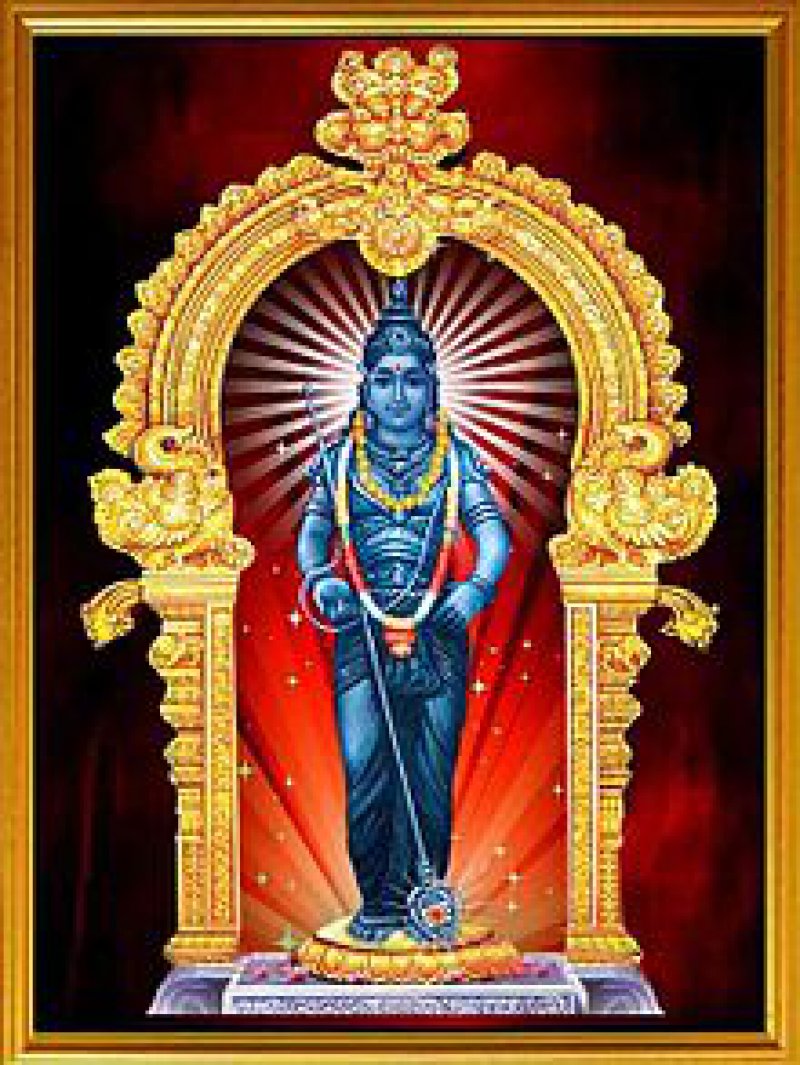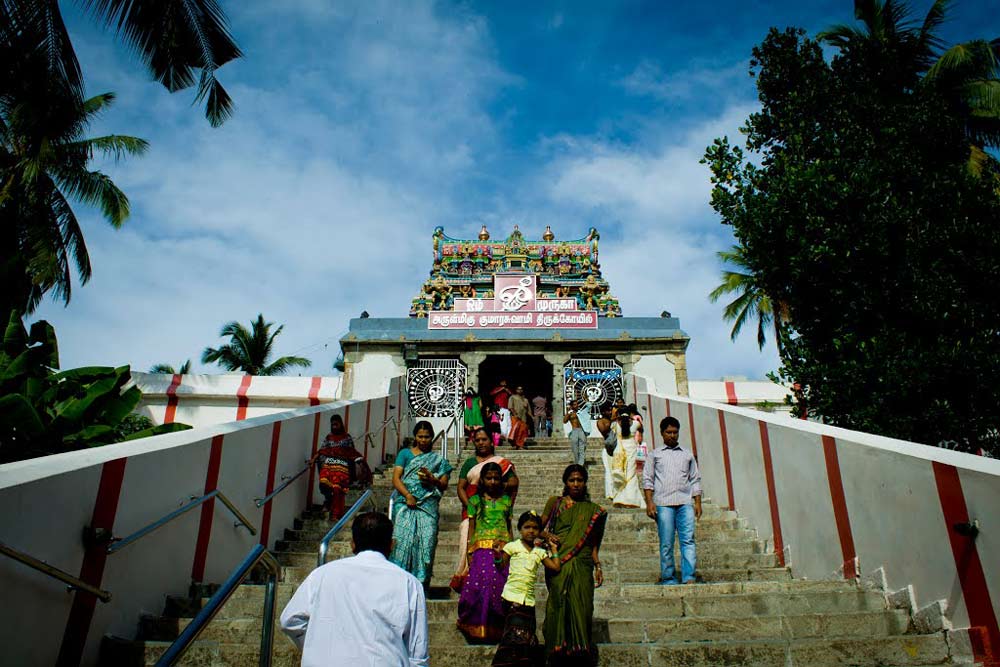
The bounty of Grace is not reserved for only to the adherents to Hinduism.
It flows in abundance to any one who has faith and one who worships, irrespective of religious denominations.
We have Raghavendraswamy , Mantralaya. speaking to a British Collector, which was notified in the Gazette, a British collector seeing Rama and Lakshmana guarding the tank in Madhurantakam, Goddess Meenakshi saving British collector, Samayapuarthu Amman curing a British Collector.
There are more incidents that have been documented.
Sangameswara Temple, Bhavani.
Please refer my Posts on these.
Devi Vedanayaki, Sanagameswara temple, Bhavani, Tamil Nadu saved a British collector from floods and thea grateful Britisher donated an Ivory Cradle.
It is, with his signature, on display at the temple even today.
Sangameswarar alayam is a temple in Bhavani, in the Erode district, of the Indian state of Tamil Nadu. It is a Hindu templededicated to Lord Shiva.
The temple was built at the confluence of Kaveri river, Bhavani river and ‘agaya gangai’, an invisible underground water source.
The temple was praised in old Tamil literatures Thirupugazh, Pillaithamizh by Thirugnanasambandar and Arunagiriyar, as Thirunana.
Sangameswarar alayam is a Tamil Nadu tourism spot and has a huge hall for social events, a beautiful river side garden, round boat ride, swim and bath area, and an elephant too. Here Kaveri river, Bhavani river and Amudha river join together. River Amudha flow as Antharvahini, just like Sarasvathy at Triveni Sangamam of Allahabad. The place is also known as Dakshina Triveni Sangamam. This place is also known as Padhuma Giri which is surrounded by Naga Giri, Veda giri, Sanga Giri and Mangala Giri.The temple is known as Kooduthurai by locals.
Pooja Time.
Morning
5.00 A.M. to 1.00 P.M.
Evening
4.00 P.M. to 8.30 P.M.
How to reach.
Airport. Coimbatore.
Railway Station. Erode.
Bus Station. Erode, Salem, Coimbatore.
“It is said that during the East India Company regime the then Collector of Coimbatore and Salem Districts, William Garrow, who had his headquarters at Bhavani, worshipped Goddess Vedanayaki,almost on a daily basis and being a Xtian was barred from entry..But he chose to live in a Bungalow adjusant to the Amman and made 3 holes on the wall so that he can have uninterrupted Darshan every day of his favourite Deity(The holes are still there!) One night ,he was awakened in his Draem with the appearance of Amman Vedanayaki and the Goddess directed him in his dream to vacate his bungalow immediately. The moment he moved out, the entire bungalow collapsed. He wondered at this miracle and he presented to the temple an ivory cradle, which is still in the temple, with his signature…
There are some astounding features in Indian temples.
The construction of a temple is very complex and it hs to follow well laid norms in the Agama Sastra.
Thittai Vasisteswarara Temple roof.
In addition to this , many temples have special features.
Vasishteswarar ,Thenthittai
Rays of the Sun falling on the Idol at fixed time of the year.
Idols shadow touching the wall.
Idols changing colors at fixed time every day.
Temples being aligned in the same longitude.
Idol looking like one figure from the front and another from the back.
Idols growing.
Idol which feels like Human at our touch.
Shadow of the roof of the temple falling in its base(Thanjavur)
The list is endless.
Please read my posts on what is listed above and for more.
Now there is a Temple in Thittai near Thiruvarur, Tamil Nadu, India, where a special stone called Surya/Chandra Kanthakal( Sun, Moon Stones) is fixed in the Vimana,roof of the temple over the Garbha Gruha.
This stone absorbs moisture from the atmosphere and drips water on the Shiva Linga once in 24 Minutes.( Half Muhurtha)
Vasishteswarar temple is situated in the village “Thittai” near Thanjavur.
As the village is situated south of the Cauvery river, it is also called “Thenkudi Thittai”.
The presiding deity is Swayambootheswarar and the Goddess, Ulaganayaki. As the main deity is a Swayambu Lingam he got the name “Swayambootheswarar”.
The main deity is also called as Vasishteswarar as he was worshipped here by Saint Vasishtar.
The unique feature of this temple is that a drop of water falls on the Shiva linga every 24 minutes from the ceiling.
This is because of a very special stone called Chandrakanth kept on the roof.
This stone absorbs moisture from the surrounding air and converts into a drop of water.
This temple attracts huge crowds because of the above stone as well the presence of the temple for Raja Dakshinamoorthy.
“Thittai”, the name of the village means “Thittu” in Tamil, (i-e) a Mound.
When the whole world was surrounded by water because of “Pralayam”, Brahma & Vishnu worshipped the Lord Maheshara for protection. After wandering much for a safe place, they found this only mound, which did not drown in the Pralaya waters, where there was a Shiva Lingam.
They performed Pooja to the Lingam and worshipped Lord Shiva, who appeared before them and delegated their duties of Creation and Protection.
It is believed that this is the only place, which was not destroyed even during Pralayam( Dissolution of the Universe)
Unlike many other temples, here the complete temple is built using the stone. Not only for the main deities, but also all other Sannidhi’s are constructed using stones, right from floors, pillars, walls and roof.
*Two stones “Suryagaanthakkal” and “Chandragaanthakkal” which are placed at strategic points above the Vimana are the reasons for the droplets of water which falls on the deity.
These 2 stones absorb moisture from the atmosphere, convert into 1 water droplet, performing a natural Abhishegam to the deity, every 24 minutes (1 Naazhigai), be it the day or night.
A small piece of yellow cloth (Dhothi) which covers the Lingam is always wet because of this. If one can wait patiently, they can view this amazing act.
The temple tank situated opposite the temple is called “Chakra Theertham” which is believed that it was created by the Chakra from the hands of Mahavishnu.
The Goddess is called Ulaganayagi. It is said that a Vaisya girl got back her dead husband after worshipping Ulaganayagi.
There is dearth of information about Shiva as Chandramouleswara.
I came to know of Chandramouleeswara, when I was ver young, during the visit of Sringeri Jagadguru His Holiness Abhinava Vidya Theertha Swamigal, Sri Sringeri Sarada Mutt, to my Home at Srivilliputhur.
The name was quite different and many did not know much about it.
Shiva as Chandramouleeswara.
Shiva without Moon on the Forehead.
Our Puranas have it that Lord Shiva sacrificed Moon, Chandra from His Head on His journey to Amarnath.
And the Moon awaited His return.
This place is Chandanpadi, Jammmu & Kashmir, on the way to Amarnath.
“the next place after Pahalgam is Chandanbadi. It is 16 kms from Pahalgam. According to beliefs, Lord Shiva did a very unique thing here. Also known as Chandramauli, Lord Shiva sacrificed the moon from his head here. The moon then waited for Lord Shiva to return here. This is how the name of this place became Chandanbadi’.
Scroll down for Sivasarana Chandra Mouli Stotra.
Chandanbadi, Pahalgam.
How To reach Chandanbadi.
Situated 16-km from Pahalgam, Chandanwari is the starting point of the Amarnath Yatra, which takes place every year in the month of Sawan (Rain). It is famous for snow sledging on a snow bridge.Taxi cabs can be hired from Pahalgam for a roundtrip. The trip takes about four-five hours on a semi-road that has the Lidder river meandering on the one side, and lofty, snow-capped mountains on the other. Some people prefer to do a day hike to Chandanwari.At Chandanwari, the Sheeshnag river is captivating with its sheer force and clear waters. You can get an opportunity to do sledge riding and get up to some heights, upto the fifth point which is also a route that yatris take to reach the Amarnath Cave. “Snow fights” is what people generally indulge in here before they sledge back down. Many prefer to sip a cup of tea of snack at the near by dhabas.Hajan, on the way to Chandanwari is an idyllic spot for a picnic. Filmgoers will recognize it instantly as it has been the location of several movie scenes.”Betaab Valley” is the place where they shot the famous scenes from movie Betaab.
Chandanwari is also known for its natural attractions. It has some of the best picnic spots and is reachable by road. Mini buses operate from Pahalgam to Chandanwari. The weather can be very unpredictable at the place so do carry some warm clothes and rain coats as well.
Special Features : The Pony ride and the Palanquin rides are a must do however, if you do like trekking then a walk to the caves is a must do. The place is also famous for its picnic spots and its natural beauty.
Connectivity : The place is connected by road however, to go up to the caves you need to either walk or take a pony ride or a Palanquin ride.
Dressing restrictions : Carry something for rain and cold weather as the weather can be very unpredictable at the place.
Nuisance : The place is calm and free of irritants
Best time to visit : During the summers from the mid April to mid June is good time to visit the place.
Entry fee : No entry fee is charged
Suggestions : Do be well prepared for the weather changes.
There is a Temple near Unkal circle and Unkal Lake on Old NH4 between Hubli and Dharwad.
Chandramouleshwar is a 900-year-old temple from the Badami Chalukyan era. It was built on the lines of Badami, Aihole and Pattadakaltemples, is a Monument of National Importance, and is designated as a Protected Monument under the Ancient Monuments and Archaeological Sites (Act (1958)) by Archaeological Survey of India (ASI).
Unlike other Shiva temples in the North Karnataka region, the Chandramouleshwar Temple has four doors in as many directions, altogether accounting for twelve doors in the temple besides two Shivalingams and two Naandi statutes at the entrance. One of the two lingams is the ‘Chaturmukha Lingam’, a four-faced Shiva lingam, which is the speciality of the temple.
The details that have been taken into account to construct a Temple in India of the olden days is amazing.
These details reveal not only the depth of Devotin to the Deity/ies,but also the deep knowledge they had of the universe and its principles.
Lord Nataraja.
The designs of these temples are narrated in the Agama sastra.
Please refer my Posts on this.
The Building of the halls, breaking them up into Praharas(outer Corridor),Mandapas(halls),Artha Mandapas( halls of half the measurement of the Mantapas),Pillared Halls, Sabha Mantapas and the Sanctum, Garbha Gruha…..
all these follow either geological or magnetic , electromagnetic, astronomical principles or all of these put together.
I shall be writing on these aspects of some great temples of India.
I shall start with the Thillai Natarja temple, Chidambaram, Tamil Nadu, India.
More than the well-known Temples, it is the less known temples which have astounding characteristics.
I have written on some of these.
For the present Let me concentrate on Nataraja, Chidambaram.
Nataraja,a form of Shiva, temple in Chidambaram is one of the Pancha Bhutha Sthalas(,Earth, Water, Fire,Air and Ether)
representing the Ether.
There is Empty Space in the enclosure adjacent to Nataraja idol in the temple.
Aarthi is performed to this Space after an Aarthi is offered to Nataraja.
This empty Space reflects the Abstract principle Brahman, the Reality.
Researches have been conducted on this temple on various aspects, its construction, Roof, Pillars, Magnetic Radiation,
Natarja’s Big Toe is presumed to represent the center of the universe.
It is also stated that Lord Nataraja ‘s big toe is the Centre Point of World ‘s Magnetic Equator.
Chidambaram ,Kanchipuram and Sri Kalahasti lie in a straight line at 79* 41 East Longitude.
Curious as these happen to be among the Panchabhuta Sthalas, Places of Five Elements, Earth, Water, Fire, Air and Ether.
The Southern Cross and Canopus tally with Trishanku Swarga and Agasthya Star respectively.
Hence I did not want to dismiss the point that Chidambaram being the Centre of earth’s /universe’s Magnetic field.”
Research into the Idol of Lord Nataraja scholars indicate and confirm that the Idll’s design represents the Crab super Nova Explosion of 1054 AD!
‘Although the Nataraja metal icon with right leg extended was regarded as a tenth century Chola innovation, this study suggested that two fine Nataraja bronzes previously classified as Chola better fitted the metallurgical profile of Pallava bronzes of about 800 AD (Srinivasan 2001, 2004). The likely worship of Nataraja by the Pallava period at Chidambaram with ideas of cosmic creation and destruction is suggested in Manikkavachakar’s Tiruvachakam, which says, ‘Let us praise the Dancer (kuttan) who in good Tillai’s hall dances with fire, who sports (vilaiyatu), creating, destroying, this heaven and earth and all else’ [Dehejia (2002: 103)]. For me, it has been rather lovely and apt, that what had not really been discerned by conventional art history had been revealed through the dance of science and its patterns of elemental and isotopic particles. …
There seem to be astronomical connotations to the rituals associated with Nataraja worship at the Chidambaram temple. Arudra/Ardra darisanam is a ten-day annual festival in December related to the moon being full in the lunar asterism of the naksatra ardra (the reddish star Betelguese or Alpha Orionis), associated with the wrathful aspect of Siva. The constellation of Orion and surrounding stars is bathed in the soft glow of the full moon when it is high in the sky at Chidambaram. A thousand years ago, devoid of the present smog and light flares, the stars must have been even brighter in the tropical night sky.
Another annual festival at Chidambaram, the Brahmotsavam of Ani Thirumanjanam, which is related to the lunar asterism of Uttara Nakshatra around June-July, seems to have begun in the mid-eleventh century from inscription. The Indian zodiac of 360 degrees is divided into 27 parts based on the moon’s sidereal period such that a nakshatra denotes the longitudinal position of the moon within 13 degrees 20 minutes. Thus, by using astronomical software, Dr. Raghavan could ascertain that in 1054 AD the moon would have been full in Uttara Nakshatra on 11 July. This is uncannily close to the date that Chinese astronomers recorded the crab supernova explosion of 4 July! Although this is a preliminary finding, it could suggest a perceived metaphoric link between an observed cosmic phenomenon and notions of cosmic dance.
Indeed, a drawing from a Tamil manuscript sourced by Raja Deekshitar of Chidambaram shows how the Nataraja icon itself was probably traditionally visualized within the stars around Orion. In an exciting collaborative study with Dr. Raghavan, we took some photographs of Nataraja images dated from archaeometallurgical fingerprinting and plotted star charts for the constellation Orion of that corresponding era onto them. As reported in Orientations (Srinivasan, 2006), the star positions were found to a fair extent to correlate with iconometric design as noted in an image in the British Museum attributed from archaeometallurgical fingerprinting to the Pallava period (c. 800 AD). Moreover, the star chart for 1054 AD fitted well the iconometric design of a Nataraja image from Kankoduvanitham archaeometallurgically fingerprinted to the mid-eleventh century AD. Here, the hypothetical position of the crab supernova which exploded in 1054 AD lies near the top left of the head, close to the crescent moon. Chinese records suggest that the crab supernova came into view with a morning crescent moon near it and was visible for 23 days, being four times as bright as Venus. Even American Indians are believed to have made cave paintings of a supernova with a crescent moon. Could it be that the iconometric design of this icon had indeed taken into account the observation of
the supernova explosion?
Crab Nebula Explosin 1054 AD
At any rate, the above studies suggest scope for further investigation into the history of astronomy. No less than celebrated astronomer Carl Sagan suggested that the Nataraja imagery conveyed ‘a premonition of modern astronomical ideas’
The wonders of temples and Gods do not cease to amaze.
I have written quite a few articles on this subject.
There is Narasimha Temple, near Warangal,
Narasimha Swamy, Hemachalam,
Sri Hemachala Narasimha Swami Temple – Puttakonda, Malluru , Mangapeta, Warangal, AP
Lord Narasimha is believed to be incarnated from a Valcano mountain and the Lord’s body is felt and sensed same as human body.
Chintamani Jalapatham and Koneru in the temple premises has its water originated at Lord’s feet.
When one touches the Idol, the Idol feels like Human skin and is flexible as a Human!
According to the historical stories, the demon king, Ravana had gifted this place to his loving sister, Shurpanaka where around 14000 demons lead by Khara Dushana were done to death by the great Rama. It was Agastya , the great sage who gave the present name to the shrine as Hemachalam. There is a belief exhibited by the devotees that the deity, if alone, enflames the temple premises. But as the deity is affixed with a golden Goddess Lakshmi on his chest region, the deity assumes tranquility thus lessening the troubles due to fire accidents. It is a divine wonder to note that the sandal in the fluid form flows through the Umbilicus of the great Maha vishnu.
Understanding the gravity of the miracles that the temple holds for itself, the devotees in large number throng to the temple to offer their prayers to fulfill their wishes, to beget children or to redeem themselves from sins and obstacles (doshas) that a student faces during his life career. There are many stories that are depicted regarding the miracles exhibited by the deity.
You must be logged in to post a comment.