Tag: Somnath temple

  • No Land Between Somnath Shiv Linga Banasthamba To Antarctica

    No Land Between Somnath Shiv Linga Banasthamba To Antarctica

    I have written on sacred places in the world and ho most of them are located  in a specific grid relating to longitudes .


    Somnath Temple,Gujarat.India
    Somnath Temple,Gujarat.


    Shiva Linga ,Somnath,Gujarat,India.Jyotir linga
    Shiva Linga ,Somnath,Gujarat,India.

    “I called for a search with the search term ’79 degrees 41 minutes Longitude’ in Google(India) Maps India.

    The result is reproduced below.

    79* 41 Longitude Temples

    and

    Chidambaram The Geo Magnetic Center of the Universe

    And

    Twenty world spiritual sites in Same latitude Seven Hinduism

    Now then there is another one!

    The Somnath temple, First Jyotir Linga Kshetra of Shiva.


    It is located at  Longitude  https://tools.wmflabs.org/geohack/geohack.php?pagename=Somnath_temple&params=20_53_16.9_N_70_24_5.0_E_type:landmark_region:IN

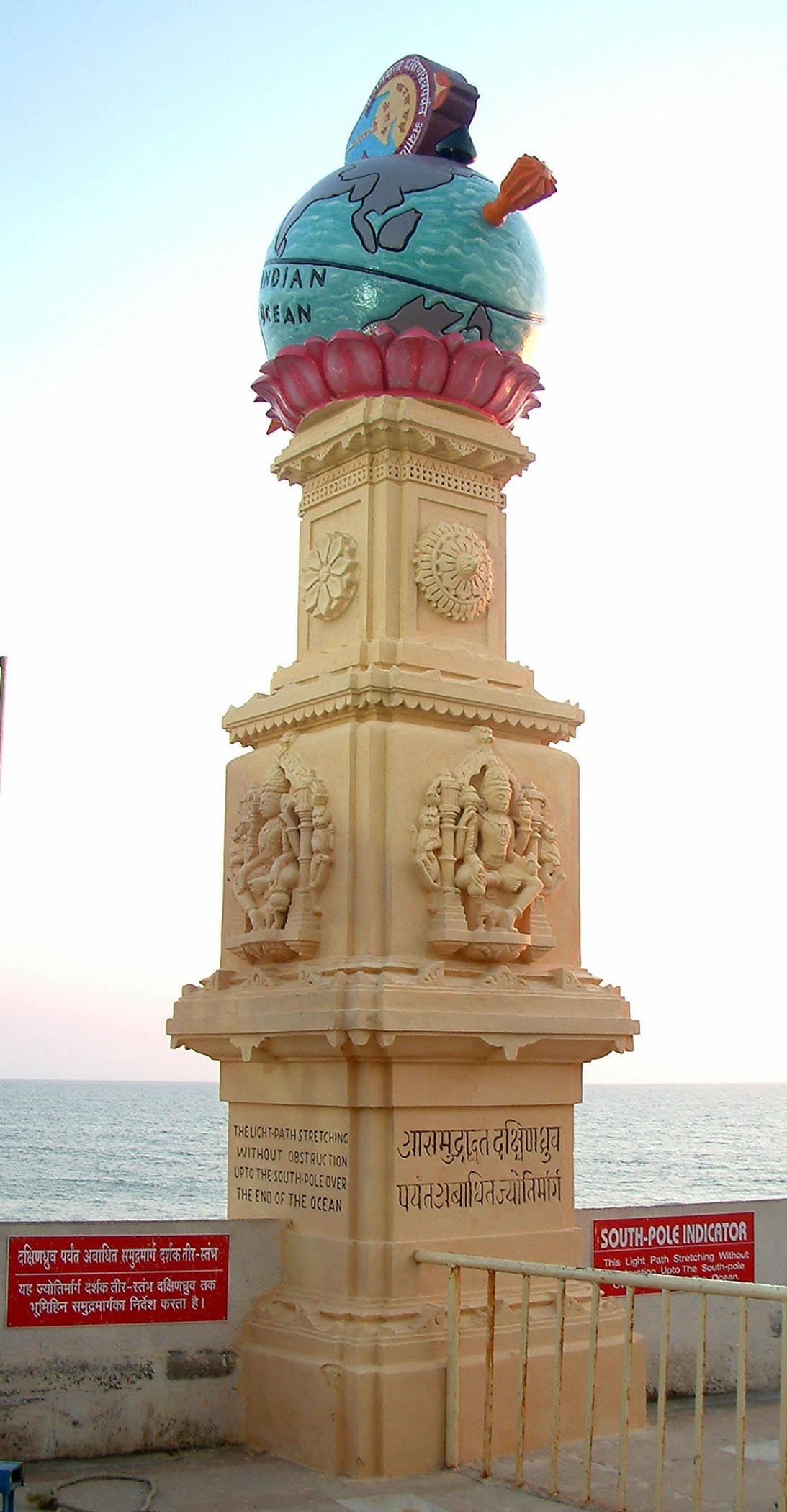
    The temple is situated at such a place that there is no land in a straight line between Somnath seashore until Antarctica, such an inscription inSanskrit is found on the Bāṇastambha (Sanskrit: बाणस्तम्भ, lit. arrow pillar) erected on the sea-protection wall. The Bāṇastambha mentions that it stands at a point on the Indian landmass that is the first point on land in the north to the South Pole at that particular longitude.

    Bansthamba, Gujarat
    Banasthamba, Arrow Pillar at Somnath Temple

    I had also written that Shiva is mentioned only in the passing in the Vedas but is referred to constantly in Tamil Literature calling Shiva as The Unborn Elder and He is recorded  as having founded the Tamil language with Subrahmanya.

    and Daksha hid from Shiva in Antarctica.

    India in Antarctic Circle and Daksha Underground Tunnel in Antarctica


    Somnath temple situated at the seashore of the Arabian ocean on the western corner of Indian subcontinent in Gujarat State. This pilgrimage is one of the oldest and finds its reference in the earliest texts like Skandpuran, Shreemad Bhagavat, Shivpuran etc. The hymn from Rig-Veda quoted below mention the Bhagvan Someshwar along with the immense pilgrimage like Gangaji, Yamunaji and Eastward Saraswati. This signifies the ancient value of this Tirthdham.

    According to legend, Som, the Moon God constructed the Somnath Temple from gold, Ravan made it from silver, Lord Krishna made the temple from wood and King Bhimdev of Anhilwad made the temple from stone.

    Som erected the temple out of admiration afterLord Shiva cured his disease that was caused by Som’s father-in-law Daksha Prajapati’s curse. Daksha Prajapati had cursed Som as he was charmed by Rohini and was not giving adequate attention to his other 26 wives who were all girls of Prajapti. It is accepted that Lord Brahma advised Som to construct the temple to respect Lord Shiva.

    The Somnath Temple is the seventh temple constructed to honour Lord Somnath, who was famous called Bhairaveshwar, Shravanikehswar and Shrilingeshwar, in Sat Yug, Treta Yug and Dwapar Yug separately.

    As per Shiv Mahapuran, once Brahma and Vishnu had an dispute in terms of superiority of creation. To test them, Shiva pierced the three worlds as a huge endless pillar of light, the jyotirlinga.Vishnu and Brahma divide their ways to downwards and upwards correspondingly to find the end of the light in either direction. Brahma lied that he found out the end, while Vishnu accepted his defeat. Shiva appeared as a second pillar of light and cursed Brahma that he would have no place in ceremonies while Vishnu would be worshipped till the end of time without end. The jyotirlinga is the supreme partless truth, out of which Shiva partly appears. The jyothirlinga shrines thus are places where Shiva appeared as a blistering column of light. Originally there were supposed to be 64 jyothirlingas while 12 of them are considered to be very auspicious and sacred. Each of the twelve jyothirlinga sites takes the name of the presiding deity – each considered diverse manifestation of Shiva. At all these places, the primary image is lingam demonstrating the beginningless and endless Stambha pillar, symbolizing the never-ending nature of Shiva. The twelve jyothirlinga are Somnath in Gujarat, Mallikarjuna at Srisailam in Andra Pradesh, Mahakaleswar at Ujjain in Madhya Pradesh, Omkareshwar in Madhya Pradesh, Kedarnath in Himalayas, Bhimashankar in Maharastra, Viswanath at Varanasi in Uttar Pradesh, Triambakeshwar in Maharastra, Vaidyanath Jyotirlinga, Deogarh in Deoghar, Jharkhand, Nageswar at Dwarka in Gujarat, Rameshwar at Rameswaram in Tamil Nadu and Grishneshwar at Aurangabad in Maharastra.

    The seond somnath temple was built and replaced first on same location around 649 CE by Vallabhi Yadava kings in Gujrat. The temple was ruined by Muslim king Mahmud Ghazni in 1024, who raided the temple from the thar desert. It was again built by Gujjar Paramara King Bhoj and the Solanki king Bhimadev I of Anhilwara during 1026 to 1042. The wooden temple design was changed by Kumarpal, who made the temple by stone.

    The temple was again destroyed by army of Allauddin Khilji on 1296. Gujrat Raja Karan was conquered and forced to flee by Allauddin Khilji. According to Taj-ul-Ma’sir of Hasan Nizami, the Sultan boasted that “fifty thousand infidels were dispatched to hell by the sword” and “more than twenty thousand slaves, and cattle beyond all calculation fell into the hands of the victors”. Somnath temple was re-created by his son Khengar sometime between 1326 and 1351.

    Somnath Temple Live Darshan: 6.00am to 9.00pm
    Aarti : 7.00 am, 12.00 pm and 7.00 pm

    The Jay Somnath Sound and Light Show : 8.00 pm to 9.00 pm Do not miss it if you are in Somnath during the evening hours.

    How to reach Somnath Temple

    By Flight
    Nearby airport to Somnath is Diu, which is 90 km away from Somnath city. This airport is connected to Mumbai only. International travellers have to get connecting flights from Mumbai international airport, which is at a distance of 890 km from Somnath. Mumbai is well linked with all main cities in India and many cities in abroad.

    By Train
    Somnath is well connected to other major cities of the country via regular trains.

    By Bus
    You can easily get regular buses to Somnath from other main cities of the country.

    Reference and citations.

    https://en.wikipedia.org/wiki/Somnath_temple

    http://www.maadurgawallpaper.com/somnath-temple

    Banasthamba Image credit.

    By <a href=”//commons.wikimedia.org/w/index.php?title=User:Admishra&amp;action=edit&amp;redlink=1″ class=”new” title=”User:Admishra (page does not exist)”>Admishra</a> – <span class=”int-own-work” lang=”en”>Own work</span>, Public Domain, https://commons.wikimedia.org/w/index.php?curid=7730687

    Featured image credit.

    https://www.quora.com/What-is-the-best-mystery-of-Indian-temples-until-now

  • Levitating Shiva Linga Somnath Kazvini Persian Geographer

    There is no end to the skills of the Indians, especially in architecture .

    They use all the principles of Nature.

    One has a Temple where the shadow of the Spire  falls within the Base of the Gopuram.

    Thanjavur Big Temple.

    Shiva Linga ,Somnath,Gujarat,India.Jyotir linga
    Shiva Linga ,Somnath,Gujarat,India.

    Spring water flows the base of the Idol.a,Thiruvanaikkaval.,Tamil Nadu

    Idols in many temples change colors during a day/once in fortnight.

    The composition of the elements that go into the making of the idol is unique and it can not be deciphered even by Atomic analysis-Palani,Tamil Nadu.

    Thirupati Balaji Idol Sweats every morning and His Body temperature is at 110 F.

    Sikkil Singaaravelan Subrahmanya,Sikkil, Tamil Nadu  sweats on Skanda Shashti.

    Cool breeze wafts in the hall while the entrance to the Hall is hot,Thiruvellarai,Tamil Nadu.

    One can go on.

    Now we can  add one more.

    Somnath Shiva Linga at Somnath,Gujarat.

    The Shiva Linga, which is  among the Twelve Jyotir Lingas in India levitated.

    This is recorded , not by an Indian, but by a Persian geographer while describing Ghazini’s invasion and loot of India.

    This is his report.


    About 1263 A.D.

    The famous temple at Somnath, with its celebrated idol which was destroyed by Mahmud of Ghazni, “the Image-Breaker,” when he sacked the city in 1025–1026 A.D., has been alluded to several times in the Mohammedan section of this History. An account of the wonders of the temple and the optical delusion in connection with the idol is given by the Persian geographer Zakariyah Kazvini, who wrote, however, in Arabic, about the year 1263 A.D. Kazvini, though not a traveller himself, drew upon the works of travellers for his geographical materials, and he gives the following interesting account of the famous Somnath shrine, over whose destruction, two centuries before, he rejoices with the Moslem joy that hailed the downfall of a house of idols….


    ‘Somnath is a celebrated city of India, situated on the shore of the sea and washed by its waves.

    Among the wonders of the place was the temple in which was placed the idol called Somnath. This idol was in the middle of the temple without anything to support it from below, or to suspend it from above. It was regarded with great veneration by the Hindus, and whoever beheld it floating in the air was struck with amazement, whether he was a Mussulman or an infidel. The Hindus used to go on pilgrimage to it whenever there was an eclipse of the moon, and would then assemble there to the number of more than a hundred thousand. They believed that the souls of men used to meet there after separation from the body, and that the idol used, at its pleasure, to incorporate them in other bodies, in accordance with their doctrine of transmigration. The ebb and flow of the tide was considered to be the worship paid to the idol by the sea.

    ‘Everything that was most precious was brought there as offerings, and the temple was endowed with the taxes gathered from more than ten thousand villages. There is a river, the Ganges, which is held sacred, between which and Somnath the distance is two hundred parasangs. They used to bring the water of this river to Somnath every day, and wash the temple with it. A thousand Brahmans were employed in worshipping the idol and attending on the visitors, and five hundred damsels sang and danced at the door – all these were maintained upon the endowments of the temple. The edifice was built upon fifty-six pillars of teak, covered with lead. The shrine of tile idol was dark, but was lighted by jewelled chandeliers of great value.

    .

    it was a chain of gold weighing two hundred mans. When a portion, or watch, of the night closed, this chain used to be shaken like bells to rouse a fresh lot of Brahmans to perform worship.

    ‘When Sultan Mahmud, the son of Sabuktagin, went to wage religious war against India, he made great efforts to capture and destroy Somnath, in the hope that the Hindus would then become Mohammedans. He arrived there in the middle of Zu-l-ka’da, 416 A. H. (December, 1025 A.D.). The Indians made a desperate resistance. They kept going in to the temple weeping and crying for help; and then they issued forth to battle and kept fighting till all were killed. The number of the slain exceeded fifty thousand. The king looked upon the idol with wonder, and gave orders for the seizing of the spoil and the appropriation of the treasures. There were many idols of gold and silver, and countless vessels set with jewels, all of which had been sent there by the greatest personages in India. The value of the things found in the temples of the idols exceeded twenty thousand thousand dinars.

    When the king asked his companions what they had to say about the marvel of the idol, and of its staying in the air without prop or support, several maintained that it was upheld by some hidden support. The king directed a person to go and feel all around and above and below it with a spear, which he did, but met with no obstacle. One of the attendants then stated his opinion that the canopy was made of loadstone, and the idol of iron, and that the ingenious builder had skilfully contrived that the magnet should not exercise a greater force on any one side – hence the idol was suspended in the middle. Some inclined toward this explanation, others differed from it. Permission was obtained from the Sultan to remove some stones from the top of the canopy to settle the point. When two stones were removed from the summit, the idol swerved on one side; when more were taken away, it inclined still further, until at last it rested on the ground.’

    By Kazvini Persian Biographer.

    The following is another description by a Persian Traveler about the idol.

    ‘The idol has a human shape and is seated with its legs bent in a quadrangular posture on a throne made of brick and mortar. Its whole body is covered with a red skin like morocco leather, and nothing but its eyes are visible. Some believe that the body is made of wood, some deny this; but the body is not allowed to be uncovered to decide this point. The eyes of the idol are precious gems, and its head is covered with a crown of gold. It sits in a quadrangular position on the throne, its hands resting upon its knees, with the fingers closed, so that only four can be counted.’

    al-Istakhri, who journeyed through India and other Mohammedan countries in the first half of the tenth century.

    Somnath Location.

    The Somnath temple located in Prabhas Patan near Veraval in Saurashtra on the western coast of Gujarat, India, is the first among the twelve Jyotirlinga shrines of Shiva. It is an important pilgrimage and tourist spot. The temple is considered sacred due to the various legends connected to it. Somnath means “Lord of the Soma”, an epithet of Shiva..

    Citation and Reference.

    http://www.ibiblio.org/britishraj/Jackson9/chapter05.html