Tag: Siddha Yoga

  • Ganesa Devi in Mooladhara Siddhas Explain

    Ganesa Devi in Mooladhara Siddhas Explain

    It is very difficult to lay one’s hands on Siddhas’ Texts, though theoretically, they are available in the web. But to get the correct text is difficult as there are fake poems floating around masquerading as Original. Unless one is familiar with ancient Tamil and the unique style of Siddhas’ Expressions, one may be misled.

    Though the Ashtanga Yoga of Patanjali is widely popular and is practiced Today, the basis on which it is built is the Vaasi Yoga. The first Exponent of Vaasi Yoga is Siva Himself. In Vaasi Yoga, consciousness is directly addressed to,with emphasis on Breath Regulations.And this step is preceded by Do’s and Don’ts as in Ashtanga Yoga Niyama and Yama.Here in Vaasi, Asanas, one can follow what is comfortable for him) her. This point is referred to in Srimad Bhagvad Gita when Krishna talks about Sukhasana,that Posture which is pleasant. Patanjali also makes a point of this For Breath control, time taken to inhale and exhale is provided in terms of Matras. Thirumoolar Pranayama Ratio Explanation

    The process of Vaasi is difficult for people,except for those who are gifted. To solve this,Siva had advised Patanjali to simplify Vaasi and introduce a yoga practice that would elevate one to Vaasi consciousness from where Vassi Yoga will take over. Accordingly Patanjali composed Yoga Sutra ,laying emphasis on postures ,followed by Pranayama.

    In Vaasi as I said earlier, Prana is given priority and each Chakra is assigned a Deity. Normally one would not find texts of Yoga discipline associated with Vishnu and Lakshmi, though there is Lakshi Tantra and references to Narayana in the Sanskrit tradition.In Tamil tradition, Mahalakshmi and Vishnu are Deities for specific chakras.

    In this article, I shall present details about Mooladhara chakra as explained by Thirumoolar and Bhogar. Agasthya has written extensively on similar lines.

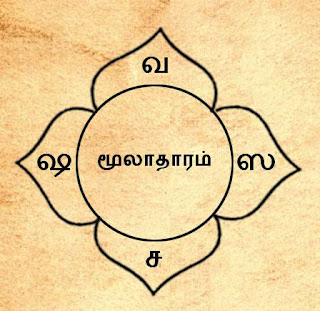
    Mooladhara chakra lies in between genital organ and rectum. It lies approximately twice the thickness of Ring finger upper to rectum and twice the thickness of Ring finger lower from genital organ .See image below.

    Mooladhara location.
    Mooladhara Chakra

    The Mooladhara chakra lies twelve inches below the Navel;People do not know this and the Mantra to establish,( here it means to raise Kundalini) and once you know how to establish this,you shall find Siva present there.( Here Esa refers to Siva).I have provided the text of Thirumoolar’s Thirumandihram below .

    நாபிக்குக் கீழே பன்னிரண்டு அங்குலம்

    தாபிக்கும் மந்திரம் தன்னை அறிகிலர்

    தாபிக்கும் மந்திரம் தன்னை அறிந்தபின்

    கூவிக் கொண்டு ஈசன் குடியிருந்தானே -Thirumoolar

    Now Bhogar says, in his Bhogar 7000, thus.

    Ganesha stands on A’) Kaara அ,,in that at an angle stands U,உ,there at an angle Devi resides as Vallabhai( she is also considered as the Consort of Ganesa in Tantric Texts / He is also portrayed as Vallabha Ganapathi): at an angle shall be as Kadhali flower( as shown here), lies Kundalini as a coiled, hissing female snake as Su kaara. சு காரம், as Thuriya State( The fourth stage,thers being Jagrath,Swapna,Sushupti )

    Kadhali flower

    Bogar in his book ‘Bogar 7000’ noted as follows:

    அகாரத்தின் மேலாகக் கணேசர் நிற்பார்

    அதிலே யோர்கோணத் திலுகாரம் நிற்கும்

    உகாரத்தில் வல்லபையாம் சக்தி நிற்பாள்

    ஒடுங்கிய தோர்முனை யொன்றில் கதலிப்பூவாய்

    புகாரமாய் முகங்கீழ்க் குண்டலியாம் சக்தி

    பெண்பாம்பு போல்சுருட்டிச் சீறிக் கொண்டு

    சுகாரமாய்ச் சுழிமுனையூ டுருவி நிற்பாள்

    துரியாதீ தம்மென்ற வவத்தை தானே.

    Join 4,576 other subscribers
  • How To Find Siddha Amirtha Marana Yoga

    Hindus, in determining auspicious time, take into account, apart from Day,Stars,Thithis(waxing and waning of the Moon),Yoga Karana.


    These five, Day, Star, Thithi,Yoga( not the Yoga of Patanjali, here Yoga indicates auspicious/conducive period) and Karana form the basis of Hindu Almanac, called Panchanga(Five limbs).


    Kolam/Rangoli .jpg
    Kolam/Rangoli indicate auspiciousness


    Apart from the inauspicious time of each day,Rahu Kalam and Yama Kanda(some do not take Yama Kanda  as inauspicious as this time being inauspicious for Yama the God of death, and by reverse Logic is auspicious for the Living)


    Not much is known about Yogas, Siddha ,Amirth and Marana.


    It would help one to read about Time calculation of the Hindus,


    Please check my posts on How to find an auspicious day and Time, Hindus Calculation.


    One can cross check the Yoga daily by understanding what it is about.


    EIGHT DAYTIME PERIODS—THE KALAS

    The period between sunrise and sunset each day is divided into eight pe- riods. Each period, or kala, lasts approximately one and one-half hours, depending on the total duration of sunlight. Three of the eight kalas are considered most im- portant—Rahu Kala, Yama Kala and Gulika Kala—known collectively as the trini samayam. Rahu Kala is considered malefic for commencing new undertakings. Yama is also an interfering current, but is less influential than Rahu. Yama Kala is considered an auspicious time for antyesti (funeral) rites. Gulika is the most auspi- cious time of the day for commencing new activities.

    Each kala occurs at approximately the same time on each particular day of the week. Thus, Gulika Kala occurs at approximately 7AM every Friday. If you’ve ever wondered why Monday mornings are so infamous, note that Rahu Kala is generally between 7:30 and 9AM every Monday. The trini samayam are listed at the top of column three for each day.


    Yogas are Twenty Seven.


    ROUTINE OR CREATIVE WORK DAYS—AMRITADI YOGAS

    The resultant of the waves propagated by the planets and the stars on the human psyche are indicated in four degrees. In the Vedic Calendar, this esoteric yoga is listed in bold type in the left column of each day’s designations.


    AMRITA YOGA—CREATIVE WORK: Very good for creative types of work and auspicious undertakings.

    SIDDHA YOGA—CREATIVE WORK: Good for creative types of work and auspicious undertakings.

    MARANA YOGA—ROUTINE WORK: Should be avoided for new under- takings and beginning travel. Routine work only.

    PRABALARSHTA YOGA—ROUTINE WORK: Should be absolutely avoided for new undertakings and beginning travel. Routine work only.


    How to find the Yogas.

    ” Siddha Yoga:

    This is formed due to the combination of the Tithi and vara

    There are 5 categories of Tithis:

    Nanda  : Pratipad,  Shasthi, Ekadasi
    Bhadra : Dvitiya,   Saptami, Dvadasi
    Jaya   : Tritiya,   Astami,  Trayodasi
    Rikta  : Chaturthi, Navami,  Chaturdasi
    Purna  : Panchami,  Dasami,  Purnima, Amavasya

    The 5 categories of Tithis are governed by 5 elements of nature which are given below. When a tithi falls on a weekday (Vara) governed by the same element as that of the tithi a very auspicious time is formed which goes by the name of Siddha Yoga.

    Following combination of Tithis and the Varas constitute the siddha yoga:

    Nanda  : Friday    :Venus   : Jala    Tattva
    Bhadra : Wednesday :Mercury : Prithvi Tattva
    Jaya   : Tuesday   :Mars    : Agni    Tattva
    Rikta  : Saturday  :Saturn  : Vayu    Tattva
    Purna  : Thursday  :Jupiter : Akash   Tattva

    * * * * * * * *
    II Sarvartha Siddha Yoga

    Certain combination of Nakshatras and Weekdays go by the name of Sarvartha Siddhi yoga. Activities done during this yoga usually concludes with Positive results.

    Monday    : Sravana, Rohini      , Mrigashiras, Pushya    , Anuradha
    Tuesday   : Aswini , U.Bhadrapada, Krittika   , Ashlesha
    Wednesday : Rohini , Anurada     , Hasta      , Krttika   , Mrgashiras
    Thursday  : Revati , Anuradha    , Aswini     , Punarvasu , Pusya
    Friday    : Revati , Anuradha    , Aswini     , Punarvasu , Sravana
    Saturday  : Sravana, Rohini      , Swati
    Sunday    : Hasta  , Mula        , U.Ashadha  , U.Phalguni, U.Bhadra, Aswini, Pushya

    * * * * * * * *
    Amrita Siddhi Yoga:
    This yoga is formed due to combination of Vara and Nakshatra

    Sunday  : Hasta
    Monday  : Mrgashiras
    Tuesday : Aswini
    Mercury : Anuradha
    Thursday: Pusya
    Friday  : Revati
    Saturday: Rohini

    Though this is a auspicious combination, following events should be avoided:

    Thursday- Pushya: Marriage
    Tuesday - Aswini: Grha Pravesha
    Saturday- Rohini: Travel

    * * * * * * * *
    Dvipushkar Yoga:

    Following combination of Tithi, Vara and Nakshatra is called Dvipushkar Yoga:

    Dvitiya  , Saptami, Dvadasi
    Sunday   , Tuesday, Saturday
    Dhanistha, Chitra , Mrgashiras

    The events repeat again at least once if they happen in this yoga. Hence good events should happen in this yoga such as purchase of property etc. and unfortunate events such as diseases and death should not happen.

    * * * * * * * *
    Tripushkar Yoga:

    Following combination of Tithi, Vara and Nakshatra is called Tripushkar Yoga:

    Sunday,   Tuesday,   Saturday
    Dvitiya,  Saptami,   Dvadasi
    Krittika, Punarvasu, Uttaraphagulni, Vishaka, Uttarashadha, Uttarabhadrapada

    The events repeat again at least twice if they happen in this yoga. Hence good events should happen in this yoga such as purchase of property etc. and unfortunate events such as diseases and death should not happen.

    * * * * * * * *
    ASHUBHA YOGA:
    (Inauspicious combinations)
    * * * * * * * *
    Mrtyu Yoga:
    This yoga is formed due to combination of Vara and Tithi

    Tuesday   , Sunday :: Pratipad , Shasthi, Ekadasi
    Monday    , Friday :: Saptami  , Dvadasi
    Wednesday          :: Tritiya  , Ashtami, Trayodasi
    Thursday           :: Chaturthi, Navami , Chaturdasi
    Saturday           :: Panchami , Dasami , Purnima

    Adham Yoga:
    This yoga is also formed due to combination of Vara and Tithi

    Sunday   : Saptami, Dvadasi
    Monday   : Ekadasi
    Tuesday  : Dasami
    Wednesday: Pratipad, Navami
    Thursday : Ashtami
    Friday   : Saptami
    Saturday : Shasti

    Dagdha Yoga:
    This yoga is formed due to combination of Vara and Nakshatra

    Sunday   : Bharani
    Monday   : Chitra
    Tuesday  : Uttarashadha
    Wednesday: Dhanishtha
    Thursday : Uttaraphalguni
    Friday   : Jyestha
    Saturday : Revati

    Yamaghata Yoga:
    This yoga is also formed due to combination of Vara and Nakshatra

    Sunday   : Magha
    Monday   : Vishakha
    Tuesday  : Ardra
    Wednesday: Moola
    Thursday : Krittika
    Friday   : Rohini
    Saturday : Hasta
    
    Citation.
    
    
    http://www.panchanga.net/about-panchanga/panchangam-intro-other-indicators-in-hindu-panchangam/
    
    
    http://varahamihira.blogspot.in/2005/11/yogas-in-muhurtha.html
    
    * Corrections welcome.