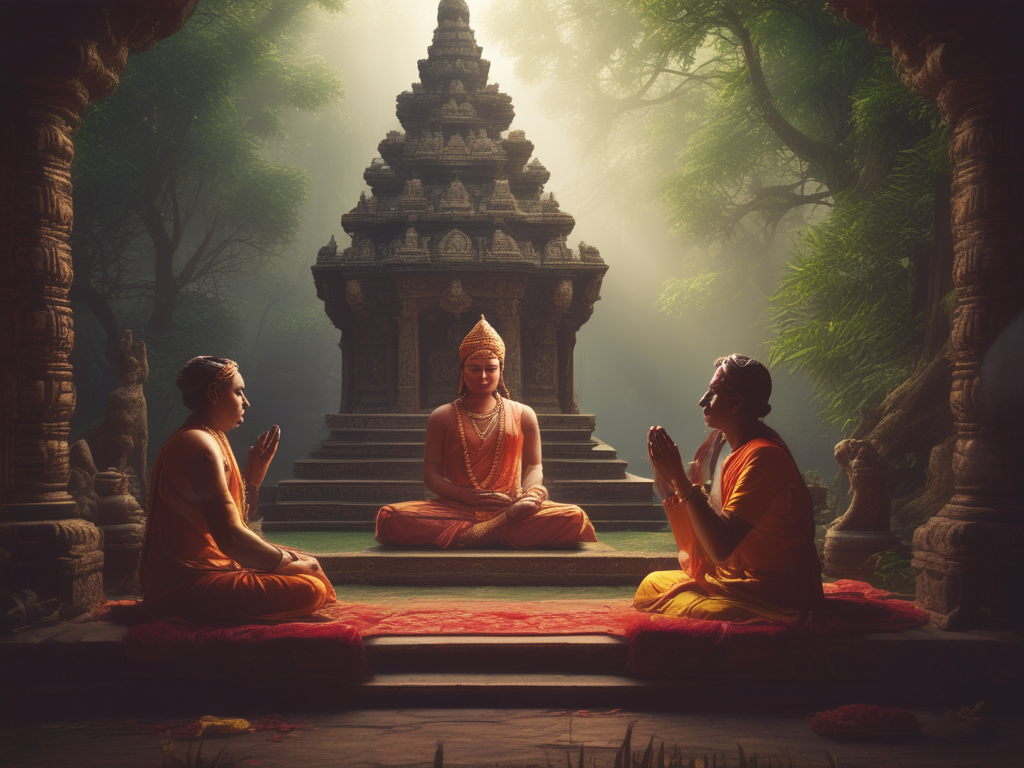
Tag: Saguna Aradhana

  • Understanding Saguna and Nirguna Brahman in Hinduism

    Understanding Saguna and Nirguna Brahman in Hinduism

    Introduction To Nirguna Saguna Sahasranama Aradhana.

    Saguna means “with attributes.” Nirguna means “without attributes.” “Saguna Brahman” describes a God with (tangible) attributes. The term “Nirguna Brahman” describes a God with no (tangible) attributes.

    One with Attributes, qualities,Saguna.The other Nirguna, without Attributes,Nirguna.The western thought explores the Universe through what is outside,the perceived.It is necessary to have something in us to perceive .For all we know, there may be things out there and if one does not se it or perceive it, one may never know it, aware of it.Awareness, which is the rudiment of Knowledge,, needs two things.That which is to one known and that which knows or is aware.‘We have the Mind as an instrument.We know things through the Mind.If the Mind is absent or dysfunctional, we will not know things out there or may not know them as they are.Hinduism makes further distinction.Mind is what interprets sensations and the Data received.The sensations or Data is received is through the Brain, which is just like a CPU, just receives.The job of sorting them out, collating adding value judgements is reserved for the Mind.The classification and addition of value judgments is by the Chitta that directs the mind.The Chitta is based on Human Dispositions.The dispositions of individuals vary.So what is out there varies .So logically what we perceive is not what IS but what we perceive as what IS.So Reality expresses itself in the way we want to perceive it.This is the reason why many Gods and Goddesses are found in Hinduism.Without accommodating the Mind to perceive by providing it with a Target, we can not know what is outside.Therefore knowing the limitations of the Mind, Hinduism prescribes different systems of worship.The target of worship may be an Idol, Symbol.Once the Mind gets focussed on this, it evolves to comprehend the Ultimate Reality without Attribute, Brahman.These procedures are like gradually moving from LKG to Ph.d.Once you obtain Ph.d , LKG seems to be irrational and look unnecessary.But without it, you could not have reached Ph.d level.Yet there are individuals who are equipped with dispositions to do Ph.d, that is to understand Reality without Attributes, Nirguna Brhaman.One Like Ramana MaharishiAdi Shankaracharya has provided a Stotra addressed to Nirguna Brahman which explains these.One may notice that all the Sahasranamas, Vishnu and Lalitha Sahasranamas have Saguna and Nirguna Brahma upasanas embedded in them.Lalitha Sahsranama has organised this better by allotting separate portions,like Saguna Aradhana, Nirguna Aradhana and the identification of Shiva and Shakthi in the same Text.

    Aghora Pasupatha Homa Evil Eye Protection Mukthi

    Removal of Evil eye, Protection from forces that hinder Spiritual development. Protection from Black magic,Animals. Increases self confidence and self assurance. Clarity of thought.. Above all,Mukthi and Gnana are facilitated.

    Rig Veda Inflenced Civilizations Outside India

    Date of Rig veda in Ramanisblog According to Ramanisblog, the date of the Rig Veda is subject to considerable debate, with modern scholarly estimates generally ranging between 2000 BCE to 1000 BCE[1]. However, Ramanisblog highlights that Hindu tradition considers the Vedas to be timeless and without a specific beginning[1]. Perspectives on Rig Veda Dating Ramanisblog…

    Navavarana Pooja 1 Guru Stuthi

    Following in the Ai Generated transcript of the Navavarana Pooja Mantras . Recorded and sent to my Shishyas. This is being made public so that this secret knowledge is not lost to posterity. Those who want to be initiated may contact me through mail at ramanan50@gmail.com. Also they can contact through the comment column. If…

    Brahman

    Brahman, a key concept in Hinduism, is the ultimate, unchanging reality beyond the physical world. It is described as omnipresent, infinite, and eternal. The concept of Brahman encompasses both Saguna (with attributes) and Nirguna (without attributes) manifestations. Saguna Brahman represents a God with tangible attributes, while Nirguna Brahman represents a God without tangible attributes. Understanding and realizing Brahman is central to various forms of Hindu worship and philosophical inquiry.

    In Hindu philosophy, the human mind plays a crucial role in perceiving and interpreting the external world. According to Hindu thought, the mind interprets sensations and data received from the external world, with the brain acting as a receiver. However, it is the mind that processes and adds value judgments to this information through the faculty known as Chitta, which is influenced by individual dispositions.

    Recognizing the limitations of the human mind, Hinduism prescribes various approaches to worship and spiritual practice. Different systems of worship are intended to gradually lead the mind from focusing on tangible forms, such as idols or symbols, to comprehending the ultimate reality without attributes, the Nirguna Brahman. This gradual progression is likened to the educational journey from kindergarten to obtaining a Ph.D. Individuals with predispositions for understanding the reality without attributes, like Ramana Maharishi and Adi Shankaracharya, are rare yet exemplify this profound understanding.

    It is notable that Hindu scriptures, such as the Vishnu and Lalitha Sahasranamas, incorporate both Saguna and Nirguna aspects of Brahman worship. Lalitha Sahasranama, in particular, comprehensively organizes these aspects by allocating separate sections for Saguna and Nirguna worship, acknowledging the interplay of Shiva and Shakti within the same text.

    In summary, the concept of Brahman in Hinduism encompasses both Saguna and Nirguna manifestations, reflecting the profound understanding of ultimate reality and the methods to realize it.

    Related Articles

  • Deceive Mind Experience Reality Brahman

    Deceive Mind Experience Reality Brahman

    Vedas,the sacred text of Hindus, do not advocate Idol worship or even personal God. Vedas talk about Reality,Brahman, as a Principle, which is beyond Attributes,Names,Forms,Mind, Intellect and Reason. Brahman is Unknowable but can be Experienced.

    Then how does one attain Salvation if it is beyond Attributes, Names,Forms Mind and Intellect…? One must have tools to Realize Brahman.Hinduism, to sort out this issue, proposed the concept of Iswara,Personal God.
    This Concept, one can find in Patanjali’s Yoga Sutra, as Iswara Pranidhana.The process and the end result of Search and Realisation of Brahman, is cessation of the modifications of Chitta, of the actions and reactions generated by one’s dispositions and actions.Then ,at that stage,one becomes devoid of the urge to Act and thereby is relieved of the bondage of Actions one accumulates.This results in the Individual Souls becoming aware of its innate Attributes of Being, Consciousness and Bliss. Sat, Chit and Ananda. At this level, the individual soul gets rid of its ignorance of perceiving itself being different from Brahman, the underlying Reality of Everything.

    This is very difficult if one were to follow the description and methodology described in Upanishads.When I say difficult, I mean that it is difficult for most of us.But many have followed Upanishads in their own way and Realized Brahman,Ramana Maharshi, Kanchi Periyavar of our Times.

    For us normal mortals, ruled by passions, this process is difficult. So the worship of individual God is proposed.

    Human Mind behaves in a strange manner.Many of us are not aware that what we think about, we become.And when what we like are Attributes, Qualities that are Perfect in Measure, our mind is engrossed in It.And, defying Logic,we are bestowed with what we desire,which, under normal circumstances, are unachievable by us. Take the instance one, either in fear or Flight response, lifting weights which one can never imagine of lifting under normal conditions or running so fast that it would astonish one later.

    So, Vedas have proposed personal God. Iswara.When one follows this Concept, he is taking a step closer to Know the Unknowable, by transforming the Unknowable into something which appears to be Knowable to The Heart.

    Thus one deceives one’s Mind so that Heart experiences what can be experienced, which in the lexicon of Mind is not Knowable.

    Cognition becomes Experience.

    Experience,Experienced and Experiencer …All become One. Distinction disappears.

    This is Experiencing Reality, Brahman.

    This is Advaita.

  • Realize Brahman Reality Through Rama Kalyana Gunas Attributes

    Realize Brahman Reality Through Rama Kalyana Gunas Attributes

    According to Sanatan Dharma, Reality is a Principle to be Realised by an individual. Reality is beyond Attributes , can not be explained ,can not be reached through Mind/Intellect.Reality can not be Known. It can only be experienced,just as you experience Hunger,Pain or Pleasure.

    This is the Ultimate Truth as enunciated in the Vedas.

    Truth may be one thing, but our coming to terms with it, is a different proposition altogether.We, as human beings are limited by our Mind, especially the two spectacles of Space and Time,that condition Mind.So, our mind is limited. Try speaking about without reference to Space and Time.I have not deliberately used ‘Try speaking about a Thing’, because Space concept is used here to refer to something.The same Logic for Time.

    Sanatan Dharma does not simply suggest something to follow as a Dogma. As the goal of Sanatan Dharma is to understand Reality and the means to Salvation,what Sanatan Dharma teaches should be followable. However, Truth need not conform to our Limitations.It exists. So the process to realise It, need not be through instrument which we think is sufficient. It is not.I refer to our Mind.

    How to marry these two concepts?

    Sanatan Dharma suggests, though the Reality is A Principle and can not be apprehended by cognitive processes, Sanatana Dharma offers a unique solution.

    That of Worship of personal Gods.The concept of Iswara, personal God,one comes across in Patanjali’s Yoga Sutra as Iswara Pranidhana. The concept of God is useful because it is easy to Focus your Mind on something which has a Name and Form And one ascribes qualities in Absuloute Terms.And also the Ascribed Qualities and Forms are those one loves .Thus was formed the Saguna Aradhana in Hinduism.Once your mind is focussed on the individual God,you become immersed in that and become one with it, emotionally.Difference between Perceiver,Perceived and The Process of Perception , disappears and Reality is experienced,shorn of Attributes.

    Thus one Finds in Sri. Rama, a short cut to Realize Brahman, One Beyond Attributes.

    As explained above, sixteen Attributes are attributed to Sri Rama. And these sixteen Attributes are in perfect, in Full measure, Auspicious.These are the Kalyana Gunas of Sri Rama.Valmiki in Balakanda of Ramayana had listed them. They are provided below.

    1. Virtuous: गुणवान् (Gunavan): Who is Virtuous
    2. Valorous: वीर्यवान् (Viryavan): Who is Valorous
    3. Knower of Dharma: धर्मज्ञ (Dharmagya): Who is the knower of Dharma
    4. Doer of Good Deeds: कृतज्ञ (Krtagya): Who is the doer of Good Deeds (according to Dharma)
    5. Truthful: सत्यवाक्य (Satyavakya): Who is the speaker of Truth
    6. Firm in Vows: दृढव्रत (Dridhavrata): Who is firm in his Vows
    7. Endowed with Character: चारित्रेण युक्त (Catritrena Yukta): Who by Character is united (with Dharma)
    8. Disposed towards Welfare of all: सर्वभूतेषु हितः (Sarvabhuteshu Hitah): Who is disposed towards the Welfare of all beings
    9. Learned: विद्वान् (Vidvan): Who is Learned
    10. Capable of upholding Dharma: समर्थ (Samartha): Who is Capable (in upholding Dharma)
    11. Graceful: प्रियदर्शन (Priyadarshana): Who has a Graceful and Pleasant appearance
    12. Self-Composed: आत्मवान् (Aatmavan): Who is Self-Composed
    13. Free of Anger: जितक्रोध (Jitakrodha): Who has conquered Anger
    14. Effulgent: द्युतिमान् (Dyutiman): Who is Effulgent (filled with the Effulgence of Aatman)
    15. Free of Envy: अनसूयक (Anasuyaka): Who is not Envious
    16. Whom even Devas Fear: बिभ्यति देवाः (Bibhyati Devah): Whom even the Devas Fear

    (Ref: Valmiki Ramayana – Bala Kanda – 1). https://greenmesg.org/stotras/rama/