Tag: Rosary prayer Christianity

  • Rosary Prayer Counting Christianity from Hinduism Prohibited By The Bible

    Rosary Prayer Counting Christianity from Hinduism Prohibited By The Bible

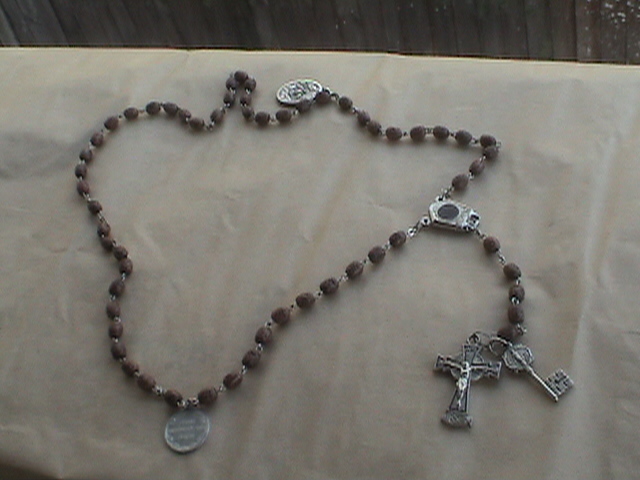
    Rosary is a practice followed by almost all Religions of the world to keep track of counting God’s name or a Prater.

    You would find it in Hinduism, Buddhism, Christianity….

    The origin of counting thus is lost in time.

    However, present evidence shows the first use of Rosary, called Japamaala is from Sanatana Dharma.

    There are various methods described and followed in Hinduism to count prayers.

    Shall write in detail.

    The practice of Rosary was a later development in Christianity.

    I am providing the abstract and Link on Rosary towards the end of this article.

    Though widely practiced in Christianity it is prohibited by the Bible.

    Most commonly recognized in the United States
    as a symbol of Catholicism, other religions including
    Buddhism, Hinduism, Paganism and Islam employ
    rosary beads as well.”
    -The Meaning of Rosary Beads
    What Do Rosary Beads Symbolize?
    By Jessica Ciosek

    “Prayer beads, or prayer rosaries, are really
    another form of the “witch’s ladder,” a knotted
    rope or cord used to count repetitions during
    a spell or ritual. Praying with beads is a spiritual
    practice with a long history in most of the world’s
    religions.”
    -Sacred Mists Shoppe
    Janet Farrar & Gavin Bone

    “prayer beads originated with the Hindu faith.
    Using beads for devotions dates to the 8th century BC
    in the cult of Shiva. In India sandstone sculptures,
    statues ca 185 BC, show Hindus with prayer beads.
    The names of Hindu gods and prayers are repeated
    on stringed beads, called mala, separated by larger
    or different colored beads.”
    -A HISTORY OF PRAYING ON BEADS
    Patricia A. Dilley

    “Hindu converts kept their traditional use of
    prayer beads. Buddhist monks always carry a strand
    of prayer beads, or rosary, usually of 108 beads.”
    -A HISTORY OF PRAYING ON BEADS
    Patricia A. Dilley

    Prayer beads are used by : Hindus, Buddhists, Muslims,
    and Catholics among others.

    “Often, when religions sought converts,
    they allowed them to retain some of their
    pagan ways: ceremonial garb, heathen rituals
    and traditions; in order to add to their numbers.
    This led to spiritual pollution.”
    -A HISTORY OF PRAYING ON BEADS
    Patricia A. Dilley

    “Before the 12th century, rosaries were used for
    talismans (amulet or occult charms). Rosaries and
    prayer beads were intended by the catholic church
    hierarchy, for use by the ignorant.”
    -A HISTORY OF PRAYING ON BEADS Patricia A. Dilley

    Patricia A. Dilley

    The Bible warns us against use of prayer beads –
    Matthew 6:7 says – “But when ye pray, use not vain
    repetitions, as the heathen do: for they think that
    they shall be heard for their much speaking.

    “And when you pray, do not…repeat the same
    words over and over as the Gentiles (pagans) do,
    for they think they will be heard for their much
    speaking.”
    (Matthew 6:7)(AMP)-BibleGateway

    “But when praying, do not say the same things
    over and over again, just as the people of the
    nations do, for they imagine they will get a
    hearing for their use of many words.”
    (Matthew 6:7)(NWT)

    Source.

    https://www.google.co.in/amp/s/falsereligionstartedinbabylon.wordpress.com/2013/07/07/the-pagan-origin-of-rosary-beads/amp/

    Rosary.

    Prayer beads are used by members of various religious traditions such as Hinduism, Buddhism, Christianity, Islam, Sikhism and the Bahá’í Faith to mark the repetitions of prayers, chants or devotions, such as the rosary of the Blessed Virgin Mary in Catholicism, and dhikr (remembrance of God) in Islam.

    …..

    The Desert Fathers of the 3rd to 5th centuries, used pebbles or knotted ropes to count prayers, typically the Jesus Prayer(“Lord Jesus Christ, Son of God, have mercy on me, a sinner”). The invention is attributed to Anthony the Great or his associate Pachomius the Great in the 4th century.

    The Catholic Encyclopedia mentions strings of beads, presumably for prayer, found in the tombs of Saint Gertrude of Nivelles (7th century) and Saint Norbert and Saint Rosalia(12th century). A more explicit reference is that in 1125 William of Malmesbury mentioned a string of gems that Lady Godiva used to count prayers.

    Source.

    https://en.m.wikipedia.org/wiki/Prayer_beads