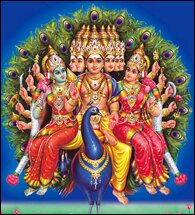
Tag: Murugan

  • Lord Krishna Stayed At Madurai Yanaimalai?

    I have written a few articles on the Tamils and people of Sanatana Dharma interacting quite frequently and Tamils were a Part of Sanatana Dharma, despite efforts being made to project Tamils as Inimical to Sanatana Dharma and that the North looked down at the South.

    YanaiMalai,Elephant Mountain.jpg YanaiMalai

    History proves otherwise.

    Tamil Kings attended Nala Damayanthi Swayamvara, which had taken place before the Ramayana,Rama’s wedding with Sita, Draupadi’Swayamvara in the Mahabharata, Tamil Kings fought alongside the Pandavas in the Epic Battle of Mahabharata,Tamil King Cheralaathan fed both Kaurava and Pandava army during the Mahabharata war,He performed Tharpana for those who lost their Lives in the war, Arjuna, Sahadeva went on a Pilgrimage to South,Arjuna married a Pandyan Princess and Lord Krishna was a special Invitee for the Tamil Sangam, He married a Pandyan Princess, had a daughter through her named Pandiah,had her married to a Pandyan Prince and gave away 100 Yadava Families as  Gift f to her during her marriage.

    Lord krishna with Radha,Image.jpg
    Radha Krishna.

    And Balarama visited the South and worshiped Lord Murugan, ( Subrahmanya) at Valliyur, Durga at Kanya Kumari, and also worshiped Parashurama.

    And he visited Sriranagam before proceeding to meet Krishna at Yanaimalai, near Madurai!

    Rishaba Parvata means mountain of Bull.

    This may be due to some versions which state that the mountain looks like a Bull.

    The other Rishba mountain near Bangalore, is Nandi Hills, which is quite far away from Madurai.

    And there is yet another one near Tumkur(Near Bangalore), which is far from Madurai

    Considering that Krishna married a Pandyan Princess, the place mentioned as Rishaba Mountain in the Mahabharata is to be taken as the Yanaimalai(Elephant hill, Ana/Yanai in Tamil means Elephant,near Madurai as the other Anaimalai is in the western Ghats and lies in Kerala/Coimbatore ,Tamil Nadu.

    And Yanaimalai ,

    “Two Hindu temples are present in the foothills, one being the Ladan cave temple (Ladan koil), a Shaivite temple dedicated to Muruga, and the other being Yoga Narasimha temple, a Vaishnavite temple dedicated to Vishnu. Both are rock-cut temples constructed by the Pandyas, belonging to the 8th century. The place where the Yoga Narasimha temple is situated is known as Narasingam. Tamil-Brahmi and Vattelettu inscriptions in the temples shows their history. The Ladan temple has been declared a protected monument by theArchaeological Survey of India.

    There is a Vishnu Temple called Azhagar Koil and Vishnu comes to Madurai for Madurai Meenakshi’s marraige with Lord Shiva as Somasundara.

    Please read my Post on this,

    Thirupaaran Kundram , near Madurai is one of the Major temples of Lord Murugan( The Six Temples of Subrahmanya-Aarupadai Veedu.

    ““Lord Balarama bathed in the Gomati, Gandaki and Vipasa rivers, and also immersed Himself in the Sona. He went to Gaya, where He worshiped His forefathers, and to the mouth of the Ganges, where He performed purifying ablutions. At Mount Mahendra He saw Lord Parasurama and offered Him prayers, and then He bathed in the seven branches of the Godavari River, and also in the rivers Vena, Pampa and Bhimarathi. Then Lord Balarama met Lord Skanda and visited Sri Saila, the abode of Lord Girisa. In the southern provinces known as Dravida-desa the Supreme Lord saw the sacred Venkata Hill, as well as the cities of Kamakosni and Kanci, the exalted Kaveri River and the most holy Sri-ranga, where Lord Krsna has manifested Himself. From there He went to Rsabha Mountain, where Lord Krsna also lives, and to the southern Mathura. Then He came to Setubandha, where the most grievous sins are destroyed.” (Sri Balarama’s pilgrimage (Mahabharata 9 – Shalya Parva))

    Yanaimalai (Elephant Hill) is a protected monument and tourist attraction in Tamil Nadu, India. It has Jain sculptures, a Shaivitetemple, and a Vaishnavite temple.


    Yanaimalai is in Tamil Nadu, India. The hill stretches over 3 kilometres (1.9 mi) and is 90 metres (300 ft) high.

    It is near Madurai.

    Citation and Source.

    Balarama Worships Murugan Ramani’s blog

    Yanaimalai wiki


  • Skanda Son Of Agni Is Not Subrahmanya? Vadavagni, The Face of Horse

    The topic of Skanda and Subrahmanya is intriguing.

    Subrahmanya or Murugan is not mentioned in the Vedas.

    Murugan.jpg
    Lord Subrahmanya

    Skanda is referred to in The  Sama Veda thus.

    iti dve esā skandasya samhitā, etām prayuñjan skandam prīnati

    The Vamśa Brāhmana is a minor treatise associated with the Sāma Veda. It is concerned with the deities, the Samhitās or their musical renderings of specific hymns among them, and the long line of sages through which the Sāma Veda has come down. The introductory part of Vamśa Brāhmana entitled Sāmatarpana enumerates the list of deities, to whom water-libations are to be offered. Amongst them figure the twin-gods Skanda-Viśākhau, (p. 217, Vamśa Brāhmana).

    The Atharva Pariśistas are a collection/compilation delating with elaborate ritualistic and procedures details of important Atharva rites as related to many deities. The 20th section in this text is titled Skandayāga or Dhūrtakalpa, ‘dhūrta’ (literally, ‘rogue’) being a synonym of Skanda.

    This vrata is to be observed on the sixth day after new moon in the months of Phālguna (February-March), Āsādha (June-July) and Kārtika (October-November). The worship of Skanda on the occasion follows the usual routine of invocation (āvāhana), invitation (āhvāna), his entry, offering of pādya to wash his feet, worship with flowers, followed by the cordialities (upacāras), naivedya, offerings in fire, worship and consecration of the thread (pratisara), and tying the same, and allowing the god to leave the place (visarjana).

    Skanda is called by his other names including Viśākha in the course of the varied worship. In one context (20.6.4) his diverse parentage as the son of Agni, Krttikās, Paśupati, Rudra and Indra is mentioned.

    āgneyam krttikāputiamaindram kecidadhīyate /
    kecitpāśupatam raudram yo śi so śi namo stu te // iti //

    Importantly in 20.2.9, in the context of inviting Skanda to be present for the worship, Skanda is referred to as a ‘brother of Viśākha’.

    bhrātra viśakhena ca viśvarūpa
    imam balim sānucaram jusasva

    Valmiki in his Rāmāyana, compares Rāmā and Laksmana to Skanda-Kumāra, the twin sons of Agni, in youthful charm and prowess (Kumārāviva Pāvakī)..

    While Skanda is extolled in the Vedas no mention is made of Subrahmanya.

    However Skanda Purana refers thus.

    As narrated here, Śiva listens to the troubles of the gods created by the demons against them, and the necessity for Śiva procreating a son soon to overcome their problems. According to their wishes, Śiva took up a beautiful form with six faces and looked at Pārvatī lovingly. At that time, a dazzling lustre similar to numerous suns arose from the eye in his forehead. This was so, because Śiva is greatly self-controlled that his semen can have only an upward movement. Hence he is called Ūrdhva-retas.

    The six-faced lustre spread out in the whole world. People, not being able to put up with it, ran in all directions. At Śiva’s suggestion, the Fire and Wind gods carry the lustre to a forest of reeds near Ganges, who united it with a lotus that was in a pond nearby. There a charming child with six faces and twelve arms was born. In the next moment the infant was transformed into a normal but extremely beautiful child (26.16-17).

    Again, when at the bidding of Visnu, the six Krttikās came near, the child again became sextuple in order to allow each of them to feed it with millk (tāsām anugrahārthāya sodhā mūrtir abhūt ksanāt). In another context it is said that when Pārvatī embraced the children, they all converged into one form.

    In this account there is the emission of the lustre of Śiva through his eye(s) in his forehead. We also have the appearance of Kumāra as a baby in six forms or their merger into a single personality as needed in the context. Hence both the meanings of the root skand, namely, ’emitting’ and ‘merging into one’ are applicable here.

    II.v. In yet another context the Skanda Purāna (35.11) applies the third meaning of skand as ‘drying’ or ‘scorching’ (śosana). Does he not attack and scorch the power of his enemies in the three worlds and win over them?

    ākramya ca yato śkandaddhikramena jagattrayam
    tena skando yamākhyātah sutaste girisambhave..

    So Subrahmanya seems to be different as Skanda is associated with Vishaka as his brother whereas Ganesha is treated as the Brother of Subrahmaya.

    Skanda Poorvaja , Ganesha is elder to Skanda.

    There is a cause for a little confusion here.

    Ganesha is referred in the Vedas with Ganesha Upanishad and I have published the text..

    But no reference to Subrahmanya in the Vedic texts.

    Yet there is another legend that Skanda is the son of Agni, born of Vadavagni, the northern Fire.

    Vadavagni is a form of Agni (fire) that is mentioned in the Hindu scriptures. It is believed that it is the escape of this fire from under the ocean which will finally consume the current cycle of creation and prepare the universe for the next cycle of creation.

    Hindu Puranas states that Vadavagni was born in the lineage of Sage Bhrigu. The sons of Kartavirya Arjuna in order to finish off the lineage of the Sage Bhrigu started killing descendents of Bhrigu including children. A wise woman of the lineage, who was pregnant, in order to save her child moved the unborn child from her womb to her thighs. When the child was born it was called Aurva.

    Later when the sons of Kartavirya came to know about the child they came to kill it. When they held it up they became blind due to the rays that emitted from the child’s body. The child’s anger did not subside and it gave rise to a flame which had the power to eat up the whole world. Sages then put the flame under the ocean. This is the story of Vadavagni.

    Vadavagni is located beneath the ocean and has the face of a horse. Hindu Scriptures suggest that mists and clouds are formed due to the activity of the Vadavagni under the sea. It also prevents the sea from consuming the land.

    Just before Pralaya, Vadavagni will burst forth as volcanoes from under the sea and escape. Subsequently the seas will consume the land. .

    Considering these points and the fact that the Rig Veda was composed in the Arctic, Satyavrata Manu medtiated in  the Mascarene Plateau, the land mass of the present India was near the Arctic in the distant past(please read my post on this), Shiva is found in Australia and Antarctica, The place where Soora Samhara, where Soorapadman was killed by Subrahmanya,Thiruchendur in the southern most tip of India , Murugan Shiva worship is widespread in the far-eastern countries,, it is probable that Shiva and Subrahmanya have more of Southern connection and they moved to Arctic later, as I have postulated earlier.

    I shall be checking this with Geology and post my views..

    Citation and references

    http://www.hindu-blog.com/2010/12/vadavagni-story-of-agni-or-fire-under.html

    http://murugan.org/research/janaki.htm

    Related Post.

    https://ramanisblog.in/2014/05/20/skanda-the-protector-of-chinese-buddhism-wei-tuo-pu-sa/

  • Where Palani Andavar Moolavar Was Made By Bhogar.Thannasiappan Koil

    Where Palani Andavar Moolavar Was Made By Bhogar.Thannasiappan Koil

    The history of Bhogar tells us that he made the Palani Dhandauthapani Idol in the Garbha Graha at a place called Thannasi

    Appan Temple.

    Bhogar is reported to have used Nine Minerals/Herbs/poisons to prepare the raw material for the Idol.

    The term Paashaana means, Minerals, herbs, Poison.

    He is reported to have made three Idols.

    One has been installed at Palani garbha Gruha.

    Bhogar in Nirvikalpa Samadhi .jpg Bhogar in Nirvikalpa Samadhi .

    Two Idols are reported to have been hidden by Bhogar in the Eastern Ghats and it is believed that they would surface at an appropriate moment.

    The idol at Palani Garbha Gruha was found to be weak below the Neck and therefore the Abhishekams were stopped.

    Now Abhishekams are performed for the Utsavar only.

    The committee formed by the Government of Tamil Nadu to find out the status of the Idol found , by Atomic Test, that the material used for the construction of the Idol of Murugan is neither Granite, Nor Minerals.

    Please read my Post on this, where I have provided the excerpt of the Report.

    Thannasiappan Temple entrance.jpg Thannasiappan Temple entrance.

    ‘Bogar is a Siddhar, he is considered as one of the 18 siddhars born in the world. According to epigraphical sources and his book Bogar Seven thousand his period is around 3000 B.C. Bogar born at India and visited China in search of truth of life, he gained knowledge in medicine, astrology, spritiuality, yoga etc.

    Bogar anticipating that in due course of period, human beings will suffer from large number of disease. As an expert in medicine he used 4448 rare herbs and made 9 poisonous medicine, mixing these 9 poisons into one needs great knowledege and skill, to make a Master Medicine ( One medicine to cure all disease ). Thirumoolar also discuss one such Master Medicine in his book Thiru Mandiram. With the consultation of Agasthiar ( Father of Ayurvedic Medicine) and other siddhars Bogar mixed the 9 poisons ( Nava Bashanam ) and made the Master Medicine in the form of Lord Murugan which is currently worshiped at Palani Murugan temple. There is a place near Palani Hill called Thanasiappan Temple which is the place were Bogar mixed the Nava Bashanam and made  the Murugan idol.’

    http://palani_murugan.tripod.com/bogar.htm

    http://wikimapia.org/

  • Mysterious Cave Atop Palani Bhogar Worshiped Devi

    Mysterious Cave Atop Palani Bhogar Worshiped Devi

    Palani Dhandayuthapani is our Family Deity.

    Some years back, when I went to Palani, I was asked by a stranger in the Temple the directions to visit Bhogar Shrine in the complex.

    Though I have been visiting the Palani Temple ,I never knew that there was a Shrine for Bhogar.

    I asked the Priests for directions and went to the Shrine.

    I was reciting,if I recall correctly the Durga Suktha,when the the priest at the Bhogar Shrine asked me to have a look at an Idol of  Bhuvanewari worshiped by Bhogar.

    Maragatha(Emerald) Shiva Linga, Bhuvaneswari and Dhandayuthapani.jpg
    Maragatha(Emerald) Shiva Linga, Bhuvaneswari and Dhandayuthapani worshiped by Bhogar,Palani

    He gave me the Idol in a Velvet cloth and it was very beautiful.

    I had darshan and left with no further thought on the subject.

    This was about 30 years ago.

    Though I know anything  about the Siddhas, I did not know much till recently.

    I have been, for the past few days, trying to find information on the Devi and Bhogar worship.

    Only today I have been able to get some information on this.

    It seems that there is an opening at the top of the Sivagiri(Palani), with a cavern underneath it and Bhogar is reported to have worshiped Devi there, with Pulipani as his Guard.

    Read on.

    At the top of Palani Hill, near the holy Murugan which Bhogar had crafted from nine poisonous substances, there is an opening in the Earth; it is a hole in the ground; the mouth of a cave which lies below. Bhogar often lowered himself into the Earth, sat in the cave, accessing Life’s hidden secrets. He performed great austerities there, the magnitude of which very few in this modern age can fathom.

    There at the opening Bhogar erected a humble shrine to the Great Mother: a few yantras, a couple of five-metal icons baring the form of the Mother and her son Murugan. He worshipped a small emerald lingam there, about ten inches in height. His one and only disciple, Pulipani (perhaps the only one who truly understood the sage), kept him company at the entrance to the underground cavern on the top of Palani Hill.

    When Bhogar felt that his outer work was done, he entered the gateway of earth and stone and sat down in the darkness of the cave. Faithful Pulipani heaved a stone slab over the entrance, sealing Bhogar forever in the blackness of his earthen womb.

    For thirteen generations Pulipani’s descendants have watched over that stone slab that marks the gateway to the underground chamber. Long ago, Bhogar’s little shrine was set atop that hallowed spot, and even today, is still worshipped by the vigilant sons of the faithful Pulipani. They say that Bhogar is seated quietly in meditation even now; alone in the darkness; watching the slow passage of time.

    His breath is still. His mind is quiet, his heart unwavering; but through the dense dark matter of his earthly form stabs the vibrant & relentless flame of the Kundalini Shakti. There he waits…

    ‘At the top of Palani Hill, near the holy Murugan which Bhogar had crafted from nine poisonous substances, there is an opening in the Earth; it is a hole in the ground; the mouth of a cave which lies below. Bhogar often lowered himself into the Earth, sat in the cave, accessing Life’s hidden secrets. He performed great austerities there, the magnitude of which very few in this modern age can fathom.

    There at the opening Bhogar erected a humble shrine to the Great Mother: a few yantras, a couple of five-metal icons baring the form of the Mother and her son Murugan. He worshipped a small emerald lingam there, about ten inches in height. His one and only disciple, Pulipani (perhaps the only one who truly understood the sage), kept him company at the entrance to the underground cavern on the top of Palani Hill.

    When Bhogar felt that his outer work was done, he entered the gateway of earth and stone and sat down in the darkness of the cave. Faithful Pulipani heaved a stone slab over the entrance, sealing Bhogar forever in the blackness of his earthen womb.

    For thirteen generations Pulipani’s descendants have watched over that stone slab that marks the gateway to the underground chamber. Long ago, Bhogar’s little shrine was set atop that hallowed spot, and even today, is still worshipped by the vigilant sons of the faithful Pulipani. They say that Bhogar is seated quietly in meditation even now; alone in the darkness; watching the slow passage of time.

    His breath is still. His mind is quiet, his heart unwavering; but through the dense dark matter of his earthly form stabs the vibrant & relentless flame of the Kundalini Shakti. There he waits…

    Courtesy: Forward to Shaking the Tree: Kundalini Yoga, Spiritual Alchemy, & the Mysteries of the Breath in Bhogar’s 7000 English rendering by Layne Little

    http://www.alchemywebsite.com/bhogar1.html

  • Siddha Bhogar Designed Aircraft Tamils In South America

    The world of Siddhars is unique and their thought run parallel to Sanatana Dharma, if one were to go by their works.

    Many thoughts found in their works are reflected in the Sanatana Dharma.

    This could be because of the fact that we were fed the concocted History of India, where Tamil is portrayed as anti Sanatana Dharma,inimical to North.

    Hence with this background one tends to think Tamil System of Tought is different from the Sanatana Dharma.

    But my researches for the past six years show that  this is not so.

    One finds the echo in the other.

    The problem is which preceded.

    This seems difficult to fathom as the time frames are quite vast, running into thousands of years,

    This BC, AD business has no relevance in Indian Thoughts because of its antiquity.

    The Siddhas are realized souls who transcend Time and Space and they are believed and in many cased have been sen in Physical frame.

    To cite a few, Babaji of Himalayas.Trilinga Swamigal, Kuzhandaianada Swamigal and many more from both he south and north of Vindhyas.

    While the worship of Shiva has not been  mentioned in the Vedas, the Tamils swear by it  from their fist Grammar book, Tholkaappiyam.

    Shiva is credited with the Creation of the Tamil language, with His son Lord Subrahmanya as his successor.

    And Sage Agstya was entrusted with the job of nurturing Tamil.

    Agastya is considered to be one of the early co-founders of Tamil, if the term could be used.

    Agastya composed the first Tamil Grammar work called Agathiyam.

    Agastya is a Siddha.

    Bhogar, is the disciple of Agastya.

    Bhogar installed the Idol of Lord Subrahmanya at Palani,Tamil Nadu with Nine poisonous herbs and this Idol is being worshiped even now and it is expected to last this Kaliyga, the prest aeon.

    Bhogar was also a Yogin as the other other Siddhars..

    He indulged in Astral Traveling, can use Transmigration at Will.

    He is recorded to have been to Chile in South America.

    This has been cited in their legends.(?)

    Bhogar was also reported to have designed Aircraft for Traveling and used it.

    I had written articles on the connection between the Tamil and the Aztecs,Mayas .

    Kindly refer these Posts to have more information.

    Bhogar a Senior Siddha surveying far away places.jpg Bhogar, traversing the sky, observes faraway places like Arabia, Rome, and China.Bhogar a Senior Siddha surveying far away places.

    In one of his songs Bhoganāthar claims to have flown to China at one point in a sort of airplane which he built: he held discussions with Chinese Siddhas before returning to India (Kailasapathy, 1969, p. 197-211). His visit to South America has been confirmed by accounts left by the Muycas of Chile:

    “Bocha, who gave laws to Muycas, was a white, bearded man, wearing long robes, who regulated the calendar, established festivals, and vanished in time like others (other remarkable teachers who had come across the Pacific according to numerous legends of Incas, Aztecs and Mayans).” (Lal 1965, p. 20)Citaitons.Material in this chapter is based upon the life story of the Siddha Bhoganāthar narrated by Yogi S.A.A. Ramaiah in his introduction to the third volume of the collected works of Bhoganathar, Bogar Kandam Yogam: Babaji’s Yoga of Boganathar, and notes in lectures.

    Authorities quoted by Bancroft in the Pacific States, Vol. V., 23-24.

    See ‘The Wandering Taoist’, by Deng Ming-Dao. 1983 for a contemporary account of Taoist immortals and their practices in China, and ‘The Tao and Chinese Culture’ by Da Liu. 1979 for a description of the highest goal of Taoist practices, ‘golden” immortality.

    It is here that Macchamuni (Macchendranātha), one of his disciples, later composed the first great treatise on the scientific art of Kriya Tantra Yoga, from which arose the Kalpia and Kapalika tantric traditions.

    Babaji and the 18 Siddha Kriya Yoga Tradition, by M. Govindan (Kriya Yoga Publications, 1991), pp. 113-118.

    More on Bhogar and Siddhars to follow.


    Citations.

    http://palani.org/bhogar-biography.htm

    From Google scholar.

    http://www.energyenhancement.org/Tamil-Siddar-BHOGAR-Kundalini-Yoga-and-Spiritual-Alchemy.htm

    Related.

    The Incas celebrated the Makara Sanakrathi.

    The Ayar-Incas that primitive Aryan words and people came to America especially from Indo-Arya by the island chains ofPolynesia. The very name of the boat in Mexico is a South Indian (Tamil) word: Catamaran.”-

    The Ayar-Incas (2 Volume Set): 1. Monuments, Culture, and American Relationship; 2. Asiatic Origins-Miles Poindexter,Former US Ambassador-

    The Incas celebrated the Makara Sankaranti in the South Indian Style.

    https://ramanisblog.in/2015/02/01/incas-of-peru-ancestors-tamils-celebrate-makara-sankaranti/


    ‘Most of you in India are familiar with the Charak Puja ceremonial observed in Bengal and several States in South India. This Hindu Ceremonial also observed in Mexicohistorian call it the mexicon and peru. The Spanish Valador ritual. A relief of Bayon central temple of Angkor Thom inCambodia represents a rite similar to the Mexico Valador. The use of parasol (Chhatra) is an age-old sign of royalty and rank in India, Burma, China and Japan. The Maya Astec and the Incas also used it as a sign of royalty. Frescoes of Chak Multum in Yucatan show two types of parasols both of which correspond to types still in use in South-East Asia.’

    Incas celebrated it as “Inti Raymi”

    https://ramanisblog.in/2015/06/09/indra-in-incas-peru-viracocha-ramayana-upanishad/