Tag: Mahabharata battle

  • Madurai Meenakshi’s Father Sarangadwaja Killed By Aswathama Mahabharata

    Madurai Meenakshi’s Father Sarangadwaja Killed By Aswathama Mahabharata

    The relationship that existed between the Kings of North and South was quite ancient and was determined by the exigencies of the Times. During the Mahabharata period, Tamil Kings, Chera, Chola and Pandyas took part in Draupadi’ Swayamwar, Attended Yudhishtra’s Rajasuya Yaga,Arjuna and Krishna married Princesses from Dravida Desa, Arjuna, Balarama, Sahadeva, Bhima went on Pilgrimage to South, Krishna married a Pandya princess, had a daughter called Pandyah, Megasthenes refers to this, Krishna killed Kulasekara Pandya, Krishna spent sometime in Yaanai malai near Madurai..and the references are too many..

    Kulasekara Pandya was Madurai Meenakshi’s Grandfather. He was killed by Sri Krishna in a battle and his son Sarangadwaja was advised by his well wishers not to try to seek vengeance as it would be counter productive.

    Sarangadwaja , later, took part in the Mahabharata War on the side of Pandavas against Kauravas. He fought valiantly against Drona, Aswathama. Sarangadwaja was killed by Aswathama Mahabharata records this.

    Pandya king Sarangadhwaja sided with the Pandavas in the great Kurukshetra War. His main opponent was Ashwathama.

    As per Bhishma’s ratings, Pandya king was rated as a great Ratha (a grade for chariot-warriors) (5,172).

    Pandya, who dwelt on the coast-land near the sea, came accompanied by troops of various kinds to Yudhishthira, the king of kings (5:19). There hath come Pandya. Remarkably heroic and endued with prowess and energy that have no parallel, he is devoted to the Pandava cause. (5:22).

    Dhrishtadyumna and Shikhandi and the five sons of Draupadi and the Prabhadrakas, and Satyaki and Chekitana with the Dravida forces, and the Pandyas, the Cholas, and the Cheras, surrounded by a mighty array – were mentioned as part of the Pandava army (8:12).

    Pandya, that foremost of warriors skilled in shafts and weapons, was destroying crowds of foes by means of diverse kinds of shafts. Piercing the bodies of the elephants and steeds and men with sharp shafts, that foremost of smiters overthrew and deprived them of life. Cutting off with his own shafts the diverse weapons hurled at him by many foremost of foes, Pandya slew his enemies (8:19). He was slain by the Kaurava hero Ashwatthama (8:20,46) His name was mentioned as Sarangadhwaja.

    https://en.m.wikipedia.org/wiki/Pandya_kingdom_(Mahabharata)

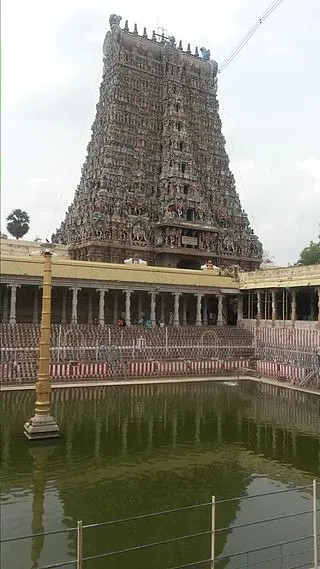
    Sarangadwaja was also called as Malayathdwaja and his daughter was Meenakshi who ruled Pandya Kingdom later from Madurai and Meenakshi temple st Madurai is named after her.

  • Weapons List Of Mahabharata Podcast

    Weapons List Of Mahabharata Podcast

    7.Narayanastra.

    One of the three Great weapons of Mass destruction, others being Brahmastra, Pasupatasta, Narayanstra would destroy anything and the only way to escape its wrath is to drop all the weapons and prostrate before it.

    Aswathama used it unsuccessfully and under instructions from Krishna Arjuna had it withdrawn.

    8.Brahmastra-Though not used in the Mahabharata war, it is one of the Great weapons.

    Please read my post on this.

    9.Pasupathstra.

    Though this was obtained by Arjuna from Lord Shiva, Karna from Parasurama, Arjuna did not have the occasion to use this and Karna could not as he

    was cursed to forget the launching Mantra, by Parasurama.

    10.Aindra astra:
    Presiding Deity: Indra, the god of weather
    Weapon’s Effect: Would bring about a shower of arrows from the sky.

    Used by both the sides.

  • Was Lord Krishna an Irresponsible Father?

    I have received a comment on Lord Krishna being an irresponsible father, asking me for an explanation.

    I have reproduced the comment towards the close of the article.

    The comment has two parts.

    One,Lord Krishna being an irresponsible father

    and

    Upbringing of children today.

    Hinduism is a practical Religion.

    It understands obligations and also the limitations of people in changing others,even it be they are of your Blood.

    Before understanding the behaviour of Lord Rama, Krishna,one must understand the approach of Hinduism on Patenting.

    It does not accord Parenting any special place or does it ignore it.

    It treats as a routine affair of Life and treats is such…..

    It considers all these as a Natural process and one need not be overly concerned about this as such.

    The Vedas offer basic Guide lines.

    1.Dharmachara, Righteous Conduct.

    Behavior should be according to the Dharma, Moral Principle.

    Parents are expected to behave he way they expect their children to behave towards them or others when they become adults.

    Parents are prohibited from using vulgar language or the use of harsh words in front of their children.

    2.Dharma Svagriha.

    Worship at Home.

    Parents should set an examples of following the Anushtaanas laid down for them in the Shastras.

    Parenting in Hinduism

    Beyond these guidelines one does not find anything much about Parenting in Hinduism.

    Apart from laying the foundation to be a good Human being,by setting a personal example and sending to a a teacher of impeccable character and learning,parents in Hinduism do not interfere.

    There is a saying in Dharma SASTRA.

    ‘Treat your son as

    A King till till Five,

    Treat as a slave till 15, and as

    A friend thereafter.

    Stages of Life in an individual is classified into four.

    Brahmacharya,the Celibate stage,

    Gruhastha, Married Stage,

    Vanaprastha,Stage of leaving the family affairs to the eldest and leaving for Forest to meditate on Reality with spouse if she desires, and

    Sanyasa,total Renunciation.

    Aware of the fact that one can not do much to change one’s Swabhava, Natural disposition,people limited themselves to what is possible and stopped at that.

    They did not set impossible goals in Life, including changing others,even it be wife or children.

    One performs as his Swabhava.

    This is reflected in ancient social life.

    Take Lord Ram’s case.

    He obeyed his parents unconditionally.

    He loved his relatives,be it Lakshman or Bharatha.

    He was accessible to his devotees, like Hanuman.

    He was harsh towards his enemies,Ravana.

    Yet the reason for all this is Dharma, loosely translated as Righteousness.

    Rama performed all these actions so long as they were in conformity with Dharma.

    The moment an instance is against Dharma,he would not hesitate to be against people whom he loves dearest.

    He sent a pregnant Sita Away from home, because there was a slur,though he knew it was false.

    He resorted to this step as as A King His Dharma is to set an example for His subjects however painful the act could be for him

    He fought against his sons and Hanuman as it would be a bad example as a King to have his children and devotee to raise against him , however justified they might have been from their standpoint.

    Once the issue was resolved he took them back.

    Dharma was the cardinal principle and not relationships.

    Relationships belong to Apara Vidya stage,lower Knowledge.

    Para Supreme knowledge is by following scriptures and Dharma.

    While Rama followed Karma Yoga,the Path of Knowledge thus,Lord Krishna belongs to another Higher level in performing Karma.

    Rama had a conscious goal while performing can action and was looking forward to its results being favourable to him, Krishna had no such thoughts.

    He performed an action because it ought to be performed, period.

    It did not matter to Krishna who ruled Among Pandavas or Kauravas,both being his relatives:he would not an inch of land from either of them or any other favour,not that Krishna needed anything from anyone!

    Yet he took the side of Pandavas for it was Dharma to be with just cause.

    Krishna practiced what he preached in Bhagavad-Gita.

    Renouncing the determination of the fruits of His actions.

    Karma Sankalpa Thyaga.

    Lord Rama was not in the same league,he practised one aspect of Karma Yoga.

    As to Samba.

    The incidents narrated are found in The Vishnu Purana as well.

    One additional information.

    After Samba was cursed, the Rishis came to Krishna and sought His forgiveness for their act in cursing his son,Samba.

    Krishna replied,

    ‘ Why do you worry?

    You have done your Dharma.

    I should reap the consequence of my action in Rama Avatar,of killing Vaali from Behind a tree.

    I should face the consequences for that.

    The Yadava Vamsa is growing by leaps and bounds and it should stop to reduce the weight,Basra of Bhoomi,earth.

    And I should have an excuse to shed this Body.

    You have obliged me by cursing Samba’

    That’s it.

    While we remember Samba,who was a bad apple,how many know of Pradyumna Krishna’s other son,who was valiant and built a city in Port Barzhyn in Russia,which has been found?

    Everyone has one’s destiny.

    Shall write on present day parenting.

    The comment I received.

    Namaste. Devdutt patnaik is raising questions as below. Need help to respond pls.
    One of the most disturbing stories that we find in the Puranas is the story of Krishna’s son Samba, whose mother was the bear-princess, Jambavati.

    He dupes his father’s junior wives by disguising himself as Krishna and is cursed by Krishna that he will suffer from a skin disease that will enable his wives to distinguish father and son. Samba is cured after he builds temples to the sun. All sun temples in India, from Konark in Odisha to Modhera in Gujarat to Markand in Kashmir, are attributed to this son of Krishna.

    Samba also attempts to kidnap Duryodhana’s daughter and this leads to war between the Kauravas and the Yadavas. Peace is restored, and the marriage is solemnised, only after Balarama, Krishna’s elder brother, and Samba’s uncle, in a fit of fury threatens to drag Hastinapur into the sea.

    Then there is the story of Samba pretending to be a pregnant woman and duping sages who were visiting Dwaraka. They sages were not amused and cursed Samba that he would give birth to an iron mace that would be responsible for the end of the Yadu clan.

    Must not Krishna’s son be as noble and divine and wise and loving as Krishna? But that is not so. Samba comes with his own personality and his own destiny over which Krishna has no influence. Or does he?

    Can we wonder if Samba was a product of his father’s neglect? For was not Krishna spending most of his time with Arjuna and the Pandavas and in the politics of Kuru-kshetra?

    There are hardly any stories of Krishna as father. He is friend, philosopher and guide to Arjuna, but the only stories of father and son are of tension, rage and violence.

    In conversations about corporates, we often forget about the other half of our lives, the personal one. As more and more people are working 24×7, thanks to Internet, and smart devices, the lines between professional and personal, work and life are getting blurred. In fact, people feel noble when they sacrifice family for work and guilty when they take a holiday to take care of their family.

    Family is not seen as achievement. Children are not seen as purpose. They are seen as obligations, duties, by-products of existence, even collateral damage.

    We admire leaders who sacrifice family for a ‘larger’ cause. Like freedom fighters who neglect their wives and children. Like business men and entrepreneurs and consultants who spend most of their time in office.

    With the rise of feminism, women are also working. Parenting has been outsourced to maids, teachers, computers, videogames and grandparents.

    Women who work in the office have not been compensated by their husbands spending more time at home. Instead women are made to feel guilty for not being good mothers. No one questions men for not being good fathers. Eventually, the office wins. Absent parents rationalise how office is more important than the children: we need the money, the children eventually grow up, surely our needs are also important.

    Many great Krishnas in the workplace discover that they have nurtured Samba at home: sons who either follow destructive paths as they seek attention, or sons who make their way away from parents, as they have grown used to not having them around. Who wins?

    Corporates were supposed to create wealth for the family. Now families are creating only workers for the corporates.

    We have many more Krishnas in this generation and maybe many Sambas in the next.

    As written *By Devdutt Pattanaik*

    Thought Provoking …

    👆

  • Two Tamil Empires In India Northwest, South India? Missing History

    I have written articles in detail about the Kings of India, as listed in the Puranas and other Sanskrit texts of India.

    Kings List of India by Puranas Vaidated

    I have also listed the Kings List of Tamil from 400 BC 

    dd80b-haeckel_1868_lemuria

    Lord Krishna married a Pandyan Princess and had a daughter whom he married her off to a Pandyan Prince.

    Arjuna married a Pandyan Princess from Manalur Tamil Nadu and had a son.

    Tamil Chera King Perunchotru Udiyan Neduncheralathan fed both Pandava and Kaurava army during the Mahabharata Battle..

    Sahadeva and Balarama  were on a Pilgrimage to South and Balarama worshiped Lord Subrahmanya in Tamil Nadu.

    Parashurama established the present Kerala.

    One issue intrigued me.

    We had the Mahabharata War, there was a deluge later and Dwaraka was submerged.

    Sage Agastya took families from Dwaraka and had them settled in what is now Karnataka and those who had settled in Tamil Nadu were called ‘Velirs’ and they had small Kingdoms in places like what is now called Krishnagiri and Dharmapuri.They took sides between the Cheras, Cholas and Pandyas depending on the exigencies.

    Kanndigas from Yadava Tribe

    This would imply, at the time of the Tsunami which devoured Dwaraka, these people were moved by Agastya to South.

    The same Tsunami, called as ‘kadalkol’ in Tamil devoured the South as well.

    This Tsunami, incidentally is the third to strike the South, according to Tamil Literature and this is validated by foreign Flood legends and archaeology..

    Now the issue is if people were moved from Dwaraka and settled in Tamil Nadu, it should have been after the Tsunami died down.

    Then what happened to the Tamils living in the south during the period just before the Tsunami?

    Where did they go?

    The references to Tamil kings are found in the Ramayana which mention them as belonging to earlier period than Rama.

    To be specific Tamil Kings were present in Damayanti Swayamvara.

    There is Nala Theertha, a sacred pond where people take bath to be rid of Saturn, Shani’s influence, like Sade Saathi,seven and a half years.

    The pond is in Thirunallar, Pondicherry and is famous for Shani temple.

    Shiva worship preceded  in south even  before Vedic Period.

    While Subrahmanya and  Shiva merit only a limited mention in the Vedas, they are the principle Deities in the Dravida Desa.

    And there was a Tamil Kingdom, Elamite, now the term has become corrupted to be Elam.

    The Elamite people lived around the present Iran and spoke a Language which has been traced to Tamil.

    And some tribes in Iran speak this language which resembles Tamil even today!

    The Tamils were referred to as Dramila in Vedic texts.

    The Mediterranean Peoples (Dravidians)

    (Extracts from ‘The Original Indians — An Enquiry’ by Dr. A. Desai)

    How the Mediterranean people came to be called Dravidians makes interesting story. The Pre-Hellenistic Lycians of Asi Minor, who where probably the Mediterranean stock called themselves Trimmili. Another tribe of this branch in the island of Crete was known by the name Dr(a)mil or Dr(a)miz. In ancient Sanskrit writings we find the terms Dramili and Dravidi, and then Dravida which referred to the southern portion of India.

    South India was known to the ancient Greek and Roman geographers as Damirica or Limurike. Periplus Maris Erithroei (Periplus of the Eritrean Sea) in the second or third century AD described the maritime route followed by Greek ships sailing to the South Indian ports: “Then follow Naoura and Tundis, the first marts of Limurike and after these Mouziris and Nelkunda, the seats of government.â€

    Dramila, Dravida and Damirica indicated the territory. Then it was applied to the people living in the territory and the language they spoke, in the local parlance Tamil and Tamil Nadu or Tamilakam.’ https://2ndlook.wordpress.com/2009/04/06/dravidian-history-no-one-talks-about/

    Later texts speak of them as Dravida?

    Sibi ruled from Pakistan

    Not to forget the fact that Vaivaswatha Manu , ancestor of Rama lived in the south and moved to Ayodhya after the Tsunami.Please read my article   on this.

    Is there a subtle message here?

    Yes,

    This accounts for the missing chapters in Tamil and  Bharatvarsha History and this would reconcile the seeming inconsistencies in Indian History.

    Detailed article follows


  • Mahabharata Weapons User Manual Found Kerala

    I have written on the use of weapons in the Mahabharata..

    I have also written articles on

    Rules of War,

    Battle Formations,

    Weapons of Mass Destruction,

    List of Astras,

    Brahmastra Invocation Mantra.

    Now  a manuscript containing the Mantra for the weapons used in the Mahabharata War has been found in Kerala.

    They are a sort of User Manual.

    ‘A manuscript found from the collections of Ashtavaidyan Vaidyamadham Cheriya Narayanan Namboodiri, who passed away recently, clearly mentions the mantras to use brahmastra, agneyastra, among others. The 63-folio manuscript in palm leaves, believed to be rewritten about 120 years ago, is the only manuscript retrieved so far in the country that tells how to use all the deadly weapons mentioned in the Mahabharata in about 48 well-described mantras.

    “It was Cheriya Narayanan Namboodiri’s wish to digitize all his manuscript collections — 1,300 bundles — for the benefit of researchers, students and the future generation. The particular manuscript was noticed while we were digitizing the collections using the most reliable method, reprography,” said A R Krishnakumar, project manager at Central Council for Research in Ayurvedic Sciences (CCRAS). Krishnakumar is part of a team from the Indira Gandhi National Centre for the Arts (IGNCA), New Delhi that has been bestowed with the responsibility of digitizing all the manuscripts available with both public and private parties in the country. “People may wonder why the manuscripts should be digitized. It is because they would throw light on our history, culture, customs, ancient religions besides giving information on the environment, health and science of ancient times,” said Krishnakumar.

    “Till now, we haven’t even used 15% of the information from the manuscripts being written on ayurveda. Yet ayurveda is considered to be one of the most accepted system of medicine in the world. Now imagine if the knowledge in five lakh-odd bundles of manuscripts are made available to the society, how much more effective would ayurveda be,” he added.

    “We had digitized a portion of the manuscripts available with libraries, colleges, universities and other institutions in Kerala a few years ago. We started the second phase of the initiative from Vaidyamadham at Mezhathur in Palakkad district. Our next destination is Kanippayyur Mana near Kunnamkulam, famous for thachu sasthra (architectural science), and other centres that have hundreds of manuscripts preserved with them. Thankfully, all these private parties are now coming forward to share the knowledge they have been preserving from the past,” said senior reprographic officer of IGNCA Krishnakumar B. ‘

    Citation.

    http://timesofindia.indiatimes.com/india/Found-User-guide-for-Mahabharata-weapons/articleshow/26762484.cms