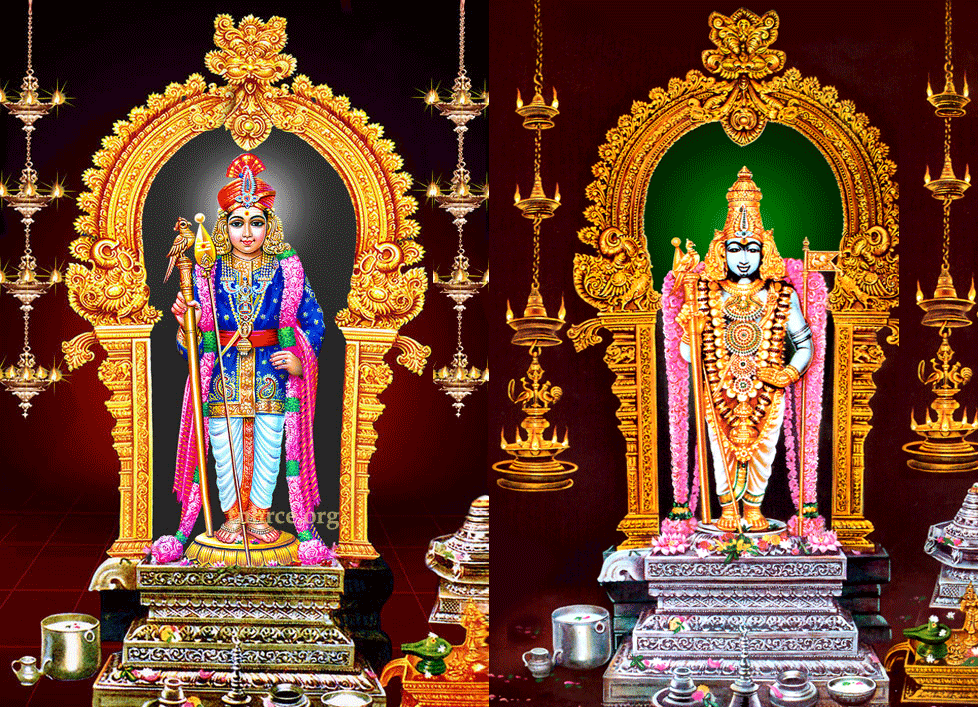
The history of Bhogar tells us that he made the Palani Dhandauthapani Idol in the Garbha Graha at a place called Thannasi
Appan Temple.
Bhogar is reported to have used Nine Minerals/Herbs/poisons to prepare the raw material for the Idol.
The term Paashaana means, Minerals, herbs, Poison.
He is reported to have made three Idols.
One has been installed at Palani garbha Gruha.
Bhogar in Nirvikalpa Samadhi .
Two Idols are reported to have been hidden by Bhogar in the Eastern Ghats and it is believed that they would surface at an appropriate moment.
The idol at Palani Garbha Gruha was found to be weak below the Neck and therefore the Abhishekams were stopped.
Now Abhishekams are performed for the Utsavar only.
The committee formed by the Government of Tamil Nadu to find out the status of the Idol found , by Atomic Test, that the material used for the construction of the Idol of Murugan is neither Granite, Nor Minerals.
Please read my Post on this, where I have provided the excerpt of the Report.
Thannasiappan Temple entrance.
‘Bogar is a Siddhar, he is considered as one of the 18 siddhars born in the world. According to epigraphical sources and his book Bogar Seven thousand his period is around 3000 B.C. Bogar born at India and visited China in search of truth of life, he gained knowledge in medicine, astrology, spritiuality, yoga etc.
Bogar anticipating that in due course of period, human beings will suffer from large number of disease. As an expert in medicine he used 4448 rare herbs and made 9 poisonous medicine, mixing these 9 poisons into one needs great knowledege and skill, to make a Master Medicine ( One medicine to cure all disease ). Thirumoolar also discuss one such Master Medicine in his book Thiru Mandiram. With the consultation of Agasthiar ( Father of Ayurvedic Medicine) and other siddhars Bogar mixed the 9 poisons ( Nava Bashanam ) and made the Master Medicine in the form of Lord Murugan which is currently worshiped at Palani Murugan temple. There is a place near Palani Hill called Thanasiappan Temple which is the place were Bogar mixed the Nava Bashanam and made the Murugan idol.’
Some years back, when I went to Palani, I was asked by a stranger in the Temple the directions to visit Bhogar Shrine in the complex.
Though I have been visiting the Palani Temple ,I never knew that there was a Shrine for Bhogar.
I asked the Priests for directions and went to the Shrine.
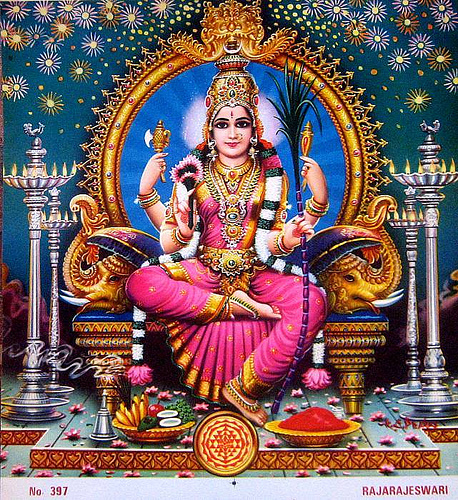
I was reciting,if I recall correctly the Durga Suktha,when the the priest at the Bhogar Shrine asked me to have a look at an Idol of Bhuvanewari worshiped by Bhogar.
Maragatha(Emerald) Shiva Linga, Bhuvaneswari and Dhandayuthapani worshiped by Bhogar,Palani
He gave me the Idol in a Velvet cloth and it was very beautiful.
I had darshan and left with no further thought on the subject.
This was about 30 years ago.
Though I know anything about the Siddhas, I did not know much till recently.
I have been, for the past few days, trying to find information on the Devi and Bhogar worship.
Only today I have been able to get some information on this.
It seems that there is an opening at the top of the Sivagiri(Palani), with a cavern underneath it and Bhogar is reported to have worshiped Devi there, with Pulipani as his Guard.
Read on.
‘
At the top of Palani Hill, near the holy Murugan which Bhogar had crafted from nine poisonous substances, there is an opening in the Earth; it is a hole in the ground; the mouth of a cave which lies below. Bhogar often lowered himself into the Earth, sat in the cave, accessing Life’s hidden secrets. He performed great austerities there, the magnitude of which very few in this modern age can fathom.
There at the opening Bhogar erected a humble shrine to the Great Mother: a few yantras, a couple of five-metal icons baring the form of the Mother and her son Murugan. He worshipped a small emerald lingam there, about ten inches in height. His one and only disciple, Pulipani (perhaps the only one who truly understood the sage), kept him company at the entrance to the underground cavern on the top of Palani Hill.
When Bhogar felt that his outer work was done, he entered the gateway of earth and stone and sat down in the darkness of the cave. Faithful Pulipani heaved a stone slab over the entrance, sealing Bhogar forever in the blackness of his earthen womb.
For thirteen generations Pulipani’s descendants have watched over that stone slab that marks the gateway to the underground chamber. Long ago, Bhogar’s little shrine was set atop that hallowed spot, and even today, is still worshipped by the vigilant sons of the faithful Pulipani. They say that Bhogar is seated quietly in meditation even now; alone in the darkness; watching the slow passage of time.
His breath is still. His mind is quiet, his heart unwavering; but through the dense dark matter of his earthly form stabs the vibrant & relentless flame of the Kundalini Shakti. There he waits…
‘At the top of Palani Hill, near the holy Murugan which Bhogar had crafted from nine poisonous substances, there is an opening in the Earth; it is a hole in the ground; the mouth of a cave which lies below. Bhogar often lowered himself into the Earth, sat in the cave, accessing Life’s hidden secrets. He performed great austerities there, the magnitude of which very few in this modern age can fathom.
There at the opening Bhogar erected a humble shrine to the Great Mother: a few yantras, a couple of five-metal icons baring the form of the Mother and her son Murugan. He worshipped a small emerald lingam there, about ten inches in height. His one and only disciple, Pulipani (perhaps the only one who truly understood the sage), kept him company at the entrance to the underground cavern on the top of Palani Hill.
When Bhogar felt that his outer work was done, he entered the gateway of earth and stone and sat down in the darkness of the cave. Faithful Pulipani heaved a stone slab over the entrance, sealing Bhogar forever in the blackness of his earthen womb.
For thirteen generations Pulipani’s descendants have watched over that stone slab that marks the gateway to the underground chamber. Long ago, Bhogar’s little shrine was set atop that hallowed spot, and even today, is still worshipped by the vigilant sons of the faithful Pulipani. They say that Bhogar is seated quietly in meditation even now; alone in the darkness; watching the slow passage of time.
His breath is still. His mind is quiet, his heart unwavering; but through the dense dark matter of his earthly form stabs the vibrant & relentless flame of the Kundalini Shakti. There he waits…
When the self-styled rationalists call every thing Hinduism stands for and Hindu sages as non sense and irrational , it is befitting to recall the words of Sir Isaac Newton, considered to be one of the Giants of Physics.
Palani Dhandayuthapani , Moolavar,Palani.
‘ Sir Isaac Newton modestly remarked. “All that I have done to the human community is to make a common man understand His observable laws”. He added further by saying. “God created the forces of gravity. I connect this by a mathematical equation in an understandable way”.
How true these words are!
Palani Subrahmanaya, called as Palani Andavar, Palani Dhandayuthapani, Idol is believed to have been made and installed by Bhogar a senior Siddha.
He prepared the Idol, according to some traditions with a strange mixture called Nava Paashana.(Nine Poisonous Minerals)
This , the traditions say,was prepared by mixing minerals in a specific proportion/combination.
Bhogar was also an Alchemist.
Paashaana also means Poison.
This mixture could have been prepared by mixing Nine rare herbs of poisonous nature .
The resultant mixture was used by Bhogar to make the Idol.
( It is believed that Bhogar made three idols, one is now at Palani, the other two have been hidden by Bhogar somewhere in the Eastern Ghats in South India: they are expected to surface at an appropriate time).
The other option for the Idol’s raw material is granite.
It has been observed that the Dhandayudhapani Idol at Palani became weak below the neck and the lower portions looked as if they would fall at any time.
A suggestion was mooted to repair or change the Idol.
This was not agreeable to the devotees as it would be against the Shastras.
So the Government of Tamil Nadu appointed a committee to study the issue and submit its recommendations.
I am providing the report afer a few sentences about the findings of the committee.
1.The Idol’s face was fresh as though it was installed recently.
2.The lower portions were damaged.
3.On testing with an Atomic Analyser, it was found that the Idol was made of neither Granite, nor minerals.
4.The Scienists were unable to determine what it is made of.
Now an abstract of the report; the web site Link is provided towards the close of the Post.
Dhandayuthapani Temple,Palani.
”
Though the preliminary visual examination of the idol revealed the possibility of the material being of granitic origin. It could not be confirmed, as neither a microscopic examination nor a chemical analysis could be done in the absence of loose material from the idol being available for such detailed investigation. But we were aware that the abhishekam materials flowing over the idol could possibly absorb some of the ingredients from the idol to acquire the medicinal property, curative qualities and offer relief to many devotees from their ailments.
Guided by this knowledge and taking a clue from this, we applied sandalwood paste to the idol and let it remain overnight. The next day the sandalwood paste was collected and a solution was prepared for further chemical examination, using
As the next step, the sandal wood paste solution from the paste left on the idol overnight was subjected to the experiment. The instrument showed no apparent reading. The experiment was repeated several times and the instrument showed a zero absorption. When other samples were tested, the instrument showed positive results but for the sandal wood paste left overnight on the idol of the lord, the result was zero absorption. It was revealed to us as a stupendous moral – that even modern scientific analysis cannot penetrate the Divine Structure.a sophisticated instrument, the Perkin-Elmer 707 atomic absorption spectrophotometer to identify the trace elements. A standard solution required for the experiment was made to calibrate the instrument.’
The Study was by Dr. Prof. M.S. Saravanan, M.Sc., Ph.D., F.M.S., F.G.S. is an an earth scientist and mineralogist and former Director of the Tamil Nadu Department of Geology & Mines and Chairman of Tamilnadu Minerals Limited and a one-time close associate of Kripananda Variar.
He was also a sub-committe member constituted by the Government of Tamil Nadu to Study and Test the Idol.
You must be logged in to post a comment.