Tag: Kings List

  • Rama Dynasty Ruled 432000 Years Sumerian Kings List Confirms

    I have written about the Sumerian connection with Hinduism.

    Lord Rama.jpg
    Lord Rama In Sumeria

    I have also written that Lord Rama , Dasaratha, Bharatha are  mentioned  in the Sumerian King List.

    Reign of Sumerian Kings Reign of Sumerian Kings, 4,32, 000 years, Sumerian King List.

    Now there is evidence to suggest that the Kings of Sumeria ruled for a period of 4.32,000 Years.

    Ramayana took place in Treta Yuga, spanning 1,296,000 years.

    Earliest Avatar of Vishnu in this Yuga was Vamana.

    It was followed by Parashurama and Rama.

    The Ramayana took place during the closing years of Treta Yuga.

    The number of years ruled by the Sumerian Kings , according to the Kings List( which includes Rama) is 4,32,000 years.

    This is the same the time span of Kali Yuga!

    Coincidence?

    http://etcsl.orinst.ox.ac.uk/section2/tr211.htm

    http://theoryofeverything.org/MyToE/?attachment_id=3179

  • Hinduism Kings Gods In King List Sumeria

    Hinduism Kings Gods In King List Sumeria

    I have posted an article that Lord Rama and Bharata’s names are found in the Kings List of Sumerians chronicling their Kings.


    Not only Rama and Bharata, but the names of other Hindu Puranic figures find a place in the Kings List.


    The Names found are,

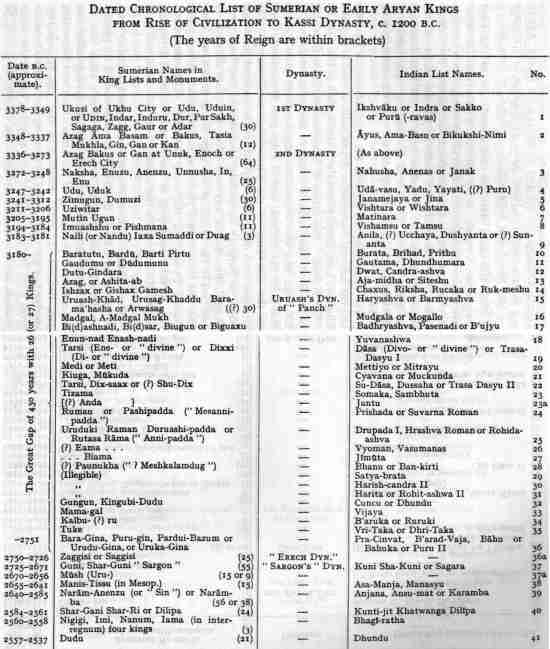
    Sumerian Kings, Chronological order,Kings List.jpg
    Sumerian Kings, Chronological order,Kings List.


    Indra,Pururavas,Dasaratha,Parashurama,Satyavrata,Iksvahu,Kakusha,Janaka,Vasishta, Janamejaya,Dushyanta(Father of Bharata,after whom India is named as Bharatavarsha),Rishis Gautama,Dundhu,,Muchukunda,Drupada,Harischandra,Sagara,Bhagiratha, Lava, Kusha(Rama’s sons),Aja and Raghu(Rama’s ancestors),Pundarika,


    Curious enough ‘ all of them belong to Solar Dynasty mentioned in Puranas.


    “Waddell’s primary chronology was compiled from various Sumerian king lists, Egyptian list of pharaohs, the Bhagavata Purana, Mahabharata, Rigveda and numerous Indus Valley Civilization seals and other monuments and relics and sources, some of which he had deciphered himself.[2] It was entitled “Dated Chronological List of Sumerian or Early Aryan Kings from the Rise of Civilization to the Kassi Dynasty” and documented an alleged list of world emperors as follows:


    Citation.

    en.wikipedia.org/wiki/Waddell’s_chronology

    Image Credit.

    http://www.goldenageproject.org.uk/chronological_sumerian_early_aryan_kings.php


    No. Names in Sumerian King Lists and monuments Date BCE
    (approximate)
    Indian list names
    1 Ukusi of Ukhu City or Udu, Uduin, or Odin, Indar, Induru,
    Dur, Pur, Sakh, Sagaga, Zagg, Gaur, or Adar
    First Sumerian Dynasty
    3378–3349 BCE
    Ikshvāku or Indra or Sakko or Pururavas
    2 Azag Ama Basam or Bakus, Tasia, Mukhla, Gin, Gan or Kan or Nimmirud 3348–3337 BCE Ayus, Ama-Basu or Bikukshi-Nimi
    Azag Bakus or Gan at Unuk, Enoch or Erech City 3336–3273 BCE As Above
    3 Naksha, Enuzu, Anenzu, Unnusha, In, Enu Second Sumerian Dynasty
    3272–3248 BCE
    Nahusha, Anenas or Janak
    4 Udu, Uduk 3247–3242 BCE Udā-vasu, Yadu, Yayati, (?) King Puru
    5 Zimugun, Dumuzi 3241–3312 BCE Janamejaya or Jina
    6 Uziwitar 3211–3206 BCE Vishtara or Wishtara
    7 Mutin Ugun 3205–3195 BCE Matinara
    8 Imuashshu or Pishmana 3194–3184 BCE Vishamsu or Tamsu
    9 Naili (or Nandu) Iaxa Sumaddi or Duag 3183–3181 BCE Anila (?) Ucchaya, Dushyanta or (?) Sunanta
    10
    11
    12
    13
    14
    1516
    17
    18

    19
    20
    21
    22
    23
    24

    25
    26
    27
    28
    29
    30
    31
    32
    33
    34
    35

    36

    Baratutu, Bardū, Barti Pirtu
    Gaudumu or Dūdumunu
    Dutu-Gindara
    Azag, or Ashita-ab
    Ishzax or Gishax Gamesh
    Uruash-Khād, Urusag-Khaddu,
    Barama’hasha or Arwasag (c. 3100 BCE)
    Magdal, A-Magdal, Mukh
    Bidashnadi, Bidsar, Biugun or Biguaxu
    Enun-nad Enash-nadi
    Tarsi (Ene- or “divine”)
    or Dixxi (Di- or “divine”)
    Medi or Meti
    Kiuga, Mūkuda
    Tarsi, Dix-saax or (?) Shu-Dix
    Tizama or Tizkar, Anda
    Rumau or Pashipadda
    (“Mesanipadda”),
    Uruduki Raman Duruashi-padda or Rutasa Rama
    (“Anni-padda”) (c. 2900 BCE)
    Eama
    Biama
    Paunukha (“?Meshkalamdug”)
    illegible
    illegible
    illegible
    Gungun, Kingubi-Dudu
    Mama-gal
    Kalbu or Kalburu
    Tuke
    Bara-Gina, Puru-gin, Pardu-Bazum
    or Urudu-Gina, or Urukka-Gina
    The Great Gap of 430 years
    with 26 (or 27) KingsUruash’s Dynasty of “Paunch”
    3180–2751 BCE
    Burata, Brihad, Prithu
    Gautama, Dhundhumara
    Dwat, Candra-ashva
    Aja-midha or Siteshu
    Chaxus, Riksha, Rucaka or Ruk-meshu
    Haryashva or BarmyashvaMudgala or Mogallo
    Badhryashya, L’asenadi or B’ujyu
    Yuvanashwa
    Dāsa (Divo- or “divine”) or Trasa Dasyu I
    Mettiyo or Mitrayu
    Cyavana or Muckunda
    Su-Dāsa, Dussaha or Trasa Dasyu II
    Somaka, Sambhuta
    Jantu
    Prishada or Suvarna Roman

    Drupada I, Hrashva Roman
    or Rohidashva
    Vyoman, Vasumanas
    Jimūta
    Bhanu or Ban-kirti
    Satya-brata
    Harish-candra II
    Harita or Rohit-ashwa II
    Cuncu or Dhundu
    Vijaya
    B’aruka or Ruruki
    Vri-Taka or Dhri-Taka
    Pra-Cinvat, B’arad-Vaja, Bahū or Bahuka or
    Puru II

    36a Zaggisi or Saggisi 2750–2726 BCE
    37 Guni, Shar-Guni, Kin or Sargon Sargon’s Dynasty
    2725–2671 BCE
    Kuni Sha-Kuni or Sagara
    37a Mush Uru 2670–2656 BCE
    38 Man-ishtishu or Menes First Egyptian Dynasty
    2655–2641 BCE
    Son of Sargon, Asa-Manja, Manasyu
    39 Naram-sin 2640–2585 BCE Grandson of Sargon, Anjana, Ansu-mat or Karamba
    40 Shar-kali-sharri 2584–2561 BCE Son of Naram-sin, Kunti-jit, Khatawanga, Dilīppa
    Irgigi, Nigigi, Imi, Nanum, Iama (in inter-regnum) four kings 2560-2558 BCE Bhagi-ratha
    41 Dudu 2557-2537 BCE Dhundu
    42 Shūdur-kib 2536-2522 BCE Suhotra II, Shruta Shrutāyas
    43 Uru-Nigin (? Nikin Uru of seal WSC. 390 2nd Erech Dynasty
    2521-2519 BCE
    Nabhin, Nābhāga
    44 Urish-Ginar 2518-2513 BCE Harish-Candra or Ambarisha
    44a Tardu (or Kudda) 2512-2507 BCE (?) RathiTara “great-grandson of Ambarūshu”
    45 Ba-Sha-nini (or -ama) 2506-2502 BCE Sindhu-dhipa, Sanjaya
    Uru-ash (or -an) -uta 2501-2494 BCE
    46 Guti occupation without kings Guti Dynasty
    2493-2452 BCE
    Kusha Dynasty
    Ayunāyus (or ? Duthaliyas, k. of Khatti)
    47 Muruta 2451-2449 BCE Mūrtaya
    In Kishu or Gishu 2448-2443 BCE Kusha
    Irilla Tax (or Warla Gaba) 2442-2437 BCE
    Dug-me or Ug-me 2436-2431 BCE
    48 Eamamesh (or Kashushamama) 2430-2425 BCE Kushāmba or Sarva-Kāma
    Inima Bakies, Baesses, Bakus or Basam 2424-2420 BCE Basu II or Bhaji
    Iziaush 2419-2414 BCE
    49 Iārla Tax or Dax 2413-2399 BCE Su Dāsa II
    Ibate 2398-2396 BCE
    Iārla Gash or Kashushamama (2nd term) 2395-2393 BCE Kushāmba (2nd term)
    Basium, Basam or Bakus (2nd term) 2392- BCE Basu II or Bhaji (2nd term)
    Nikīm or Nigin 2391-2389 BCE
    Lasi-rubum or La-Sirab 2388-2387 BCE Sarva-bhauma
    Irarum 2386-2385 BCE
    Darranūm 2384- BCE
    50 Khāblum or Khab-Kalamu 2383-2382 BCE Kalmāshu-pāda
    Suratāsh Sin or Sarati Gubi Sin 2381-2375 BCE Sruta, Upa-Gupta
    Guda, Iārla Guashda or Gudia 2374-2368 BCE Gādhi
    En-Ridi-Pizir, Pisha Ruddu 2367-2361 BCE Vishva-Ratha (son of Gādhi)
    Tiri-gan 2360- BCE Trishanku
    51 Ashukhamukh or Utukhe-gal 3rd Erech Dynasty
    2360-2353 BCE
    Ashmaka
    52 Uruash-Zikim Third Dynasty of Ur
    2352-2335 BCE
    Uru-Ricika Mūlaka
    Dungi or Duk-gin (Shamu-) 2334-2277 BCE Dagni or Dagni-Jama
    Purash-Sin (“Bur-Sin” 2276-2268 BCE Parashu-Rāma (and his massacre) Dasharatha or (?)
    53 Suash-Sin (“Gimil-Sin”) 2267-2259 BCE Shata-ratha or Sushena Shata-ratha
    54 Il-Ibil-Sin 2258-2233 BCE Il-Ibila or Ilivila
    55 Ishbi-Ashuurra Isin Dynasty
    2332-2200 BCE
    Vishva-saha
    56 Katini-Kat (or Shu-Lilishu 2199-2190 BCE Khatvanga or Dilipa
    57 Itiash-Dakhu 2189-2169 BCE Dirga-bahu
    58 Ishshibash-Dakhu 2163-2149 BCE Raghu
    59 Libiash Ugun 2148-2138 BCE Aja
    60 Dashashi-urash, Muru 2137-2110 BCE Dasha-ratha
    61 Amar-Sin, (“Bur-Sin II”) 2109-2089 BCE Rama or Rama-Chandra
    62 Libi (Insakh) 2088-2084 BCE Lava and Kusha
    Ashurra Iwiti or Urra Iwiti 2083-2076 BCE
    63 Insakh-bani 2075-2052 BCE Atithi or Suhotra IV
    64 Zāmbi (3) Tenirpisha (4) Urdukuga, Sin Mapish (II) 2051- BCE Nishadha
    65 Damiq-ilushu -2007 BCE Nala
    66 Anuha-Mubalit (“Sin Muballit” (20, of which four as emperor) First Babylonian Dynasty
    as emperors
    2023-2004 BCE
    Nabha or Nabhas
    67 Khammu-Rabi or “Great Lotus” 2003-1961 BCE Pundarika or “Great Lotus”
    68 Sāmsui-Uduna 1960-1923 BCE Kshema-Dhanvan
    69 Abieshu’a 1922-1895 BCE Devānīka
    70 Ammi-Satana or Ammi-Ditana 1894-1858 BCE Ruru or (?) Suto-rusta
    71 Ammi-Saraga or Ammi-Suduga 1857-1837 BCE Ahi-nagu
    72 Sāmsu-Satana 1836-1806 BCE Sudhanvan ofr Pariyatra
    73 Sakhari-Bal Sea-Land Dynasty
    1805-1791 BCE
    Sahasra-Bala or Bala (with separate line)
    74 Xatal (“Gandash”) Kassite Dynasty
    1790-1775 BCE
    Sthala or Gaya
    75 Agu-um 1774-1753 BCE Auka or Uktha
    76 Bisuiru (“Kashtiliash”) 1752-1745 BCE Vajra-nābha
    77 Ushigu 1744-1737 BCE Shankha
    78 Abisuttash 1736- BCE Ab’Yutthit-ashva or Dhyushit-ashva
  • Lord Rama Was A King of Sumeria King List

    Lord Rama Was A King of Sumeria King List

    The King List which chronicles a list of Kings of Sumeria is written in Sumerian Language.


    Ancient Sumeria, one of the oldest civilizations flourished in the southern parts of Iraq.


    In the Kings List, one finds the Dynasties of the Kings of Sumeria with their official locations.


    It includes the names of Kings of adjoining countries, then called city states


    The Kingship was believed to be from the Gods and was transferable from one  city to another.


    Sumeria was believed to have had an hegemony during its period of existence.


    It is curious to find the name of Lord Rama in the Sumerian King List.


    Not only Lord Rama but his brother Bharata also find a place in the List.


    The King List.jpg
    King List,Sumeria


    Fortunately, a study of Sumerian history provides a fairly vivid flesh-and-blood picture of Rama. The highly authentic Sumerian King-list appear such hallowed names as Bharat (Warad) Sin and Rim Sin. Sin was the Moon god Chandra and as the cuneiform symbol for ‘Rim’ can also be read as ‘Ram’, Rim Sin is the same as Rama Chandra. In the Sumerian texts Ram-Sin is said to be from Elam which links him to Indo-Iran. Rama was the longest reigning monarch of Mesopotamia who ruled for 60 years. Bharat Sin ruled for 12 years (1834-1822 BC), exactly as stated in the Dasaratha Jataka. The Jataka statement, “Years sixty times hundred, and ten thousand more, all told, / Reigned strong-armed Rama”, only means that Rama reigned for sixty years which agrees exactly with the data of Assyriologists. Ayodhya may be Agade the capital of Sargon which has not yet been identified. It is possible that Agade was near Der or the Heart near Harayu or Sarayu. Learned scholars like D. P. Mishra were aware that Rama could be from the Herat area. The noted linguist Sukumar Sen also noted that Rama is a sacred name in the Avesta where he is mentioned together with Vayu. Rama is called Rama Margaveya in some texts from which Dr. Sen concluded that he hailed from Margiana. The Cambridge Ancient History contains priceless information relevant to Indian ancient history. The Sumerian records furnish the first date of the Indus era – the war with Ravana took place in 1794 BC. The significance of the fact Ram-Sin’s reign (60 years) was the longest in Sumerian history has been lost on most writers. There are two Ram-Sins in Sumerian history.”…….


    My researches into the relationship from between the Dravadas (South of Bharata Varsha) and Sanatana Dharam have led me to establish that the ancestor of Lord Rama, Vaivaswatha Manu migrated from Dravida desa because of a Tsunami to Ayodhya to establish a Kingdom.


    * Seemingly different dates of Rama from the Date of Rama of Ramayana tells another story.


    Shiva and His sons Ganesha,Muruga left by the Arabian Sea and spread through the Middle East, establishing their lineage en route, Iraq, Africa, Spain,Latin America,North America, Central America before reaching the Arctic where the Rig Veda was composed.


    Later their descendants traveled from the Arctic through Russia to reach India again.


    These facts are culled from Tamil Classics Vedas, Sanskrit Literature and cross checked by Astronomical facts mentioned in these texts.


    More to follow on this subject.


    Citations.

    http://www.ranajitpal.com/rama.html


    http://en.wikipedia.org/wiki/Waddell%27s_chronology

    Waddell’s Chronology.

    Amar-Sin, (“Bur-Sin II“) 2109-2089 BCE Rama or Rama-Chandra