The Spring Water turned Darkish just before Indira Gandhi was assassinated.
When black or darkish, it’s believed to be an indication of inauspicious times for Kashmir. In 1886, Walter Lawrence, the-then British settlement commissioner for land, during his visit to the spring, reported the water of the spring to have a violet tinge.
Kashmiris claim to have observed a darkish or murky tinge to the water just before the assassination of Indira Gandhi and the 1989 insurgency in the valley.
This is the Temple where Ravana offered her kheer (rice pudding), which Goddess Bhavani accepted.
Kheer Bhavani Temple is at a distance of 14 miles east of Srinagar near the village of Tula Mula,Kashmir.
Kheer Bhavani Temple,Tula Mula
Kheer Bhavani Temple, Interior View
Kheer Bhawani in Atma Linga Form
Other names of Kheer Bhavani
Maharagya Devi,
Ragnya Devi,
Rajni,
RagnyaBhagwati,
The Color of the Water Spring indicates auspicious or auspiciousness.
The Temple is constructed over a Water Spring.
”
This spot is now called vata-shun. Haider Malik Chadoora calls this spring “Votur-Gang”, and relates that its defiling, brought a fear of a snow-fall in Summer Hassan supported Haider Malik and has called it ‘votur-nag’. Now this spring is used by the water-works department (PHE) as a water-source.
A mela is held at this spring, on the 12th of the bright-half of Shravana. It has been called Achha-ra-na Nag in Harmukh Mahatamya.
Raithan is to the North-West of Srinagar 32 km away. Near the village, between the Son-moi river and the road, there a very large stone which the Hindus have been worshipping since time immemorial as a form of Goddess Ragniya.
Legend:
Maharagya was pleased with the devotion of Ravana and appeared before him and Ravana got an image of the Goddess installed in Sri Lanka.
However, the Goddess became displeased with the vicious and licentious life of Ravana and so didn’t want to stay in Sri Lanka.
Therefore, she is believed to have instructed Lord Hanuman to get the image from Sri Lanka and install it at the holy spot of Tula Mulla.
The mention of Kheer Bhawani is found in Kalhana‘s Rajtarangini. Kalhana writes that the sacred spring of Tula Mula is situated in a marshy ground.
The name of the spring is Mata Ragini Kund (pond).
Maharagini is the form of Durga Bhagvati.
Tula Mula and the spring of Maharagya has been considered very sacred.
Thousands of years ago, many floods occurred in Kashmir and the sacred spring of Tula Mula was inundated under its sway and the holy place could nowhere be traced.
At last, Kashmir’s Yogi Krishna Pandit had a dream in which the Goddess appeared to him and directed that she would swim in the form of a snake at the proper place and that he should stick large poles to demarcate the holy spot in the marsh land.
Subsequently, when the water subsided there the holy spot was discovered.
This event happened during the Samvat 4041 (Hindu lunar date). Abul-Fazal in his book Aini-Akbari mentions the area of Tula Mula extending over a region of hundred bighas (unit of land area) of land, which used to sink in the marshy lands during the summer season
How To reach and Festivals.
Deities: Ragnya Devi (Hindu Goddess) Location: At Tullamula of Srinagar Built by: Maharana Pratap Singh Built in: 1912 Attraction: Natural Spring Best time to visit: Around the year
he eighth day of the full moon in May holds great significance for the devotees of Ragnya Devi.
They fast on this particular day and gather at the temple in huge numbers.
It is believed that on this day, the goddess changes the colo.of the spring’s waters.
The Kheer Bhavani temple serves as the venue for an annual festival held in May-June, on the occasion of Jesht Ashtami.
Another Festival at Kheer Bhavani temple Shukla Paksh Ashtami.
On this day, havans/yagnas are performed to please the goddess.
by Air: Srinagar airport is approximately 20 km away.
by Rail: the nearest railhead for Srinagar. Trains from Delhi, Calcutta, Pune, Mumbai and other cities arrive at this station only. by Road: One can easily reach Kheer Bhavani Temple by taking regular Buses or by hiring Taxis from Srinagar.
The Sharada Peeta of Ashtadasa Peeta is in LoC between India and Pakistan,80 km from Srinagar.
As it is not possible to visit this shakti peetha, one can visit the famous Saraswathi temple in Basara in Nizamabad district of Andhra Pradesh. Basara is 200 km from Hyderabad.
Sharada Peeta Kashmir
Sharada Script resembles Devnagari
The original idol of Sri Sharadamba in sandalwood, now housed in the temple of Sri Vidyashankara at Sringeri.
HHH Abhivava Vidya Theertha,My Guru
“It may be noted that Goverments of both countries, India and Pakistan have allowed muslim population of Kashmir to cross the line of actual control and have allowed trade as well across the border , both these countries are not allowing Kashmiri Hindus to visit the above shrine despite many requests.”
Any updates on this position?
Varanasyam Vishalakshi, Kashmire tu Saraswati / Ashtadasha Shakti peethani, Yoginamapi durlabham // Ashtadasa Stotra of Adi Shankaracharya.
Devi is called Kashmirpura vasini,one who lives in Kashmir and there is a script called Sharada resembling Devanagari .
” Kashmir was a high established centre of learning of vedantic works until Muslim invaders from central-Asian countries came and destroyed it.
Indegenious script of Kashmir is named after the deity Sharada Devi.[2]
Kashmir was sometimes called Sharada Desh because of this temple and Sharada was called Kashmira Puravasini (resident of city of Kashmir ).[citation needed]
The Kashmiris are highly devoted towards this great deity[1] addressed as Bhagavathy.
During their daily worship they often say
“Namastey Sharada Devi Kashmir Pur Vasini Tvam Ham Prartheye Nityam Vidya Danam Che De hi mey”
meaning,
Salutations to you, O Sharada, O Goddess, O one who resides in Kashmir.I pray to you daily, please give me the charity of knowledge”
. According to the Prabhāvakacarita, a Jain historical work dated 1277–78, the Śvetāmbara scholar Hemacandra requested grammatical texts preserved here so he could compile his own grammar, the Siddhahema.[10]
The Vaishnava saint Swami Ramanuja traveled all the way from Srirangam to refer to Bodhayana’s vritti on Brahma Sutras preserved here, before commencing work on writing his commentary on the Brahma sutras, the Sri Bhasya.
Near Sree Sharada Devi temple, there used to be famous Sanskrit university.
Kashmir was also called “Shardapeeth” (the base of Sharda), the name being derived from the temple. We can take this to be an allegory of all the struggles Shankara had to face in his life. Ascending the seat of Sarvajna situated in Kashmir of the North is a symbol.
The meaning of it is that Shankara reached the peak of spirituality. We can get an idea of his greatness from the fact that a person of just thirty had ascended the throne of all knowledge.
They are all well to do, all of them occupying important positions in the Society
They still have their ancestral home in Kashmir, though all of them are settled in Delhi.
When I started discussing the Kashmiri Pandit‘s Problems, they broke out in tears , hugged me and said they were moved that some one from deep South is bothered about their problems.
They narrated the problems, utter contempt with which they were treated in Kashmir, where they have no say in anything at all.
Their problems after displacement from Kashmir have only multiplied, with the Government, irrespective of whichever party comes to power.
They find it difficult to voice their grievances to the Government at The State pr at the Center,
Worst is that whomsoever they get to meet, on rare occasions, in the Government, they got a stock reply that Kashmir is a sensitive issue with international ramifications and the Government has to tread carefully.
But the Muslims of Kashmir say that they are persecuted?
By whom?
Brahmins?
They were/are being ruled by Muslims and by the Sheikh Abdullah Family, Sheikh Abdulla to Omar Abdullah , his Grand son.
Muslims cry foul with Muslims ruling here.
What about the Kashmiri Pandits?
The history of Kashmir makes a sad reading.
Except for a limited period during the period of King Lalitaditya-Muktapida’s (725-753 A.D.) reign.
During the reign of King Rajadev (1213-1236 A.D.) the oppression and plunder of the Brahmins was extreme.
Once Asoka came to Kashmir, began the death-knell of Hinduism and Brahmins.
Then came the Mongols, Turks,Mogul and the British.
We know how the Mongols, Turks and the Moguls treat inavding countries and the British , as is their wont, developed the ‘Divide and Rule Policy’
“
According to figures from the CIA for 2007, at that time about 300,000 Pandits living in India were “internally displaced people” from Kashmir and Jammu. The US government has reported on the terrorist threat to Pandits still living in the Kashmir region.
The socio-political situation in Kashmir continues to be volatile, with the displaced Kashmiri Pandits beginning to lose their cultural identity. The USDepartment of State reports that, according to the National Human Rights Commission of India, the Kashmiri Pandit population in Jammu and Kashmir dropped from 15 percent in 1941 to 0.1 percent as of 2001.[17] In 2009 Oregon Legislative Assembly passed a resolution to recognise 14 September 2007, as Martyrs Day to acknowledge ethnic cleansing and campaigns of terror inflicted on non-Muslim minorities of Jammu and Kashmir by terrorists seeking to establish an Islamic state..
Read this,
During one of these days my brotherhad gone to get some air into the wheel of his cycle when suddenly two young men carrying guns killed a man in the Kralpora Bazar. Both men lived close to our village and my brother was naïve to tell someone that he knows one of them.A well wisher visited us that evening and told us to send him out of Kashmir.This advice fell on us like a pack of bricks. My grandmother cursed my brother for being stupid and my mother started sobbing. It was too late to do anything.My brother thankfully knew how to ride a scooter. We had some petrol in the fuel tank of the scooter which would have been enough to take him to Lal Chowk.My father put some money into the pocket of his Pheran and told him, if there is a knock on the door just jump from the back window and don’t stop the scooter till you reach Tiku’s who lived near Central Telegraph Office in Lal Chowk. We kept awake all night hoping against hope that no one would come asking for Rinku, and no one did.
Strange diktats started appearing on walls. Some would tell us how to dress, others what not to drink but the most interesting were the ones asking us to time our watches with Pakistan StandardTime. Mohalla Committees were made to check vice. It was like a Taliban Ministry of Promotion of Virtue and Prohibition of Vice. What constituted vice included watching something as harmless as Doordarshan. Everything Indian was the new untouchable. During all this time the writ of the terrorists went unchallenged.The National Conference government had run away and abdicated all its responsibilities. There was no administration at all.
The timing was just right for the“mass uprising” to be engineered. From here on I write the account that my brother had written in his dairy many years after that fateful night.
“We were about to have dinner when the final call for prayers was heard. It was normal for us to hear the call to the faithful. A soulful Allah-u-Akbar rendering went up in the cold mist ofJanuary. As soon as we finished dinner the soulful voice of our pious localMuslim priest was replaced by someone who sounded not just hoarse but uncouth too. He didn’t sound like a Kashmiri .At first his words sounded like cacophony but it took us little time to realize that he was provoking the people of the village to come to the mosque and hit the streets. The nearest mosque was almost seven hundred meters from our home. People were possibly awaiting the call. A song blazed out of the loudspeaker and went something like this.
Jago Jago Subah Huyee;Rus ne Baazi Haari Hain,Hind par larzaan tarehain,Ab Kashmir ki baaree hain
Wake Up,Russia has fallen and India eyes defeat,It is the turn of Kashmir to be freed.
We looked at each other in complete silence. No one even had the guts to move from his/her place. The song was played for a long duration, many times over and as soon as it ended it gave way to sloganeering of a different kind, the kind that did not just target the establishment of India but the one which targeted the Pandits directly.
The slogans that were now filling the air left us in no doubt that we were about to be defiled or killed.
Hum Kya Chahte Azadi…(We want freedom)
Azzadi Ka Matlab Kya,La Illah Il lallah(Freedom means La Illah Il Laalh)
Agar Kashmir Main Rehna Hoga,Allah-u-Akbar Kehna Hoga(If you want to live in Kashmir,you have to sayAllah-u-Akbar)
“Exactly 24 years ago, on January 19, 1990, the biggest ever exodus of people happened since the partition of India. The minority Hindus of Kashmir, Kashmiri Pandits, fled the valley leaving behind their homes and homeland to save themselves from persecution at the behest of Islamic extremists/terrorists.
Around four to five lakh Kashmiri Pandits were displaced due to militancy in Kashmir valley. Every year since that day, Kashmiri Pandits commemorate January 19 as Kashmiri Pandit Holocaust/Exodus Day, hoping to go back to their homes one day.
Terrorism in Kashmir valley started with the ethnic cleansing and genocide of Kashmiri Pandits in 1989-1990. Ethnic cleansing refers to an attempt to create ethnically homogeneous geographic areas through the expulsion or forcible displacement of persons belonging to particular ethnic groups. United Nations defines ethnic cleansing as rendering an area ethnically homogeneous by using force or intimidation to remove from a given area, persons of another ethnic or religious group.
The so-called freedom movement (Azaadi) in Kashmir was joined by many local Kashmiri Muslims (and not all). They opted for guns for the so-called Azaadi which never was attained. The main purpose of terrorism in Kashmir was to create a valley homogenous in its religious (read Islamic) character. The minority Kashmiri Pandits were forced to leave the valley to create such homogeneity. If the majority community of the valley had not supported the insurgency, there probably wouldn’t have been any exodus of the minority community”
This has become loud after Narendra Modi declared that he will rethink on the Article 370 for Kashmir if he becomes the PM.
I remember having asked my Father, (who is no more) as to why this provision was applied to Jammu and Kashmir and why Sheikh Abdullah was not imprisoned in a tough Jail instead of a resort for his anti India utterances.
He replied that Sheikh Abdullah was Nehru‘s half-brother!
I recalled this when I read a news item that the Congress has decided(meaning Sonia Gandhi has decided) to move a fresh Bill to legalize Gays.
The paper declared that this was in keeping with the progressive outlook of the Nehru clan.
Without going into the merits of granting Gays Rights( my readers know what my views are on this), I wanted to check on the Nehru family‘s myth of Brahmins from Kashmir and that despite being orthodox Brahmins the Nehru’s have been progressive( does not mean that Brahmins are not progressive)
This is what I came up with.
Nehru Family Tree
“The Nehru family starts with the Mughal man named Ghiyasuddin Ghazi. He was the City Kotwal i.e. police officer of Delhi prior to the uprising of 1857, under the Mughal rule. After capturing Delhi in 1857, in the year of the mutiny, the British were slaughtering all Mughals everywhere. The British made a thorough search and killed every Mughal so that there were no future claimant to the throne of Delhi. So, the man Ghiyasuddin Ghazi (the word means kafir-killer) adopted a Hindu name Gangadhar Nehru and thus saved his life by the subterfuge. Ghiyasuddin Ghazi apparently used to reside on the bank of a canal (or Nehr) near the Red Fort. Thus, he adopted the name ‘Nehru’ as the family name. The 13th volume of the “Encyclopedia of Indian War of Independence” (ISBN:81-261-3745-9) by M.K. Singh states it elaborately. The Government of India have been hiding this fact…
JAWAHAR LAL NEHRU:—Jawahar Lal’s father was Moti Lal and Moti Lal’s father was Gangadhar Nehru. His wife was kamala Kaul, who died in Switzerland of tuberculosis. M. O. Mathai in his book– “Reminiscences of the Nehru Age”– which opens secret of Jahawarlal Nehru relationship with a Beneras girl. His relationship with several teens , Nehru was a playboy type , drinking wine, smoking with Edwina Mountabattien & others secretly. (Link:–http://www.sikhsundesh.net/nehru_dynasty.htm )..
Also Nehru had love affair with Sarojini Naidu’s daughter Padmaja Naidu, whom Nehru got appointed as the Governor of Bengal. It is revealed that he used to keep her portrait in his bed room, which Indira would often remove. It caused some tension between father and daughter.
Also Nehru had an affair with a sanyasin from Benares named Shraddha Mata in 1949, in a convent in Bangalore. A son was born and he was kept at a Christian Missionary Boarding School. His date of birth is estimated to be 30th May, 1949.
In 1929 Nehru father Motilal made a report , after that Muslims in India demanded new country.Then Jinnah who was in Congress Party was forced to join Muslim League.Nehru was so eager to take position of Prime Minister,created differences with Jinnah.Nehru even didn`t thought of poor people who died in civil war between Hindus Vs Muslims.
The Vishnu Purana, where the Evolution of the Universe is described, also describes a Number Kingdoms, there were fifty-six .
The other Seventeen Puranas also do for this for the description of the Universe and the Bharatavarsha is one of the Rules for being classified as a Purana.
There is also a tradition that there were fifty-six Kingdoms in India, this is explained in the Mahabharata, where the Story of Nala and Damayanti is narrated.
It provides a list of fifty-six kings who attended the Swayamvara of Damayanti.
The Ramayana also lists more or less the same number in the Ramayana for the Swayamvara of Sita.
Tamil Classical Literature also mentions fifty-six Kingdoms.
Now I came across information that the number of Kingdoms are not fifty-six but seventy-six,
One may note from the Sankalpa or Resolution a Hindu chants for a function includes the Line.
Jambo Dweepe.,Bharata Varshe, Bharatakkande’
‘KANDA ‘ Means Continent.
As Kanda has already been mentioned, Varsha must be larger than this but smaller than Jambudweep.
There is a view that Jambudvipa means ‘beginning from Kashmir’
The Term Jamboo means a Tree bearing a Fruit of the same name, a type of Blackberry.
I do not see any connection between this Blackberry and Kashmir..
As the text goes on to describe the geographical locations, it must be indicative of a Large Mass of Earth,smaller than a Planet, bigger than a continent.
Again the Ancients Texts mention ‘Milechas’ indicating people beyond the Bhartakanda, but not approved by the Bharatvarsha and are declared to be unfit to be called as decent as Human Beings.
Some subscribe to the view that the term Milecha means the early European tribes, including the Americans.
I do not think so.
Texts also mention about these tribes as Nomads differentiating them from those who are unfit.
So the Jambudweep must mean(Dweepa means Continent) ,a large Island Continent, possibly Atlantis.
Lemuria has been included in the Dravidian land Mass.
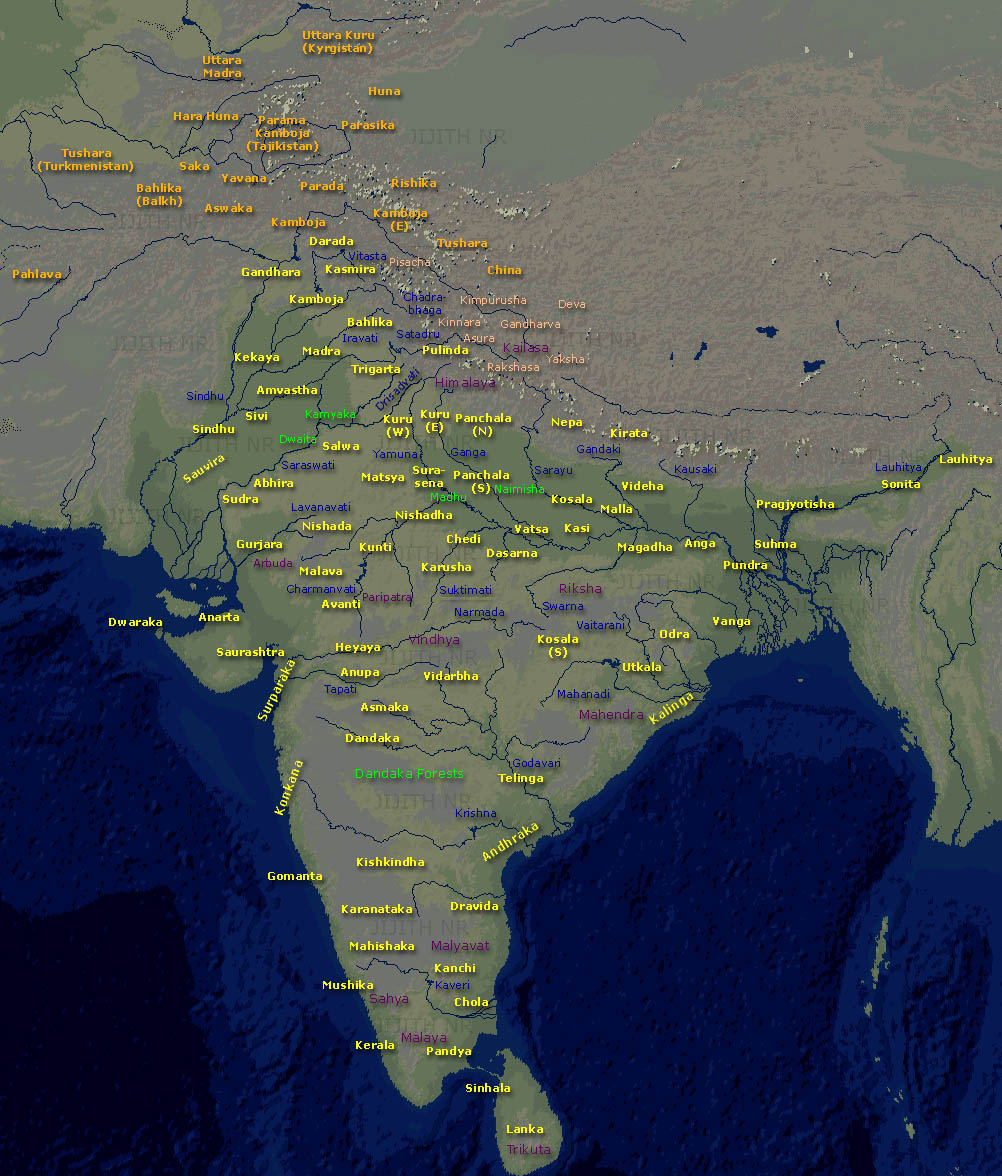
Now I have information from a site that lists 76 Kingdoms.
Jamvudvipa is the name of the regions south of the Himalaya region as per ancient Indian texts. Some identifies this region with the Jammu region that lies to the immediate south of Himalaya in Kashmir. Others identify it with the whole of Indian peninsula that lied to the south of the Himalayan range and also consider Himalaya to be a mountain range that surrounds this region both to the west (the western mountain ranges in Pakistan , north (Himalaya proper) and east (eastern ranges in North-Eastern India and Myanmar) of it.
Below is the Ancient India Map I created in 2004. It is formerly added to Wikipedia under creative common license. It is also used by many web-sites dealing with ancient India. Jamvudwipa is the Indian Peninsular region which can be seen in this map. The smaller Jamvu region is the region south of Kasmira, between the rivers Vitasta and Chandrabhaga. It is not marked in this map.


You must be logged in to post a comment.