Russia and India have shared a special relationship throughout history, with the former being a significant contributor to India’s economic and political growth. While India has always been known as a land of cultural and religious diversity, few know about its traditional ties with Russia.
The roots of Indian and Russian relations can be traced back to the ancient times when India was part of a larger region called ‘Bharatha Varsha.’ This region, consisting of present-day India, Pakistan, Bangladesh, Nepal, and parts of Tibet, was a cultural hub that fostered diverse philosophical and religious traditions.
One of the significant contributions of Russia to India was in the field of literature. The Russian classics were translated into Indian languages, which played a significant role in shaping Indian literature.
Another area of Russian influence on India is in the form of defense and technology. Russia remains one of India’s leading weaponry suppliers, including the acquisition of Sukhoi fighter jets, naval missiles, and tanks.
The Indian and Russian relationship continues to flourish as both nations remain committed to strengthening their partnership. As the world becomes increasingly geo-politically complex, the bond between these two nations proves critical in maintaining stability and creating a peaceful world for future generations.
I recently came across a research paper by a Russian researcher stating that Russia, not India, was responsible for giving the world the Vedas, Vimanas, philosophy, and sciences. This claim did not surprise me because of various pieces of evidence that suggest a strong connection between ancient Russia and India.
Ancient India , image by AI .
Listen to the article below
For instance, it is believed that the Vedas were composed in the Arctic, and Shiva and Ganesha left India through the western part of India, traveled to the Arctic to compose the Rig Veda, and returned to India through Russia. The Rig Vedic Swasthik Mandala City can be found in Arkaim, Russia, and Siberians worship Ayur Devatas, which many Hindus may not be aware of.
Krishna’s son Pradhyumna founded the city of Port Baijn in Russia, which was called Sthree Varsha or the land of women ruled by women. Lake Baikal is also considered Vaikanasa Theertha, and Indra’s city Amravathi was in Russia. Moreover, the Russian Veda is known as Santi Veda, and the Caspian Sea is referred to as the Kashyap Sagar.
Interestingly, India is referred to as Bhata Kande in the Sankalpa recited before any religious function. Bhata Kande means the continent of Bharatha, an ancient Indian emperor, and the land mass of which it forms a part is referred to as Bharatha Varsha. However, the term Bharatha Kande refers to Bharata’s continent to indicate India, suggesting a larger landmass beyond India.
The Hindu system of tagging refers from the bigger to the smaller, indicating that Bharatha Kanda is Greater India. Therefore, Bharatavarsha, which is mentioned irrespective of where one lives, even in the US, Australia, or Europe, should refer to a larger landmass than Bharatha Kanda. This larger landmass is believed to be described in the concept of Bhu Mandala, the Earth. Geology has proven the existence of supercontinents like Pangea, Archea, and Rodinia, suggesting that the landmass in ancient times was quite huge.
According to a research paper by a Russian researcher on the history of the world, it was Russia that gave the Vedas, Vimanas, philosophy, and sciences to the world, not India. The author of the paper suggests that the Vedas were composed in the Arctic, and Shiva and his son Ganesha traveled through the western world before arriving at the Arctic to compose the Rig Veda. They then returned to India through Russia. Additionally, the author claims that many Hindu deities and cities are found in Russia and that Lake Baikal is Vaikanasa Theertha.
The author also explores the concepts of Bharatha Kanda and Bharatavarsha in Hinduism. The author suggests that Bharatavarsha encompasses the world and includes present-day Russia. Furthermore, the author suggests that the home of people in the Bhu Loka was Bharatavarsha.
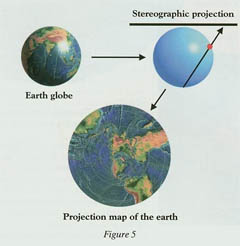
The Bhagavatam describes Bhu-mandala as a planisphere, or a polar-projection map of the Earth globe. The stereo-graphic projection method can be used to map a modern Earth globe onto a plane, resulting in a flat projection called a planisphere. Bhu-mandala can be viewed as a stereo-graphic projection of a globe, similar to ancient Indian globes. The purpose of these globes was astronomical, rather than geographical.
In conclusion, the author suggests that present-day Russia was the cradle of Hinduism and that Bharatavarsha encompassed the world, including India and Russia. The author also explores the concept of Bhu-mandala as a planisphere and stereo-graphic projection of a globe in Hinduism.
This article was rewritten by www.chat .openai.com from my article Bharathavarsha is not India.
I have written about the presence of Sanatan Dharma in Russia. We find references in Indian texts, Puran ( eighteen) Mahabharata and Ramayana.The step mother of Sri Rama of Ramayana was Kaikeyi and she was born in Russia.
Amrvathi, the capital of Indra, the chief of Devas was in Russia,
Yagnyavalkya lived in Russia,
Lord Krishna’s son, Pradhyumna founded a city Port Baijin, Russis,
The Vedas were called Santi Veda,…..
River Moksha is found in Russia…..
You may check for more evidence by googling Russia+ramanis blog.
By referring to texts of Sanatan Dharma and Ancient Tamil literature, one finds Sanatana Dharma Links to world culture and Civilizations.I have documented them in this site.
As I happen to have basic knowledge of Sanskrit and ancient Tamil, I record information I find which appeal to as connected to either Sanatana Dharma or Tamil or both. As the site is research based, you may not find all information regarding one subject,that is in this case, Russia, in one article.As evidence mounts, I collate them, see how far they go and stand the test of verification and cross verification. Thus, I have been able to find evidence to confirm the presence of Sanatan Dharma throughout the world.So, before jumping the gun stating that mere mention of names is not sufficient proof for the presence of Sanatan Dharma, I request the reader to have an open mind,check the references and links I have provided in each article and also read other related articles.
Now there is a Sita Lake in Russia.Taking into consideration the information that Sanatan dharma was present in Russia as evidenced as stated above,there seems to be some strong evidence to relate Sita to Sita Lake.
I am searching for information and readers may contribute.
‘
‘
The Sita River is a river in the Khabarovsk Territory
The Sita River is a river in the Khabarovsk Territory . The sources of the river are swamps, located near the village of Sita, district named after Lazo. The river flows into the shallow Petropavlovskoe Lake, which is connected by channels with the Amur River. The main tributaries are: Obor, Chernaya, Dzhulikha, Kamenushka, Malaya Sita Vtoraya, Malaya Sita, Beshenaya. It spills heavily during floods, flooding a low-lying swampy valley for many kilometers.
Between the villages of Knyaze-Volkonskoye and Blagodatnoye, it forms a wide valley where gravel is mined and a dredger works. Here, on the site of a former quarry, Blagodatnoye Lake was formed – a favorite summer vacation spot for Khabarovsk residents.
Navigable only for small vessels. In the areas of the villages Blagodatnoye and Knyaze-Volkonskoye, the river is crossed by two reinforced concrete bridges. The waters of the river are taken for technical and economic needs.
Original of the material quoted above is in Russian .Here it is.
‘
Река Сита́ — река в Хабаровском крае. Истоки реки- болота, расположенные рядом с поселком Сита р-на им.Лазо. Впадает река в мелководное Петропавловское озеро, сообщающееся протоками с рекой Амур. Основные притоки: Обор, Черная, Джулиха, Каменушка, Малая Сита вторая, Малая Сита, Бешеная. Сильно разливается в половодье, затапливая на много километров низменную заболоченную долину.
Между сёлами Князе-Волконское и Благодатное образует широкую долину, где ведется добыча гравия и работает земснаряд. Здесь, на месте бывшего карьера образовано озеро Благодатное – излюбленное место летнего отдыха хабаровчан.
I had posted earlier that the Rig Veda was compiled in the Arctic,There was a Kingdom of Women in Russia and Tripura, destroyed by Lord Shiva was in Russia.
Now evidence has surfaced that
Narodnaya mountains,Ural
“Twenty of the spiral-shaped settlements, believed to be the original home of the Aryan people, have been identified, and there are about 50 more suspected sites. They all lie buried in a region more than 640km long near Russia’s border with Kazakhstan. The cities are thought to have been built 3500-4000 years ago, soon after the Great Pyramid in Egypt. They are about the same size as several of the city states of ancient Greece, which started to come into being in Crete at about the same time.
The shape of each of the cities, which are mainly in the Chelyabinsk district, resembles an ammonite fossil, divided into segments with a spiral street plan. The settlements, which would each have housed about 2000 people — the same as an ancient Greek city such as Mycenae — are all surrounded by a ditch and have a square in the middle.
The first city, known as Arkaim, was discovered in 1989, soon after the soviet authorities allowed non-military aerial photography for the first time.
The Russians knew about these settlements for about 20 years.
This information was revealed by historian Bettany Hughes on the BBC program “Tracking the Aryans”.
And there is a Mountain named after the Hindu Sage, Narada.
‘
According to Bulgarian linguist Vladimir Georgiev, geographical names are the most important source for determining how a group of people acquire their ethnicity. This can originate through a process of self-identification or it could be the result of outside identification.
Georgiev says the most stable – or longstanding – names are that of rivers. “But in order to preserve the names it is necessary to maintain the continuity of the population, transmitting these names from generation to generation. Otherwise, new people may come and give it their own name,” he says.
Georgiev illustrates that in 1927 a detachment of geologists “discovered” the highest mountain in the Urals. The mountain was called Narada by the local population, and interestingly the ancient Indian epics describe the great sage Narada as living in the north. But since it was the 10thanniversary of the October Revolution, the geologists decided to mark the event and rename the mountain as Narodnoy – or People. And that’s what it is now called in all geographic references and on all maps.”
And,
‘
In the meanwhile I read a Book where the author, a Scholar in Sanskrit, Tatyana Elizarenkova in her Book ‘Language and Style of the Vedic Rsis’ states that the Rig Veda was written in Russia!
This is based on the language construction, Grammar and the affinity between Sanskrit and Russian.
Based on a Study of Indo-European Languages and cross checking with other scholars of the West who knew Sanskrit she seemed to have arrived at the conclusion.” Rig Veda composed in Russia
Russia was known as Rishi Varsha an it surrounded the Bharata Varsha as described in the Puranas.
There have been migrations from India, from the Sarasvati Valley Civilization,from the Dravida Kingdoms, and from the North again.
There is enough evidence in the present Russia right from the names of Rivers,Olga,Moksha from which Moscow is derived,Karaggana, Utkaraganga,
People living in the valley of the River Moksha spoke a language Moksha!
Place Arkaim, the name of Surya, Sun is Arka.
Arkaim is an important archeological site .
Many Hindu Ritual signs are found here.
One finds the designs of swastika here and this site is dated 4500BC!
Arkaim, Russia.
Arkaim.
But reasonable reactions notwithstanding, why have people who are looking for their roots in the direction of Vedic ancestry been more suspect than any other indigenous people curious about their heritage? After all, it would appear to be an uncommonly large area upon which such ancestors would have enjoyed their apparently advanced culture. Such a culture would seem to have “fed” much of what we now call Western civilization and parts of Asia, including migrated tribes, such as American Indians and even Europeans settling America.
Moreover, as we also explore elsewhere regarding linguistic research efforts around the so-called Nostratic or Proto-Language question, some linguists are struggling with the possibility of linguistic ancestral roots for possibly ALL humankind, of all colors, so that the suspect idea of any “superiority” should be supported as an excitement for all of humanity maybe re-discovering its true origin and common spiritual heritage.
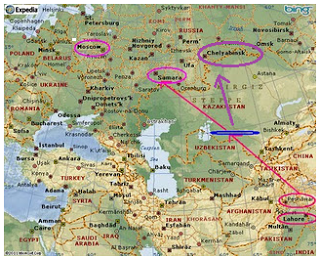
Mahabharata describes the route to Russia while talking about Kekaya Kingdom.
Kaikeyi of Ramayana was born here.
“Lahore was the kingdom of Lava, son of Rama. ead my post on this.
Peshawar was the kingdom of Pushkalavathy ruled by Pushkala, son of Bharatha.
These two cities were established during the reign of Rama, the son of Dasaratha. These cities are in the route toKekaya, today’s Kazaksthan which was the maternal land of Kaikeyi, mother of Bhratha. One has to cross riverChakshus to reach Kekaya. This river is now known as Oxus . It is shown in blue colour in this picture”
The Route to Russia,, Mahabharata.
People who lived in the valley near Moscow worshiped Indra and Vayu.
Moscow Empire was ruled by women called Sthree Rajya.
It was dominated by women – due to which it got the name Sthree Rajya – the land of women or dominated by women. They were supposed to seduce men and lead a free life.
Varaha mihira has mentioned this place as one of the countries surrounding Bharatha varsha.
Vatsyanana also has mentioned about Sthree Rajya in the context of “Grama naari vishayam” where he has said that the women of Sthree Rajya were free to have sex with a any man they liked.
Bhattasmin , the commentator for Artha sastra also has talked about SthreRajya as a country abounding in luxurious artilces and happiness.
Please read my post on where an ancient Vishnu Idol was found in Russia.
Also there are suggestions that the Rig Veda might have been composed in the Arctic.
Please refer my post.
So what now is called Russia was following Santana Dharma and many Rishis, Yagnyavalkya and Vasishta traveled and stayed there.,near Vaikhanasa now called Baikal.
Leave a Reply