‘When I say that Buddhism is a part of Hinduism, certain people criticize me. But if I were to say that Hinduism and Buddhism are totally different, it would not be in conformity with truth.” —Dalai
“When I say that Buddhism is a part of Hinduism, certain people criticize me. But if I were to say that Hinduism and Buddhism are totally different, it would not be in conformity with truth.” —Dalai Lama
Of late, there is a tendency to state that Buddhism preceded Sanatana Dharma and that Sanatana Dharma is from Buddhism.
Buddhism and Vedic thoughts are so close, especially in their view of Reality that Sri Adi Shankaracharya is often called as ‘Pseudo Buddhist’ for his explanation of Brahman . His system of Philosophy is Advaita, Non- Dualism. Buddhism calls the Reality as Sunya,which is without Attributes .The details of this discussion may be found in my site filed under the Indian philosophy category .
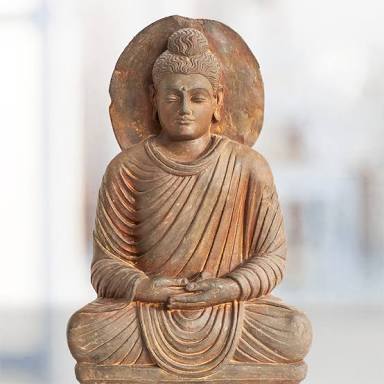
The ethics of Buddha is also found in Sanatan Dharma.The purpose of the article is not to go out to prove that Buddhism is from Hinduism but to set history straight. Buddha was born as a Sakya ,a clan. He belonged to Gautama Gotra.His system was established as a result of the numerous deities being worshipped on the one hand and on the other hand, Mimamsa system was emphasizing more on the Karma Kanda portion of the Vedas to such an extent that the rituals were being conducted on a massive scale foregoing the Concept of Iswara.People were fed up of this and came Buddhism with its message of Ahimsa, Non violence which effectively forbade Killing , especially of animals in Yagnya as sacrifice.
It took centuries for Sanatan Dharma to regain lost ground from Buddhism and it took the efforts of Adi Shankaracharya to achieve this.He codified the methods of worship into six as Shanmathas and also emphasized Gnana and Bhakthi Yogas.
So it would be better if people study Buddhism and Sanatan Dharma before making statements.
Buddhism and Jainism are both called as Nastika system, not because they deny the Existence of but because they do not accept the Sruthi, Vedas as a source of Knowledge. That’s all . Both Jainism and Buddhism are also philosophical systems of India and Buddha is revered as the incarnation of Vishnu.
‘
Buddhists and Hindus are not rivals and are not competing for converts or privilege.
We happily visit each others temples respect each others clergy and listen to each others teachings which are not all that different. For most part there is a symbiosis.
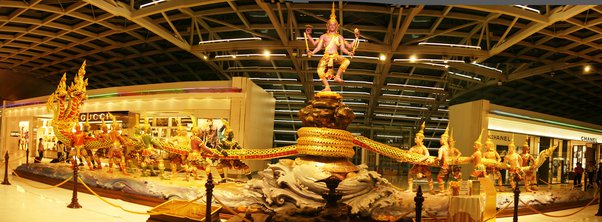
Thailand which is one of the premier Buddhist countries is the best example of Hindu-Buddhist harmony – the King is a Buddhist and the Royal preceptor (rāja-guru) is a Brahmin.
Ganesa in Buddhist Temple Thailand.
The palace in Bangkok contains a Hindu Devasthānam (temple) dedicated to the Hindu Trinity and the (Thai) Brahmins chant Tamil hymns of the Tiruvemppāvai.
All State ceremonies are conducted by the royal Brahmins. The recent coronation of the (Buddhist) King was officiated by the royal (Hindu) Brahmins.
The Ramayana is depicted on the walls of the palace which also contains a replica of Angkor Wat a Hindu temple dedicated to Vishnu which the Buddhist Thais claim as their own.
The most popular shrine in Bangkok is the Erawan Shrine dedicated to Brahma and almost every building has a shrine to Brahma at the entrance.
There is a statue of Ganesha outside the Bangkok stock exchange.
The Dalai Lama has expressed support and appreciation for the Hindu custom of not proselytizing, and supported Hindus and Buddhists uniting against Islamic aggression in this respect. He has attended the Kumbha Mela, and sprinkled himself with water from the river Ganga. He joined the Shankaracharya of Kanchi in performing Ganga Arati at dusk.
The Dalai Lama has spoken of Buddhism and Hinduism as being like spiritual brothers, sharing shila (ethics), shamatha (concentration), and prajna (wisdom). He has praised Hindus for being largely a peaceful people, and has held various discussions on the correspondences of the two spiritual traditions as well as the philosophical disagreement on atman vs. anatman. On this point, he has expressed the position that it is a personal decision as to which view appeals more.
Here is the Dalai Lama performing Rudra Abhishekam, a Hindu ritual, as a show of solidarity:
But his genealogy as gleaned from Buddhist texts indicate his ancestry goes back to one of the first Rishis after whom the gotra system of Hindu lineage springs from.
The rishi is Gautama and he was a Brahmin .
There is Gauthama gotra among Brahmins.
He was one of the Rig Vedic Rishis.
Hence Buddha’s given name was Gauthama Siddhartha.
One of my readers asked me how I arrived at the conclusion that Gautama Buddha was aa Brahmin.
Buddha’s given name Siddhartha Gautama.
He belonged to Sakhya clan, Kshatriya.
But his genealogy as gleaned from Buddhist texts indicate his ancestry goes back to one of the first Rishis after whom the gotra system of Hindu lineage springs from.
The rishi is Gautama and he was a Brahmin .
There is Gauthama gotra among Brahmins.
He was one of the Rig Vedic Rishis.
Hence Buddha’s given name was Gauthama Siddhartha.
His father was Suddodhana and Mother Maya Devi.
His place of birth Lumbini.
Year is placed between 483 BC.
But I am of the view that he could be dated much earlier.
So,by genealogy he belongs to Brahmin Gotra but by disposition his Varna at the time of his birth was Kshatriya.
This illustrates how dispositions decided Varna,loosely translated as Caste now,and geneology decided The Gotra.
There are records that show that the Northwest of India was once ruled by Greeks.
However the relations between the Greeks and India,especially the Tamils date back to centuries earlier.
These Greek Kings later ,some of them, converted to Buddhism.
They held both Hinduism and Buddhism that they minted Coins in honor of the Deities of these religions.though Buddhism does not endorse the view of God.
“Sudras will also be utterers of bho (a form of address used towards an equal or inferior), and Brahmins will be utterers of arya (a form of address used towards a superior), and the elders, most fearful of dharma, will fearlessly exploit the people. And in the city the Yavanas, the princes, will make this people acquainted with them: but the Yavanas, infatuated by war, will not remain in Madhyadesa.”
—Yuga Purana, Paragraph 55–56, 2002 edition.
There is also significant archaeological evidence, including some epigraphic evidence, for the Indo-Greek kings, such as the mention of the “Yavana” embassy of king Antialcidason the Heliodorus pillar in Vidisha.
Agathocles Dikaios (Greek: Ἀγαθοκλῆς ὁ Δίκαιος; epithet meaning: “the Just”) was a Buddhist Indo-Greek king, who reigned between around 190 and 180 BC. He might have been a son of Demetrius and one of his sub-kings in charge of the Paropamisadebetween Bactria and India. In that case, he was a grandson of Euthydemus whom he qualified on his coins as Βασιλεὺς Θεός,Basileus Theos (Greek for “God-King”).
At the same time, Agathocles issued an intriguing range of bilingual coinage, displaying what seems to be Buddhist as well as Hinduist symbolism. The coins, manufactured according to the Indian standard, using either Brahmi, Greek orKharoshthi (a first in the Greek world), and displaying symbols of the various faiths in India, tend to indicate a considerable willingness to accommodate local languages and beliefs, to an extent unseen in subsequent Indo-Greek kings. They may be indicative of the considerable efforts of the first Indo-Greek kings to secure support from Indian populations and avoid being perceived as invaders, efforts which may have subsided once the Indo-Greek kingdoms were more securely in place.’
The difference between Buddhism and Santana Dharma(Vedic Hinduism) is so great that Buddhism is regarded as Nastika System since Buddhism does not accept the authority of the Vedas as a Pramana, source of Knowledge .
However excepting this point and Sunya Vada,many similar and in some areas identical views concurring with the Vedas are found in the Buddhism.
And Buddhism is profoundly influenced by Hindu Purana.
Wei Tuo Pú-sà (bodhisattva Skanda)is recognized as one of the eight divine protectors in Chinese Buddhism. Iconographically, he appears as a majestic general in his armor.
Before entering Nirvana, Buddha ordered the general, who remained in this world, to protect the Buddha Dharma. After the death of Buddha, the relics were robbed by evil demons. The bodhisattva Wei Tuo managed to overcome the demons and recovered the relics of Buddha.
Wei Tuo Pú Sà is regarded as a devoted guardian of Buddhist monasteries who guards faithfully the Buddhist treasures and the objects of the Dharma.
Baima (White Horse Monastery in Luoyang, Henan province) is the earliest monastery established in China with a long history of more than 1,000 years. According to legend a white horse carried Buddhist scripture here, and so it got the name.
Followers of Buddhism have always acknowledged Baima Monastery as their ‘ancestral temple’ and the ‘source of Buddhism’ in China. Two life-sized statues of Wei Tuo Pú sà (Bodhisattva Skanda, at left) are also among the deities represented at Baima Monastery.
You must be logged in to post a comment.