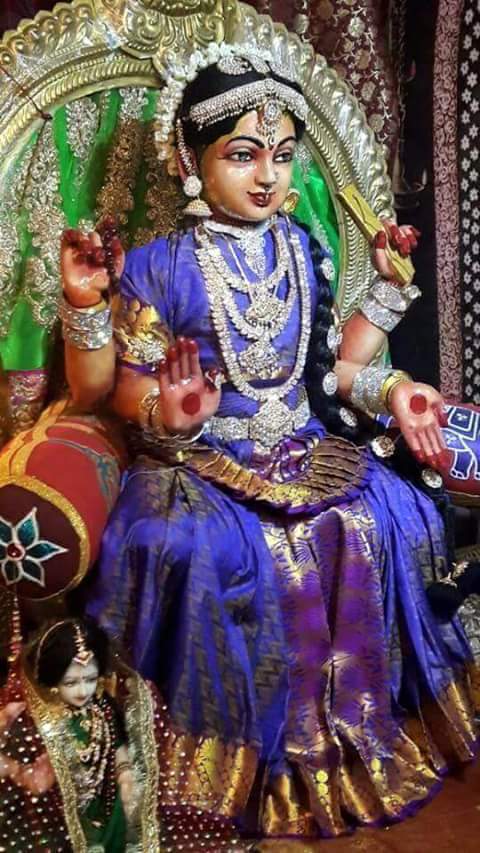
Tag: Devi Upasana

  • Speech Stages Gayathri Savitri Sarasvati Kesri Vidya

    Approaches to God are many.


    As many individuals as many Paths.


    For the approach to Godhead depends on one’s attitude and aptitude, Bhava.


    Broadly speaking they have been classified as  The Path Of Knowledge(Gyana Yoga),Bhakti Yoga(Path Of Devotion),Karma Yoga( Path Of Action, and Raja Yoga(Through meditation and regulation of sense organs.


    Under each are various sub paths.


    Again there are different instruments of reaching this goal through these steps.


    We have Tantra and Mantra Shastras.


    Basing the Sound some systems of worship has been developed in Indian Philosophy/Hinduism.


    One such is the Kesari Vidya.


    This comes under the Mula vidya of Devi, Lalitha,


    In Mula Vidya, The Devi is worshiped thus.


    Gāyatri: Vedic Gāyatri, the primary Vidyā that one is initiated into, before the ŚrīVidyā mantras like Bāla or Pancadāsi.


    (  I shall be posting more on this subject as I am still researching into this, so complex)


    Chanting is of three types.


    1.Chanting aloud,this is considered to be lowest stage,Adhama

    2.Chanting  where the Lips move, no sound emanates, this method is acceptable, Madhyama and


    3.Chanting in the Mind,Highly recommended,Uththamam.


    Chanting s a process of manipulating sounds,Subda.


    When we speak we use the Sabda of the Universe and transform t into Speech with our inputs.


    The Stages of Speech according to Kesri Vidya.


    1.Sol-Speech, speaking as we do normally.


    Animals do this through sounds while we do it with organized sound with a common meaning, language.


    2.Vaak.This is the unexpressed Speech.


    Speech is formed in the Mind and then transformed in a Language.


    This Speech which is yet to be spoken lies in the Tongue.


    This is called Vaak.


    ‘Srimadvakbhava kooda Swarupa Mukha Pankaja(Lalitha Sahasranama.


    Vaak lies underneath the Speech.


    This is called the Bootha Vaaku.


    Many a times we have some intention to speak our mind , knowing well that it would crate problems, we try to keep quiet; we fail to control, we speak out face the consequences and regret having spoken.


    We say we cold not help speaking out.


    This is the path of ‘Dhikbrama’ which is determined by his/her Karma.


    When this speech comes from a Realized Soul it is called ‘Deva Vaaku’


    Once it is kindled , Speech emanates.


    We may observe this when we watch children attempting to speak.


    They would struggle with sounds, choose a couple of them , mix them, produce the words, see our approval and choose such sounds that are approved by those around.


    This Dormant Speech  Vak is controlled by Vakdevi/Savitri , a form of Goddess Sarasvati.


    Gayathri is the Driving Force, Savitri is the Dormant Speech and Sarasvati , expressed Speech.


    This is the reason we have  in the Sanshyavandan Aavaahava Mantra,,


    Gayathreem Aavaahayami, Savithreem Aavaahayami, Sarsvatheem Aavaahayami’


    The Third is The Inner Voice(Kural)


    This is what we hear when we think of some thing in the Mind.


    You would, if you observe carefully, whenever you start thinking/attempting to speak, you would notice contrary thoughts are heard in your mind,.


    That is when you think of some thing, you have the image and a voice in your mind relating to the subject, both for and against.


    Speech as we deliver emanates by manipulating the Prana by Sabda.


    The process of  Realizing Godhead or Brahman by bringing forth the original Knowledge imbedded in us, lying dormant in our tongue is Kesri Vidya.


    The next stage is Mounam, ‘Quietude’


    More on this and Kesri Vidya follows.


    Enhanced by Zemanta
  • Essentials Of Devi Srividya Upasana

    Essentials Of Devi Srividya Upasana

    What is Upasna?

    Srichakra of Devi
    The Srichakra

    Upasana’ in Sanskrit literally means “Sitting near” but normally the term is used in Hinduism to denote a prescribed method for approaching a Deity or God or getting close to a deity/deities. In the Vedas, some Upasanas are prescribed whereby one meditates on the all-pervading Brahman as some aspect of creation, such as fire, water, directions, food, mind, joy, etc. Thus, Upasana can be described as a systematic practice of a prescribed method of worship for pleasing and winning the attention of the deity or it can be a deity-less practice of austerities involving meditating upon some aspect of nature as told in specific texts.

    “The seeker of knowledge does not achieve his end merely by a study of scriptures. Without upasana there cannot be attainment for him, this is definite.”—Sri Ramana Leela, Ramana Gita I.22, quoted in Sri Krishna Bihkshu, Sri Ramana Leela (Pingali Surya Sundaram tr. 2004), p. 80.

    Pooja and external disciplines are essential in the path of attaining Godhead or Realizing Brahman.

    All are not Ramana Maharishi, to say I have known Reality.

    We are at the lowest level and have to evolve by practice by way of the practices mentioned in the Sruthi and Smritis.

    I have mentioned in my earlier Post ‘Lalitha Sahasranama, An Introduction’, I listed the different ways of worshipping The Divine Mother, Sri Lalitha Devi.

    I am planning to post articles on the Varivasya Rahasyam of Bhaskararaya.

    To understand the Varivasya Form of worship, familiarity with the worship of Devi in this Form will be helpful.

    The Sri Vidya is to be practised by any of the following Four ways,traditions

    1.Samayacharam. Worshiping in The Mind.

    Worship is done mentally, internally and no object is used in this tradition

    2.Dakshinacharam,Worshiping through an Object, Sri Chakra or an Idol.

    3.Vamacharam is worshiping through the terrible aspects of The Divine, Laya Pradhana

    4.Kaulacharam is worshiping through the Human Body/parts.

    This includes Rituals some which are erotic in nature.

    This Mode of worship is considered by some the Ultimate practice of Bhakti Yoga, while the Advaitins consider this to be best form of Advaita in full flow.

    I am making this as a passing remark as my purpose is to familiarize the Practice of Tantra;so let us not get nto the philosophical discussions on this subject.

    “Shakti is the power of Shiva.

    Her activity at will towards manifestation becomes evident while Shiva, the source of all power remains in volute.

    As such, the Eternal Shakti emanates as form and assumes different phases while the Eternal Shiva remains in the subtle state of Chaitanya.

    This is depicted in the Shakta lore as Shiva lying as if dead and Shakti stands on him in full vigor of awareness.

    The sleeping Sadashiva forms the berth of the palanquin in which Sri Mahatripurasundari is borne by the four powerful deities:

    Brahma, Vishnu, Rudra and Ishwara.

    ‘Panchapredha Manchaathsaayini” Lalitha Sahasranama.

    Brahma,Vishnu,Rudra, Shiva and Sadashiva.

    Her four arms represent the powers of four prominent parts (Kalaa) of the creative divinity.”

    Her three eyes connote the three luminary powers i.e. the sun, the moon and the fire, which correspond to knowledge (Pramaana), object of knowledge (Prameya) and empirical experiencer (Pramaata).

    The Third Eye also connotes Wisdom.

    Her breasts connote the meaning of alert awareness of light and sound or Prakasha and Vimarsha.

    Her bending waist is the sign of inclination towards manifestation.

    Decoding this symbolism, we obtain the nine enclosures of the Srichakra.

    1. valiitrayaa~Nkitatanum – Moolaadhaara Chakra – Bhoopura Trailokyamohana Chakra.

    2. madhye nimna – Swadhishthana Chakra – Sodasha dala Padma – Sarvashaparipooraka Chakra.

    3. aapiinottu~Ngastaniim – Manipooraka Chakra – Ashtadala Padma Sarvasamkshobhana Chakra.

    4. trinayanaam – Anahata Chakra – Chaturdashara Sarvasaubhagyadayaka Chakra.

    5. chaturbhujaam – Visuddhi Chakra – Bahirdasara Sarvarthasadhaka Chakra.

    6. pretaasanaadhyaasiniim – Ajna Chakra – Antardashara Sarvarakshakara Chakra.

    7. bandhuukaprasavaaruNaambaradharaam – Manasa Chakra – Ashtara Sarvarogahara Chakra.

    8. nR^imuNDasrajam – Soma Chakra – Trikona sarvasiddhiprada Chakra.

    9. shashikhaNDamaNDitajaTaajuuTaam – Sahasrara – Bindu Sarvanandamaya Chakra.

    Note: This is the Samhara Krama accepted by Dakshinamurthy sampradaaya.

    Hayagriva tradition and Anandabhairava traditions omit triple girdle from Sri Chakra.

    The three worlds (of which she is the supreme queen) refer in the microcosm to BhuH, BhuvaH and SvaH (earth, space and heaven) or to Vishwa, Praajna and Taijasa or Virat, Hiranyagarbha and Ishwara in terms of Vedanta.

    Sridevi is the supreme ruler of these and hence she is Turiya, the incomprehensible fourth.

    There are basically only three castes, as there are the three Vedas, the three Gunas etc.

    The three castes represent the three qualities viz. Satva, rajas and Tamas, as suggested by the pet offerings made by devotees who are quite established in their respective modes of worship.

    A Brahmana should offer Tarpana only with milk and sugar during Navavarana Pooja.

    Using other articles is banned by the Agamas. Ghee and honey are prescribed for the other two castes.

    These may not necessarily mean castes, but instead may refer to different stages of spiritual advancement.

    More information on this may be obtained in a work called `Srividya Sudhodaya’, a classic by Deepakanatha Siddha.

    This also finds sanction in the Shubhagama Panchaka.

    As mentioned earlier, milk, ghee and honey represent Satva, rajas and Tamas in the devotees belonging to different levels of consciousness.

    In offering oblations or doing any kind of worship to the Divine Mother, one must not involve oneself in the desire of a return or fruit thereof.

    If one does, the earnestness and one-pointed ness required for its success lose their intensity.

    puujaa naama na puShpaadyairyaa matiH kriyate dR^iDhaa |
    nirvikalpe mahaavyomni saa puujaa hyaadaraallayaH ||

    `Worship does not mean merely offering of flowers etc. It rather consists in setting one’s heart on that highest ether of consciousness, which is above all thoughtconstructs. It is dissolution of individuality with perfect ardor’.

    Before performing the Pooja, Sandhyavandana must be performed by all the Three varnas.

    Ladies are allowed to perform Pujas and they also must perform Sandhyavandana,

    On this.please read my post on Can Women Learn Vedas?;Upakarma for

    Women”.

    http://www.kamakotimandali.com/srividya/urahasya.html

    Image:http://www.bloguez.com


    Join 4,576 other subscribers