Tag: Chola Genealogy

  • First Tamil King of Kaliyuga Pernarkkilli 3102 BC

    First Tamil King of Kaliyuga Pernarkkilli 3102 BC

    Tamil Kings have recorded the grants they had made to Temple, Important events of their reign,their genealogy in Copperplates too, apart from Epigraphs in temples and other structures constructed by them. All Tamil Kings, Chera, Chola,Pandyas, Pallavas and others have recorded history thus.

    One of the important Copperplates are found in Thiruvaalankaadu, Tamil Nadu. These Copperplates are named after the place and are called ‘ திருவாலங்காடு செப்பேடுகள் Thiruvaalankaadu Copperplates. These were by Rajendra Chola, son of Rajaraja Chola and they are from 10 Century AD.This Copperplate evidence traces the genealogy of Cholas from Ikshvaku ,who founded the Suryavansh to which Sri. Rama belongs This dynasty is also called Ikshvaku Dynasty.

    Thiruvaalankaadu Copperplates of Rajendra Chola

    Rajendra Chola, son of Rajaraja Chola.

    The plate mentions King Perunarkilli, பெருநற்கிள்ளி, Chola Emperor. He performed Rajasuya Yaaga and was called as Perninarkkilli, who performed Rajasuya, ராஜசூய யாக வேட்ட பெருநற்கிள்ளி.The evidence also lists him as the first Tamil King of Kaliyuga.

    Coming to the rulers of the Kali age, the first king mentioned is Perunatkilli who was born in this same family and was highly learned (v. 41).  In his race[12] was born Kalikala who renovated the town Kanchi with gold and established his fame by constructing flood-embankments for the river Kaveri.  The poet explains the name Kalikala as ‘the god of Death (Kala)’ either to the Kali age or to the elephants (kari) of his enemies
    South Indian inscriptions https://www.whatisindia.com/inscriptions/south_indian_inscriptions/volume_3/no_205_aditya_ii_karikala.html#_ftn12(v. 42).

    Kaliyuga beginning date. It means that the existing Kali era is 5101 in 1999 AD, which comes to (5101 – 1999) 3102 BC.

    Perninarkkilli. The Thiruvalangadu copperplates discovered in 1905 C.E. comprise one of the largest so far recovered and contains 31 copper sheets. The Thiruvalangadu plates contain text written in Sanskrit and Tamil. These two seem to have been written at least a decade apart. These plates record a grant made to the shrine of the goddess at Tiruvalangadu by Rajendra Chola I. The list of the legendary Chola kings forms the preamble to the Sanskrit portion of these plates. typical Chola copperplate inscription currently displayed at the Government Museum, Chennai’s, India, is dated c. 10th century C.E. It consists of five copper plates string in a copper ring, the ends of which area secured with a Chola seal bearing in relief, a seated tiger facing the right, two fish to the right of this. These three figures have a bow below, a parasol and two fly-whisks (Champaran) at the top and a lamp on each side. Around the margin engraved in Grantha characters, “This is the matchless edict of Kong Parakesarivarman, who reached justice to the kings of his realm”…

    A portioned of this inscription is in Sanskrit and the rest is in Tamil.https://en.m.wikipedia.org/wiki/Tamil_copper-plate_inscriptions

  • Cholas From Surya Vamsa Rama’s Dynasty Copperplate Evidence

    Cholas From Surya Vamsa Rama’s Dynasty Copperplate Evidence

    There were two dynasties that ruled ancient India. Both trace their origins to Vaivaswatha Manu, the First Man,after whom the word ‘Man’ was coined.

    He hailed from the Dravida Desa, Dravida in Sanskrit meaning South.

    Bhagavatha Sloka mentions that Manu was a Dravida. I am providing a Link on this and on the fact that Manu meditated near Madagascar.

    Manu,apart from sons had a daughter,Ila or Ela.From Ela sprang the Aila dynasty.This is the Chandra Vam!sa or Lunar Dynasty.From the Male offspring of Manu came the Surya Vamsa or Solar Dynasty. I shall be writing on the other sons of Manu and what happened to them. While people talk of Vedic kingdoms,they tend to overlook or notice the kingdoms of Dravida Desa.They were respected by the kings of Aryavartha.(I shall write on what Aryavartha means and its boundaries.The people of Aryavartha and Dravida Desa intermarried.So did the Kings.

    People of Dravida Desa were ruled by the great Kings,Chera,Chola and Pandyas.They ruled the South.And the early kings ruled from the landmass Lemuria.These kings trace their ancestry to Surya Vamsa.Lord Rama belonged to this Dynasty. One of his ancestors,Sibi,had a second capital near North West Frontier Province,now in Pakistan.Much earlier to him was Muchukunda ,who killed a Yavana King,Yavana means Greek.

    Thiruvaalangadu Copper Plates

    The Cholas called themselves as Descendants of Surya Vamsa.They also had ceremonial titles,one of them being Parakesari,the name of a King belonging to Surya Vamsa,Solar Dynasty.Cholas also called themselves as belonging to Kasyapa Gotra.Am providing Link towards the closing of the art.That the Cholas belonged to Solar Dynasty is known from Literary sources,Epigraphs and Copper Plates.I am mentioning one copper plate called ‘Thiruvaalankaadu Cheppedugal,Copper Plates of Thiruvaalangadu,Thiruvaalangadu being the name of a town near Chennai,Tamil Nadu,India.These copper plates were found in the famous Siva temple there.The other copper plate is from Kanyakumari,Tamil Nadu.

    Copper plate inscriptions are made in individual copper plates,strung together with Royal Seal.These generally contain two parts.One part will list out the genealogy of the king in whose period it was prepared and the other part details the grants given to Temples,Villages,and persons. It also lists work to be carried about by the individual officers of the local adminstration and also by those to whom the grants had been provided.

    In the Thiruvaalangadu Cheppedu,31 plates are found;ten are in Sanskrit and twenty in Tamil.The thirty copper plates are in the form of flower petals and are joined together by Chola Royal Seal.It also has Chera,Pandya and Rashtrakoodas,signifying that The Cholas have conquered them all.The plates are in praise of Rajendra Chola. His father was Rajaraja Cholan,who built the Thanjavur Big Temple.Rajaraja Cholan was also called as Arulmozhi Varman. These plates were put in place during the sixth year for his reign,that is around 1004 to 1044 AD. https://en.m.wikipedia.org/wiki/Rajendra_Chola_I

    The plates list the genealogy of the Cholas,beginning with Chola,who was born of Bharata,after whom India is named as Bharatavarsha.

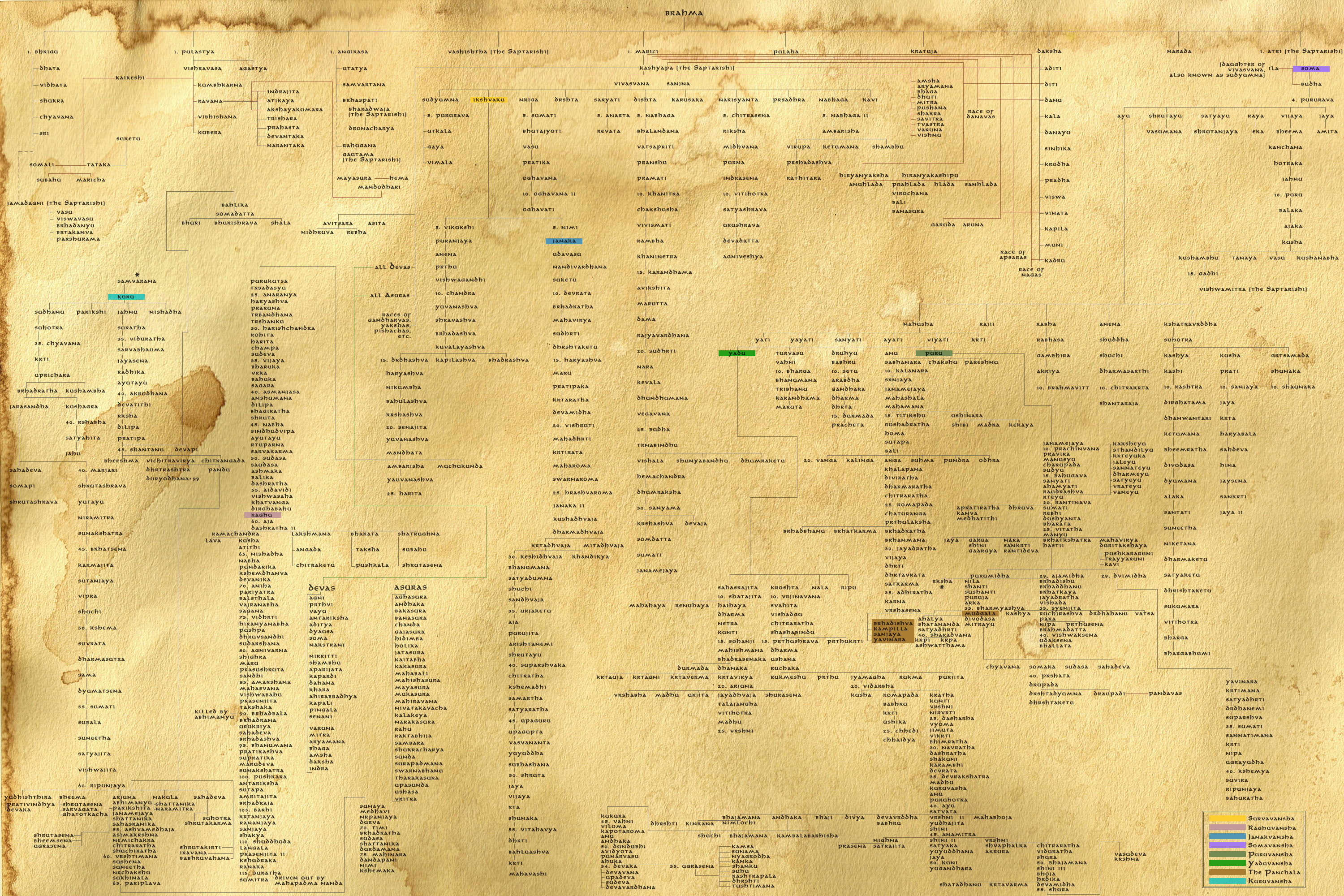
    The list in the copperplates tally with the Kings List found in the Puranas. I am providing Bharat’s family tree as the featured image. You may find the common names.

    As to differences between these two,it is because of the incomplete information regarding the Dynasties of India,that is by considering only the Surya and Chandra Vamsa,without information about the other descendants of Many and more importantly the Vamsas of the Saptha Rishis,whose progeny includes Manu and Ikshvaku Dynasty,Ela and her dynasty,Chandra vamsa.I shall write in detail do that we may understand the dynasties.

    ‘People) say that Dushyanta was an ornament of the race of this (king).  His son was Daushyanti (i.e., born of Dushyanta) Bharata.To him was born a son named Chola after whom the Solar race on this earth became illustrious.

    On the basis of this,one may observe that Cholas descended from Many and are from Solar Dynasty,Surya Vamsa.

    Please note that the people were aware that some of the ancient kings belonged to Treta Yuga,about a million year old and the new Chola dynasty began with Perunarkilli in Dealers Yuga.I had written on Cheers and Pandya Kings participating in Mahabharata war and Krishna and Arjuna’s marriage with Pandyan Princesses.

    (V. 29.) Him (i.e., the king Chola), learned men described as the generous lord of gods (i.e., Indra) who incarnated on earth (on seeing that) the glory of his own (i.e., Amaravati) was humbled by the varied and lustrous riches of the Chola country.

    (V. 30.) Cholavarman’s son was Rajakesarivarman (‘the lion among kings’) who split asunder with (his) nails (viz., crooked knives) the elephants (viz., crooked knives) the elephants (viz., his enemies) and (was) the cage (wherein resided the goddess) of prosperity.

    (V. 31.) Rajakesarin’s son was king Parakesarin by whose fire-like anger the enemies’ forces were consumed.

    (V. 32.)  Thenceforward these two names indicative of (their) suzerainty were alternately borne by the Chola (kings) in the order of their coronation.

    (V. 33.) Parakesarin’s son was king Chitraratha ; his son (was) Chitrasva ; to him (was born) king Chitradhanvan.

    (V. 35.) Having come to know that king Bhagiratha engrossed in penance brought down (from heaven) the river of gods (i.e., Ganga) (to earth), this king (also) desirous to fame brought her (i.e., Ganga) to his dominions under the name Kaverakanyaka (i.e., Kaveri).

    (V. 36.) In that family was (born) Suraguru who was the hereditary abode of the maiden, the Lakshmi of victory.  This king having conquered by his glory the god of Death in his own territory acquired the name Mrityujit.

    (V. 37.) In his race was born king Chitrartha called Vyaghraketu from his banner-cloth bearing (the figure of) a tiger, who was a store of great heroism and who wore as an ornament on his head the flowers of the dhataki (Grislea Tomentosa).

    (V. 38.) The Treta-age having come to a close, a son of this king known as Narendrapati became the ruler.  The diadems of (subordinate) kings dropped down their gems ; (because their) fastenings had become loosened by the constant rolling at his footstool.

    (V. 39.) From him was produced the head-jewel of the powerful Solar race, (king) Vasu, who was the cause of the destruction of the demons (and) who (known) by the significant surname of Uparichara moved in any direction he liked in a celestial car which was presented (to him) by the lord of gods (i.e., Indra).

    (V. 40.) At the end of the Dvapara (-age) was born in the family of this head-jewel of kings a conqueror of all hostile kings named Visvajit.

    (V. 41.) In his race was born Perunatkilli who was the receptacle of all sciences, the abode of (the goddess of) Prosperity, who was worshipped by the diadems of all the rulers of the earth which were set with rows of precious gems.

    Reference,source. Thiruvalankaadu Plates

    செப்பேட்டின் பெயர்-திருவாலங்காட்டுச் செப்பேடுகள்செப்பேடு கிடைக்கப் பெற்ற இடம்-திருவாலங்காடுஊர்-எழும்பூர்வட்டம்-அமைந்தகரைமாவட்டம்-சென்னைமொழியும் எழுத்தும்-தமிழ், வடமொழி – தமிழ், கிரந்தம்அரசு / ஆட்சியாளர்-சோழர் / முதலாம் இராஜேந்திரசோழன்ஆட்சி ஆண்டு-6வரலாற்று ஆண்டு-கி.பி.11-ஆம் நூற்றாண்டுவிளக்கம்-

              தொண்டை நாட்டுப் பாடல் பெற்ற தலங்களுள் காளியோடாடும் இரத்தினசபையான திருவாலங்காடு காரைக்கால் அம்மையார் முத்திப்பெற்ற திருத்தலமாகும். சோழர்கள் ஆட்சிக்காலத்தில் திருவாலங்காடு மிகுந்த சிறப்பினைப் பெற்றிருந்தது என்பதனை இக்கோயில் இறைவர்க்கு அரசர்கள் அளித்த கொடைக்கல்வெட்டுகள் மூலம் அறிய முடிகின்றது.

              முதலாம் இராஜேந்திர சோழன் வழங்கிய இவ்வூருக்கான நிலதானம் பற்றிய ஆணையை திருவாலங்காடு செப்பேடு தெரிவிக்கின்றது. 1903-இல் இக்கோயில் திருப்பணியின் போது சில ஐம்பொன் சிலைகளுடன் 31 ஏடுகளைக் கொண்டு இச்செப்பேட்டுத் தொகுதி கண்டறியப்பட்டது.

              திருவாலங்காட்டுச் செப்பேட்டுத் தொகுதியில் 31 ஏடுகள் பெரிய வளையத்துடன் உள்ளன. இணைப்பு வளையத்தில் சோழ அரசின் இலச்சினை காட்டப்பட்டுள்ளது. இலச்சினையின் மேல்பகுதியில் குடையும் அதன் இருபுறமும் சாமரங்களும் உள்ளன. அதன்கீழ் இரட்டைக் கயல்களும், புலியும் பொறிக்கப்பட்டுள்ளன. அவற்றிற்கு இருபுறமும் இருவிளக்குத் தாங்கிகளும், இவற்றிற்குக் கீழே வில்லும் இடம் பெறுகின்றன. பாண்டியர் மற்றும் சேரரை வென்ற சோழப்பேரரசின் புலிச் சின்னத்தோடு, அவ்விரு அரசர்களின் சின்னங்களும் பொறிக்கப்பட்டிருப்பது சோழப்பேரரசின் கீழ் பாண்டிய, சேர நாட்டுப்பகுதிகள் இணைக்கப்பட்டிருந்ததைக் காட்டி நிற்கின்றன. மொத்தம் 31 ஏடுகளில் 10 வடமொழி ஏடுகள் ஆகும். கிரந்த எழுத்துக்களில் வடமொழிப்பகுதி பொறிக்கப்பட்டுள்ளது. மற்ற 21 ஏடுகள் தமிழ் எழுத்தில் காணப்படுகின்றன. வடமொழிப்பகுதி சுலோகமாகவும், தமிழ்ப்பகுதி உரைநடையாகவும் உள்ளன.

              முதலாம் இராஜேந்திர சோழனின் ஆறாவது ஆட்சியாண்டைக் குறிப்பிடும் திருவாலங்காட்டுச் செப்பேடுகள் அக்கோயில் இறைவர்க்கு இறையிலியாக அளிக்கப்பட்ட நிலக்கொடையைப் பற்றியும், வழங்கப்பட்ட நிலத்தின் எல்லைகள் பற்றி விரிவாகவும் இச்செப்பேட்டில் குறிக்கப்பட்டுள்ளன. மேலும் இங்குள்ள அம்மை நாச்சியாருக்கு வழங்கப்பட்ட கொடைபற்றியும் கூறப்பட்டுள்ளன.ஒளிப்படம் எடுத்தவர்-முனைவர் கோ.சசிகலாஒளிப்படம் வழங்கிய நிறுவனம் / நபர்-தமிழ் இணையக் கல்விக்கழகம்சுருக்கம்-

    தமிழகத்தின் வரலாற்றின் முக்கியமான பகுதியை வெளிப்படுத்திய செப்பேடுகள் திருவாலங்காட்டில் கிடைத்தன. ஒரு பெரிய வளையத்தில் சேர்த்து சோழ முத்திரையுடன் தமிழிலும், வடமொழியிலும் பொறிக்கப்பட்ட சாசனங்களுடன் கிடைத்த அந்த 22 செப்பேடுகள் சோழர்களின் வரலாற்றை நன்கு புலப்குறிப்புதவிகள்-

    1. தென்னிந்திய கல்வெட்டுகள் தொகுதி 3, தொல்லியல் துறை, மைசூர். 2. சு.Source .https://www.tamildigitallibrary.in/copper-plate-details.php?id=jZY9lup2kZl6TuXGlZQdjZpy#lg=1&slide=27

    Related
    Manu ,Dravida

  • Chola King List From 3020 BC

    The Tamil Kingdoms run parallel to Puranic Timelines and the Puranas, Ramayana and Mahabharata mention these kings in various places, Damayanthi/Sita/Draupadi Swayamvara,Krishna/Arjuna marrying a Pandyan Princess,Shahadeva/Balarama pilgrimage to South,import of spices and elephant tusks.Agastya’s visit to South…..


    Tanjore Big Temple.image.jpg
    Thanjavur Big Temple

    I am providing a list of Cholas from 3020 BCE based on Puranas and the evidence from the copperplates,Chola Inscriptions belonging to Chola period.

    Even this may not be accurate as Chera King Udiyan Cheralaathan , Chola and Pandya Kings took part in the Kurukshetra war in the Mahabharata.

    As Ramayana also refers to these Kings the date may be pushed back to somewhere around 5000 BC.

    List of Chola Kings as indicated by Puranas.

    • Eri Oliyan Vaendhi C. 3020 BCE
    • Maandhuvaazhi C. 2980 BCE
    • El Mei Nannan C. 2945 BCE
    • Keezhai Kinjuvan C. 2995 BCE
    • Vazhisai Nannan C. 2865 BCE
    • Mei Kiyagusi Aerru C. 2820 BCE
    • Aai Kuzhi Agusi Aerru C. 2810 BCE
    • Thizhagan Maandhi C. 2800 BCE
    • Maandhi Vaelan C. 2770 BCE
    • Aai Adumban C. 2725 BCE
    • Aai Nedun jaet chozha thagaiyan C. 2710 BCE
    • El Mei Agguvan a.k.a. Keezh nedu mannan C. 2680 BCE
    • Mudiko Mei Kaalaiyam Thagaiyan C. 2650 BCE
    • Ilangok keezh kaalaiyan thagaiyan a.k.a. Ilangeezh nannan C. 2645 BCE -start of Kadamba lineage by his brother Aai Keezh Nannan
    • Kaalaiyan gudingyan C. 2630 BCE
    • Nedun gaalayan dhagayan C. 2615 BCE
    • Vaengai nedu vael varaiyan C.2614 BCE
    • Vaet kaal kudingyan C. 2600 BCE
    • Maei Ila vael varaiyan C. 2590 BCE
    • Sibi Vendhi C. 2580 BCE
    • Paru nonji chaamazhingyan C. 2535 BCE
    • Vaeqratrtri chembiya chozhan C. 2525 BCE
    • Saamazhi chozhiya vaelaan C. 2515 BCE
    • Uthi ven gaalai thagan C. 2495 BCE
    • Nannan that kaalai thagan C. 2475 BCE
    • Vel vaen mindi C. 2445 BCE
    • Nedun jembiyan C. 2415 BCE
    • Nedu nonji Vendhi C. 2375 BCE
    • Maei Vael paqratrtri C. 2330 BCE
    • Aai Perun thoan nonji C. 2315 BCE
    • Kudiko pungi C. 2275 BCE
    • Perun goep poguvan C. 2250 BCE
    • Koeth thatrtri C. 2195 BCE
    • Vadi sembiyan C. 2160 BCE
    • Aalam poguvan C. 2110 BCE
    • Nedun jembiyan C. 2085 BCE
    • Perum paeyar poguvan C. 2056 BCE
    • Kadun jembiyan C. 2033 BCE
    • Nedun kathan C. 2015 BCE
    • Paru nakkan C. 1960 BCE
    • Vani sembiyan C. 1927 BCE
    • Udha chira mondhuvan C. 1902 BCE
    • Perun kaththan C. 1875 BCE
    • Kadun kandhalan C. 1860 BCE
    • Nakka monjuvan C. 1799 BCE
    • Maarko vael Maandhuvan Aaththikko C. 1786 BCE
    • Musukunthan Vaendhi C. 1753 BCE
    • Peru nakkan Thatrtri C. 1723 BCE
    • Vaer kaththan C. 1703 BCE
    • Ambalaththu Irumundruvan C. 1682 BCE
    • Kaari mondhuvan C. 1640 BCE
    • Vennakkan Thatrtri C. 1615 BCE
    • Maarko chunthuvan C. 1565 BCE
    • Vaer parunthoan mundruvan C. 1520 BCE
    • Udhan kaththan C. 1455 BCE
    • Kaariko sunthuvan C. 1440 BCE
    • Vendri nungunan C. 1396 BCE
    • Mondhuvan Vendhi C. 1376 BCE
    • Kaandhaman C. 1359 BCE
    • Mundruvan Vendhi C. 1337 BCE
    • Kaandhaman C. 1297 BCE
    • Monjuvan Vendhi C. 1276 BCE
    • Ani sembiyan C. 1259 BCE
    • Nungunan Vendhi C. 1245 BCE
    • Maarkop perum Cenni C. 1229 BCE
    • Monjuvan Nanvendhi C. 1180 BCE
    • Kop perunar chenni C. 1170 BCE
    • Monthuvan jembiyan C. 1145 BCE
    • Narchenni C. 1105 BCE
    • Caet chembiyan C. 1095 BCE
    • Nakkar chenni C. 1060 BCE
    • Parun jembiyan C.1045 BCE
    • Venjenni C. 998 BCE
    • Musugunthan C. 989 BCE
    • Maarkop perun jembiyan C. 960 BCE
    • Nedunjenni C.935 BCE
    • Thatchembiyan C. 915 BCE
    • Ambalaththu iruvaer chembiyan C. 895 BCE
    • Kaariko chenni C. 865 BCE
    • Venvaer chenni C. 830 BCE
    • Kaandhaman, C. 788 BCE
    • Kaandhalan C. 721 BCE
    • Caetchenni C. 698 BCE
    • Vani nungunan C. 680 BCE
    • Mudhu sembiyan Vendhi C. 640 BCE
    • Peelan jembiyach chozhiyan C. 615 BCE
    • Maeyan gadungo C. 590 BCE
    • Thiththan C. 570 BCE
    • Perunar killi Porvaiko C. 515 BCE
    • Kadu mundruvan C. 496 BCE
    • Kopperunjozhan C. 495 BCE
    • Narkilli Mudiththalai C. 480 BCE
    • Thevvan go chozhan C. 465 BCE
    • Naran jembiyan C. 455 BCE
    • Nakkam peela valavan C. 440 BCE
    • Iniyan thevvan jenni C. 410 BCE
    • Varcembiyan C. 395BCE
    • Nedun jembiyan C. 386 BCE
    • Nakkan aran jozhan C. 345 BCE
    • Ambalathu irungoch chenni C. 330 BCE
    • Perunar killi C. 316 BCE
    • Kochaet Cenni C. 286 BCE
    • Cerupazhi Erinda Ilanjaetcenni, C. 275 BCE
    • Nedungop perunkilli C. 220 BCE
    • Cenni Ellagan C. 205 BCE
    • Perun gilli C. 165 BCE
    • Kopperun jozhiyav ilanjaetcenni C. 140 BCE
    • Perunar killi Mudiththalai ko C. 120 BCE
    • PerumpootCenni C. 100 BCE
    • Ilam perunjenni C. 100 BCE
    • Perungilli Vendhi aka Karikaalan I C. 70 BCE
    • Nedumudi Killi C. 35 BCE
    • Ilavanthigaipalli Thunjiya Maei Nalangilli Caet Cenni, C. 20 BCE
    • Aai Vaenalangilli C. 15 BCE
    • Uruvapakraer Ilanjaetcenni, C. 10 – 16 CE
    • 16–30 CE Kingdom ruled by a series of Uraiyur chieftains
    • Karikaalan II Peruvalaththaan, C. 31 CE
    • Vaer paqradakkai Perunar killi, C. 99 CE
    • Perun thiru mavalavan, Kuraapalli Thunjiya C. 99 CE
    • Nalangilli C. 111 CE
    • Perunarkilli, Kula mutrtraththu Thunjiya C. 120 CE
    • Perunarkilli, Irasasuya vaetta C. 143 CE
    • Vael kadunkilli C. 192 CE
    • Kochenganaan C. 220 CE
    • Nalluruththiran C. 245 CE

    Based on Chola Inscriptions.

    • Manu
    • Ikshvaku
    • Vikukshi
    • Puranjaya
    • Kakutstha
    • Kakshivat
    • Aryaman
    • Analapratapa
    • Vena
    • Prithu
    • Dhundhumara
    • Yuvanasva
    • Mandhata
    • Muchukunda
    • Valabha
    • Prithulaksha
    • Parthivachudamani
    • Dirghabahu
    • Chandrajit
    • Sankriti
    • Panchapa
    • Satyavrata
    • Rudrajit
    • Sibi
    • Marutta
    • Dushyanta
    • Bharata
    • Cholavarman
    • Rajakesarivarman
    • Parakesarin
    • Chitraratha
    • Chitrasva
    • Chitradhanvan
    • Suraguru
    • Chitraratha
    • Vyaghraketu
    • Narendrapati
    • Vasu
    • Visvajit
    • Perunatkilli
    • Karikala
    • Kochchengannan

    Please read my posts on Cholas from Kasyapa Gotra, Sibi, Cholas from Ikshvaku Dynasty.

    For more articles on Cholas ,please Google Cholas+ramanan50.


    Citation and reference.

    http://america.pink/legendary-early-chola-kings_2572689.html