Tag: Aircraft design Hinduism

  • Afghanistan Vimana Disappearing Fact Description?

    I published an article on how an Ancient Vimana, Aircraft was found in Afghanistan and the US soldiers who were sent to investigate it disappeared. There have been a lot of skepticism on the veracity of the event, despite no concrete rebuttal has come nor any proof to the contrary.

    Vimana in Afghanistan.

    World leaders, including from US,UK,Russia,France, Germany, Newzealand, seem to have rushed to the spot. No denial of the trip has been forthcoming. But ,confirmation of the trips have been unearthed.I shall be writing in detail as to who all visited and the confirmation thereof.
    In the present article, we will look into other evidence on this evidence.

    I have been following up the story ,and I found the supporting videos are regularly removed and information missing from many sites. In fact, I had to find an alternate source for the Video I had uploaded in my article.

    Vimana In Afghanistan.

    I have come across further evidence in Spanish and the introduction of the event is provided here below.

    I shall be writing more on the subject from a source in Newzealand

    Vimana in Afghanistan

    Con lo cual, descubrimos lo que de verdad buscaban los yanquis en Afganistán, y no Bin Laden, que murió en el 2006, de causas naturales, según sus guardaespaldas chechenos.

    Lo que estoy casi seguro que no saben estos dos investigadores es que hay una película titulada “Vimanas” que cuenta exactamente eso… en el año 2008.

    Translation of the Spanish text by Google Translate.

    Proof that movies are turning fiction into what is real.

    In the first video, researcher Steve Quayle comments on the news that 8 American soldiers disappeared when they were in a cave in Afghanistan looking for a “Vimana”, one of the mythical extraterrestrial ships of which the sacred Hindu scriptures speak.

    With this, we discovered what the Yankees were really looking for in Afghanistan, and not Bin Laden, who died in 2006, of natural causes, according to his Chechen bodyguards.

    What I am almost sure these two researchers do not know is that there is a movie entitled “Vimanas” that tells exactly that … in 2008.

    PS: If you watch the movie to the end you will find that one of the co-writers is named… Wesley Clark Jr, the son of an important general of the United States, in command of the troops in Yugoslavia during the war. 

    How Fact unfolds as Fiction.

    English

    A group of Special Ops Reservists on a mission in the harsh and hostile terrain of Afghanistan find themselves lost in a Middle Eastern “Bermuda Triangle” of ancient evil.

    In Ghazni Province, Afghanistan, a Special Forces team meets CIA Agent Benjamin Keynes, who explains their mission is to find a very important Afghan cleric by the name of Mohammad Aban.

    The team leader, Wally Hamer briefs the men to be ready. After being inserted, the team finds a local guide, Abdul (incorrectly pronounced ‘abdool’ in the film, similar to Abdul’s slight mispronunciation of some words due to obvious language barriers), in a village in Southern Afghanistan, where the cleric is from. Together, they go to the mountains, where the cleric has a reputation for hiding.

    As they go further into the mountains, they begin to have strange encounters. First, they are ambushed by gunmen, who kill Trinoski. The team returns fire, killing multiple gunmen, but when they check the bodies, they have disappeared.

    That night, the team spots headlights of a vehicle approaching. However, the two lights separate and then speedily fly into the sky and disappear. After speculating on what the lights may have been, they radio for a helicopter to resupply them. The next day, they cannot get reception on their radio or GPS.

    Their truck, damaged from the ambush, is struggling to move up the mountain. At night, the team hears a helicopter approaching, though they cannot spot it.

    As their radio is not working, they attempt to signal the helicopter. As the helicopter, still unseen, sounds to be directly on top of them, the noise abruptly and instantaneously stops, something that shouldn’t be physically possible. Meanwhile, the radio picks up what sounds like Farci or Arabic, but no one can understand it.

    They cache Trinoski’s body so that they can move to a safer position for the night. The next morning, the team finds parts of Trinoski’s body strewn out across rocks.

    Further up the mountain, they spot strange, triangular markers made of sticks across the mountain’s surface. As they continue on foot with their mission in the rocky and barren landscape, fatigue, frustration and confusion take their toll on the members of the team and they come across a cave. Inside, they find an old man who gives them shelter and refills their canteens.

    Sergeant Sadler notices that under the man’s robes, he appears to be wearing a nineteenth century British army uniform.

    Sadler tells the others of a legend of how a British regiment disappeared in Afghanistan’s mountains, leaving only one survivor. In the morning Sergeant Cole observes the old man apparently talking to himself. But when he looks through his night vision goggles, the soldier sees a group of men with swords in black robes.

    Panicking, the soldier opens fire, accidentally killing the old man. Abdul says they must bury the body, but Keynes orders the team to move on in case the enemy heard them. One soldier, the medic, develops horrible stomach pains.

    As he tries tries to drink from a canteen, he finds that it is full of sand, as are everyone else’s water containers. Further on, Abdul is surprised to find that there is an entire valley that did not used to be there. The tensions further increase when the team is encountered by a bright light at night. As K.T. and Cole try to flank the light, believing it to be a ruse by the Taliban, they’re immediately vaporized.

    The next morning, Abdul warns Keynes that they are dealing with a supernatural phenomenon that is beyond human conception, and has deadly consequences; he then commits suicide by stepping off a cliff.

    As the team progresses further and tensions among the men increase, the soldiers confront Keynes and demand the truth.

    Keynes shows them a recording from his thermal imaging camera and informs them about the real motive. The thermal video shows a triangular object in the desert. Being nearly invisible to the naked eye, it lifts off the ground after three (supposed) men, including Muhammad-Aban, walk to it and vanishes right in front of Keynes’ eyes.

    It was this object that killed the men.

    The CIA monitored this phenomenon for some time and sent Keynes and the special forces team there to further investigate it. The whole time, Keynes has been recording with his special thermal camera and sending the images to Langley via an advanced laser aimed at CIA satellites.

    Keynes theorizes that this object originates from an ancient Indian mythology called ‘Vimanas‘, a sort of UFO-related phenomena that occurred when Alexander rode through this area of land as he was conquering, and the bright lights and the ghostly gunmen are associated with it. He also explains that the team is an ‘expendable’ for the investigation and they will not be rescued, which causes a brief scuffle with the agitated sergeant.

    Running out of ammo, water and food the team wanders further into the desert where they finally encounter the Vimanas at what appears to be the location that the British regiment was destroyed.

    Sadler, overwhelmed with fear, opens fire upon the seemingly invisible Vimanas only to be vaporized. Keynes flees with Degetau and abandons him later, as is too sick to continue, and later hears his screams before being obliterated by the objects. Exhausted and traumatized, Keynes searches for water.

    He encounters an oasis and drinks water from it only to discover the body of Hamer laying next to the water. Unable to grasp the horror, he passes out.

    When he wakes up in the night, he hears the distant sound of a helicopter and fires his flare gun. Simultaneously, several flares fire up from the valley. The bright light he encountered earlier re-appears and two beings from it approach him.

    As it touches his forehead, he sees visions and hallucinations of various objects and landscapes from his previous encounters, causing him to go into a trance. In the final scene he is shown floating several inches above a bed with a talisman he took from Aban’s home in his hand, inside a hospital room, where doctors and a military colonel are observing him through a glass window.

    In a trance, he finally whispers, “They will save us all…”
     

    Ihttpsn the Site from where the above information is taken, the Video link does not work,much as it was with my earlier VIDEO.

    Source and citation.

    https://www.bibliotecapleyades.net/vimanas/esp_vimanas_12.htm

  • Indian Vimana Design Works University of California Video

    Indian Vimana Design Works University of California Video

    I published an article some years back about a group of American forces finfing a Vimana, Aircraft in Afghanistan and when they started to investigate it,they disappeared.

    I posted the article with videos.

    Many Heads of State including Vladimir Putin rushed to Afghanistan.

    I shall be adding more information on this in a separate post.

    Now ancient Indian texts speak of Aircraft designs and Mr.Talpade flew an aircraft based on these designs.

    You may get more information on this by GooglingVimanas+ramanan50.

    The design as explained in the ancient Indian texts dated about 5000 years ago, was tested in University of California at Irvine, by an Aero Space Engineer Mr. Travis Taylor.The experiment was conducted in April 2017.

    He had set parameters to find out whether the designs work.

    Based on a model of the Aircraft design, an aircraft model was made.

    It was tested in a Wind tunnel.

    The result is that the design works.

    Please watch the video below.

    You can watch the episode in history.com Voices of the Gods Season 12 Episode 11. I am providing the link towards the close of this post.

    I may add one of my friends Ms. Kavya has written a Research Book on the Vimanas and I am happy I was able to be of some use in the the Research,which she has gracefully acknowledged in the Preface of the Book.

    Image of YouTube write-up on Vimana video

    S 12 E 11

    Voices of the Gods

    42m | 2017 | | CC

    India’s Sanskrit texts are filled with incredible stories about advanced technology in the ancient world. Highly complex building techniques, brain surgery, flying crafts, and even nuclear physics are described with uncanny accuracy. Hindu scholars attribute this knowledge to a time when “gods” walked among men. Might this period of time actually be referring to an age when extraterrestrials inhabited the planet’ Giorgio A. Tsoukalos travels to India to further explore the Sanskrit texts, as well as the structures and technology that have stood the test of time. From a temple that inexplicably survived a major earthquake to evidence of ancient brain surgery and instructions for advanced flying machines, Giorgio studies the sacred knowledge that is said to have come directly from the voices of the gods. https://play.history.com/shows/ancient-aliens/season-12/episode-11

  • Vimana Aircraft Types From Rig Veda Purana Kalidasa

    I have written on the types of Vimanas referred to in ancient Texts.

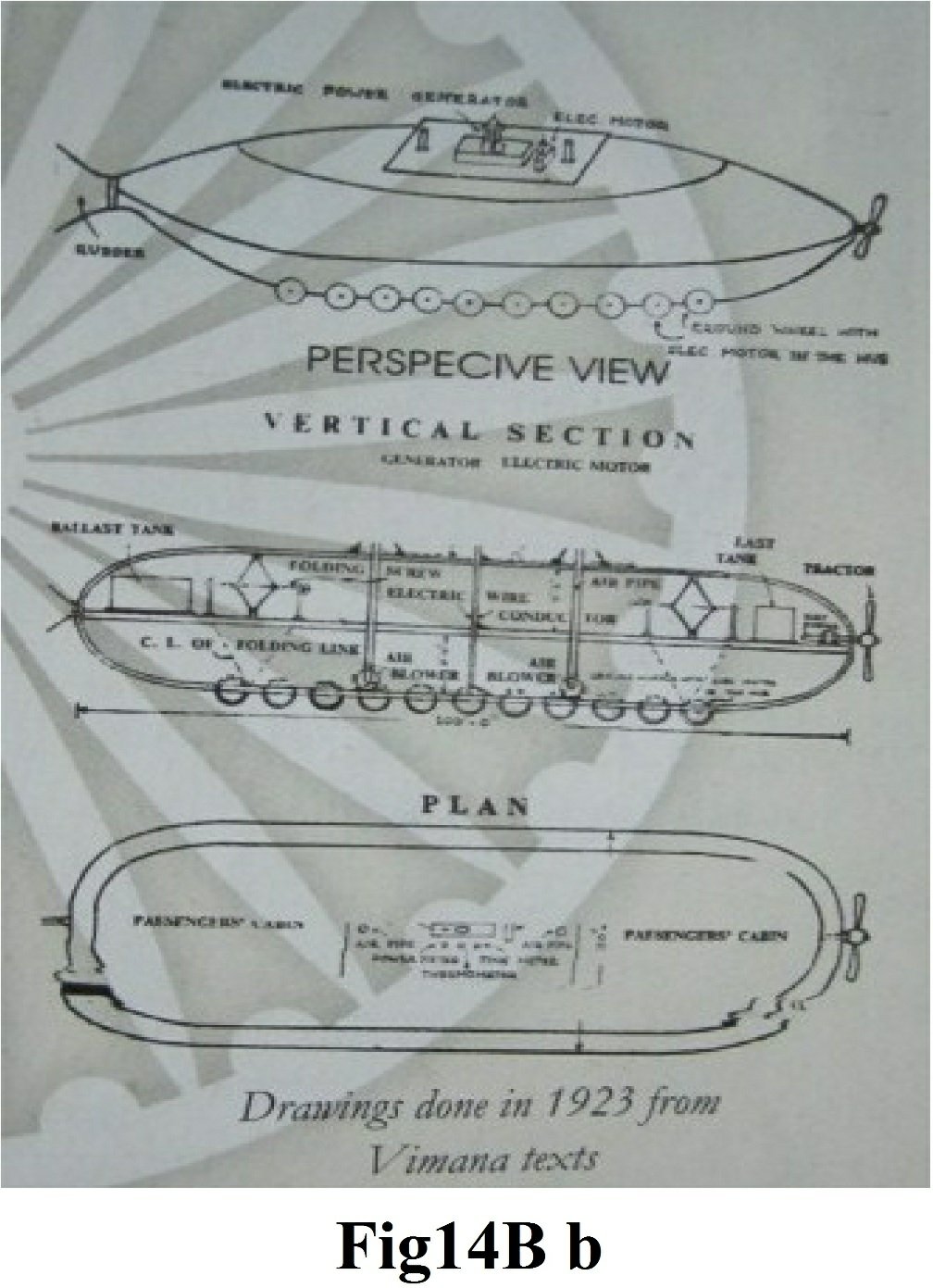
    Aircarft Drawing done in 1923 Based on Ancient Vimana Texts of India.jpg Aircraft Drawing done in 1923 Based on Ancient Vimana Texts of India.

    Rig Veda

    I have also written on the Aircraft designed and flown by Talpade in India, based on these ancient texts of Bharadwaja.

    Rotating Vimanas,

    Skyscrapers,

    Private Aircrafts

    Robots and space technology

    I have posted articles on these as well.

    here I present some texts and more references from the Rig Veda,Agastya Samhita.Artha Sastra and Kalidasa’s Vikramorvasiyaa.

     The Rig-Veda, the oldest document of the human race includes references to the following modes of transportation: Jalayan a vehicle designed to operate in air and water (Rig Veda 6.58.3).

    Kaara- Kaara- Kaara- a vehicle that operates on ground and in water.

    (Rig Veda 9.14.1)

    Tritala- Tritala- Tritala- a vehicle consisting of three stories.

    (Rig Veda 3.14.1);

    Trichakra Ratha, a three-wheeled vehicle designed to operate in the air.

    (Rig Veda 4.36.1)

    Vaayu Ratha, a gas or wind-powered chariot. 

    (Rig Veda 5.41.6)

    Vidyut Ratha a vehicle that operates on electromagnetic power.

    (Rig Veda 3.14.1).

                  The “Agastya Samhita” gives us Agastya’s descriptions of two types of aeroplanes. The first is a “chchatra” (umbrella or balloon) to be filled with hydrogen. The process of extracting hydrogen from water is described in elaborate detail and the use of electricity in achieving this is clearly stated. This was stated to be a primitive type of plane, useful only for escaping from a fort when the enemy had set fire to the jungle all around. Hence the name “Agniyana”. The second type of aircraft mentioned is somewhat on the lines of the parachute. It could be opened and shut by operating chords. This aircraft has been described as “vimanadvigunam” i.e. of a lower order than the regular aeroplane. Bhardwaja’s “Vaimanika Shastra” not only gives information on his methods of aeroplane construction but also provides a bibliography. He had consulted six treatises by six different authors previous to him. After him too there have been four commentaries on his work. Planes which will not break (abhedya), or catch fire (adaahya) and which cannot be cut (achchedya) have also been described. Along with the treatise there are diagrams of three types of aeroplanes , “Sundara”, “Shukana” and “Rukma”. It appears that aerial warfare was also not unknown, for the treatise gives the technique of “shatru vimana kampana kriya” and “shatru vimana nashana kriya” i.e. shaking and destroying enemy aircraft, as well as photographing enemy planes, rendering their occupants unconscious and making one’s own plane invisible.
     
             The Arthasastra of Kautilya (c. 3rd century B.C.) mentions amongst various tradesmen and technocrats the Saubhikas as ‘pilots conducting vehicles in the sky’. Saubha was the name of the aerial flying city of King Harishchandra and the form ‘Saubika’ means ‘one who flies or knows the art of flying an aerial city’. Kautilya uses another significant word ‘Akasa Yodhinah’, which has been translated as ‘persons who are trained to fight from the sky.’ The existence of aerial chariots, in whatever form it might be, was so well-known that it found a place among the royal edicts of the Emperor Asoka which were executed during his reign from 256 B.C. – 237 B. C. Only a few years ago, the Chinese discovered some Sanskrit documents in Lhasa, Tibet and sent them to the University of Chandrigarh to be translated. Dr. Ruth Reyna of the university said that the documents contain directions for building interstellar spaceships! The Chinese announced that they were including certain parts of the documents for study in their space program(* I had written on the ancient Sanskrit Texts found in Lhasa, Tibet)..’

    The Rig Veda, the oldest document of the human race includes references to the following modes of transportation:

    • Jalayan – a vehicle designed to operate in air and water. (Rig Veda 6.58.3)
    • Kaara- Kaara- Kaara- a vehicle that operates on ground and in water. (Rig Veda 9.14.1)
    • Tritala- Tritala- Tritala- a vehicle consisting of three stories. (Rig Veda 3.14.1)
    • Trichakra Ratha – Trichakra Ratha – Trichakra Ratha – a three-wheeled vehicle designed to operate in the air. (Rig Veda 4.36.1)
    • Vaayu Ratha- Vaayu Ratha- Vaayu Ratha- a gas or wind-powered chariot. (Rig Veda 5.41.6)
    • Vidyut Ratha- Vidyut Ratha- Vidyut Ratha- a vehicle that operates on power. (Rig Veda 3.14.1).

    Kathasaritsagara refers to highly talented woodworkers called Rajyadhara and Pranadhara. The former was so skilled in mechanical contrivances that he could make ocean crossing chariots. And the latter manufactured a flying chariot to carry a thousand passengers in the air. These chariots were stated to be as fast as thought itself. (source: India Through The Ages: History, Art Culture and Religion – By G. Kuppuram p. 532-533).


    According to Dr. Vyacheslav Zaitsev:

    “the holy Indian Sages, the Ramayana for one, tell of “Two storied celestial chariots with many windows” “They roar like off into the sky until they appear like comets.” The Mahabharata and various Sanskrit books describe at length these chariots, “powered by winged lighting…it was a ship that soared into the air, flying to both the solar and stellar regions.”
    (source: Temples and Spaceships – By V. Zaitsev – Sputnik, Jan. 1967 and Hinduism in the Space Age – By E. Vedavyas p. 31-32

    The mention of airplanes is found many times throughout Vedic literature, including the following verse from the Yajur-Veda describing the movement of such machines:

    “O royal skilled engineer, construct sea-boats, propelled on water by our experts, and airplanes, moving and flying upward, after the clouds that reside in the mid-region, that fly as the boats move on the sea, that fly high over and below the watery clouds. Be thou, thereby, prosperous in this world created by the Omnipresent God, and flier in both air and lightening. (Yajur Veda, 10.19)

    The Rig Veda, the oldest document of the human race includes references to the following modes of transportation:

    • Jalayan – a vehicle designed to operate in air and water. (Rig Veda 6.58.3)
    • Kaara- Kaara- Kaara- a vehicle that operates on ground and in water. (Rig Veda 9.14.1)
    • Tritala- Tritala- Tritala- a vehicle consisting of three stories. (Rig Veda 3.14.1)
    • Trichakra Ratha – Trichakra Ratha – Trichakra Ratha – a three-wheeled vehicle designed to operate in the air. (Rig Veda 4.36.1)
    • Vaayu Ratha- Vaayu Ratha- Vaayu Ratha- a gas or wind-powered chariot. (Rig Veda 5.41.6)
    • Vidyut Ratha- Vidyut Ratha- Vidyut Ratha- a vehicle that operates on power. (Rig Veda 3.14.1).

    Kathasaritsagara refers to highly talented woodworkers called Rajyadhara and Pranadhara. The former was so skilled in mechanical contrivances that he could make ocean crossing chariots. And the latter manufactured a flying chariot to carry a thousand passengers in the air. These chariots were stated to be as fast as thought itself. (source: India Through The Ages: History, Art Culture and Religion – By G. Kuppuram p. 532-533).


    According to Dr. Vyacheslav Zaitsev:

    “the holy Indian Sages, the Ramayana for one, tell of “Two storied celestial chariots with many windows” “They roar like off into the sky until they appear like comets.” The Mahabharata and various Sanskrit books describe at length these chariots, “powered by winged lighting…it was a ship that soared into the air, flying to both the solar and stellar regions.”
    (source: Temples and Spaceships – By V. Zaitsev – Sputnik, Jan. 1967 and Hinduism in the Space Age – By E. Vedavyas p. 31-32

    Vimanas  in Ramayana.

    It was capable of accommodating all the vanaras besides Rama, Sita and Lakshman.

                 Again in the Vikramaurvaisya, we are told that king Puraravas rode in an aerial car to rescue Urvasi in pursuit of the Danava who was carrying her away. Similarly in the Uttararamacarita in the flight between Lava and Candraketu (Act VI) a number of aerial cars are mentioned as bearing celestial spectators. There is a statement in the Harsacarita of Yavanas being acquainted with aerial machines. The Tamil work Jivakacintamani refers to Jivaka flying through the air. Kathasaritsagara refers to highly talented woodworkers called Rajyadhara and Pranadhara. The former was so skilled in mechanical contrivances that he could make ocean crossing chariots. And the latter manufactured a flying chariot to carry a thousand passengers in the air. These chariots were stated to be as fast as thought itself.

    The Arthasastra of Kautilya (c. 3rd century B.C.) mentions amongst various tradesmen and technocrats the Saubhikas as ‘ pilots conducting vehicles in the sky’. Saubha was the name of the aerial flying city of King Harishchandra and the form ‘Saubika’ means ‘one who flies or knows the art of flying an aerial city.’ Kautilya uses another significant word ‘Akasa Yodhinah’, which has been translated as ‘persons who are trained to fight from the sky.’ The existence of aerial chariots, in whatever form it might be, was so well-known that it found a place among the royal edicts of the Emperor Asoka which were executed during his reign from 256 B.C. – 237 B. C. The Vaimanika Shastra (Hindi edn) refers to about 97 works and authorities of yore of which at least 20 works deal with the mechanism of aerial Flying Machine, but none of these works is now traceable. The Yuktikalpataru of Bhoja includes a reference to aerial cars in verses 48-50 and a manuscript of the work belonging to the Calcutta Sanskrit College dated at 1870 A.D.

    We are thus in possession of some manuscript material and from the above it appears that there were Vimanas or aircrafts in ancient India and they followed the route over the western sea i.e. Arabian Sea – Africa – Atlantic ocean – Latin America/Mexico, this being the shortest route.

    Some ships also might have followed this route, but most of the cargo ships, however, had to follow the longer route over the Pacific ocean via Indonesia – Polynesia – Latin America/Mexico because of the favorable trade winds and the equatorial currents which made the navigation easier.

    And if the ancient Indians could perhaps boast of some form of air travel the Nazca lines of Peru acquire an added significance. Not only the scriptural references of aircrafts and the routes of navigation, even some base landing sites might have possibly been found in the tangled outlines and figures in the Pampas of Nazca. Maria Reiche, a German scientist, through her life-long dedication studied these seriously, preserved them from destruction and publicized them before the world. The huge figures which are visible from the sky might have helped the ancient pilots (Sauvikas) of India to land in Peru.

    (For more information please refer to Chapters on Pacific, Suvarnabhumi, War in Ancient India, Hindu Scriptures and Seafaring in Ancient India).


    The Nazca lines of Peru seem to be landing signal for the air chariots of pre-Colombian times. There are several references in Sanskrit texts about the Indian Vimanas carrying kings and dignitaries to pataldesa.Ramayana describes Ravana’s flight from Varunalaya (Borneo) to Rasatala (Peru).


    Prof. D. K. Kanjilal analyses the legend of the Matsya Purana (chapters 129) in his Vimana in Ancient India in the following words:

    “Behind the veil of legend and scientific truth comes out that three flying-cities were made for and were used by the demons. Of these three, one was in a stationary orbit in the sky, another moving in the sky and one was permanently stationed in the ground. These were docked like modern spaceships in the sky at particular time and at fixed latitude/longitudes. Siva’s arrow obviously referred to ablazing missile fired from a flying satellite specially built for the purpose and the brunt spaceship fell in the Indian ocean. Vestiges of onetime prosperous civilization destroyed in battles only flicker through these legends.


    These references sharply point to the use of some kind of aerial flying vehicles known as Vimana apart from mechanical contrivances, armored cars, various types of missiles etc. These references sounding queer and unscientific even in recent past have been approximated to the present-day technology through the innovation of highly sophisticated weapons and of the space-satellites likeMariner, Vostok, Soyuz, Aryabhatta etc. These facts require more than a passing notice.


    The flying vehicles were firstly designated Ratha (vehicle or carriage) in the Rig Veda. Vimanas possessed a very high speed. This aerial vehicle was triangular, large, 3-tier uneven and was piloted by at least three persons (tribandhura). It has three wheels which were probably withdrawn during aerial flight. In one verse the chariot is said to have three columns. It was generally made of anyone of the three kinds of metals, gold, silver or iron but the metal which usually went into its make up according to the Vedic text was gold. It looked beautiful. Long nails or rivets were attached to it. The chariot had three types of fuel. Possessing very fast speed, it moved like a bird in the sky soaring towards the Sun and the Moon and used to come down to the earth with great sound”.

    (source: The Indians And The Amerindians

    By Dr. S. Chakravarti p.141-146).

    In addition to the Vaimanika Shashtra, the Samarangana Sutradhara and the Yuktikalpataru of Bhoja, there are about 150 verses of the Rig Veda, Yajurveda and the Atharvaveda, a lot of literary passages belonging to the Ramayana, the Mahabharata, the Puranas, the Bhagavata and the Raghuvamsa and some references of the darma Abhijnanasakuntalam of Kalidasa, the Abimaraka of Bhasa, the Jatalas.

    The Avadhana Literature and of the Kathasaritsagara and a number of literary works contained either references to graphic aerial flight or to the mechanism of the aerial vehicles used in old ages in India. In the Ramayana both the words “Vimana” and “Ratha” have been used:

    • Kamagam ratham asthaya…nadanadipatim (3. 35. 6-7). He boarded the aerial vehicle with Khara which was decorated with jewels and the faces of demons and it moved with noise resembling the sonorous clouds.
    • You may go to your desired place after enticing Sita and I shall bring her to Lanka by air.. So Ravana and Maricha boarded the aerial vehicle resembling a palace (Vimana) from that hermitage.
    • Then the demons brought the Puspaka aerial vehicle and placed Sita on it by bringing her from the Ashoka forest and she was made to see the battle field with Trijata.
    • This aerial vehicle marked with Swan soared into the sky with loud noise.

    Reference to Flying vehicles as Vimana occur in the Mahabharata in about 41 places of which the air attack of Salva on Krisna‘s capital Dwaraka deserve special notice. The Asura king Salva had an aerial flying machine known as Saubha-pura in which he came to attack Dwaraka.


    He began to shower hails, and missiles from the sky. As Krishna chased him he went near the sea and landed in the high seas. Then he came back again with his flying machine and gave a tough fight to Krishna staying about one Krosa (about 4,000 ft) above the ground level. Krishna at last threw a powerful ground-to-air weapon which hit the plane in the middle and broke it into pieces. The damaged flying machine fell into the seas. This vivid description of the air attack occurs in the Bhagavata also. We also come across the following references to missiles, armaments, sophisticated war-machines and mechanical contrivances as well as to Vimanas in Mahabharata.

    The inscriptions of emperor Asoka are by far the most authentic records in support of the existence of aerial flying vehicles which are mentioned as Vimana. The existence of aerial chariots in whatever form it might be was so well-known that it found a place among the royal edicts of the Emperor Asoka which were executed during his reign from 256 B.C.- 237 B.C. Vatsyana in his Kama Sutra referred to mechanical contrivances in their origin among 64 ancillary Sciences.

    The Arthasastra of Kautilya (3rd century B.C), a treatise mainly dealing with political economy but containing information on kindred scientific topics refers to a class of mechanic known as Saubhika…

    8. Sundara Vimana: Vertical Section

    A discussion regarding the existence of and the use of flying vehicles in ancient India naturally waits for an advanced state of knowledge in cosmogony. A close and careful study of the Vedic literature shows that it was not just a collection of primeval poetry but a varied literature of a powerful and dynamic society where the people had the knowledge of cloud and vapor, of the season and of the monsoon, of the different types of wind, of the expanse of the sky, of the strength of the wind blowing at high speed and so on.

    Three types of cloud have been referred to in the Rig Veda (1.101.4). which also states that smoke and vapor surcharged with water turn into cloud. Formation of vapor through heat and the subsequent formation of cloud has been referred to in the Vedas. Indian meteorological concepts thus date back to the age of the Rig Veda.

    Citations.

    http://trusciencetrutechnolgy.blogspot.in/2013_07_01_archive.html

    http://www.bibliotecapleyades.net/vimanas/esp_vimanas_2a.htm