Tag: Adi Shankara

  • World An Illusion Objects Altered By Us Quantum Proves Hinduism 

    Indian philosophy states that Consciousness (Chit) is all pervasive in living beings as well as non living.

    That is the reason non living Beings are called as Achalam, that is Non moving and those without Consciousness  (which we normally  associate with Life by calling those with Life as possessing Consciousness)and non living beings as without Consciousness because we presume that they have no Life.
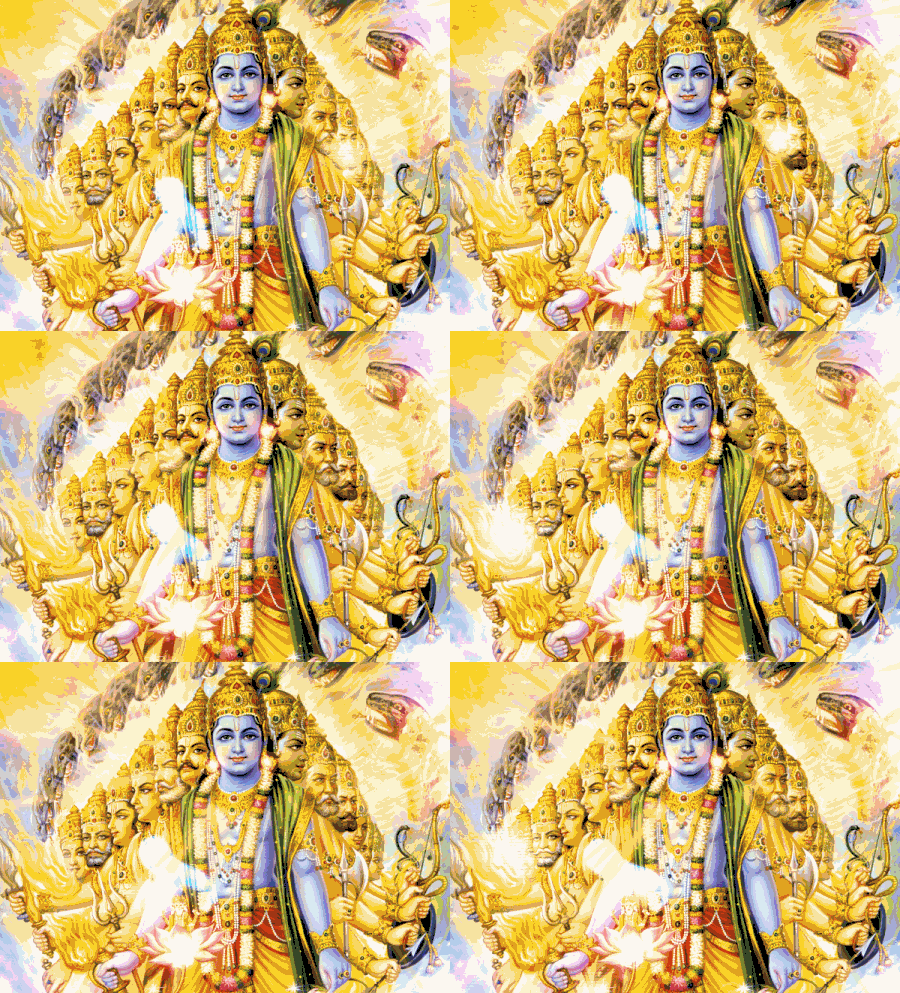
    (for that matter even today we do not have an aaccurate definition of Life and Death) 

    Living being  are called as  Chalam , MOVING, movement being associated with movement . 

    When we we perceive, we have three components.

    The Perceiver (S), the Perceived (O) the object of Perception. 

    These alone would not do to complete the Process of Perception. 

    We need both the Perceiver and the Perceived to B complete the process of Perception. 

    This connection is called R. 

    So Perception  Is Subject Object Relationship . 

    This is expresses thus. 

    S➡O➡R. 

    Consciousness Is that which enables understanding or Perception. 

    This is the modern concept  of Perception . 

    According to Indian philosophy  especially  Advaita, propounded by Adi SShankaracharya states   that the external world of things of Names and Forms are mental Projections and Illusory. 

    However these objects with Names and Forms have relative existence.

    They are Real as far as or so long  or in so far as they remain connected ,as the Perceiver perceives them and do not have Absolute Existence.

    This theory is called Maya Vaada . 

    However the Perceived objects continue to Exist even if they are not perceived by one. 

    If one moves away from perceiving an Object,  still the Object  continues to Exist because it is perceived by someone else.

    This, again is relative . 

    In Western philosophy this school of Thought is called Objective Idealism. 

    Indian sschool of Thought Mimamsa  states that an Atom has a unique quality, apart from its ability to combine with other Atoms apart from the one with which it is in cconnection. 

    This Quality is called Visesha.

    This quality is the ability of the Atoms to combine with any other Atom other the one with which it is ccurrently interacting. 

    That is an Atom can be present at many places at the same time. 

    And Advaita and other texts state that you alter or perceive what you disposed or inclined to Perceive. 

    ‘Yathaa Bhaavo Thathaa Drishti’ 

    In short, one perceives objects, not as they are (if they Are) but what one is disposed or inclined to perceive:

    An Atom can be present at multiple locations at the same time.,that is An Object Can be present at the same time in many places. 

    The Perceiver, Consciousness  changes what one perceives.

    This is confirmed  by Quantum Mechanics.

    ‘QM has questioned the material foundations of the world by showing that atoms and subatomic particles are not really solid objects—they do not exist with certainty at definite spatial locations and definite times. Most importantly, QM explicitly introduced the mind into its basic conceptual structure since it was found that particles being observed and the observer—the physicist and the method used for observation—are linked. According to one interpretation of QM, this phenomenon implies that the consciousness of the observer is vital to the existence of the physical events being observed, and that mental events can affect the physical world. The results of recent experiments support this interpretation. These results suggest that the physical world is no longer the primary or sole component of reality, and that it cannot be fully understood without making reference to the mind.”

    From the Manifesto For a Post-Materialist Science

    The Manifesto linked above also says:

    :Studies of the so-called “psi phenomena” indicate that we can sometimes receive meaningful information without the use of ordinary senses, and in ways that transcend the habitual space and time constraints. Furthermore, psi research demonstrates that we can mentally influence—at a distance—physical devices and living organisms (including other human beings). Psi research also shows that distant minds may behave in ways that are non-locally correlated, i.e. the correlations between distant minds are hypothesized to be unmediated (they are not linked to any known energetic signal), unmitigated (they do not degrade with increasing distance), and immediate (they appear to be simultaneous). These events are so common that they cannot be viewed as anomalous nor as exceptions to natural laws, but as indications of the need for a broader explanatory framework that cannot be predicated exclusively on materialism.”

    To summarize, over the years the back-and-forth criticism of protocols, refinement of methods, and successful replication of this type of remote viewing in independent laboratories (Bisaha & Dunne, 1979; Dunne & Bisaha, 1979; Jahn, 1982; and Jahn & Dunne, 1986), has yielded considerable scientific evidence for the reality of the phenomenon. Adding to the strength of these results was the discovery that a growing number of individuals could be found to demonstrate high-quality remote viewing, often to their own surprise, such as the talented Hella Hammid.

    e declassified literature.

    Declassified documents also show that that the CIA kept tabs on other country’s developments with regards to individuals who could work with or break the mind/matter barrier. This document, titled “Research into Paranormal Ability To Break Through Spatial Barriers” is one such example.

    It states, “A total of 50 experiments in the ability to break through of spatial obstacles were conducted. . . . Of the 50 experiments, 25 were successful, 17 were videotaped and high speed photography were used in 6,” and goes into more detail about these individuals.

    The point is, there are no shortage of individuals who are able to do this, as well as mainstream scientific examinations under strict protocols where mind has been shown to influence matter at all levels, not just the quantum level.

    This is precisely why the American Institutes for Research concluded:

    The statistical results of the studies examined are far beyond what is expected by chance. Arguments that these results could be due to methodological flaws in the experiments are soundly refuted. Effects of similar magnitude to those found in government-sponsored research at SRI and SAIC have been replicated at a number of laboratories across the world. Such consistency cannot be readily explained by claims of flaws or fraud.

    Even as far back as 1985, a report prepared by the Army Research Institute disclosed that “the data reviewed in this report constitute genuine scientific anomalies for which no one has an adequate explanation for.”

    Another “proof,” for lack of a better term, is the mind-body connection. The results in this area are just as strong as those in the “hard sciences.”

    In 1999, a statistics professor at UC Irvine published a paper showing that parapsychological experiments have produced much stronger results than those showing a daily dose of aspirin helps prevent a heart attack.

    The placebo effect is another great example. As reported in Scientific American:

    As neuroscientist Fabrizio Benedetti, one of the pioneers of placebo research, puts it, there isn’t just one placebo effect but many. Placebo painkillers can trigger the release of natural pain-relieving chemicals called endorphins. Patients with Parkinson’s disease respond to placebos with a flood of dopamine. Fake oxygen, given to someone at altitude, has been shown to cut levels of neurotransmitters called prostaglandins (which dilate blood vessels, among other things, and are responsible for many of the symptoms of altitude sickness).

    The effectiveness of placebo has been proven time and time again, such as this Baylor School of Medicine study, published in the New England Journal of Medicine in 2002. It looked at surgery for patients with severe and debilitating knee pain. Many surgeons know there is no placebo effect in surgery, or so most of them believe. The patients were divided into three groups. The surgeons shaved the damaged cartilage in the knee of one group. For the second group they flushed out the knee joint, removing all of the material believed to be causing inflammation. Both of these processes are the standard surgeries for people who have severely arthritic knees. The third group received a “fake” surgery; the patients were only sedated and tricked into believing they had had the knee surgery. Doctors simply made the incisions and splashed salt water on the knee as they would in normal surgery. They then sewed up the incisions like the real thing and the process was complete. All three then groups went through the same rehab process, with astonishing results: The placebo group improved just as much as the other two groups who had surgery.

    You can read more about the mind-body connection in this CE article:

    This Is How Powerful The Mind-Body Connection Really.

    http://www.collective-evolution.com/2017/09/20/the-astonishing-link-between-quantum-physics-the-human-mind/

  • I Perform Sata Rudreeyam Daily Lord Krishna in Mahabharata

    I Perform Sata Rudreeyam Daily Lord Krishna in Mahabharata

    Let me narrate a legend involving Adi Shankaracharya and Devi before proceeding to the topic.

    After Adi Shankaracharya was accepted as his disciple  by Gaudapada(who is considered to be an Avatar of Vyasa,who in turn is an Avtar of Vishnu),Shankaracharya wanted to write a commentary,Bhashyam.

    (*Adi Shankara’s Guru was Govinda Bhagavadpada and both Govinda Bhagavadpada and Shankara studied under Gaudapada.
    Hence Shankara calls him Parama Guru.)

    He wanted his first work to be on Devi.

    So he fixed Devi in his mind ,meditated and asked his disciple to get the manuscript from the repository.

    When It was  brought,it was found to be the manuscript of Vishnu Sahasranama.

    Shankaracharya was annoyed and asked the disciple to bring the manuscript on Devi.

    What was brought to him,not only for the second time but the third time as well was,

    Vishnusahasranama.

    Shankaracharya meditated on Devi and She told him,

    ‘Before beginning  your work on Me,complete thee work on my  elder Brother Vishnu first’

    Thus was born the Shankara Bhashya of Vishnu.

    It can be identified as Shankara Bhashya when the phrase ‘Om Namo Bhagavathe

    Vasudevaayav’Vishnu’s Mahamantra,The Dwadasa Nama, in the Dhyana sloka before

    ‘ Santhakaaram Bhujaka Sayanam,’and this can not be found in any other  work.

    Such is the unity of Hindu thought and we have Krishna Sthuthi by

    Shiva,Mantrarajapadam by Shiva on Narasimha and Siva Stuthi by Krishna.

    Now there is something more.

    e1386-clipboard01

    Lord Krishna says He performs Satha Rudreeya daily.

    Satha Rudreeyam is on Rudra,an aspect of Shiva as Destroyer.

    Lord Krishna on Satha Rudreeyam.

    ‘Krishna confesses that he recites the Sata-Rudriya every morning, and explains how it is the  best way to please Shiva (Anushasana Parva).
    “Vasudeva said, ‘I shall recite to thee the good that I have acquired and the fame that I
    have won through the Grace of That High-Souled One. Verily, I shall discourse to thee
    on the topic, after having bowed unto Kapardin.

    Oh king, listen to me as I recite to thee
    that Sata-Rudriya which I repeat; with restrained senses, every morning after rising
    from bed…O sire, It is Sankara who Created All the creatures in the Universe, mobile
    and immobile.

    There is no being that is higher, O monarch, than Mahadeva. Verily, He is
    the Highest of All beings in the three worlds…Formerly, when Sankara became angry, the
    deities trembled with fear and bent their heads to Him. Without being appeased, Rudra
    placed on His bow-string a sharp and blazing arrow. Beholding His Prowess, the deities
    and the Rishis became all alarmed. Those foremost of gods began to pacify Him! Joining
    their hands in reverence, they began to recite the Sata-Rudriya Mantras. At last,
    Maheswara, thus praised by the deities, became gratified.’”
    vAsudeva uvAcha||
    hanta te kathayiShyAmi namaskRRitvA kapardine |
    yadavAptaM mahArAja shreyo yachchArjitaM yashaH ||
    prayataH prAtarutthAya yadadhIye vishAM pate |
    prA~njaliH shatarudrIyaM tanme nigadataH shRRiNu ||

    sha~NkarastvasRRijattAta prajAH sthAvaraja~NgamAH ||
    nAsti ki~nchitparaM bhUtaM mahAdevAdvishAM pate |
    iha triShvapi lokeShu bhUtAnAM prabhavo hi saH ||

    tataH praNemurdevAste vepamAnAH sma sha~Nkaram |
    punashcha sa.ndadhe rudro dIptaM sunishitaM sharam ||
    rudrasya vikramaM dRRiShTvA bhItA devAH saharShibhiH |
    tataH prasAdayAmAsuH sharvaM te vibudhottamAH ||
    jepushcha shatarudrIyaM devAH kRRitvA~njaliM tataH |
    sa.nstUyamAnastridashaiH prasasAda maheshvaraH ||’

    Five Methods of Chanting Rudra

    There are five methods of chanting Rudra viz.,

    1. Ordinary method where first Rudram is read and then Chamakam.
    2. Rudra ekadasini where after chanting Rudram, the first anuvaka of Chamakam is chanted, again after chanting Rudram the second anuvaka of Chamakam is chanted and so on till the eleventh chanting of Rudram followed by eleventh anuvaka of Chamakam.
    3. Eleven such Rudra ekadasinis makes one Laghu Rudram
    4. Eleven such Laghu Rudrams makes one Maha Rudram and
    5. Eleven such Maha Rudrams make one Athi rudram.

    Source. P.R.Ramchander


  • Shankaracharya Misinterpret Vedas Misled, Shiva In Padma Purana?

    Shankaracharya Misinterpret Vedas Misled, Shiva In Padma Purana?

    Not for nothing Dr. Radhakrishnan, former President of India and a Philosopher said that ,

    ‘Indian Philosophy is not a view of Life, but a Way of Life’.

    It is one thing to read,study the Vedas and other Hindu Texts but it is another proposition to understand its soul and ethos.

    Mere Intellectual or Bhakthi approach would not help one to understand the spirit of Hinduism.

    Hinduism should be lived and practiced for years  to understand it in its multifarious aspects.

    Mere abstraction would remain just that, an intellectual Narcissism..

    Mere Bhakthi, or total surrender to God , though highly recommended, is likely to lead one into disappointment as this path is, though seems easy to say, is the toughest to practice.

    One must understand that Hinduism is a personal Religion in the sense that one can practice it the way it suits him, so long it is in conformity with the Vedas.

    As individuals are numerous, so are their mental attitudes.

    Hence Hinduism provides four paths to follow so that people of different mindsets can follow Spirituality.

    They are,

    Karma Yoga, Path of Action,

    Gnana Yoga, Path of Knowledge,

    Raja Yoga, Path of Mental and Physical Discipline and

    Bhakthi Yoga, the Path of total surrender.

    The fact that one is emphasized in the Vedas and other Hindu texts, when they speak of a particular path, does not mean that the other Paths are inferior.

    They are spoken this way so as to instill in the mind the conviction to follow the path that appeals to them and such sayings reinforces the attitude.

    The same logic applies to Nirguna Brahman,Reality without Attributes and Saguna Brahman,Reality with Attributes.

    (for details  please read my article God with names and forms Yes and No)

    This one can understand from the Vedas, Puranas, Ithihasas and the Slokas /Mantras.

    One would, in the same breath, the Vedas talk about Nirguna Brahman and Saguna Brahman.

    One would find the Reality being described as a principle, Nirguna, in the Mahavakyas thus,

    1. prajñānam brahma – “Prajña is Brahman” or “Brahman is Prajña”(Aitareya Upanishad 3.3 of the Rig Veda)
    2. ayam ātmā brahma – “This Self (Atman) is Brahman” (Mandukya Upanishad 1.2 of the Atharva Veda)
    3. tat tvam asi – “Thou art That” (Chandogya Upanishad 6.8.7 of the Sama Veda)
    4. aham brahmāsmi – “I am Brahman”, or “I am Divine” (Brhadaranyaka Upanishad 1.4.10 of the Yajur Veda)

    Then you find in the Narayana Suktha.

    Narayanam mahagyem Viswaathmaanam Parayanam,

    Vishnu Suktha,

    Vishnornukam veeryani pravosam..

    or the Sri Rudram,

    nama sivaya cha, Sivadharaaya Cha,

    where the Individual deities are  praised.

    or look a the Lalitha Sahasranama, where a portion is allotted for worshiping the Devi as Nirguna, the chapter being Nirguna Upasna and another Saguna Upasna where personal deity is worshiped.

    So both options are provided.

    Reading one and discarding the other is not compatible with the Vedas.

    Quoting Vedas in isolation lands one into situations and interpretations that run counter to Vedas themselves, as it has happened in the case of the Mimamsa.

    The Karma Kanda, the portion of the Vedas that deal with duties and performance of Yagas and Yagnyas, was carried to such an extreme that only the Karmas in the form of Yagnyas were followed and the Gnana and Bhakthi were totally omitted..

    And the performance of only Yagnas and sacrifices caused a revulsion among people and this one of the reasons for the raise of Buddhism.

    And many Gods were worshiped in the Yagnyas.

    It took all the Life of Shankaracharya to set matters right and establish the authority of the Vedas, by systematizing  worship into Shanmaha, Six systems of worship.

    And he reestablished the concept of Nirguna Upasna and also provided room for Saguna Upasna.

    Iswara concept found in Patanjali’s yoga Sutra was reinforced by him.

    Such being the case I was shocked to find an observation by Stephen Knapp who has done yeoman service to Hinduism by propagating Sanatana Dharma concept that Shankaracharya misinterpreted the Vedas!

    and

    he quotes Padma Purana and Siva Purana.

    We must point out that some spiritual authorities say that Shankaracharya was an incarnation of Lord Shiva who had been ordered by the Supreme Lord to cheat the atheists. The Shiva Purana quotes the Supreme Lord as ordering Shiva: “In Kali-yuga mislead the people in general by propounding imaginary meanings from the Vedas [Vedic literature] to bewilder them”:

    dvaparadau yuge bhutva

    kalaya manushadishu

    svagamaih kalpitais tvam ca

    janan mad-vimukhan kuru 1

    The Padma Purana also says that Lord Shiva would descend as a brahmana sannyasi and teach Mayavada philosophy in the verse:

    mayavada ashat shastram prachchanna

    boudhyam uchyate moya ebe godidam

    devi kalou brahmana murtina

    To do this, Shankara gave up the direct method of Vedic knowledge and presented an indirect meaning which actually covered the real goal of Vedanta. This is confirmed in the Padma Purana where Lord Shiva addresses his wife, Parvati:

    shrinu devi pravaksyami

    tamasani yathakramam

    yesham shravana-matrena

    patityam jnaninam api

    apartham shruti-vakyanam

    darshayal loka-garhitam

    karma-svarupa-tyajyatvam

    atra ca pratipadyate

    sarva-karma-paribhramsan

    naiskarmyam tatra cocyate

    paratma-jivayor aikyam

    mayatra pratipadyate

    “My dear wife, hear my explanations of how I have spread ignorance through Mayavada philosophy. Simply by hearing it even an advanced scholar will fall down. In this philosophy which is certainly very inauspicious for people in general, I have misrepresented the real meaning of the Vedas and recommended that one give up all activities in order to achieve freedom from karma. In this Mayavada philosophy I have described the jivatma and Paramatma to be one and the same.” 2

    The Padma Purana, in the quote that follows, describes how Lord Shiva tells his wife, Parvati, that he would appear in Kali-yuga to teach the impersonalistic philosophy, which is impious and merely a covered form of Buddhism. Yet, as explained next, there was a purpose for it.

    mayavadam asac-chastram

    pracchannam bauddham ucyate

    mayaiva kalpitam devi

    kalau brahmana rupini

    brahmanas caparam rupam

    nirgunam vaksyate maya

    sarvasvam jagato’py asya

    mohanartham kalau yuge

    vedante tu maha-shastre

    mayavadam avaidikam

    mayaiva vaksyate devi

    jagatam nasha-karanat

    “The Mayavada philosophy is impious. It is covered Buddhism. My dear Parvati, in the form of a brahmana in Kali-yuga I teach this imagined Mayavada philosophy. In order to cheat the atheists I mislead them by describing the Supreme Lord to be without any personal form or qualities.”

    Herein, Lord Shiva himself points out that to believe God has no form is not accurate and is equal to atheism. Even though this Mayavada philosophy was not good for pious people to hear because it would sway them toward an impersonalistic viewpoint, we should note that Shankara’s philosophy was just right for the time and circumstance. The Buddhists, who had spread throughout India and neglected the Vedas, believed in neither a soul nor a God and that, ultimately, the essence of everything is the nothingness or void wherein lies nirvana, freedom from all suffering. So considering how the Buddhists had followed a philosophy of what would generally be considered atheism for hundreds of years and would never have accepted a viewpoint which advocated a supreme personal God, Shankara’s was the only philosophy they would have considered. It was like a compromise between atheism and theism, but Shankara used portions of Vedic knowledge as the basis of his arguments. In this way, as Shankara traveled throughout India his arguments prevailed. Thus, Buddhism bowed and Vedic culture was brought back to prominence. Therefore, his purpose was accomplished, so much so that his Sariraka-bhasya is considered the definitive rendition of Vedanta even to the present day.’

    Totally wrong interpretation.

    If Bhaja Govindam is quoted to buttress the view that Shankaracharya was really only after

    Bhakthi to Vishnu, what about his nirvana Shatgam ,Manisha Panchakam, Soundarya Lahari,Kanakadhara Sthavam,Subrahmanya Bhujanga,Ganesha Pancharatnam?

    Shankaracharya should be studie in full an no in bits.

    And if proof is needed that there are interpolations in the Puranas, Padma Purana and Shiva Purana, this is it.

    This accusation against Shankaracharya is not new.

    He was also called a Pseudo-Buddhist for His Advaita!

    If Shankaracharya was misquoting the Vedas, then how come the Mahavakyas I have quoted above speak of Nirguna Brahmana and not Saguna Brahman, Reality without Attributes?

    ‘AUM
    That supreme Brahman is infinite, and this conditioned Brahman is infinite.
    The infinite proceeds from infinite.
    Then through knowledge, realizing the infinitude of the infinite, it remains as infinite alone-

    Mundaka Upanishad.

    Great indeed are the devas who have sprung out of Brahman.-Atarva Veda.

    ‘satyam jnanam anantam brahman
    “Brahman is of the nature of truth, knowledge and infinity” -Taittriya Upanishad.

    Reference and citation.

    http://www.stephen-knapp.com/complete_review_of_vedic_literature.htm

    Images credit.

    https://ribhuv.wordpress.com/tag/shankaracharya/

  • Gotra Pravara Adi Shankaracharya Krishna Yajur Vedin

    There is a dispute about the date of Adi Shankaracharya.

    There are quite a lot of theories on this.

    Shankaracharya and Kamakshi Amman
    Kamakashi Amman,Shankaracharya

    Some date the Acharya between 688-720 AD, there are also theories that date him around 400 to 500 BC.


    Shankaracharya‘ Guru Govinda Bhagavadpada, one study claims lived during the period of Vikramaditya as there are two Vikramadityas,one of the

    Maurya and another of the Chalukya dynasty.


    The first one lived around 4th Century CE, while the latter in (Vikramaditya II )(733–746 CE)


    2.The internal evidence of Shankaracharya’s works do not provide many a clue,exception being the one about Thirugnana Sambhandar, who, it is

    agreed, is addressed by Shankaracharya as ‘Dravida Sisu’ in his Soundayalahari.


    His references to Kumarila Bhatta and Mandana Misra are equally confusing to pin point the date.


    Kumarilabhatta is dated approximately at  roughly AD 700.


    Mandana Misra at 800 AD;he was a student of Mandana Misra.


    Thirugnana Sambhandar who is referred by Shankaracharya is dated  7th Century AD

    Date of Shankaracharya

    I received a comment that whether Shankaracharya’s gotra  is Namboodiri and whether his gotra belongs to Viswakarma .

    I replied that Namboodiri is a sect of Brahmins and they have Gotras and though I have written on Namboodiris, I shall write on their Gotras.

    Definitely Shankara did no not belong to Viswakarma as some scholars suggest.

    Now to Shankaracharya’s Gotra.

    Shankracharya is from the Namboodiri community.

    Shankaracharya is from Atri Gotra.

    ‘Acharya’s grandfather is known to be Vidhyadhiraja and his father is Shivaguru. His mother’s name, though accepted as Aryamba by most biographers, is also quoted as Vishishta Devi and Sati Devi. Madhaviya Shankara Vijaya describes the auspicious Muhurta of Acharya’s birth as `lagne shubhe shubhayute suShuve kumAraM’. There is no mention of Samvatsara and other details. As per the tradition of Sringeri Sarada Peetha, it is accepted as Vaishakha Suddha Panchami.

    Acharya’s Gotra was Atri and he was a Krishna Yajurvedi. He is known to be a Nambudari Brahmana by birth.

    Adi Shankaracharya’s Pravar.

    Atri a a.k.a. AatrEya:  AatrEya, Archanaanasa, Syaavaasva.

    References.

    1. Shankara Digvijaya of Madhavacharya

    2. Shankara Vijaya of Anandagiri.

    3. Shankara Vijaya of Chidvilasa Yati.

    4. Shankara Vijaya of Vyasachala

    5. Shankara Vijayasara by Sadananda Vyasa

    6. Acharya Charita by Govindananda Yati

    7. Shankarabhyudaya by Rajachudamani Dikshitar

    8. Brihat Shankara Vijaya by Brahmananda

    9. Keraliya Shankara Vijaya by Govindanatha

    10. Bhagavatpadabhyudaya by Lakshmana Suri.

    http://www.salagram.net/Gotras.html

    http://www.kamakotimandali.com/advaita/truefacts.html


  • Shankar Mutts By Shankaracharya Four Vedas

    Shankar Mutts By Shankaracharya Four Vedas

    Those who know a little of Sanskrit and Hinduism would know what an Intellectual Giant Adi Shankaracharya was.

    But not many know the logic that has gone behind his establishing the four Mutts.

    He chose four directions to found the Mutts.

    Shishya
    (lineage)
    Direction Maṭha Mahāvākya Veda Sampradaya
    Padmapāda East Govardhana Pīṭhaṃ Prajñānam brahma (Consciousness is Brahman) Rig Veda Bhogavala
    Sureśvara South Sringeri Śārada Pīṭhaṃ Aham brahmāsmi (I am Brahman) Yajur Veda Bhūrivala
    Hastāmalakācārya West Dvāraka Pīṭhaṃ Tattvamasi (That thou art) Sama Veda Kitavala
    Toṭakācārya North Jyotirmaṭha Pīṭhaṃ Ayamātmā brahma (This Atman is Brahman) Atharva Veda Nandavala

    All the Four Vedas are represented

    Padmapadacharya (fl. 8th century CE) was an Indian philosopher, a follower of Adi Shankara.

    Padmapāda’s dates are unknown, but modern scholarship places his life around the middle of the 8th century; similarly information about him comes mainly from hagiographies. What is known for certain is that he was a direct disciple of Shankara, of whom he was a younger contemporary. Padmapada was the first head of Puri Govardhana matha. He is believed to have founded a math by name Thekke Matham in Thrissur, Kerala. Keralites believe that he was a Nambuthiri belonging to Vemannillom, though according to textual sources he was from the Chola region in South India.

    Sureśvara (also known as Sureśvarācārya, c. 750 CE) was an Indian philosopher, who studied under Śankara. Śankara is said to have entrusted to Sureśvara his first monastic institution, the Sringeri Sharada Peetham. Suresvara is believed to have founded the famous Naduvil Matham in Thrissur…

    Little is known for sure about Sureśvara’s life. According to a strong tradition within Advaita Vedānta, before he became a disciple of Śankara, Sureśvara was known as Maņdana Miśra, a Mīmāmsāka. After being defeated in debate by Śankara, Miśra renounced his life as a householder, and became a sannyāsin. Whether this Maņdana Miśra was the same as the author of Brahmasiddhi is questioned by modern scholars, on the basis of textual analysis.

    Hastamalakacharya (IAST Hastāmalakācārya) (c. 8th century CE) was a disciple of Adi Shankara, the Advaita philosopher. He was made the first Jagadguru (head) of the Dvāraka Pīṭhaṃ, the monastery founded by Adi Shankara in Dwaraka. Hastamalaka founded a matha by name Idayil Matham in Thrissur, Kerala.

    The Mādhavīya Śaṃkaravijayam states that when Adi Shankara was at Kollur, he accepted invitations by brāhmaņas to have Bhikşa (alms or food) at their houses. On such an occasion he visited a village called Śrī Bali (present day Shivalli), where every house was said to emit the holy smell of the smoke of Agnihotra sacrifice, to accept Bhikşa. That place was inhabited by about two thousand brāhmaņas who were learned in the Vedas and performed the Yajnas prescribed in the Vedas. There was also a temple dedicated to Shiva and Parvati.

    In that village there lived a brāhmaņa, Prabhākara, who was noted for his learning. He had a son who though appearing quite handsome, behaved rather like an idiot. Though upanayanam was performed for him, he did not take to studying the Vedas, instead preferred to sit around doing nothing. Hearing about Adi Shankara’s visit, Prabhākara approached the Acharya (teacher) with a load of fruit and prostrated before him. He also made his son prostrate before him. Prabhākara explained to Adi Shankara that his son behaved rather like an idiot and sat idly throughout the day.

    Then, Adi Shankara addressed that young boy and asked him who he was. The boy replied in 12 verses containing the gist of theAdvaita philosophy.Thus Adi Shankara was immensely impressed with him and accepted him as his disciple. He was named Hastāmalaka (one with the amalaka fruit in his hand) since the knowledge of the Self was natural to him like an Amalaka fruit in one’s hand. Adi Shankara took the boy into his party and started towards his next destination..

    Totakacharya (IAST Toṭakācārya) (c. 8th century CE) was a disciple of Ādi Śaṅkara, the Advaita philosopher. He was made the first Jagadguru (head) of the Jyotirmaṭha Pīthaṃ, the northern maṭha founded by Ādi Śaṅkara near Badrinath. He founded a maṭha by name Vadakke Matham in Thrissur, Kerala…

    he Mādhavīya Śaṅkaravijayam states that when Ādi Śaṅkara was at Śṛṅgeri, he met a boy named Giri. Ādi Śaṅkara accepted the boy as his disciple. Giri was a hard-working and loyal servant of his Guru, Ādi Śaṅkara, though he did not appear bright to the other disciples. One day, Giri was washing his Guru’s clothes, when Ādi Śaṅkara sat down to begin a lesson on Advaita Vedānta. He however did not start the lesson saying he was waiting for Giri to come back from his chores and singing lessons. At this, Padmapada pointed to a wall and said that it would be the same if Ādi Śaṅkara taught to this dumb object as he taught to Giri. Now, Ādi Śaṅkara wanted to reward Giri for his loyalty and devotion. Thus he mentally granted Giri the complete knowledge of all the śāstras (sciences). The enlightened Giri composed extempore the Toṭākāṣṭakam, a Sanskrit poem in the toṭaka metre, in praise of the Guru Ādi Śaṅkara. Thus the dumb disciple Giri became Toṭākācārya.

    Look at the way Shankaracharya appointed Pontiffs, from deep south to west and from North to South.

    And three of these Mutts  fall into a pattern of being in the same latitude.

    Geographically speaking the char Dham make a perfect square with Badrinath and Rameswaram falling on the same longitude and Dwarka (old) and Puri on the same latitude, representing the farthest north, east, west, and south points of India (at that time, before coastlines changed)

    Badrinath, coordinates. Longitude.

    79.49481879999996

    Rameshwaram Longitiude.

    79.31292910000002

    Dwaraka latitude.

    22.2441975

    Puri Latitude.

    19.8133822

    * Present alignment.

    Citations.

    https://en.wikipedia.org/wiki/Char_Dham

    http://www.distancesfrom.in/odisha/puri-latitude-longitude/46.html