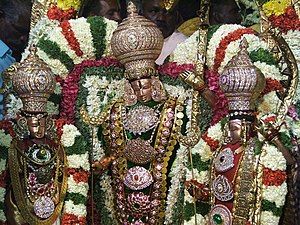
This article is the fifth in the series of articles about the temples of Sri Rama ,which are older than Ayodhya Ram temple.
There are scores of Rama Temples in India, especially in South India,which are quite ancient and the time scale of these temples go beyond our known scale of Time. I am writing about such temples,which can be dated in our limited understanding of Time.For instance many temples, like Sri Rangam temple,Tamil Nadu is recorded in literature as older than Rama Avatar. There are I such temples. I am furnishing a list of Three temples which were in existence before 4025 BC. ( Citation. Sakkottai Krishnaswami Aiyangar (1911). Ancient India: Collected Essays on the Literary and Political History of Southern India. pp. 403–404. )This date is the birth date of Poigai Azhwar,a great Saint of Si Vaishnava system of Bhakti.I have selected these temples because the Murthis in these temples are praised by Poigai Azhwar in his work,which forms a part of Nalayira Divya Prabhandham,collection of Hymns addressed to Sri Vishnu.I have selected these temples because they have a Sanctum of Sri Rama.As the date of birth of Poigai Azhwar is 4025 BC,these temples should have existed before 4025 BC.
The Temples are,
Srirangam Renganatha Temple.Though the Presiding Deity is Sri Vishnu as Ranganatha,Sri Rama has a separate Sanctum.
Tirupati Balaji temple
Ulakalandha Perumal temple, Thirukkoilur.Sri Rama has a Sanctum here.
Ulakalandha Perumal temple ,Thirukkoilur.
Thirupathi Balaji temple.
Tirumala Rama idol is one of the deities in the Tirumala Venkateswara Temple, Andhra Pradesh. While the temple is dedicated to worship of lord Vishnu as Venkateswara, it contains the idols of some of Vishnu’s other avatars: Rama and Krishna. The idol is usually accompanied by his consort Sita and his brother Lakshmana. Tirupati Rama
Fifth Temple of Sri Rama,whichb is older than Ayodhya Ram temple,is Sri Parthasarathi Temple ,Thiruvaklikkeni( Triplicane) Chennai. Though the temple is dedicated to Sri Krishna as Parthasarathi,One who drove the chariot for Arjuna,Sri Rama has a separate sanctum.The temple was built( temple work was. Carried out,) by Narasimha Varma Pallava in Eighth Century AD.One unique feature about Krishna,who is the Presiding Deity,is that he is seen with a moustache.
It was originally built by the Pallavas in the 8th century by king Narasimhavarman I. The temple has icons of five forms of Vishnu: Narasimha, Rama, Gajendra Varadaraja, Ranganatha and Krishna. The temple is one of the oldest structures in Chennai
Though works in the temple was carried out in Seventh century AD,the temple is referred to by Peyazhwar,Boothaththazhwar,and Thirumazhisai Azhwar.
The First three Azhwars are Peyazhwar Poigai Azhwar and Boothaththazhwar.They have sung in praise of the temple and it can be found in Nalayira Divya Prabhadam,the sacred Collection of Hymns addressed to Sri Vishnu..Poigai Azhwar was a contemporary of Peyazhwar.( The first three Azhwars were contemporaries)
Poigai Azhwar is dated at 4205 BC. The Thiruvaklikkeni temple about which Peyazhwar sung, should therefore be older than Fifth Century BC.
‘The Parthasarathy Temple is an 8th-century Hindu Vaishnavite temple dedicated to the Lord Vishnu, located at Thiruvallikeni, Chennai, India. The temple is glorified in the Divya Prabandha, the early medieval Tamil literature canon of the Alvar saints from the 6th–9th centuries CE and is classified as among the 108 Divya Desams dedicated to Vishnu. The name ‘Parthasarathy’, in Tamil, means the ‘charioteer of Arjuna’, referring to Krishna’s role as a charioteer to Arjuna in the epic Mahabaratha.
The temple was originally built by the Pallavas in the 8th century, subsequently expanded by Cholas and later by the Vijayanagara kings in the 15th century. The temple has several inscriptions dating from the 8th century in Tamil and Telugu presumably from the period of Dantivarman, who was a Vishnu devotee. Thirumangai Alvar, the 9th century also attributes the building of temple to the Pallava king. From the internal references of the temple, it appears that the templNandivarmane was restored during 1564 CE when new shrines were built. In later years, endowments of villages and gardens have enriched the temple. The temple also has inscriptions about the Pallava king, of the 8th Century.
The temple was extensively built during the Chola period and a lot of inscriptions dating back to the same period are found here. The outer most mandapam is replete with sculptures of various forms of Vishnu, especially the avatars. One can also see inscriptions of Dantivarma Pallava of the 8th century, Chola and Vijayanagara in the temple. The first architectural expansion of the temple took place during the reign of the Pallavas (Tondaiyar Kon) as vividly described by Tirumangai Azhwar. Reminiscent of this is the inscription of the Pallava King Dantivarman (796-847 A.D.), which is preserved in the temple. Reference and citation. Parthasarathi Perumal temple Triplicane Chennai
‘பார்த்தசாரதி கோயில் (பெருமாள் கோயில்) 8ஆம் நூற்றாண்டின் இந்து வைஷ்ணவக் கோயில்களில் ஒன்றாகும். வைணவர்களின் 108 திவ்விய தேசங்களில் ஒன்றான, கோயில் கோபுரங்களும் மண்டபங்களும், நுட்பமான சிற்பக் கலைகளும் நிறைந்த இக்கோவில் சென்னையில் உள்ள திருவல்லிக்கேணியில் உள்ளது. இத்தலத்து எம்பெருமான் மகாபாரதப் போரின்போது பார்த்தனுக்கு (அர்ஜுனன்) தேரோட்டிய (சாரதி) வடிவில் காட்சி அளிக்கிறார். இத்தலத்து மூலவரின் பெயர் வேங்கட கிருஷ்ணர் என்ற போதிலும் உற்சவராகிய பார்த்தசாரதியின் பெயரிலே புகழப்பெற்றுள்ளது.
This is the fourth article in the series about Sri Rama’s Temples,which are older than Ram temple in Ayodhya,India. Madhurantakam Tamilnadu,Erikatha Rama temple is from 7th century AD;Kodandarama temple at Gandharvakkottai is from 9 Century AD; Rama’s Chapel in Ur, Iraq is dated at 3800 BC.
The temple of Rama at Rajim, Chattisgarh ,Rajiv Lochan Temple belongs to 7th Century AD as evidenced in the temple inscriptions.
‘The Rajiv Lochan Vishnu Mandir is an ancientVishnutemple located at Rajim. A 7th century CE inscription recording the construction of the temple, and dated to the reign of the king Vilasatunga, has been found here. Vilasatunga probably belonged to a branch of theNala dynasty.
This article is the third relating to Temples of Rama,which are earlier to Ayodhya Ram temple,India.In the earlier articles,I had explained about two temples of Rama in Tamil Nadu, built by Aditya Chola and Parantaka Chola.The former temple is 1200 years old and the latter is 1300 years old.
Rama Temple, Madhurantakam, Tamilnadu
Though there are more ancient temples of Rama in India,than Ram temple at Ayodhya, India, I am listing temples that have the most compelling evidence of Rams Temple,where Ram is the Presiding Deity. There are many temples where Sri Rama Shrine is found as a part of Main temple where the main Deity is not Rama.I shall list them later. I am providing information on the Temples of Ram where Sri Rama is the main deity and for which Archeological evidence exists.Other temples of Sri Rama, though ancient,may not have as much evidence as sicularists want,for they go beyond the concepts of our definition of Time Scale,though they have compelling evidence in the form of literature,religious texts and Epigraphs.i shall list them later.
Now the oldest Ram Temple is found ,of all places, in Iraq!
Read on.
‘
Lord Rama seems to have been popular in Mesopotamia anda Chapel of Lord Rama was found by archeologists.
‘Ur (Sumerian: Urim;[1] Sumerian Cuneiform: 𒋀𒀕𒆠 URIM2KI or 𒋀𒀊𒆠 URIM5KI;[2] Akkadian: Uru;[3] Arabic: أور) was an importantSumerian city-state in ancient Mesopotamia, at the site of modern Tell el-Muqayyar (Arabic: تل المقير) in south Iraq’s Dhi Qar Governorate.[4] Although Ur was once a coastal city near the mouth of the Euphrates on the Persian Gulf, the coastline has shifted and the city is now well inland, south of the Euphrates on its right bank, 16 kilometres (9.9 mi) from Nasiriyah.[5]
Remains of UR,Iraq.
….
One of the major triumphs of modern archaeology was the hair-raising discoveries of Sir Leonard Woolley at Ur. Amidst the ruins of Ur, he unearthed a Ram-chapel but totally missed its relevance in world history. This crucial finding not only bridges the wide gaps between Indian tradition and archaeology but also unfolds the historic bonds that once united ancient India, Iran and Sumer. Ram-Sin of (Larsa) to whose memory this chapel was dedicated must have been Rama of Valmiki. The name Ararama of Larsa may be an echo of Rama. This Ram-Chapel of Ur is the earliest known memorial to the great Rama and may have been erected by Dilmun merchants who resided nearby. Dilmun was always mentioned in the Sumerian texts together with Magan and Melukkha and it is possible that these three states were somehow allied to each other.’
‘ In the highly authentic Sumerian king list appears such hallowed names as Bharat (Warad) Sin and Ram Sin. As Sin was the Moon god Chandra Ram Sin can be seen to be same as Rama Chandra. Bharat Sin ruled for 12 years (1834-1822 BC), exactly as stated in the Dasaratha Jataka. The Jataka statement, “Years sixty times hundred, and ten thousand more, all told, / Reigned strong-armed Rama”, only means that Rama reigned for sixty years which agrees exactly with the data of Assyriologists. Ram Sin was the longest reigning monarch of Mesopotamia who ruled for 60 years. The mention of the father in the inscriptions of both Warad Sin and Ram Sin is noteworthy and may point to a palace intrigue. Joan Oates is not aware of the Ramayana but writes with great insight (p. 61) that Warad sin was manoeuvred to the throne by his father. In Mesopotamia, a prince normally became king only after the death of his father. Lakshmana, mentioned the Bible as Lakhamar, ruled as a great king.
Ur,Iraq.
“Ur was a city in the region of Sumer, southern Mesopotamia, in what is modern-day Iraq. According to biblical tradition, the city is named after the man who founded the first settlement there, Ur, though this has been disputed. The city’s other biblical link is to the patriarch Abraham who left Ur to settle in the land of Canaan. This claim has also been contested by scholars who believe that Abraham’s home was further north in Mesopotamia in a place called Ura, near the city of Harran, and that the writers of the biblical narrative in the Book of Genesis confused the two. Whatever its biblical connections may have been, Ur was a significant port city on the Persian Gulf which began, most likely, as a small village in the Ubaid Period of Mesopotamian history (5000-4100 BCE) and was an established city by 3800 BCE continually inhabited until 450 BCE.” https://ramanisblog.in/2015/01/25/lord-ramas-chapel-in-ur-iraq/
‘The site became famous in 1922 CE when Sir Leonard Wooley excavated the ruins and discovered what he called The Great Death Pit (an elaborate grave complex), the Royal Tombs, and, more significantly to him, claimed to have found evidence of the Great Flood described in the Book of Genesis (this claim was later discredited but continues to find supporters). In its time, Ur was a city of enormous size, scope, and opulence which drew its vast wealth from its position on the Persian Gulf and the trade this allowed with countries as far away as India. The present site of the ruins of Ur are much further inland than they were at the time when the city flourished owing to silting of the Tigris and Euphrates rivers. …..Whatever its biblical connections may have been, Ur was a significant port city on the Persian Gulf which began, most likely, as a small village in the Ubaid Period of Mesopotamian history (5000-4100 BCE) and was an established city by 3800 BCE continually inhabited until 450 BCE. Ur’s biblical associations have made it famous in the modern-day but it was a significant urban center long before the biblical narratives were written and highly respected in its time. .
You must be logged in to post a comment.