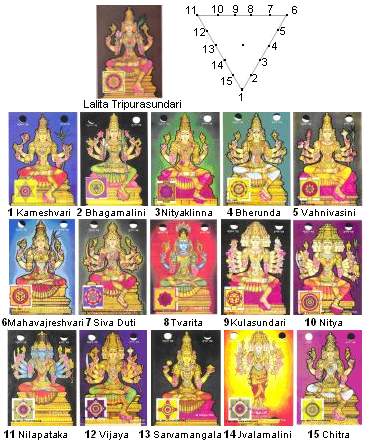
. क्रोधाकाराङ्कुशोज्ज्वला - She who shines, bearing the goad of anger १०. मनोरूपेक्षुकोदण्डा - She who holds in Her hand a sugarcane bow that represents the mind ११. पञ्चतन्मात्रसायका - She who holds the five subtle elements as arrows. https://sanskritdocuments.org/doc_devii/lalita1000.html
Krodhakarankusojwala She who glitters and has anger in the form of Anghusa –in one of her right hands.10 Mano Rupeshu Kodanda She who has the bow of sweet cane which is her mind-in one of her left hands11 Pancha than mathra sayaka She who has five bows of touch, smell, hearing, taste and sight12 Nijaruna prabha poora majjath brahmanda mandala She who makes all the universe immerse in her red colour which is like the sun in the dawn. https://www.hindupedia.com/en/Lalitha_Sahasranamam
1. ॐ शक्तिऋषये नमः शिरसि। – by uttering this mantra, touch head. 2. ॐ गायत्रीछन्दसे नमो मुखे। – by uttering this mantra, touch face. 3. ॐ श्रीभुवनेश्वरी देवतायै नमो हृदि। – by uttering this mantra, touch heart. 4. ॐ हं बीजाय नमो गुह्ये। – by uttering this mantra, touch lingam. 5. ॐ ईं शक्तये नमः पादयोः। – by uttering this mantra, touch feet. 6. ॐ रं कीलकाय नमो नाभौ। – by uttering this mantra, touch navel. 7. ॐ विनियोगाय नमः सर्वाङ्गे। – by uttering this mantra, touch entire body. — इति ऋष्यादिन्यासः।
Kara Nyāsa (करन्यास) for Sri Bhuvaneshvari Tantra:
1. ॐ ह्रां अङ्गुष्ठाभ्यां नमः । – by uttering this mantra, touch thumb from bottom to top by index finger tip (both hands simultaneously). 2. ॐ ह्रीं तर्जनीभ्यां नमः। – by uttering this mantra, touch index finger from bottom to top by thumb tip (both hands simultaneously). 3. ॐ ह्रूँ मध्यमाभ्यां नमः । – by uttering this mantra, touch middle finger from bottom to top by thumb tip (both hands simultaneously). 4. ॐ ह्रैं अनामिकाभ्यां नमः । – by uttering this mantra, touch ring finger from bottom to top by thumb tip (both hands simultaneously). 5. ॐ ह्रौं कनिष्ठिकाभ्यां नमः । – by uttering this mantra, touch little finger from bottom to top by thumb tip (both hands simultaneously). 6. ॐ ह्रः करतलकरपृष्ठाभ्यां नमः । – by uttering this mantra, touch top and bottom of both hands. — इति करन्यासः।
Hridiyādhi-Shadanga Nyāsa (हृदयादिषडङ्गन्यास)for Sri Bhuvaneshvari Tantra:
1. ॐ ह्रां हृदयाय नमः । – by uttering this mantra, touch heart with right hand ring, middle and index fingers together. 2. ॐ ह्रीं शिरसे स्वाहा। – by uttering this mantra, touch head with right hand ring and middle fingers together. 3. ॐ ह्रूँ शिखायै वषट् । – by uttering this mantra, touch hair with right hand thumb. 4. ॐ ह्रैं कवचाय हुं । – by uttering this mantra, touch left-shoulder with right-hand five fingers together and at the same time touch right-shoulder with left-hand five fingers together. 5. ॐ ह्रौं नेत्रत्रयाय वौषट् । – by uttering this mantra, touch both eyes and middle of eyebrow (Ājñā chakra/आज्ञा चक्र) with right-hand three fingers viz., ring finger (left-eye), middle finger (Ājñā chakra) and index finger (right-eye) simultaneously. 6. ॐ ह्रः अस्त्राय फट् । – by uttering this mantra, strike left-hand palm with right-hand index and middle fingers together with Finger snap (sound) after circling head with finger snap. Note: Twice finger snap (sound) should be made, first time while circling head clockwise and second while striking both the fingers with left-hand palm. — इति हृदयादिषडङ्गन्यासः। The above 6 steps is known as Hridiyadhi Nyāsa or Anga Nyāsa or Shadanga Nyāsa.
Everything in the Universe is Vibration.Vibration caught in Geometrical proportions is Yantra The Audio explains the basis of Sri Chakra Aradhana of Devi Lalithambika.
This is A live recording of one of my classes of Soundaryalahari,with the consent of my student.
Sri Vidya is a highly revered and intricate spiritual path within the traditions of Hinduism. It encompasses a profound system of worship, meditation, and ritual practices, focusing on the worship of the Goddess Lalita Tripurasundari. Central to Sri Vidya is the worship of the Sri Yantra, a sacred geometric diagram that symbolizes the goddess and the cosmos. Practitioners of Sri Vidya engage in various rituals and meditative practices to attain spiritual realization and transcendence. The tradition also places emphasis on the recitation of powerful mantras and the understanding of subtle energy channels within the body. Sri Vidya is known for its depth of philosophical teachings, esoteric practices, and the transmission of knowledge through an established lineage of enlightened masters.
In the practice of Sri Vidya worship, the concept of vibration holds great significance. It is believed that everything in the universe is in a state of vibration, and these vibrations can be harnessed and channeled through various means, including geometric proportions and mantras. The Sri Yantra, a sacred geometric diagram central to Sri Vidya, is believed to represent the vibrations of the cosmos and the goddess.
Practitioners of Sri Vidya engage in rituals, meditation, and the recitation of powerful mantras to attune themselves to these vibrations and harness their transformative energy. The understanding of subtle energy channels within the body is also integral to this practice, as it enables practitioners to work with the vibrational forces at a personal and spiritual level.
Overall, the concept of vibration in Sri Vidya worship underscores the profound connection between the individual, the divine, and the cosmic energies, and its exploration forms a vital part of the spiritual journey within this revered tradition.
Panchasthavi is a text on Devi which expresses the joy of Devi,Sri Vidya Experience. The Anubhuti of Devi is Indescribable. One has to Experience It. This happens,by Her Divine Grace,hen Sath,Being,IS,Siva is Unified with Consciousness,Chit,Devi. It is Not really a Unification for they have never been separated; they have been as The River and It’s Bed, Word and meaning. It is that our Chith which is tainted , perceives them differently.
When that ignorance is destroyed and knowledge dawns, Ananda Bliss is the consequence.
Outpouring of the Experience forms the Panchasthavi.
Adi Shankaracharya heard the Panchasthavi being changed by a Kashmirii pandit and was influenced and inspired to compose the Soundaryalahari.
The author of Panchasthavi is not known. However, some research indicates it was Lalla Bhatta of Kashmir. By goings through the lines, one can say definitely that it is not by by Kalidasa as his style is missing.
Panchasthavi is a profound text dedicated to Devi, expressing the joy of Sri Vidya experience. It emphasizes the indescribable Anubhuti of Devi and the unification of Siva and Devi through her divine grace. The text beautifully describes the consequence of destroying ignorance and attaining knowledge as the bliss of Ananda. It is believed that the outpouring of this experience led to the creation of Panchasthavi.
The text consists of five parts:
Amba Sthava
Laghu Sthava
Charcha Sthava
Ghata Sthava
SakakaJananai Sthava
The author of Panchasthavi is not definitively known, but there are indications that it might be attributed to Lalla Bhatta of Kashmir. Although it has been speculated that the renowned poet Kalidasa could be the author, the absence of his distinct style suggests otherwise.
You can explore the text further by accessing the full content of Panchasthavihere. Additionally, the app Vaidika Vignanam also offers the opportunity to read the full text, providing deeper insights into this profound work.
ऐंद्रस्येव शरासनस्य दधती मध्येललाटं प्रभांशौक्लीं कांतिमनुष्णगोरिव शिरस्यातन्वती सर्वतः ।एषासौ त्रिपुरा हृदि द्युतिरिवोष्णांशोः सदाहः स्थितात्छिंद्यान्नः सहसा पदैस्त्रिभिरघं ज्योतिर्मयी वाङ्मयी ॥ 1 ॥या मात्रा त्रपुसीलतातनुलसत्तंतूत्थितिस्पर्धिनीवाग्बीजे प्रथमे स्थिता तव सदा तां मन्महे ते वयम् ।शक्तिः कुंडलिनीति विश्वजननव्यापारबद्धोद्यमाःज्ञात्वेत्थं न पुनः स्पृशंति जननीगर्भेऽर्भकत्वं नराः ॥ 2 ॥दृष्ट्वा संभ्रमकारि वस्तु सहसा ऐ ऐ इति व्याहृतंयेनाकूतवशादपीह वरदे बिंदुं विनाप्यक्षरम् ।तस्यापि ध्रुवमेव देवि तरसा जाते तवानुग्रहे– लघु स्तवःRead full text in
You must be logged in to post a comment.