Indian cuisine is so varied that one finds subtle variations in the type of rice / wheat used,oils,vegetables,other ingredients like coconut, and spices.Not only this you can notice the process of cooking also differs yet so slightly.Leave alone the major difference between the North and South India in the use of staple food,North uses Wheat while south and East rely more on Rice,the variation within a state that too within a few miles is astonishing.On closer examination,one can find that this is not just to tickele one’s taste bud,but it takes into consideration the environment in which one lives,which includes season.Thus in the month of April one can find people of South India, starting to use more of Mangoes beginning with Ugadi .This is the season for Mangoes. And ancient Indian texts suggest one eat what is available for the season and not to consume things that are not germane to the season,of course there are exceptions.
I can say with experience that this is not aunt’s tale. Consumption of certain vegetables in winter creates health issues while it’s consumption during other times is beneficial. Consumption of Brinjal during Summer cools down your body,which can be felt.But when you use it in winter you shall get cold related issues.I shall write on what to eat and when.
We have also forgotten some of the vegetables which our parents, grandparents were using.Those vegetables have extraordinary properties in preventing, Curing rare diseases.
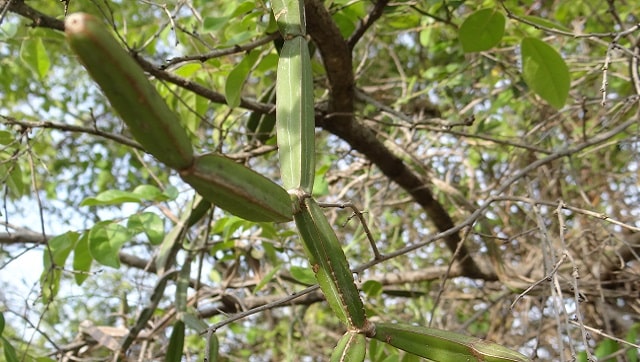
One such is Prandai.This has the ability to set fractured bones,prevents menstrual issues,helps digestion. ‘its antiulcer, antihaemorrhoid, pain-relieving and wound-healing properties. It is considered a valuable antimicrobial agent, useful in maintaining good gut flora, combating bacteria and promoting digestion.:
This Pirandai is used during Sraddha,annual ceremony for ancestors and used ,mostly in Brahmin homes in Tamil Nadu , at least once a month.
This is used in the form of Thuvayal, Chutney. This will be in the form of a paste. This is to be mixed with cooked rice along with a teaspoon of Gingelly oil.
Take one Pirandai stick.Wash it with water. Then saute in Gingelly oil preferably, four red chillies,one teaspoon Urad dal,A pinch of Asafoetida till they become golden brown.Upon cooling, take this mixture and add to the Pirandai( after cutting it down into two or three pieces,with its skin,so that it fits into mixer) ,keep these in Mixie ,add salt to taste and run the Mixie to turn this into a paste.
Other method is to Keep in a cooker for one whistle ( don’t add water) and use it instead of using it Raw.Cooking procedure remains the same.
Recommended to use it raw without cooking as explained vin the first procedure.At times Pirandai can cause itching sensation in the tongue. Before cooking, you can test this by keeping a tiny bit on the tongue by cutting a tiny bit at any of the ends of the stick, and if it itches, take the cut piece and rub it vigorously against the exposed part of Pirandai end and do the same at the other end of Pirandai by cutting va tiny bit and repeating the process.
The groundbreaking Dutch botanical text Hortus Indicus Malabaricus, Continents Regni Malabarici apud Indos celeberrimi omnis generis Plantas rariores, 1678-1681 — more commonly known as the Hortus Malabaricus — which is generally considered the oldest comprehensive printed book on the medicinal plant wealth of Malabar lists the Cissus quadrangularis as one of among 554 plants whose medicinal uses were known to physicians at the time. The curative properties of its leaves were noted to have played a role in curing intestinal gas and ear scum.
The ethnomedicinal benefits of the root and stem extracts of the Cissus quadrangularis have been long acknowledged by Ayurveda and the plant has been mentioned in ancient scriptures as a general tonic and analgesic. Its osteo protective properties can be credited for its Sanskrit name asthisamharaka, which literally translates to, “that which protects the bones from destruction”.
Vernacular Hindi names such as hadjod or “the bone setter” are also testimony to its traditional use as a medicine to accelerate the process of bone fracture healing. Rich in calcium, magnesium and the antioxidant resveratrol, the plant facilitates bone cell growth and regeneration. Veterinary practices to a similar effect have been observed by Saneesh CS, a PhD research scholar of biodiversity in the grassland ecosystem, who works in the Chittoor and Anantapur districts of southern Andhra Pradesh. The area, according to him, has a number of local Ayurvedic practititioners. He says, “A paste made of the plant is often used to heal fractures. In Chittoor and Anantapur, most people are shepherds so if a sheep or goat has a fracture, they make a paste and apply it to the broken limb and fasten it tightly with a cotton cloth.
Many have written asking me whether there is any alternative because chanting of Indrakshi Siva Kavacham is difficult and the procedure is arduous.
My observation is that we are prepared to follow the instructions of a doctor, though at times, it has no relevance to the problem and the medicine prescribed might be totally irrelevant.
We are cured, in my opinion, because of our faith in the doctor.
Then why don’t we follow the same approach towards Mantras and Pariharas?
There is a Temple and a specific Mantra for high fever.
The Sangameshwara Temple, Kooduthurai , near Bhavaani.
Nearest Railway Station/Bus Station. Erode.
Airport, Coimbatore.
Temple timings 630 am to 12noon and from 4to 8 pm.
The temple has a Jurahareswara(Lord of Fever, Shiva)
You may visit the temple after you chant the Mantra provided towards the close of this article.
‘
Jurahareshwara with three heads, three arms and three legs is found only in a few temples in Tamilnadu. He is found here in a seperate shrine and interestingly the dwarapalakas in this shrine also have three heads, arms and legs. Offering Rice, Pepper Rasam, and Araikeerai Kootu (Greens with Dhal) to the Lord is said to relieve people of fever and other ailments.
Chanting of
“Bhasmayudhaaya Vidhmahe
Raktha Netraaya Dheemahi
Thanno Jurahara Prachodhayaath”
and worshipping him with Bilva leaves, while offering pepper and cummin seeds is said to relieve people of chronic gastric ailments. have written on Indrakshi Shiva Kavacham for curing fever. ‘
Chant the mantra for 108 times day with the fingers of your right hand touching A little quantity of Vibhuthi, Bhasma placed in front of you in a small plate.
After chanting apply the Vibhuthi on the sick person’s forehead.
After fully recovered you may visit the temple and offer parihara as mentioned above.
Panchagavya,a mixture of Cow’s Urine, Dung,Milk,Curd and Ghee.
This was/is used Vedic Rituals including Homas /Havans.
Ancient Indians regarded Cow as Mother ,giver of all Wishes (Kamadhenu) and worshiped it.
There is Gosuktha,Vedic Hymn on Cows.
Cow enters first into a new home when housewarming is done.
While the rationalists,whom I consider to be a species who are convinced that they know everything and what they do not know /understand does not exist, consider the Panchagavya as Psudeo Science,patent has been issued for Cow Products and it is being sold.
Panchagavya Patent Details.
‘ABSTRACT
A pharmaceutical composition comprising an antibiotic and cow urine distillate in an amount effective to enhance antimicrobial effect of the antibiotic is disclosed. The antibiotic can be an antifungal agent. The antibiotic can be a quinolone or a fluoroquinolone. The antifungal agent can be azoles, clotrimazole, mystatin or amphotericin.
Panchagavya, an organic product has the potential to play the role of promoting growth and providing immunity in plant system. Panchagavya consists of nine products viz. cow dung, cow urine, milk, curd, jaggery, ghee, banana, Tender coconut and water. When suitably mixed and used, these have miraculous effects.
Cow dung – 7 kg
Cow ghee – 1 kg
Mix the above two ingredients thoroughly both in morning and evening hours and keep it for 3 days
Cow Urine – 10 liters
Water – 10 liters
After 3 days mix cow urine and water and keep it for 15 days with regular mixing both in morning and evening hours. After 15 days mix the following and panchagavya will be ready after 30 days.
Cow milk – 3 liters
Cow curd – 2 liters
Tender coconut water – 3 liters
Jaggery – 3 kg
Well ripened poovan banana – 12 nos.
All the above items can be added to a wide mouthed mud pot, concrete tank or plastic can as per the above order. The container should be kept open under shade. The content is to be stirred twice a day both in morning and evening. The Panchagavya stock solution will be ready after 30 days. (Care should be taken not to mix buffalo products. The products of local breeds of cow is said to have potency than exotic breeds). It should be kept in the shade and covered with a wire mesh or plastic mosquito net to prevent houseflies from laying eggs and the formation of maggots in the solution. If sugarcane juice is not available add 500 g of jaggery dissolved in 3 liter of water.
The cow dung and ghee are thoroughly mixed in the morning and evening, and kept for 3 days. After setting, it is mixed regularly for another 15 days, and then added to the other ingredients, and left to sit for another 30 days. Panchagavya is stored in a wide-mouthed earthen pot or concrete tank in open. Sufficient shade is usually provided. It is sometimes diluted before use.
Later we used to buy from the Yadavas, they are called ‘ konars’ in Tamil.
They had even a street named after them and they lived there.
They used to supply milk to homes.
They shall also supply Curds, Buttermilk.
But Ghee , we used to make Butter and get Ghee.
Hybrid and Indian cow
They also used to deliver Milk from A Cow, which delivered just then.
This is called Seempaal and was used from some illnesses.
The taste of the freshly obtained milk is something to be tasted.
Frothing and with a delicious Aroma the coffee one makes from this fresh milk can not be compared with anything.
There was also the practice of preparing Coffee with Cow’s fresh Milk.
The Milk was not boiled , the body heat of the Cow in the Milk would do.
This is the origin of Kumbakonam Degree Coffee, which is matchless.
Now we have lost all these.
We buy Packets of Milk with no taste.
We do not know if it is Cow’s or Buffaloes.
It is a mixture of all, with stabilising agents.
Not only it is not tasty but it is outright harmful to health.
Then why the promotion of branded Milk?
Simple answer, Greed for money.
Systematic conspiracy to wipe out indigenous breeds and make India dependent on foreign sources as Monsanto has done for Agriculture.
The Ban on Jallikkattu is a part of this great milk conspiracy.
Study by New Zealand Research Group and NDRI , confirm that the Milk from crossbreeds are not only harmful but lowers Immunity ans may even cause Cancer.
‘New Zealand researchers claimed that A1 milk contains beta-caesin which is harmful for human beings and leads to diseases like diabetes, cancer and a weakening of the immune system. The results of the NDRI research also indicated that A1 milk that is served to infants and old age people damages the immune system. AK Srivastava, Director, NDRI, Karnal, tells Indiaopines, “In India, the experiment conducted six months ago on animals indicated that A1 milk caused immunity problems. But as of now we have to wait further for a credible source…
What is A1 and A2 milk?
Both A1 and A2 varieties of milk are the product of two genetically different cow breeds. The main proteins available in this milk are whey and casein. Earlier all cows used to be A2 until a naturally occurring genetic mutation in European breeds changed the genetics of milk producing cow herds. And today most of the milk that we consume comes from the A1 variety.
Research in New Zealand on the A1 and A2 breeds showed that casein is most abundant overall, and the genetic variations of the A1 and A2 refer to the beta-casein. Beta-caseins can have a helpful effect on the body. But drinking A1 milk may not be so helpful.
‘
A1 versus A2
Milk of European breeds is addictive, triggers schizophrenia,diabetes and cardiovascular diseases
In July 2007, Dr Keith Woodford, a professor of farmmanagement at New Zealand’s Lincoln Universitypublished a paper titled A2 Milk, Farmer Decisions, andRisk Management that reported how “approximately 500 New Zealand dairy farmers are converting their herds to eliminate production of A1 beta-casein within the milk” responsible for “Type 1 diabetes, heart disease and autism”.
Dr Woodford went on to explain: “The alternative (to A1) is A2 beta-casein, and the associated milk is known as A2 milk. Originally all cow milk was of the A2 type. However, a genetic mutation, probably between 5000 and 10,000 years ago, has resulted in a proportion ofcows of European breeds producing a casein variant called A1 beta-casein. A1 beta-casein is absent in the milk of pure Asian and African cattle.”
He offered “eight strands to the evidence” to the ill-effects of A1 beta-casein: countries with high intakes of A1 beta-casein are the countries with high levels of Type 1 diabetes and heart disease; A1 and A2 beta-caseindigest differently and only A1 beta-casein releases beta-casomorphin7 (BCM7) which is a powerful opioid(addictive) and causes arterial plaque; rabbits fed A1 beta-casein develop considerably more plaque on their aorta and rats show higher incidence of Type 1 diabetes;evidence from American and European investigationsshow that autistic and schizophrenic persons typically excrete large quantities of BCM7 in their urine; and many who are intolerant to milk are able to drink A2 milk.
Dr Woodford was worried that most consumers and dairy farmers worldwide remained unaware of the issues surrounding A1 and A2 milk. Within four years, Indian scientists at the National Bureau of Animal Genetic Resources (NBAGR) came up with their own study. “The A2 allele gene in Indian milk breeds of cows and buffalos are 100 per cent, while in foreign breeds, it is around 60 per cent,” it said in 2011.
NBAGR screened the status of the A2 allele of the beta-casein gene in 22 indigenous breeds and the twodominant foreign breeds Holstein Friesian and Jersey. While the A2 allele was 100 per cent in the top five indigenous milch breeds –Red Sindhi, Sahiwal,Tharparkar, Gir and Rathi – and around 94 per cent in other indigenous dual and draught breeds, its status was merely 60 per cent in Holstein Friesian and Jersey.
According to Dr Woodford, the major consumer market for A2 milk is in Australia where it is available in some 800 supermarkets and 200 convenience stores.However, overall market share is probably less than 1% because of limited publicity. In an increasingly health conscious world, this creates a huge potential for global demand for the A2 milk of our indigenous breeds. For now, we must rethink our strategy of flooding the domestic markets with A1 milk by aggressively pushing exotic breeds at home and opening up the dairy sector toforeign brands.
When we drink the milk of an A1 cow, the body breaks it down to produce high levels of a molecule that is not a healthy sign. This is a bioactive opioid peptide and morphine-related compound called beta casomorphin-7 (BCM7). While A2 milk also causes some of this morphine molecule to be produced, it is negligible ascompared to A1 milk. BCM7 is a very active molecule in our body….
Once in our blood stream, this creates opioid oxidize cholesterol at a high rate, which may be one reason for its link to heart disease. Animal studies have singled out BCM7 since it creates inflammatory reactions in the small intestines. It also changes the hormonal function, as well as affects the nervous and immune system. BCM7 will cause brain fog, poor thinking, and problems with sleep.
These neurologic issues may also be a factor in the concerns with schizophrenia and autism. The ischemic heart disease is the most common cause of death in the majority of countries. A study New Zealand study looking at 20 affluent countries clearly shows higher rates of death from a type of heart disease called ischemic heart disease in A1 milk drinkers, while the A2 variety shows lower cardiovascular problems and type-I diabetes.
Earlier there were no human trial results to check the claims of A1 and A2 milk. But on August 11, 2014 the Curtin University of Australia published a report in the European Journal of Clinical Nutrition by Associate Professor Sebely Pal of the School of Public Health. The report found that humans on an A2 milk diet had less bloating abdominal pain and firmer stools since they stayed off the A1 beta casein. The tests were carried out on 41 persons for eight weeks…..
Anurag Tomer, counsel for Swami Achutyanand, tells Indiaopines, “The civil writ petition said that 80 percent of milk provided to consumers in India was adulterated and not safe for human consumption. The petitioner also gave the court a copy of the FSSAI survey report claiming that 68.4 percent of milk in the Indian market was adulterated with the synthetic and detergent materials which were hazardous for health.The Bench of Justice KS Radhakrishnan and Justice Vikramjit Sen took the matter seriously and then hearing of the case began in the month of December 2013.”
Anurag further says, “In the meantime we pointed out to the court that the punishment awarded in India for food adulteration is insufficient. So the apex court in December issued a notice to the Union of India and all the States asking them to bring a suitable amendment in Section 276 of the Indian Penal Code and also suggested the Government to increase the provision of punishment from six months to a life term.”
During the hearing of the case the apex court was also informed about the Allahabad High Court Judgment on where in a similar case the court stated that since the Food Safety Standard Act could take care of all the matters related to food adulteration. Section 276 of the IPC cannot be applied in this.
After the writ petition a counter affidavit was filed by the Director of the Food Safety Authority on behalf of the Union of India in the SC on March 10, 2014 admitting that in the year 2011 a survey was conducted nationwide by the FSSAI. The survey said that 68.4 per cent of milk which was collected from various States was found adulterated with detergents.
The deviations were found highest on account of Fat and SNF content in 574 samples (46.8%) of the total non-conformity, including 147 samples with detergents and two samples with neutrilizers, respectively. Detergent was also found in 103 samples (8.4%). The second highest parameter of non-conformity was the skim milk powder (SMP) in 548 samples (44.69%) including glucose in 477 samples. Glucose is added in milk to probably enhance SNF.
Mohan Singh Ahluwalia, President of Gwala Gaddi, an organization fighting to save native desibreed cows across the country and provide pure milk to the consumers with more than seven lakh twenty thousand members across the country and also the petitioner along with Swami Achutyanand, tells Indiaopines,
“People are losing their faith in milk now. The present condition is very serious as a single person is making a brand of itself and we are against it. Our movement mainly deals with the interests of consumers and we are demanding that pure milk be served to people.” Ahluwalia further says, “Currently there is no law which deals with the standard of milk as in the government guideline it is not clear how to achieve standards whether in a natural way or in an artificial way. Thus all the companies and dairies across the country are doing a black business of impure milk and making huge profits. And Government of India is the part of this conspiracy with its millions of consumers.”
Protein chain showing Amino acids A 1 and A 2 beta_ casein.
‘The milk you get from Aavin and other companies are toxic A1 milk. Cow’s milk contains proteins, fats, carbohydrates (in the form of lactose), minerals and water. There are two types of cow’s milk : A1 & A2. The main difference between the A1 & A2 milk is their protein component. The protein is of two types : Casein and Whey. There are different types of casein proteins and one particular type is called the BETA-CASEIN which has two variations : A1 & A2. The A1 beta casein is a highly toxic component while the A2 is harmless and safe. Your mother’s milk is A2 and so is the Indian cow’s. It has micronutrients like cytokines and minerals which enhances your immune system. But the western cow’s milk which we drink today, is highly toxic and not suitable for human consumption. ..
Bottom line is, once people drink milk, the western cow’s milk (which contains A1 beta casein) digests differently than the Indian Cow’s milk (which has A2 beta casein). With the A1 beta casein, there’s a release of a ‘peptide’ which a small fragment of protein called ” Beta-Caso-Morphin-7 ” the devil in the milk.
The BCM7 is an opioid (psychoactive chemical) and when it gets through from the stomach into the blood, it can cause all sorts of problems. The human body simply doesn’t like this opioid and it tries to react against it, and depending on the individual’s genetic make up, one could get all sorts of diseases ranging from juvenile diabetes, autism, allergies and etc. To make it worse, BCM7 crosses the Blood Brain Barrier. Which means, it could get in to your brain, resulting in schizophrenia and auto-immune diseases such as MS and Parkinson’s. In children, it could cause several issues for their psychomotor and physical development (a recent study made by Russian scientists has confirmed this).
The west has now woken up to the truth and more and more people are going to A2 milk. This has made the western diary industry nervous. So they’re in the process of converting their useless, toxic A1 cows to A2 cows. They come to India for the A2 cow embryos as a result of which, now some of our wonderful native breeds like the Punganur and Vechur cows are nearly extinct. And thanks to the lack of a mechanism to check the illegal export of embryos at Indian sea ports, they’re doing this with no issues. Today we see western humpless cow in indian diaries , and Indian humped cow in western diaries. Aavin and other milks we get in India now is the toxic A1 kind…
Meaning: 1.1: (Salutations to Sri Ganesha) Who Always has a Child-like Form, but can Destroy Mountains of Obstacles, 1.2: Who has an Elephant Face with a Huge Tusk, but is respected by the Five-Faced Shiva, 1.3: Who is sought after by Vidhi (Brahma), Indra and Others; and Who is known as Ganesha; To me … 1.4: … please bestow Sri (Glory and Prosperity), O the Lord with an Auspicious Form.
नजानामिशब्दंनजानामिचार्थं नजानामिपद्यंनजानामिगद्यम् । चिदेकाषडास्याहृदिद्योततेमे मुखान्निःसरन्तेगिरश्चापिचित्रम् ॥२॥ Na Jaanaami Shabdam Na Jaanaami Ca-Artham
Na Jaanaami Padyam Na Jaanaami Gadyam |
Cid-Ekaa Ssaddaasyaa Hrdi Dyota-Te Me
Mukhaan-Nihsarante Girash-Ca-Api Citram ||2||
Meaning: 2.1: (Salutations to Sri Subramanya) I know neither Words, nor their Meanings O Lord, 2.2: And I know neither Poetry, nor Prose, but … 2.3: … within the Core of my Heart, I see the Conscious Effulgence of Your Six Faces, … 2.4: … which is making these various Words pour forth through my Mouth.
Meaning: 3.1: (Salutations to Sri Subramanya) Whose Form Mounted on a Peacock represents the deepest Secret of the UpanishadicMaha Vakyas, 3.2: Whose Heart-Stealing Beautiful Body Dwells within the Great Heart of Spiritual Consciousness, 3.3: Who is the Great God of the Devas and represents what the Great Vedas convey, 3.4: I Worship that Son of Mahadeva (another name of Shiva) Who is the Protector of the World.
Meaning: 4.1: (Salutations to Sri Subramanya) When Persons come to My Presence (and completely surrender to me), 4.2: They have Indeed Crossed the Ocean of the Samsara, 4.3:Thus You seem to proclaim Manifesting on the Shore of the Sea (at Tiruchendur) and Dwelling there, 4.4: May I always Praise You, O the Ever Pure Son of Parashakti (Divine Mother).
यथाब्धेस्तरङ्गालयंयन्तितुङ्गाः तथैवापदःसन्निधौसेवतांमे । इतीवोर्मिपंक्तीर्नृणांदर्शयन्तं सदाभावयेहृत्सरोजेगुहंतम् ॥५॥ Yatha-Abdhes-Taranggaa Layam Yanti Tunggaah
Tathai[aa-E]va-[A]apadah Sannidhau Sevataam Me |
Iti-Ivo[a-Uu]rmi-Pangktiir-Nrnnaam Darshayantam
Sadaa Bhaavaye Hrt-Saroje Guham Tam ||5||
Meaning: 5.1: (Salutations to Sri Subramanya) Like the Huge Waves of the Sea Disappear within the Sea, … 5.2: … similarly, the Calamities of My Devotees will Disappear Who come to My Presence where I Dwell (and completely surrender to me), 5.3:Thus You seem to proclaim showing the Rows of Waves on the Sea (to the Devotees), 5.4: May I always Meditate on You, O Guha (another name of Subramanya) within the Lotus of my Heart.
Meaning: 6.1: (Salutations to Sri Subramanya) Those Persons who Ascend the Hills of My Abode (and completely surrender to me), … 6.2: … they thereby Ascend the Great Silvery Mountain which leads to the path of Liberation (referring to Mount Kailash which appears Silvery due to snow), 6.3:Thus You seem to proclaim Abiding on the Sugandha Hill, 6.4:Let me always Rejoice in the contemplation of You, O my Lord Shanmukha.
Meaning: 7.1: (Salutations to Sri Subramanya) On the Shores of the Great Sea, the Place which Steals away the Great Sins of the People, … 7.2: … the Place which is very Favourable for Munis (Saints or Ascetics) to perform Sadhana, the Place which is known as the Sugandha Hill, … 7.3: … the Place where Guha Abides in His Own Splendour, … 7.4: … and Removes the Distress of the People; I Remember that Place and take Refuge in You, O Guha.
Meaning: 8.1: (Salutations to Sri Subramanya) Within the Shining Golden House (i.e. Temple Room), Granting the Wishes of theDevotees, … 8.2: … Abides the Lord on a Shrine which is covered with heaps of Flowers and various Gems, … 8.3: … the Lord Himself Shining with the Effulgence of Thousand Suns, 8.4: Let me always Meditate on that Form of Kartikeya, the Lord of the Devas.
रणद्धंसकेमञ्जुलेऽत्यन्तशोणे मनोहारिलावण्यपीयूषपूर्णे मनःषट्पदोमेभवक्लेशतप्तः सदामोदतांस्कन्दतेपादपद्मे ॥९॥ Rannad-Dhamsake Man.jule-Atyanta-Shonne
Manohaari-Laavannya-Piiyuussa-Puurnne
Manah-Ssatt-Pado Me Bhava-Klesha-Taptah
Sadaa Modataam Skanda Te Paada-Padme ||9||
Meaning: 9.1: (Salutations to Sri Subramanya) On the Jingling Anklets on the Feet which are very Charming and Reddish, … 9.2: … the Feet which are Heart-Stealing, Lovely and filled with Nectar … 9.3: … On those Six pair of Feet (in Your Six Abodes), let me who is afflicted with the Distress and Heat of the World, … 9.4: … always Rejoice, O Skanda, keeping my Mind always on Your Lotus Feet.
Meaning: 10.1: (Salutations to Sri Subramanya) Clad in Divine Clothes which are Shining with the Lustre of Gold, … 10.2: … and wearing a beautiful Girdle on the Waist on which small Bells are Tinkling, … 10.3: … along with a Golden Silk Cloth which is Flashing like Lightning, … 10.4: … I Meditate on Your Waist, O Skanda, You Who Enlighten my Heart.
Meaning: 11.1: (Salutations to Sri Subramanya) Like how You Embraced the Woman of the Pulinda Tribe (i.e. Sri Valli, who meditated on You for long) who had Big and Round …. 11.2: … Bosom, and as a result of that Embrace, Your Chest became Red like Saffron (signifying deep attachment towards Devotees), … 11.3: … I Bow down to You, the Enemy of Taraka, and Who is extremely Powerful, … 11.4: … Please extend the same Anuraga (Love and Affection which You showed towards Valli) towards Your Devotees also,always, You Who are the Joy of the Devotees.
Meaning: 12.1: (Salutations to Sri Subramanya) The Arms which Effected Punishment to Vidhi (Sri Brahma) and the Arms whichSupported the Universe as One’s Play, … 12.2: … The Arms which Casted off the Elephant (Valli Story) and the Arms which are like Kaaladanda (Staff of Death) to the Hostile, … 12.3: … The Arms which Killed the Multitude of Enemies of Indra, and the Arms which are Skilled in Protecting the World, … 12.4: … I Always take Refuge in Your Formidable Arms, O Subramanya (which are like a Mighty Protecting Staff for the World).
Meaning: 13.1: (Salutations to Sri Subramanya) If Six Autumn Moons Continuously Shine, … 13.2: … Rising Together and Staying side by side, such that their Splendour is a Continuous Whole, … 13.3: … and they are Always Shining with Full Brightness, without any Spot on them, … 13.4: … Even then, they can be said to be like Your Face, only for the name’s sake, O Skanda, without the real Splendour matching.
Meaning: 14.1: (Salutations to Sri Subramanya) With Shining Gentle Smile like a group of Swans Moving Happily, … 14.2: … and Side Glances like a group of Bees Shining with Splendour, … 14.3: … along with Lips like Bimba Fruit filled with Nectar; O the Son of the Lord of Earth, … 14.4: … I Behold Your Six Faces within my Heart; those Six Faces which blossom like Six Lotuses.
Meaning: 15.1: (Salutations to Sri Subramanya) From Your Large and Long Eyes extending till the Ears, from which continually … 15.2: … pours forth Compassion; those Twelve Eyes, … 15.3: … If on me once Cast their Glance, … 15.4: … What Loss indeed will there be to You, O my Compassionate Lord?
Meaning: 16.1: (Salutations to Sri Subramanya) “Son, you are born from my body, May your glory live (forever)”; Over Your SixHeads which Supports the World, … 16.2: … Mahadeva, the Great Lord, Joyfully uttered Mantras and Blessed You, 16.3: O Jagannatha (Lord of the World), You Who Bear the Burden of the World, … 16.4: … I Salute those Six Heads (blessed by Mahadeva and) which are Adorned with Shining Diadems.
Meaning: 17.1: (Salutations to Sri Subramanya) With a Delightfully Pleasing Form adorned with Bracelets and Garlands studded withGlittering Gems, … 17.2: … and Beautiful Ear-Rings moving to and fro over the Shining Face, … 17.3: … With Golden Yellow Clothes over the Waist and the Beautiful Shakti Vel on His Hands, … 17.4: .. I See Your Beautiful Form before my eyes, O the Son of the Enemy of Tripurasura (referring to Shiva).
Meaning: 18.1: (Salutations to Sri Subramanya) “Come here, my Son”, by Extending the Arms … 18.2: … When Shankara calls You, You from Your Mother’s Lap … 18.3: … Spring up and go towards the endearing Embrace of Your Father, O Kumara (another name of Subramanya), 18.4: I Worship that Form of Bala Kumara (Child Kumara) Whose Body was Embraced by Hara (another name of Shiva).
Meaning: 19.1: (Salutations to Sri Subramanya) O Kumara, You Who are the Son of the Lord (Shiva), You Who are also called Guhaand Skanda, You Who are the Commandar of the Army of Devas, … 19.2: … You Who hold the Shakti Vel in Your Hands, You Who Mount the Peacock, … 19.3: … You Who are the Beloved of the Daughter of the hunter of Pulinda tribe (referring to Valli), … 19.4: … O Lord, You Who are the Enemy of Tarakasura, Please Protect me always.
Meaning: 20.1: (Salutations to Sri Subramanya) During my Old Age, when my Senses will become Calm, when I will lose Consciousness and lie Motionless, … 20.2: … When my Face will Emit Phlegm and my whole Body will Tremble with Fear, … 20.3: … When I will lie Waiting for Death, O my Lord, during that time, for me, this Helpless creature, … 20.4: … Come to me Quickly and be before me, O Guha, the Compassionate Lord.
Meaning: 21.1: (Salutations to Sri Subramanya) When the Messengers of the God of Death (Yama) who are Fierce, will say withFerocity, … 21.2: … “Burn him, Cut him, Split him”, threatening me, … 21.3: … (during that time) You, Mounted on Your Peacock and assuring “There is no need to be afraid”, … 21.4: … Please Come to me Quickly with Your Shakti Vel in Hand.
Meaning: 22.1: (Salutations to Sri Subramanya) I Salute You by Falling at Your Feet right now, … 22.2: … Be Gracious, O Lord, I am Praying to You Many Times now, … 22.3: … For during that time (i.e. during my old age and when I am nearing death), I will not have the Strength to Speak, O the Ocean of Compassion, … 22.4: … Do not therefore Forsake me during the end of my life even for a little while.
सहस्राण्डभोक्तात्वयाशूरनामा हतस्तारकःसिंहवक्त्रश्चदैत्यः । ममान्तर्हृदिस्थंमनःक्लेशमेकं नहंसिप्रभोकिंकरोमिक्वयामि ॥२३॥ Sahasra-Anndda-Bhoktaa Tvayaa Shuura-Naamaa
Hatas-Taarakah Simhavaktrash-Ca Daityah |
Mama-Antar-Hrdistham Manah-Klesham-Ekam
Na Hamsi Prabho Kim Karomi Kva Yaami ||23||
Meaning: 23.1: (Salutations to Sri Subramanya) The Enjoyer of Thousand Universes by name Soora (i.e. demon Soorapadma) was byYou … 23.2: … Slain along with the demons Taraka and Singhavaktra (i.e. demon Singhamukha), 23.3:Within the Core of my Heart lies one Mental Affliction, 23.4: You have still not Killed that, my Lord; What shall I do now? Where shall I go now?
Meaning: 24.1: (Salutations to Sri Subramanya) I am always sunken with the burden of Sorrows, 24.2: You are the Friend of the Miserable in all the Worlds; apart from You, I Pray to None Else, 24.3:Preventing full Devotion towards You by always causing Obstacles … 24.4: … are my Mental Sorrows; O the Son of Uma, please Destroy them Quickly.
Meaning: 25.1: (Salutations to Sri Subramanya) Apasmara (Epilepsy), Kussttha (Leprosy), Kssaya (Consumption), Arsha (Piles),Prameha (Urinary diseases like Diabetes), … 25.2: … Jwara (Fever), Unmada (Madness, Insanity), Gulma (Enlargement of Spleen or other glands in the abdomen) and other formidable Diseases, … 25.3: … as also all types of Pisachas (Evil Spirits), … (when) in Your Bibhuti (Sacred Ash) contained in a Leaf, … 25.4: … sees You, Who is the Enemy of the formidable Taraka (i.e demon Tarakasura), they hasten to Run awayImmediately.
दृशिस्कन्दमूर्तिःश्रुतौस्कन्दकीर्तिः मुखेमेपवित्रंसदातच्चरित्रम् । करेतस्यकृत्यंवपुस्तस्यभृत्यं गुहेसन्तुलीनाममाशेषभावाः ॥२६॥ Drshi Skanda-Muurtih Shrutau Skanda-Kiirtih
Mukhe Me Pavitram Sadaa Tac-Caritram |
Kare Tasya Krtyam Vapus-Tasya Bhrtyam
Guhe Santu Liinaa Mama-Ashessa-Bhaavaah ||26||
Meaning: 26.1: (Salutations to Sri Subramanya) Always Seeing the Form of Skanda and Hearing the Glories of Skanda, … 26.2: … May my Mouth always Eulogize those Pure Deeds, 26.3: With my Hands always full with Your Works, may my Body always be Your Servant, 26.4:May All my Feelings (Bhava) be completely Absorbed in You, O Guha.
Meaning: 27.1: (Salutations to Sri Subramanya) Is it not that Worshipped by the Great Sages and Ascetics only, … 27.2: … the Devas (Gods) everywhere (i.e. in most cases) become the bestower of Desired Boons? 27.3: But even for the sake of Persons (i.e. Devotees) who are of the Lowest Births, to Grant them His Grace, … 27.4: … Apart from Guha, I do not know any other, I do not know any other.
कलत्रंसुताबन्धुवर्गःपशुर्वा नरोवाथनारिगृहेयेमदीयाः । यजन्तोनमन्तःस्तुवन्तोभवन्तं स्मरन्तश्चतेसन्तुसर्वेकुमार ॥२८॥ Kalatram Sutaa Bandhu-Vargah Pashurvaa
Naro Va-Atha Naari Grhe Ye Madiiyaah |
Yajanto Namantah Stuvanto Bhavantam
Smarantash-Ca Te Santu Sarve Kumaara ||28||
Meaning: 28.1: (Salutations to Sri Subramanya) Let my Wife, Children, Relatives or other People, … 28.2: … whether they are Men or Women, all those who stay in my House, … 28.3: … Let them all Worship You alone, let them all pay Obeisance to You alone, let them all Praise You alone, let them allTurn to You alone, … 28.4: … Let them all become absorbed in Your Rememberance only, O Kumara.
मृगाःपक्षिणोदंशकायेचदुष्टाः तथाव्याधयोबाधकायेमदङ्गे । भवच्छक्तितीक्ष्णाग्रभिन्नाःसुदूरे विनश्यन्तुतेचूर्णितक्रौञ्चशौल ॥२९॥ Mrgaah Pakssinno Damshakaa Ye Ca Dussttaah
Tathaa Vyaadhayo Baadhakaa Ye Mad-Angge |
Bhavac-Chakti-Tiikssnna-Agra-Bhinnaah Suduure
Vinashyantu Te Cuurnnita-Kraun.cashaula ||29||
Meaning: 29.1: (Salutations to Sri Subramanya) Those Animals, Birds and Biting Insects which are offensive, … 29.2: … and in like manner, those Diseases which cause Pain and afflict my Body, … 29.3: … Piercing them with Your Sharp Shakti Vel and casting them Far away, … 29.4: … Please Destroy them, O You Who Crushed the Krauncha Mountain.
जनित्रीपिताचस्वपुत्रापराधं सहेतेनकिंदेवसेनाधिनाथ । अहंचातिबालोभवान्लोकतातः क्षमस्वापराधंसमस्तंमहेश ॥३०॥ Janitrii Pitaa Ca Sva-Putra-Aparaadham
Sahete Na Kim Deva-Sena-Adhinaatha |
Aham Ca-Ati-Baalo Bhavaan Loka-Taatah
Kssama-Sva-Aparaadham Samastam Mahe[a-Ii]sha ||30||
Meaning: 30.1: (Salutations to Sri Subramanya) Mother and Father, seeing the Faults of their Children, … 30.2: … do they not Tolerate and Forgive those, O the Chief of the Army of Devas? 30.3:I am a mere Child and You are the Father of the World, 30.4: (So like a Father) please Forgive all my Faults, O the Great Lord.
Meaning: 31.1: (Salutations to Sri Subramanya) Salutations to Your Peacock and Your Shakti Vel, 31.2:Salutations to Your Goat, Salutations to Your Cock, 31.3:Salutations to Your Pilgrimage (referred to as Sindhudesha) by the side of the Sea, 31.4:Salutations, Salutations to You again and again, O Skanda, Salutations to Your Beautiful Form.
Meaning: 32.1: (Salutations to Sri Subramanya) Victory to You, the Inner World of Bliss Consciousness, Victory to You Whose Abodeis in that Shoreless (i.e. Unbounded) Bliss Consciousness, 32.2:Victory to You Whose Glory (both Inner and Outer) unfailingly extend everywhere, Victory to You Whose Form is an Embodiment of Bliss, 32.3:Victory to You Who is an Ocean of Bliss, Victory to You Whose Friendship is Unbounded (being the all pervading Consciousness), 32.4:Victory to You Always, Who is the Son of the Lord Who bestows Liberation (i.e. Lord Shiva).
Meaning: 33.1: (Salutations to Sri Subramanya) This Hymn which is Arranged and set in Motion in the Bhujanga (Snake-like) Metre,the person who … 33.2: … Recites with deep Devotion and Reverentially Bowing before Guha, … 33.3: … will get good Spouse and Sons, Wealth and long Life … 33.4: … and finally that person will obtain the Sayujya (absorption in the Divine Essence) of Skanda.
-Subrahmanya Bhujangam by Adi Sankaracharya.
Begin the Mantra on any of the Thithis in Sukla Paksha(Waxing Moon)
Chaturthi,
Panchami,
Shashti.
Recite this in the morning,
Naivedyam. Honey/Dry Fruits.
On the concluding Day, Naivedyam Sakkarai Pongal and feed the poor.
Number of people to be fed depends on your budget.
In addition to this chant the Maha Mrutyunjaya Mantra 108 times.
The Mantra.
Maha Mriytunjaya Mantra
The patient may recite these Mantras, if they can.
You must be logged in to post a comment.