Tag: Pre Islamic Arabia

  • Naivedya Prarthana Pradakshina Ahuthi in Pre Islamic Arabia

    Naivedya Prarthana Pradakshina Ahuthi in Pre Islamic Arabia

    I have written on the religious practices in Kaaba are similar to what is practiced in sanatana dharma, Hinduism.

    Vedic practices in Islam ,Kaaba

    Pre Islamic society borrowed the conceptsl of Hinduism either directly or through the Hitties/Sumeria.

    Prophet had destroyed 360 Idols in Kaaba.

    There were four Major Deities.

    Hubbol,

    Al-lat,

    Al-Uzza and

    Manat.
    (Will be writing on these Deities)

    Ghazni invaded and destroyed Somnath temple, believing that a an idol of Manat was spirited away to Somnath temple,India.

    I am quoting from Islamic source.

    My comments are in Itlalics..

    Some features of their worship of idols were:
    Self-devotion to the idols, seeking refuge with them, acclamation of their names, calling for their help in hardship, and supplication to them for fulfillment of wishes, hopefully that the idols (i.e., heathen gods) would mediate with Allâh for the fulfillment of people’s wishes.

    Performing pilgrimage to the idols, circumrotation round them, self-abasement and even prostrating themselves before them.

    This is Theertha yatra,pradakshina and prarthana of Hinduism.

    Seeking favour of idols through various kinds of sacrifices and immolation.

    ..

    Consecration of certain portions of food, drink, cattle, and crops to idols. Surprisingly enough, portions were also consecrated to Allâh Himself, but people often found reasons to transfer parts of Allâh’s portion to idols, but never did the opposite. To this effect, the Qur’ânic verses go:

    This is Naivedya and offering Aahuthi.

    “And they assign to Allâh a share of the tilth and cattle which He has created, and they say: ‘This is for Allâh according to their pretending, and this is for our (Allâh’s so-called) partners.’ But the share of their (Allâh’s so-called) ‘partners’, reaches not Allâh, while the share of Allâh reaches their (Allâh’s so-called) ‘partners’. Evil is the way they judge.” [6:136]

    Carrying favours with these idols through votive offerings of crops and cattle, to which effect, the Qur’ân goes:

    Hinduism offers cattle to deities even today.

    Dedication of certain animals (such as Bahira, Sa’iba, Wasila and Hami) to idols, which meant sparing such animals from useful work for the sake of these heathen gods. Bahira, as reported by the well-known historian, Ibn Ish, was daughter of Sa’iba which was a female camel that gave birth to ten successive female animals, but no male ones, was set free and forbidden to yoke, burden or being sheared off its wool, or milked (but for guests to drink from); and so was done to all her female offspring which were given the name ‘Bahira’, after having their ears slit. The Wasila was a female sheep which had ten successive female daughters in five pregnancies. Any new births from this Wasila were assigned only for male people. The Hami was a male camel which produced ten progressive females, and was thus similarly forbidden.

    ….

    The Arabs believed that such idols, or heathen gods, would bring them nearer to Allâh, lead them to Him, and mediate with Him for their sake, to which effect, the Qur’ân goes:

    “We worship them only that they may bring us near to Allâh.” [39:3], and

    “And they worship besides Allâh things that hurt them not, nor profit them, and they say: These are our intercessors with Allâh.” [10:18]

    in whatever Form you worship, all come to me
    -Bhagavad Gita.
    Akasaath pathitham ……sloka states,
    Just as water,whatever be its form,rivers,rivulets,rain…reaches the Ocean finally,whatever Gods/Forms you worship ,all of them reach Me…Krishna.
    This is recited thrice everyday by Brahmins while performing Sandhya vandana.

    Another divinatory tradition among the Arabs was casting of Azlam (i.e. featherless arrows which were of three kinds: one showing ‘yes’, another ‘no’ and a third was blank) which they used to do in case of serious matters like travel, marriage and the like. If the lot showed ‘yes’, they would do, if ‘no’, they would delay for the next year. Other kinds of Azlam were cast for water, blood-money or showed ‘from you’, ‘not from you’, or ‘Mulsaq’ (consociated). In cases of doubt in filiation they would resort to the idol of Hubal, with a hundred-camel gift, for the arrow caster. Only the arrows would then decide the sort of relationship.If the arrow showed (from you), then it was decided that the child belonged to the tribe; if it showed (from others), he would then be regarded as an ally, but if (consociated) appeared, the person would retain his position but with no lineage or alliance contract.

    This was very much like gambling and arrow-shafting whereby they used to divide the meat of the camels they slaughtered according to this tradition.

    Moreover, they used to have a deep conviction in the tidings of soothsayers, diviners and astrologers. A soothsayer used to traffic in the business of foretelling future events and claim knowledge of private secrets and having jinn subordinates who would communicate the news to him. Some soothsayers claimed that they could uncover the unknown by means of a granted power, while other diviners boasted they could divulge the secrets through a cause-and-effect-inductive process that would lead to detecting a stolen commodity, location of a theft, a stray animal, and the like. The astrologer belonged to a third category who used to observe the stars and calculate their movements and orbits whereby he would foretell the future. Lending credence to this news constituted a clue to their conviction that attached special significance to the movements of particular stars with regard to rainfall.

    The belief in signs as betokening future events, was, of course common among the Arabians. Some days and months and particular animals were regarded as ominous. They also believed that the soul of a murdered person would fly in the wilderness and would never rest at rest until revenge was taken. Superstition was rampant. Should a deer or bird, when released, turn right then what they embarked on would be regarded auspicious, otherwise they would get pessimistic and withhold from pursuing it.

    This is Prasna,Naimithika and Arul vaaku

    People of pre-Islamic period, whilst believing in superstition, they still retained some of the Abrahamic traditions such as devotion to the Holy Sanctuary, circumambulation, observance of pilgrimage, the vigil on ‘Arafah and offering sacrifices, all of these were observed fully despite some innovations that adulterated these holy rituals. Quraish, for example, out of arrogance, feeling of superiority to other tribes and pride in their custodianship of the Sacred House, would refrain from going to ‘Arafah with the crowd, instead they would stop short at Muzdalifah. The Noble Qur’ân rebuked and told them:

    “Then depart from the place whence all the people depart.” [2:199]

    Another heresy, deeply established in their social tradition, dictated that they would not eat dried yoghurt or cooked fat, nor would they enter a tent made of camel hair or seek shade unless in a house of adobe bricks, so long as they were committed to the intention of pilgrimage. They also, out of a deeply-rooted misconception, denied pilgrims, other than Makkans, access to the food they had brought when they wanted to make pilgrimage or lesser pilgrimage.

    They ordered pilgrims coming from outside Makkah to circumambulate Al-Ka‘bah in Quraish uniform clothes, but if they could not afford them, men were to do so in a state of nudity, and women with only some piece of cloth to hide their groins’

    This portion reminds me of Tantra ,Kaaplika worship of Shiva, Shakti.

    Reference and citation.
    https://islamreigns.wordpress.com/2015/12/17/religions-of-the-arabs/

  • Ghazni Muhammad Destroyed Somnath For Manat Arabia,A Hindu Goddess?

    Ghazni Muhammad Destroyed Somnath For Manat Arabia,A Hindu Goddess?

    I have often wondered why Ghazni Muhammad should single out the Somnath Temple,an Abode and Temple of Shiva in Gujrat.

    An idol of her was also likely among the 360 idols in the Kaaba. According to Ibn al-Kalbi, when worshipers would circumambulate the Kaaba, they would chant her name along with that of her sisters, al-Lat and al-Uzza, seeking their blessings and interception.[12]


    The attack on Somnath temple in India in 1024 by Mahmud of Ghazni may have been inspired by the belief that an idol of Manat had been secretly transferred to the temple.[20] According to the Ghaznavid court poet Farrukhi Sistani, who claimed to have accompanied Mahmud on his raid, Somnat (as rendered in Persian) was a garbled version of su-manat referring to the goddess Manat. According to him as well as a later Ghaznavid historian Abu Sa’id Gardezi, the images of the other goddesses were destroyed in Arabia but the one of Manat was secretly sent away to Kathiawar (in modern Gujarat) for safe keeping. Since the idol of Manat was an aniconic image of black stone, it could have been easily confused with a lingam at Somnath. Mahmud is said to have broken the idol and taken away parts of it as loot and placed so that people would walk on it. In his letters to the Caliphate, Mahmud exaggerated the size, wealth and religious significance of the Somnath temple, receiving grandiose titles from the Caliph in return’

    Source.

    https://en.m.wikipedia.org/wiki/Manat_(goddess)

    Manat was also thought to watch over graves, as indicated by a tomb inscription reading “And may Dushara and Manat and Qaysha curse anyone who sells this tomb or buys it or gives it in pledge or makes a gift of it or leases it or draws up for himself any document concerning it or buries in it anyone apart from the inscribed above”.[2]

    • 1025: Somnath: Mahmud sacks the temple and is reported to have personally hammered the temple’s gilded Lingam to pieces, and the stone fragments are carted back to Ghazni, where they are incorporated into the steps of the city’s new Jama Masjid (Friday Mosque) in 1026. He places a new king on the throne in Gujarat as a tributary. His return detours across the Thar Desert to avoid the armies of Ajmerand other allies on his return.( https://en.m.wikipedia.org/wiki/Mahmud_of_Ghazni )

    Islamic sources indicate that Ghazni Muhammad believed that an Idol of Manat was spirited away to Somnath ,India from Mecca when the idols at Mecca’s were destroyed at the behest of The Prophet.

    The information.


    Contrary to what we have been taught,Arabia indeed had Religion and street culture before the advent of The Prophet.

    The Pre Islamic Arabia had a Religion and they had a Pantheon of Gods ,whose legends have been borrowed from Hinduism.

    Arabia was influenced by Sumrerian Culture and Religious practices.

    Sumerian culture in turn was influenced by Vedic and Tamil culture.

    Among the host of Goddesses were three,Al-Uzza,Al-Lat and Manat.

    Three Arabian Goddesses.image

    Pre Islamic Goddesses Al-Lat, Al-Uzza, Manat

    Image Credit. https://www.booksfact.com

    The Prophet Muhammad destroyed around 300 Idols in Mecca.

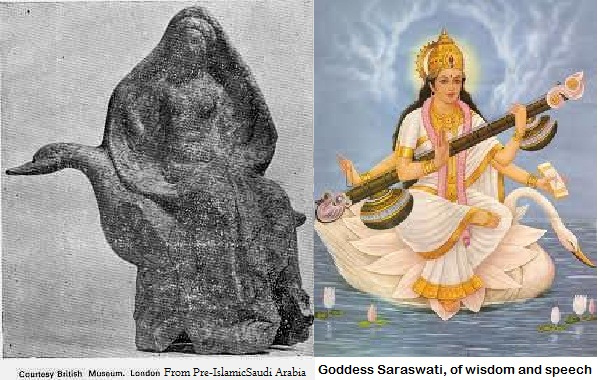
    These included the Navagrahas and Saraswathi.

    The three Goddesses mentioned above are from the Hindu Trinity of Goddesses Saraswathi,Lakshmi and Durga.

    Please read my articles on Mithraism around the world.

    Will be writing on these  Arabian Gods and Goddesses in detail.

    The Goddesses Al-Uzza, Al-Lat and Menat formed a triad in pre-Islamic Arabia. They were widely worshipped: from Nabatean Petra in the North to the legendary Kingdoms of Arabia Felix in the South, including Saba, the Biblical Sheba; as far east as Iran and Palmyra; and the three of them were very popular Goddesses in Mecca at the time of Mohammed. From left they are: Al-Uzza, whose name means “The Mighty One”, the Goddess of the Morning Star; Al-Lat, the Mother, whose name means simply “The Goddess”, as Al-Lah simply means “The God”; and Manat, Crone-goddess of Fate or Time. Sometimes the three of them are referred to as the daughters of Al-Lah; sometimes Manat and Al-Lat are considered daughters of Al-Uzza.(. Image and quote from. http://www.thaliatook.com/AMGG/arabtriple.php )

    The pre-Islamic Arabs believed Manāt to be the goddess of fate. The followers prayed to her for rains and victory over enemies. She was considered the wife of Hubal.There are also connections with Chronos of Mithraism and Zurvan mythology. The Book of Idols describes her:

    The most ancient of all these idols was Manāt. The Arabs used to name [their children] ‘Abd-Manāt and Zayd-Manāt. Manāt was erected on the seashore in the vicinity of al-Mushallal in Qudayd, between Medina and Mecca. All the Arabs used to venerate her and sacrifice before her. The Aws and the Khazraj, as well as the inhabitants of Medina and Mecca and their vicinities, used to venerate Manāt, sacrifice before her, and bring unto her their offerings… The Aws and the Khazraj, as well as those Arabs among the people of Yathrib and other places who took to their way of life, were wont to go o

    n pilgrimage and observe the vigil at all the appointed places, but not shave their heads. At the end of the pilgrimage, however, when they were about to return home, they would set out to the place where Manāt stood, shave their heads, and stay there a while. They did not consider their pilgrimage completed until they visited Manāt.

    — Book of Idols, pp 12–14

    The attack on Somnath Temple in India in AD 1024 by Mahmud of Ghazni may have been inspired by the belief that an idol of Manat had been secretly transferred to the temple.According to the Ghaznavid court poet Farrukhi Sistani, who claimed to have accompanied Mahmud on his raid, Somnat (as rendered in Persian) was a garbled version of su-manat referring to the goddess Manat. According to him as well as a later Ghaznavid historian Gardizi, the images of the other goddesses were destroyed in Arabia but the one of Manat was secretly sent away to Kathiawar (in modern Gujarat) for safe keeping. Since the idol of Manat was an aniconic image of black stone, it could have been easily confused with a Shiva lingam at Somnath. Mahmud is said to have broken the idol and taken away parts of it as loot and placed so that people would walk on it. In his letters to the Caliphate, Mahmud exaggerated the size, wealth and religious significance of the Somnath temple, receiving grandiose titles from the Caliph in return.

    Reference and citation.
    Thapar, Romila (2004), Somanatha: The Many Voices of a History, Penguin Books India, pp. 45–51, ISBN 1-84467-020-1

    https://en.m.wikipedia.org/wiki/Manāt#cite_ref-10

    • Ibn al-Kalbī; (author) and Nabih Amin Faris (translator & commentary) (1952): The Book of Idols, Being a Translation from the Arabic of theKitāb al-Asnām. Princeton University Press. LCCN 52-6741.
    • Grunebaum, G. E. von (1970). Classical Islam: A History 600 A.D. – 1258 A.D.. Aldine Publishing Company. ISBN 978-0-202-15016-1.
  • Arabia Land Of Liquor From Dates,Ramayana

    I had written on the Kingdom of Rama and how it encompassed the world.

    Also how he fought against the Atlanteans.

    There are references in the Ramayana about the various Kingdoms where people belonging to Sanatana Dharma resided and some who did not subscribe to the Sanatana dharma and were called Milechas.

    Lord Rama.jpg
    Lord Rama In Sumeria

    There were also people though rooted in Sanatna Dharma followed a slightly different form of religion, like the Dravidas.

    One more group of people were those who were the antagonists of the  Kings who followed Sanatana Dharma and they were called as Dasyus.

    In the course of sifting through the groups mentioned in the Vedas,Puranas, Ramayana and Mahabharata , one comes across references to places which we now consider as Foreign.

    One has to remember that the landmass of ancient times was different from what it is today.

    Please read my articles on this.


    The Ramayana mentions Arabia thus,

    ikṣhūn madhūn tathā lājān maireyān cha vara āsavān |
    pānāni cha mahāarhāṇi bhakṣhyān cha uchcha avachān tathā || 1-53-2

    2. ikSuun madhuun tathaa laajaan = sugar-cane [and its dishes,] honey [and its dishes,] like that, cornflakes, [rice-flakes etc.,]; vara aasavaan [aasanaan] = best, liquors [or, with best wineglasses]; maireyaan ca = arracks [Arabic ‘arak ‘sweat’, ‘arak al-tamr ‘alcoholic spirit from dates in Arabia, and from sugar-cane and rice in India,] also; mahaa arhaaNi paanaani ca = highly [very,] apposite to [royalties and army-men,] drinks, further; tathaa = like that; ucca avacaan = verily, diverse; bhakSyaan ca = foodstuffs, also; [shabala vidadhe = Shabala, bestowed.]

    Shabala bestowed dishes of sugar cane and honey, and flakes of all sorts, like cornflakes, rice-flakes, also best arracks and liquors in best wineglasses, further, the drinks and foodstuffs that are very diverse and verily apposite to royalties and army-men. [1-53-2]’

    Valmiki Ramayana , Bala Kanda, Sarga 533, Sloka 2

    Arabia was known for Arrack, a local intoxicating Spirit brewed from Dates.

    Reference and Citation.

    http://www.valmikiramayan.net/utf8/baala/sarga53/balaroman53.htm

    Join 4,576 other subscribers
    May 2026
    M T W T F S S
     123
    45678910
    11121314151617
    18192021222324
    25262728293031
  • Saudi Arabia Vedic, Vikramaditya’s Kingdom

    Many lands and its people have forgotten their History.


    Most of the histories of the Ancient Civilizations were either destroyed or doctored by the British to suit their Political aspirations and for the spreading


    of Christianity

    Empire of Vikramadhitya. Image
    Vikramadhitya Empire

    Starting from Africa,, Vikings.Pagans, Romans, Polynesian Islands, you would find that the ancient history of these people are either lost or at best very hazy.


    Muslims did not lag behind in this quest for colonization and zeal to spread their Religion, Islam.


    Recently I found that the traces of the ancient Religion of the Africans have been erased and you would find absolutely no information on their Religion


    excepting about Christianity and Islam.


    What little is known of the Great African Religion is doctored and is subject to some derogatory terms under the guise of describing it by


    “Syncretization” and the like.


    I posted an article on this.


    Now it seems that Saudi Arabia is also on this list.


    Nothing seems to be there that was before the advent of Islam.


    Arabs are described even today as uncouth, use flowery language,indecisive and are generally unreliable.


    As if to compensate this patronizingly it is stated that they are very hospitable. that’s all.


    Please read any book that has a Middle East Character,including the much acclaimed ‘Oh!Jerusalem


    People of Saudi Arabia seem to know nothing about their History sans the ones  relating to Islam or during the Crusades!


    They have taken to the description of their ancestors having been labelled a Nomads!


    I have read some information on this subject and am sharing it here.


    Seems to me that this tallies with the kingdoms and Land Mass describe din Hindu Purans.


    Arabia is an abbreviation. The original word even today is Arbasthan. It originates in Arvasthan. As observed earlier Sanskrit “V” changes into “B”. Arva in Sanskrit means a horse. Arvasthan signifies a land of horses, and as we all know Arabia is famous for its horses.

    In the 6th and 7th centuries A.D. a wave of effecting a complete break with the past spread over West Asia. All links with the past were broken, images smashed, scriptures destroyed, education discontinued and the entire West Asian region took a plunge in abysmal ignorance which lasted for centuries thereafter and perhaps persists to a certain extent even today because if in the whole world modern scientific and educational developments find stubborn and entrenched resistance anywhere it is in the West Asian countries. It is said that the late Saudi Arabia ruler could not permit a radio broadcasting station opened in his own capital because of opposition from his Maulavis. He then resorted to a stratagem. Once while he had his council of Maulavis in attendance he had a radio set switched on to a program of Koranic recitation broadcast from a small transmitting station set up earlier without much ado. The Maulavis were delighted, so goes the report, to hear the word of Allah coming to them as if from nowhere. The king told them that what objections could they have to a mechanism which broadcast the word of Allah. The Maulavis agreed and the small radio broadcasting project was at last ratified.

    According to Encyclopedia Britannica and Séance Islamia the Arabs are ignorant of their own history of the pre-Muslim era. By a strange euphemism they call it a period of ignorance and darkness. Probably no other country in the world has deliberately written off a 2,500 year period of their own history by systematically stamping out and snapping all links with the past. They have wiped the memories of preMuslim era off their minds. So while they chose to remain ignorant of their past ironically enough it is they who dub the pre-Muslim era as a period of ignorance.

    Fortunately we can still trace the history of that preIslamic Arabia. It is a well known adage that there is no such thing as foolproof destruction of all evidence. The pre-Islamic history of Arabia is the story of Indian Kshatriyas over that land, with the people following the Vedic way of life.

    In our attempt to reconstruct the story of pre-Islamic Arabia we begin with the name of the country itself. As explained earlier the name is fully Sanskrit. Its central pilgrim centre, Mecca is also a Sanskrit name. Makha in Sanskrit signifies a sacrificial fire. Since Vedic fire worship was prevalent all over West Asia in pre-Islamic days Makha signifies the place which had an important shrine of fire worship.

    Coinciding with the annual pilgrimage of huge bazaar used to spring up in Makha i.e. Mecca since times immemorial. The annual pilgrimage of Muslims to Mecca is not at all an innovation but a continuation of the ancient pilgrimage. This fact is mentioned in encyclopedias.

    VIKRAMADITYA

    Evidence is now available that the whole of Arabia was part of the great Indian King Vikramaditya’s vast empire. The extent of Vikramaditya’s empire is one of the main reasons for his world wide fame. Incidentally this also explains many intriguing features about Arabia. It could be that Vikramaditya himself had this peninsula named Arvasthan if he was the first Indian monarch to capture it and bring it under his sway.

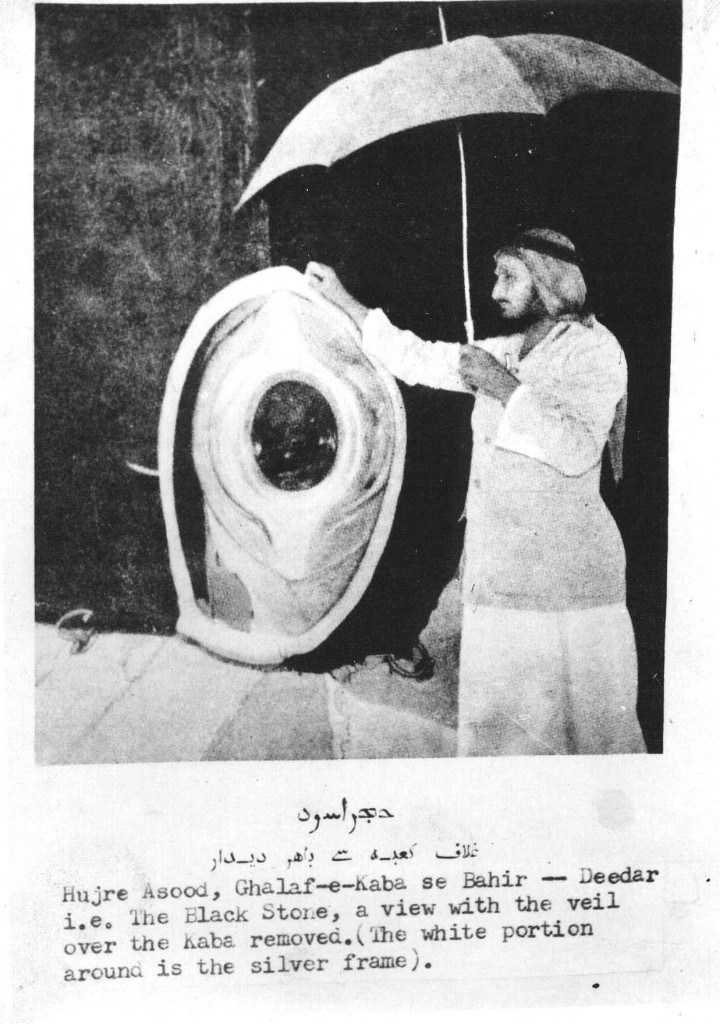
    The second intriguing aspect is the existence of a Shivalinga or the Mahadeva emblem in the Kaaba shrine in Mecca. Before going into further details about the ancient Vedic rituals and names still clinging to Muslim worship at Mecca we shall see what evidence we have about Arabia having formed part of Vikramaditya’s dominions.

    ANTHOLOGY OF ANCIENT ARABIC POETRY: SAYAR-UL-OKUL

    In Istanbul in Turkey, there is a famous library called Makteb-e-Sultania which is reputed to have the largest collection of ancient West Asian literature. In the Arabic Section of that library is an anthology of ancient Arabic poetry. That anthology was compiled from an earlier work in A.D. 1742 under the orders of the Turkish ruler Sultan Salim.

    The ‘pages’ of that volume are made of HAREER – a kind of silk used for writing on. Each page has a decorative gilded border. It may be recalled that gilding pages of sacred books is an ancient custom associated with old Sanskrit scriptures found in Java and other places. The anthology itself is known as SAYAR-UL-OKUL. It is divided into three parts, the first part contains biographic details and the poetic compositions of pre-Islamic Arabian poets. The second part embodies accounts and verses of poets of the period beginning just after Prophet Mohammad up to the end of Banee- Ummayya dynasty. The third part deals with later poets up to the end of Khalifa Harun-al-Rashid’s times. Incidentally “Banee” means “Vanee” and Ummayya as in Krishnayya are Sanskrit names.

    Abu Amir Abdul Asamai, a distinguished Arabian bard who was the Poet Laureate of Harun-al-Rashid’s court has compiled and edited the anthology.

    The first modern edition of Sayar-ul-Okul anthology was printed and published in Berlin in A.D. 1864. A subsequent edition was published in Beirut in A.D. 1932. This work is regarded as the most important and authoritative anthology of ancient Arabic poetry. It throws considerable light on the social life, customs, manners and entertainment forms in ancient Arabia. The book also contains an elaborate description of the ancient Mecca shrine, the town and the annual fair known as OKAJ which used to be held there every year. This should convince readers that the annual Haj of the Muslims to the Kaaba is only a continuation of the old fair and not a new practice.

    But the OKAJ fair was far from a carnival. It provided a forum for the elite and learned to discuss the social, religious, political, literary and other aspects of the Vedic culture then pervading Arabia. Sayar-ul-Okul asserts that the conclusions reached at those discussions were widely respected throughout Arabia. Mecca, therefore, followed the Varanasi tradition of providing a seat for important discussions among the learned while the masses congregated there for spiritual bliss. The principal shrines at both Varanasi in India and at Mecca in Arvasthan were Shiva temples. Even to this day the central object of veneration at both Mecca and Varanasi continues to be the ancient Mahadeva emblems. It is the Shankara stone which Muslim pilgrims reverently touch and kiss in the Kaaba.

    ENTRY OF NON-MUSLIMS FORBIDDEN

    A few miles away from Mecca is a big signboard which forbids entry to any non-Muslim in the area. This is a reminder of the days when the Shrine was stormed and captured solely for the newly established faith of Islam. The object obviously was to prevent its recapture.

    As the pilgrim proceeds towards Mecca he is asked to shave his head and beard and to don a special sacred attire. This consists of two seamless sheets of white cloth. One is to be worn round the waist and the other over the shoulders. Both these rites are remnants of the old Vedic practice of entering Hindu shrines, clean shaven and with holy seamless spotless white sheets.

    The main shrine in Mecca which houses the Shiva emblem is known as the Kaaba. It is clothed in a black shroud. This custom could also originate from the days when it was thought necessary to discourage its recapture. According to encyclopedias Britannica and Islamia the Kaaba had 360 images. Traditional accounts mention that one of the deities among the 360 destroyed, when the shrine was stormed, was that ofSaturn, another was of the moon and yet another was one called Allah. In India the practice of Navagraha puja that is worship of the nine planets is still in vogue. Two of these nine are the Saturn and the moon. Besides, the moon is always associated with Lord Shankara. A Crescent is always painted across the forehead of the Shiva emblem. Since the presiding deity at the Kaaba shrine was Lord Shiva i.e. Shankara, the crescent was also painted on it. It is that crescent which is now adopted as a religious symbol of Islam. Another Hindu tradition is that wherever there is a Shiva shrine the sacred stream of Ganga that is the Ganges must also co-exist. True to that tradition a sacred fount exists near the Kasba. Its water is held sacred because it was regarded as but another Ganga since pre-Islamic times. Muslim pilgrims visiting the Kaaba shrine go around it seven times. In no other mosque does this perambulation prevail. Hindus invariably perambulate around their shrines. This is yet another proof that the Kaaba shrine is a pre-Islamic Shiva temple where the Hindu practice of perambulation is still meticulously observed.

    ‘According to tradition, Chandragupta II achieved power by assassinating a weak elder brother. Inheriting a large empire, he continued the policy of his father, Samudra Gupta, by extending control over neighbouring territories. From 388 to 409 he subjugated Gujarat, the region north of Bombay (Mumbai), Saurastra (now Saurashtra), in western India, and Malwa, with its capital at Ujjain. These territories were ruled by Shaka chiefs, whose ancestors were Scythian tribes from the regions around Lake Balkhash (Balqash) in Kazakhstan. To strengthen his southern flank, he arranged a marriage between his daughter Prabhavati and Rudrasena II, king of the Vakatakas. When Rudrasena died, Prabhavati acted as regent for her sons, thereby increasing Gupta influence in the south. The emperor may also have made a matrimonial alliance with a dynasty in Mysore. He is almost certainly the King Chandra eulogized in the Sanskrit inscription on the iron pillar in the Qūwat al-Islām mosque in Delhi.

    Vikramadhitya  Brittanica.com

    Saudi Arabia Hindu Kingdom

    Islamic Review


    http://ramanan50.wordpress.com/2013/12/02/shiva-linga-in-mecca-om-is-786/

    Enhanced by Zemanta