Tag: Ancient indian texts

  • Where To Look For Ancient Indian Texts US Canada

    Where To Look For Ancient Indian Texts US Canada

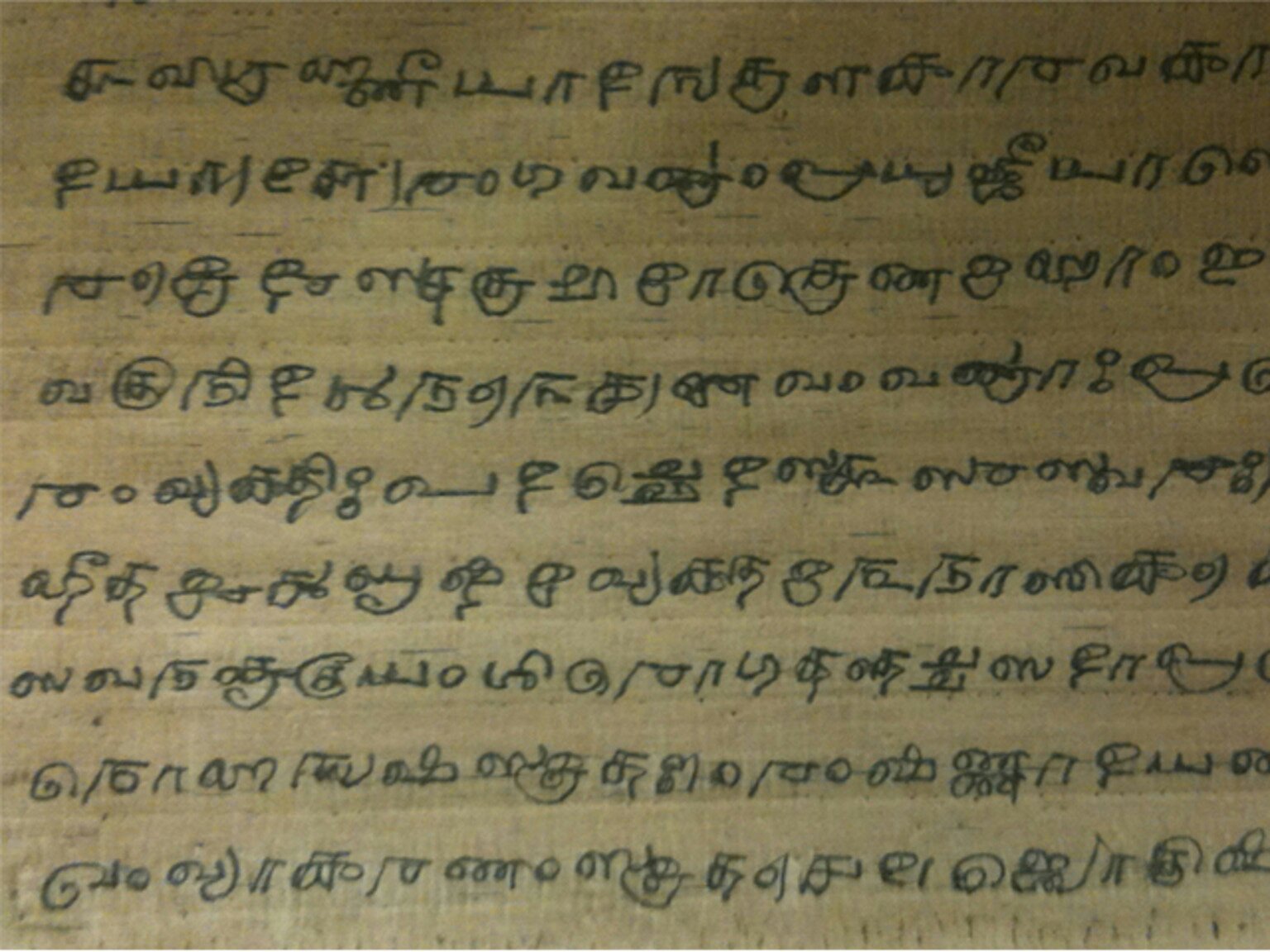
    Through Hindu religious scriptures were/ are passed through oral traditions to succeeding generations,some of them especially relating to Tantra and rare stothras, Grammar, Sanskrit literature were later transcribed in the form of manuscripts.They are, in general ,written on Palm leaves.Not only in Sanskrit but literature, philosophical , religious texts in Indian regional languages like Tamil were also written in Palm Leaves.Vedas, the most authentic scriptures of Hinduism was transmitted orally. However, these were also written during later periods and the Manuscripts of the Vedas ,at least some of them are in Pune. I have written on this.

    The complete corpus of Vedic mantras as collected in Bloomfield‘s Vedic Concordance (1907) consists of some 89,000 padas (metrical feet), of which 72,000 occur in the four Samhitas”

    This is only for the Samhitas.

    Brahmanas,Aranyakas,Upanishads remain.

    There seems to be no information on when the Vedas were written in the form of manuscripts.

    The Digitized copies  of The Rigveda Brahmanas: the Aitareya and Kausītaki Brāhmanas of the Rigveda are in American Libraries.

    (Link provided below).https://ramanisblog.in/2014/07/23/where-are-manuscripts-of-vedas/

    Manuscripts form an invaluable part of India’s documentary heritage. They capture our thoughts, achievements, experience and lessons learnt from history; in other words, they constitute our ‘memory.’ The National Mission for Manuscripts has taken the initiative to nominate Indian manuscripts for inclusion in UNESCO’s Memory of the World register. Under this programme, UNESCO provides recognition to the most valuable documentary heritage of the world and facilitates its preservation and universal access to it. Moreover, efforts are made to increase awareness of the significance of these records.

    The Shaiva manuscripts in Pondicherry were awarded the status of UNESCO’s Memory of the World in 2005 in an application jointly submitted by the French Institute of Pondicherry, Centre for Ecole francaise d’Extreme-Oriente (EFEO) and the National Mission for Manuscripts.The Mission had submitted 2 nominations to UNESCO:

    • Collection of Rigveda manuscripts at Bhandarkar Oriental Research Institute, Pune
    • Gilgit manuscripts at the National Archives of India, New Delhi and the Department of Archaeology, Archives and Museums, Jammu and Kashmir https://www.namami.gov.in/memory-world

    We can also find ancient Indian manuscripts at Library of Congress US and Canada.

    The following is post by Jonathan Loar, South Asian Reference Librarian, Asian Division)

    In 1938, the Library of Congress received a three-year grant from the Carnegie Corporation to establish a project for the development of Indic studies, which was the Library’s first initiative to collect South Asian materials systematically. This grant enabled the project’s director, Horace Poleman, to spend about a year in India between 1939 and 1940. Urgency moved him to collect both rare books and contemporary works on modern affairs, as the outbreak of World War II cast uncertainty on the future of obtaining publications from India and the rest of the region. Poleman’s trip resulted notably in the Library’s acquisition of a large number of Sanskrit manuscripts, such as the Vyavasthasarasangraha (a compendium of Hindu authorities on religious law), Sarasvatistotra (a hymn of praise to the Hindu goddess of learning and music Saraswati), and a copy of Raghunandana Bhattacarya’s Tithitattva (a treatise on Hindu rituals to be performed on specific lunar days) dated to 1628.

    Sanskrit is one of the principal classical languages of ancient India. The word itself means something like “perfected,” “refined,” or “well put together” (sam – together, krta – done, made). Works in Sanskrit are found throughout Buddhist, Jain, and Hindu religious traditions. For many Hindus, it is a sacred medium of expression – the language of ancient scriptures such as the Vedas, Upanishads, and Bhagavad Gita. Many people are familiar with Sanskrit in the Devanagari script – the same script used for Hindi, Nepali and other modern vernaculars – but Sanskrit texts have also been written in other writing systems, (e.g., the Grantha in southern India, the Sharada in Kashmir). To get a sense of what the language sounds like, check out some samples of poetry and prose from contemporary Sanskrit authors in the Library’s South Asian Literary Recordings Project.

    Sanskrit vowels and consonants with a guide to pronunciation, from H.H. Wilson’s “An Introduction to the Grammar of the Sanskrit Language,” 1841, Library of Congress general collections. Also freely available on HathiTrust.

    Poleman was prepared for his acquisition trip to India. In addition to holding a doctorate in Sanskrit from the University of Pennsylvania, he had already authored a comprehensive census of Indic manuscripts in North American libraries. The range of manuscripts in the Library’s collection reflects his deep understanding of Sanskrit literature. The majority deal with religious subjects, like the Anantapuja (worship), Shraddhasankalpa (funerary rites), and Gayatrisahasranamastotra from the Rudrayamala (esoteric religion, or tantra). There are also smaller works from sections of the Padma Purana, Brahmanda Purana, and other puranas, or religious texts that tell the stories of Hindu gods and goddesses. Notable works on other topics are the Vaiyyakaranasiddhantaratnakara (grammar) and Sanketakaumudi (astrology).https://blogs.loc.gov/international-collections/2018/01/sanskrit-manuscripts-in-the-south-asian-rare-books-collection/

    One can find rare manuscripts relating to Philosophy,Science, Astronomy, Astrology, Tantra Sastra, Grammar,..whole spectrum of Knowledge as acquired by Ancient India. These texts cover Hinduism,Jainism, Buddhism,Carvakas and Six systems of Indian Philosophy These texts are in Sanskrit,Pali.

    A census of Indic manuscripts in the United States and Canada,Cite Record.
    https://lccn.loc.gov/39001439
    Poleman, H. I. (Horace Irvin), 1905-1965. A census of Indic manuscripts in the United States and Canada, compiled by H. I. Poleman. New Haven, Conn., American oriental society, 1938.
    xxix, 542 p. 26 cm.
    Z6605.I5 P7. Visit the following Link.https://catalog.loc.gov/vwebv/citeRecord?searchId=612&recPointer=0&recCount=25&searchType=1&bibId=1691194

    Check this link also for rare collection.https://www.hathitrust.org/about
  • List of Over 1000 Ancient Indian Rare Manuscripts Tokyo University

    List of Over 1000 Ancient Indian Rare Manuscripts Tokyo University

    Treasures of Ancient Indian texts were transmitted

    orally .

    Later material was written in Palm leaves.

    This system was followed in Sanskrit, Pali,Prakrit and by regional languages like Tamil.

    Transfer of texts orally ensured that they were not lost by arson or destruction by Invaders.

    However lot of Manuscripts have found their way into Foreign Museums, Smithsonian, Gallery of Arts, UK, The Louvre , Paris, Vatican. ….


    Some of the materials are very rare and they contain advanced scientific thoughts and philosophy.

    One such collection is found in Matsunami Collection, Japan.

    It has over 1000 Books, with commentary and elaborate notes.

    They cover Veda, Tantra, Buddhism, Advanced Yoga,and Scientifique treatises.

    Would philanthropists or the Government restore these treasures back to India?

    And more treasures like,

    Vedic Atreya Shiksha in Tamil in GermanyVedic Atreya Shiksha in Tamil in Germany

    # A Palmleaf manuscript is shown as Featured Image.

    Siddhas Manuscripts

    CONTENTS 
    
    
    Photographs of Manuscripts .Frontispiece 
    
    Preface. iii 
    
    Acknowledgement. v 
    
    Abbreviation . vi 
    
    Part I Short Descriptions of each Manuscript. 1 
    
    Part II Catalogue of the Contents. 185 
    
    Section I. Sutra . 187 
    
    Section II. Avadana. 213 
    
    Section III. Tantra. 245 
    
    Section IV. Dharanl . 287 
    
    Section V. Sastra . 350 
    
    Section VI. Non-Buddhist Work . 360 
    
    Appendix. 375 
    
    Tables of the New and Old Numbers of the Manuscripts . 377

    Reference and citation.

    Matsunami 1965, A Catalogue Of The Sanskrit Manuscripts In The Tokyo University Library

  • By Whom How Indian Texts Became Myths

    Even when evidence from various sources like Archeological, Epigraphy, Linguistics, Stratification of earth, Geology,Plate tectonics , Thermal imaging of Rocks and from literature around the world cultures in different languages,it is a herculean task to prove that the ‘Myths’ tag attached to Indian texts, Puranas, Ithihasa and other ancient Indian texts.

    Why is it so?

    What is a Myth?

    Myth is what is untrue.

    Though many definitions are provided laboriously,the term Myth is from Sanskrit word, Mithya,which means ‘of illusory nature,an illusion’

    Later this term was used to denote things which are untrue.

    This term was conveniently used to denote things which you do not understand or belongs to a Culture,faith, civilisation which is older than Christianity.

    Everything must be related to Christ,is the zeal of Christianity.

    Thus we have this non sense of BC,of relating an event to the birth of Christ even though the event in question preceded Christ,causing confusion in dating.

    When the Britishers found,to their chagrin,that the History of India to be quite ancient and was factual and one that ran contrary to Christianity, especially relating to the age of the Universe and Earth,and they needed a tool to bring in India under their rule.

    They realised that the major stumbling block was Hinduism,which was the uniting factor of Indians.

    They adopted some strategies.

    1. Call Indian texts as Myths.

    2. Infiltrate Hinduism in the guise of scholars like Maxmueller and destroy it cunningly,by misinterpret Hindu texts.

    3.Offer inducements to converts Including money.

    4. Pose as Literati and misinterpret Indian literature in Regional languages like Tamil.

    5. Open free educational institutions.

    6.Misguide the gullible by ‘Miracles’

    7. Use Christian organisations in the garb of NGOS and convert.

    Under the classification of calling Indian texts as Myths,they had the History of India published by James Mill who wrote the History of India from Britain without ever visiting India or reading Indian texts.

    Mr.Mill & Mr. Grant classified these texts as Mythological on the following 4 grounds:

    1. The events in these texts seemed to go before the

    Date of creation of the earth as fixed by Father. James Usher as 9 AM, 23rd Oct, 4004 BCE.(Because According to Bible Earth is created 6000 years ago).

    ▪ If Earth is Created 6000 Years ago, How come Ramayana can happen 7000 years ago?.

    ▪ But Science has Now Proved that Earth is not 6000 years old, But it is Billions of Years old.

    2. Early British Scholars Believed in Fake Aryan Invasion Theory

    ▪ Early British Scholars like Max-Muller, Martin-Luther King, Griffith etc Proposed Aryan Invasion Theory .’

    I have articles with evidence that all these statements are lies.

    Seemingly well qualified scientists and others dismiss India’s rich culture, History and the icons of India, Rama, Krishna,Shiva, despite being presented with astronomical archeological evidence.

    Such is the entrenched misinformation by the British in their about 350 years of Rule of India.

    If one were to look for information on India and Hinduism, references pop up written by Western Authors, most of them self-proclaimed Missionaries, starting from Robert De Nobili of Tamil Nadu, Bishop Caldwell, Max Mueller, right to our secular educated Indians.

    It was by James Mill who wrote the First Book, ‘History of British India’ in 1806.

    ( His son John Stuart Mill was a great Western Philosopher)

    “James Mill began his History of British India in 1806, expecting it to take him about three years, but its completion proved to take instead twelve years, with three substantial volumes at last being published early in 1817. The work was immediately successful among British imperialists and secured for Mill for the first time a degree of prosperity. It led, with the support of David Ricardo andJoseph Hume, to Mill’s appointment in 1819 in United_Kingdom as assistant (later chief) examiner of correspondence at the imperialEast India Company at an annual salary of £800. By 1836, when he died, this income had become £2,000”

    https://ramanisblog.in/2015/01/11/how-indian-history-was-distorted-the-first-history-of-india/

    https://www.quora.com/What-is-the-scientific-proof-that-the-Ramayana-had-actually-happened/answer/Nagarjun-Nagu?ch=10&share=4170d22c&srid=pNfl