
About six months back my wife’s sister’s husband told me that he did not believe that Lord Krishna did not deliver the Discourse of Srimad Bhagavad Gita.
His argument was that, in the midst of a war, no body would have noted what Krishna spoke, that too,six hundred Couplets.
Quite ingenious.
In the same vein, my son once told me that the tamil Classics ,especially Thevaram,Thiruvaasakam,Naalaayira Divya Prabhandam could not have been written by those to whom they are attributed to for no body would have taken notes when these Saints were composing these works.
My reply , especially on Srimad Bhagavad Gita, has been explained in,my blog, filed under Indian Philosophy,Hinduism,Bhakti.
To day I happened to watch a Film,’Anonymous’ on SonyPix.
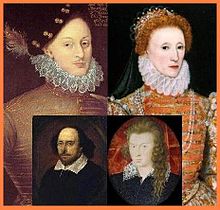
It was set against the background of Queen Elizabeth(Middle ages) and The theory that Edward de Vere, 17th Earl of Oxford. wrote The plays of Shakespeare.
I was curious and checked the web.
I found some interesting information.
Theories of incest and plagiarism.
Of Course, no final word has been said.
”
The Oxfordian theory of Shakespeare authorship proposes that Edward de Vere, 17th Earl of Oxford (1550–1604), wrote the plays and poems traditionally attributed to William Shakespeare of Stratford-upon-Avon. While a large majority of scholars reject all alternative candidates for authorship,[1] there is popular interest in various authorship theories.[2] Since the 1920s, Oxford has been the most popular candidate among “anti-Stratfordians,” a collective term for adherents of the various alternative-authorship theories.[3][4][5]
The convergence of documentary evidence of the type used by academics for authorial attribution—title pages, testimony by other contemporary poets and historians, and official records—sufficiently establishes Shakespeare’s authorship for the overwhelming majority of Shakespeare scholars and literary historians,[6] and no evidence links Oxford to Shakespeare’s works.[7] Oxfordians, (as those who subscribe to the theory are usually called), however, reject the historical record, often proposing the conspiracy theory that it was falsified to protect the identity of the real author and invoking the dearth of evidence for any conspiracy as evidence of its success.[8] Some Oxfordians believe that Shakespeare acted as a “front man,” receiving the plays from Oxford and pretending to have written them, but others claim that he was simply a merchant from Stratford who had nothing to do with the theatre.
http://en.wikipedia.org/wiki/Oxfordian_theory_of_Shakespeare_authorship
The Prince Tudor theory (also known as Tudor Rose theory) is a variant of the Oxfordian theory of Shakespeare authorship, which asserts thatEdward de Vere, 17th Earl of Oxford was the true author of the works published under the name of William Shakespeare. The Prince Tudor variant holds that Oxford and Queen Elizabeth I were lovers and had a child who was raised as Henry Wriothesley, 3rd Earl of Southampton. The theory followed earlier arguments that Francis Bacon was a son of the queen. A later version of the theory, known as “Prince Tudor II” states that Oxford was himself a son of the queen, and thus the father of his own half-brother.
http://en.wikipedia.org/wiki/Prince_Tudor_theory
Similarly there are opinions that the Thirukkural was not written by Thiruvalluvar.The arguments are.
A single individual could not have written on such a wide range of subjects , that too vividly.
The name ‘Valluvar’ denotes a Caste.
Bhagavad Gita is reported to have been written/compiled by Vyasa.
Same confusion abounds in India.
And the name they use was used by a number of persons ( example Avvaiyar)
The main reason is that the authors never used their real names.
For that matter, names in India were only indicative, of Community,Clan,Quality and the like.
Krishna -Black.
Rama-one who is liked.
Vyasa-Compiler.
Secondly, they never wrote with the intention of being spoken of nor for Royalty.
My view is that enjoy the work and do not bother about who wrote it.
In fact The Bible was complied three hundred Years after the Death of Jesus Christ,.(please read my blogs on Christianity)
The mythological pantheon of epics may have uncertain authorship, and it doesn’t matter whether a single individual or a tradition created the work. In modern narrative, from a single point of view, the author does matter. He is the unseen guide for the reader as he enters an entire world-view, and there is a natural impulse to know more of this friend, mentor, Virgil on the journey.
The case of Shakespeare, the works and the person, frustrate this natural connection. The presumed life of the author has no resemblance to the character, vocabulary, station, or motives shown or hinted about the Shakespeare canon’s creator. This is more than a frustration in appreciation but a violation of what human creativity is. We are expected to believe that with little or no education, no demonstrable interest in knowledge or art, a murky understanding of his years in London, the legal proof that he was a penurious and litigious materialist, and that no one during his life or upon his death paid tribute to him as the great Shakespeare–by magic or miracle, this man still wrote a million rhetorical words of profundity and beauty.
Your summary is most unfair and in many places incorrect. I recommend the following enlightening monographs: Mike A’Dair, Four Essays on the Shakespeare Authorship Question; Katherine Chiljan, Shakespeare Suppressed; Mark Anderson, Shakespeare by Another Name; Richard P. Roe, The Shakespeare Guide to Italy,Retracing the Bard’s Unknown Travels.