Tag: Vedas

  • Gayatri Mantra Produces  Sound Waves Hoax And  Real Study

    Gayatri Mantra Produces Sound Waves Hoax And Real Study

    In the year 1969, when I was studying in the Vivekananda College,Chennai, I had a professor of Indian Philosophy, Dr.Radha Krishnan.

    He demonstrated an experiment on the Mantras,

    He had l a learned Veda Pandit  recite the Beeja Mantras.

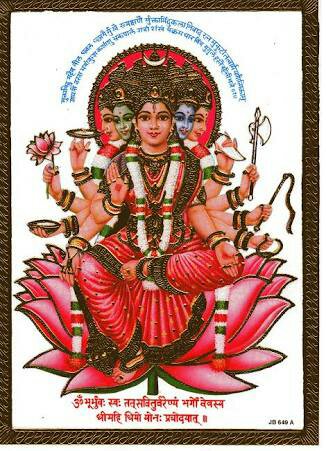
    Effect of Gayntri Mantra on Human Body.Image.jpg
    Effect of Gayntri Mantra.

    The Mantra on Ganesha produced an outline of Ganesha as we see Him in Temples appeared on the TV Screen, though the details were not very distinctively seen.

    Similar results were for Devi and Subrahmanya and Rudra.

    But when the Gayatri Mantra was recited, the picture tube blew up.

    We left it at that.

    What is certain is that the Mantras unleash energy, at highest levels.

    I had posted an article as to how the first two lines of The Purusha Suktha produce electricity and a Bangalore based Company has developed the technology.

    And there are reports that Shiva Linga spewed DNA.

    Consider the points of similarity between D.N.A. and Shiva.

    It is well known that Shiva is Ugra and his name also is Ugra. Ugra means an acid. D.N.A. is also an acid. Vedanta calls that Hiranyagarbha as Sutratma.

    Sutratma means an Atma in the form of Sutra i.e. a thread or filament.

    The modern science admits that a DNA molecule is really like a thread or filament.

    “In a single human germ-cell this filament of DNA is about one metre in length”, says Watson in his book ‘The Double Helix’.

    The Yoga-science calls it Mahan, the great. It is really great because it is present in all the living things.

    Its molecular weight is one million, so the scientists call it ‘great’. It has no birth. It develops from itself. DNA also duplicates, that means develops from itself. Mr. J. D. Watson describes this as ‘self replication’.(Ramani’s blog)

    The Gayatri Mantra is the most potent of all Mantras.

    I reproduce abstarct of some research on the Gayatri Mantra.

    Gayatri Mantra – A Study


    A Dissertation Submitted By Neha Racca

    Under the guidance of Prof. N.V.C.Swamy & Dr. H.R.Nagendra


    Abstract: The Gayatri occurs in the Rig, Yajur and Sama Vedas. It is a prayer to the sun, supposed to be recited ritualistically at dawn, midday and dusk. Even though the Mantra is known as the Gayatri, its real name is Savitri Mantra. There are thousands of Mantras in the Vedas set to Gayatri Chandas. However, the Savitri Mantra is so famous that it has come to be associated with the Chandas itself.

    Here in this report I have tried to provide a bird’s eye-view of the subject. This work gives a brief summary of the various aspects of Gayatri Mantra.

    The report starts with a brief description of Mantra yoga and japa, which includes Gayatri Mantra as japa. This is followed by the description of the Gayatri as personal mother and its inner meaning. Then the story of Vinvamitra is mentioned who was the rishi to whom Gayatri was first revealed.

    The most basic of all samskaras namely upanayana and the significance of the sacred thread is given in detail. The use of Gayatri Mantra in the form of meditation and as the greatest step towards illumination is included in this report.

    Then comes the Gayatri sadhana and how one can practice Gayatri meditation and the technique of japa with the beauty of the powerful kriya while chanting the Gayatri Mantra. The report closes with the benefits of the Gayatri Mantra in various aspects such as psychological, physical, spiritual etc. and tells us the way to get rid of our general problems.

    An attempt has been made in this report to cover most of the major aspects of Gayatri Mantra and the different types of Gayatris to help in different ways. Still I believe since it is a very vast subject I must have left some aspects of the greatest Mantra Gayatri, but it gives almost everything in brief about our earliest and traditional Mantra ie. Gayatri Mantra and sandhya vandana.


    Summary & Conclusion:  

    1. Present study was designed to examine the possibilities of influencing the REG by Gayatri Mantra chanting (GM) in contrast to Random Thinking (RT) sessions in normal males: (a) before and after GM session & (b) before and During the GM sessions and (c) during and post sessions.

    2. Present study further examined whether GM can enhance the capacity of individuals who can significantly influence the REG in comparison to Random Thinking.

    3. Thirty males in the age group 18 to 25 years participated in Gayatri Mantra chanting (GM) on the first day and Random Thinking (RT) session at the same time on the second day and repeated them alternately for two more days to check the reproducibility of the results.

    4. The pre, during and post sessions of GM and RT for 10 minutes each having same number of trials (ie. 10). The output display of Random Event Generator (REG) on a laptop computer was used to assess the influence of the state of mind associated with the above sessions.

    5. The PRE – PRE comparisons show that pre-data do not differ significantly (p>0.1) between the two events showing a matching of initial data in both the events, as done for the base line comparison.

    6. The pre-post data showed no significance in both the sessions although there was significant change in set 2 for GM session.

    7. The PRE vs DURING data showed highly significant changes in GM group, though there was little significance found in RT group also in set 2.

    8. The number of episodes in which the REG could be influenced significantly (mean value>101.00) was analysed next. The results showed that there was a highly significant increase in the PRE vs DURING data of GM. There was no significant increase but a decrease in the PRE vs DURING of RT, DURING vs POST in both GM and RT sessions showed no significance but, PRE Vs POST data showed highly significant decrease in the RT session compared to the GM session for both the set of experiment.

    9. There was significant change between GM and RT sessions. While during gayatri mantra chanting the values increased, it decreased in the random thinking sessions. This shows significance between the two groups, during the sessions, when analyzed for both the data. However, we can see significant change in the pre-post session also in set 2 when analyzed for the all values.

    The results indicate a distinct possibility of enhancement of the power of influencing the REG in Gayatri Mantra Chanting (GM) sessions compared to Random Thinking (RT) sessions.

    Study of Gayatri Mantra Effects.

    Aim:

    The aim was to evaluate the effects of Gayatri mantra (GM) chanting on attention as measured by digit-letter substitution task (DLST).

    Settings and Design:

    School setting and self as control study design.

    Materials and Methods:

    Subjects consisted of 60 school students included (boys = 30 and girls = 30) in the age range of 12-14 years, who were trained for chanting GM for 5 days. They were assessed on DLST immediately before and after two sessions (i) GM chanting (10 min) and (ii) Poem line (PL) chanting with an equal duration (10 min). Fifty percent of participants performed GM chanting and remaining on the PL recitation on day 6. The orders of the sessions were reversed on day 7.

    Statistical Analysis Used:

    Repeated measure analysis of variance with Bonferroni adjustment used.

    Results:

    Both sessions showed significant improvement in the total and net score of DLST. The magnitude of net score improvement was greater after GM (21.67%) compared to PL (4.85%). Female group had found better performance following GM compared to PL chanting.

    Conclusions:

    Both GM and PL led to improvement in performance, as assessed by DLST. But the influence of GM had significantly higher than PL in net score of female group.

    When real scientific evidence is proving the efficacy of Mantras and Hinduism is being validated by scientific methods, though some facts mentioned by Hinduism are not verifiable because of the nature of Facts, some get carried awy and produce information that is incorrect.

    These interpretations of Hinduism bring disrepute to Hiinduism.

    For example read this story.

    The said author seems to have written no books on the subject nor are there references to the study.

    “Dr.Howard Steingeril,
    an american scientist, collected Mantras, Hymns and invocations from all over the world and tested their strength in his Physiology Laboratory…

    Hindus’ Gayatri Mantra produced 110,000 sound waves /second…

    This was the highest and was found to be the most powerful hymn in the world.
    Through the combination of sound or sound waves of a particular frequency, this Mantra is claimed to be capable of developing specific spiritual potentialities.
    The Hamburg university initiated research into the efficacy of the Gayatri Mantra both on the mental and physical plane of CREATION.’

    Comment on this,

    This appears to be a hoax. Search internet for Dr Howards Steingeril and you will find no papers, books, and not even a mention of his name other than where this email is mentioned. Moreover, what is sound waves/seconds? Hz x 60? If so, this mantra produces sound frequency of 6,600,000Hz = 66000 KHz = 66 MHz. This falls within Ultrasound range typically used for medical purposes. More importantly, human ear can sense sounds between 20Hz and 20000Hz. Since the mantra can be heard by human ear, the sound frequency is clearly less than 20KHz.

    There are no instruments or non-human elements to the sound produced by this chanting, so if this were to be true, the same source (human voice) has to be producing sound at two distinct frequencies at the same time. That is a scientific impossibility.’

    However I am of the opinion that the energy part is true but it is yet to be proven empirically.

    Citation,

    http://www.healthandyoga.com/html/dissertations/neha/abstract.aspx

    http://www.ncbi.nlm.nih.gov/pmc/articles/PMC3807963/

    http://www.quora.com/Dr-Howards-Steingril-test-of-hymns-determined-that-Gayatri-Mantra-is-the-most-powerful-Is-this-true

    Related articles
  • Vedas on Consciousness

    Recently a friend of mine, who is a leading Neuro-physician. with whom I was conversing, the topic of Consciousness came up.

    Medically speaking Coma is a State where one loses the Cognitive ability, as observed by the others.

    Essential bodily functions take place.

    Being Consciousness and Bliss.Image.jpg
    Sat Chit Anandam

    ‘A coma is a prolonged state of unconsciousness. During a coma, a person is unresponsive to his or her environment. The person is alive and looks like he or she is sleeping. However, unlike in a deep sleep, the person cannot be awakened by any stimulation, including pain.'(webmd)

    Herein lies the issue.

    One notices consciousness, like air  only when it is absent.

    Some questions.

    Is Life Consciousness?

    If so, medically speaking when one is in Coma,when one’s consciousness is absent, he is said be alive;then what is Life?

    One is not aware of consciousness while in deep sleep, or even during the Dreaming State.

    Where does it go then?

    We recollect, some times, what we have dreamed.

    It is said be, because of Consciousness.

    How does this happen?

    In Psychology, there is a term which normally does not make sense.

    The term is ‘Unconscious’

    How does one say he has unconscious state in his make up, when the very term indicates you are not Conscious of it.

    It is said so because it is inferred and accounts for psychological activities of the Human being.

    Then what is Mind?

    What is Brain?

    The activity of the Brain is Mind,(Science)

    Activity of the Mind is Intellect, activity of the Intellect is Chitta(Indian Philosophy).

    Yoga soeaks of this in the first Sutra,

    Yoga;chitta Vruthi Nirodhithaha’

    The Cessation of the modification of the Chitta is Yoga.

    Mind is like a CPU , it receives sensations /Data.

    No factual or judgemental pronunciations are made.

    The Judgemental portion or the factual certification is made by Buddhi(Intellect).

    How does Buddhi pass judgements or values to an even or sensations.

    It is by the directions of the Chitta, Consciousness.

    Consciousness in an attribute of Reality.

    It is the Subject in the process of Cognition.

    It is not an object of Cognition.

    It can not be known or perceived by any thing other than by itself, Consciousness.

    It is a Sate of Being.(Sat)

    The state of Being has as its attributes Consciousness, which has Bliss or Ananda as its attribute.

    Sat Chit and Ananda.

    • sat सत् (present participle); [Sanskrit root as , “to be“]: “Truth”, “Absolute Being”, “a palpable force of virtue and truth”. Sat describes an essence that is pure and timeless, that never changes.
    • cit चित् (noun): “consciousness”, “true consciousness”, “to be consciousness of”, “to understand”, “to comprehend”.
    • ānanda आनन्द (noun): “bliss”,”true bliss”,”happiness” “joy”, “delight”, “pleasure”

    “Sat-Chit-Ananda” or “Saccidānanda” is the Sanskrit compound form of the word, which can be translated in various ways:

    • “Eternal Consciousness Bliss”
    • “Absolute Consciousness Bliss”
    • “Consisting of existence and thought and joy

    These attributes ae inseparable from each other.

    These three together constitute the Attribute of Brahman.

    Brahman is the Ultimate Reality.

    It is inferred and is never an object of perception.

    It is the Perceiver, the process of Perception and the Perceived.

    Perception is removal of Nescience or removal of Ignorance, Avidya.

    This Avidya is at the individual level.

    At the Universal level it is called Maya.

    The state of Being, Consciousness and Bliss are expressed as Sat Chit and Ananda in the Upanishads.

    This is the interpretation of Advaita by Shankaracharya.


    Prajgnam Brahma (Upanishad)


    Brahman ,Reality is Consciousness.

    The one wants to know what Mind or cognition is.

    Cognition happens when consciousness illuminates.

    Consciousness itself is Knowledge.

    “Nirajanam Nishkriam Shantam Nirvadyam Niranjanam”(Shvetashwara Upanishad, 6/19)

    It is not awareness per se.

    Awareness is a part of Consciousness and awareness is not Consciousness.

    Knowledge is awareness as made available by Consciousness.

    How and why consciousness is selective in revealing Knowledge?

    I shall be writing on this in a separate post.

    The Upanishads on conciousness and Brahman.


    That thou art.
    (“You are Brahman”)
    (Tat Tvam Asi)

    The Self (the Soul) is Brahman.”
    Sanskrit:
    ayam atma brahma. (Brihadaranyaka Upanishad 4.4.5)

    I am Brahman.”
    Sanskrit: aham brahmasmi. (Brihadaranyaka Upanishad 1.4.10)

    Brahman is Consciousness.
    Sanskrit: prajnanam brahma. (Aitareya Upanishad 3.1.3)

    All this is Brahman.
    Sanskrit: Sarvam khalvidam brahma. (Chandogya Upanishad 3.14.1)

    All this is, indeed, Brahman. This Atman is Brahman.

    This same Atman has four quarters. (Mandukya Upanishad 1.2) [The first three quarters correspond to the letters of AUM: 1 = A, 2 = U, 3 = M. The fourth quarter is silence.]


    SAT (Existence)

    In the beginning, my dear, this [universe] was Being (Sat) alone, one only without a second.”
    (Chandogya Upanishad 6.2.1 also Aitareya Upanishad 1.1.1)

    All this that we see in the world is Brahman.”
    Sanskrit:
    sarvam khalv idam brahma. (Chandogya Upanishad 3.14.1)

    Brahman is Reality, Knowledge, and Infinity.
    (Taittiriya Upanishad 2.1.3)

    CHIT (Consciousness)

    Brahman is Consciousness.
    Sanskrit: prajnanam brahma. (Aitareya Upanishad 3.1.3)

    ANANADA (Bliss)

    Brahman is bliss (ananda).
    (Taittiriya Upanishad 3.6.1)


    “Brahman that is immediate and direct—the Self that is within all.”

    “You cannot see That which is the Seer of seeing;
    you cannot hear That which is the Hearer of hearing;
    you cannot think of That which is the Thinker of thought;
    you cannot know That which is the Knower of knowledge.
    This is your Self, that is within all;
    everything else but This is perishable.” (Br. Up. 3.4.2).

    I will be posting more on this and the view of the other systems of indian Philosophy on consciousness.

  • Sanskrit Latin Tamil Which is Older

    Sanskrit and Latin are considered to be the ancient languages of the world.

    Sanskrit,

    Sanskrtit Language.Image.svg.png
    Sanskrtit Language. “The word संस्कृतम् (Sanskrit) in Sanskrit” by OldakQuill – Own work. Licensed under CC BY-SA 3.0 via Wikimedia Commons – http://commons.wikimedia.org/wiki/File:The_word_%E0%A4%B8%E0%A4%82%E0%A4%B8%E0%A5%8D%E0%A4%95%E0%A5%83%E0%A4%A4%E0%A4%AE%E0%A5%8D_(Sanskrit)_in_Sanskrit.svg#mediaviewer/File:The_word_%E0%A4%B8%E0%A4%82%E0%A4%B8%E0%A5%8D%E0%A4%95%E0%A5%83%E0%A4%A4%E0%A4%AE%E0%A5%8D_(Sanskrit)_in_Sanskrit.svg

    is considered to be the liturgical language of India,the language of Hinduism, Jainism and Buddhism,and the mother of  Proto-Indo-Iranian and Proto-Indo-European lanuage group.

    With Thirty Million  Manuscripts existing even today,Sanskrit is the oldest Language of the world and the Rig Veda which is in Sanskrit is the oldest literature of the world.

    There is a view that the Hitti Language is older than Sanskrit.

    Not so.

    I shall be posting on this  an article(‘ https://ramanisblog.in/2015/02/04/thirty-million-manuscripts-700-poetic-meters-amazing-sanskrit/)


    The Sanskrit language, whatever be its antiquity, is of a wonderful structure; more perfect than the Greek, more copious than the Latin, and more exquisitely refined than either, yet bearing to both of them a stronger affinity, both in the roots of verbs and in the forms of grammar, than could possibly have been produced by accident; so strong indeed, that no philologer could examine them all three without believing them to have sprung from some common source, which, perhaps, no longer exists.’ william Jones.

    Number Sanskrit Latin Greek
    1 éka unus mono-
    2 dvá duo di-
    3 trí tres tri-
    4 catúr quattuor tetra-
    5 páñca quinque
    6 sás sex hexa-
    7 saptá septem hepta-
    8 astá octo octa-
    9 náva novem ennea-
    10 dása decem deca-


    Western scholars date it to 2nd millennium BCE (for Rig-vedic)

    ( there are primary classifications,Vedic and Post Vedic.

    Latin.

    Inscription for 5th century Roman Consul Decius Marius Venantius Basilius in the Colosseum in Rome. CIL VI 1716 c, VI 32094 c    .Image.jpg
    Inscription for 5th century Roman Consul Decius Marius Venantius Basilius in the Colosseum in Rome. CIL VI 1716 c, VI 32094 c “Rome Colosseum inscription 2” by Wknight94 – Own work. Licensed under CC BY-SA 3.0 via Wikimedia Commons – http://commons.wikimedia.org/wiki/File:Rome_Colosseum_inscription_2.jpg#mediaviewer/File:Rome_Colosseum_inscription_2.jpg

    Old Latin, also known as Early Latin and Archaic Latin, refers to the Latin language in the period before 75 BC, i.e. before the age of Classical Latin.[2] In New and Contemporary Latin, it is called prisca Latinitas (“ancient Latin”) rather than vetus Latina (“old Latin”) as the latter is used to refer to a set of Biblical texts.(wiki)

    But Sanskrit was used during the period of Ramayana and the language was in use much earlier as the Vedas were learnt during Ramayana.

    Hence it should predate Ramayana at least by 2000 yeas to attain the level of  maturity.

    And the Rig veda is dated to 5000 BC and it recorded as the oldest literature of Humans.

    Now Rama date is 5114 BC.

    Luv and Kush grew in his ashram as his disciples. We need to be proud of the fact that Valmiki was perhaps the first great astronomer and that his study of planetary configurations has stood the test of times. Even the latest computer softwares have corroborated his astronomical calculations, which proves that he did not commit any error.


    Shabri is stated to be belonging to the Bhil tribe. Shri Rams’ army, which succeeded in defeating Ravana, was formed by various tribes from Central and South India.


    Taking into account these details the Birth date of Lord Rama  is January 10 in the year 5114 BC.

    (Ramayana Lord Rama’s Exile Date  and other details .

    (https://ramanisblog.in/2012/04/05/ramayana-lord-ramas-exile-date-and-other-details/)

    Hence Sanskrit dates to at least 7000 BC.

    Therefore Sanskrit is older than Latin.

    Wait, there is some more information.

    Tamil.

    The word Tamil in Tamil Languagesvg.png
    The word “Tamil” in Tamil language. “Word Tamil” by AntanO – Own work. Licensed under CC BY-SA 4.0 via Wikimedia Commons – http://commons.wikimedia.org/wiki/File:Word_Tamil.svg#mediaviewer/File:Word_Tamil.svg

    Tamil /ˈtæmɪl/[10] (தமிழ், tamiḻ[t̪ɐmɨɻ] ?) also spelt Tamizh is a Dravidian language spoken predominantly by Tamil people ofTamil Nadu and Sri Lanka. It has official status in the Indian states of Tamil Nadu,[11] Puducherry and Andaman and Nicobar Islands. Tamil is also an official and national language of Sri Lanka[12] and one of the official languages of Singapore.[13] It is legalised as one of the languages of medium of education in Malaysia along with English, Malay and Mandarin.[14][15] It is also chiefly spoken in the states of Kerala, Puducherry and Andaman and Nicobar Islands as a secondary language and by minorities in Karnataka & Andhra Pradesh. It is one of the 22 scheduled languages of India and was the first Indian language to be declared a classical language by the Government of India in 2004. Tamil is also spoken by significant minorities inMalaysia, England, Mauritius, Canada,[16] South Africa,[17] Fiji,[18] Germany,[19] Philippines, United States, Netherlands,Indonesia,[20] Réunion and France as well as emigrant communities around the world.

    Tamil is one of the longest surviving classical languages in the world.[21][22] 2,200-year-old Tamil-Brahmi inscriptions have been found on Samanamalai It has been described as “the only language of contemporary India which is recognizably continuous with a classical past.

    The fact that Tamil Kings were mentioned in the Ramayana and Mahabharata would enable one to date tamil around, again 7000 BC, at a conservative estimate.

    The archaeological finds from Attirappakkam northeast of Chennai evidences the existence of Tamils about a million years ago!

    “The prehistoric period during which Lower Paleolithic settlements existed in the Tamil Nadu region has been estimated to span the period from about 1,510,000 BCE[1] until around 3000 BCE.[2] For most part of the lower Paleolithic stage, humans lived close to river valleys with sparse forest cover or in grassland environments. The population density was very low and so far only two localities of this lower Palaeolithic culture have been found insouth India. One of these is in Attirampakkam valley in the northwest of Chennai in Tamil Nadu.[3] Archaeological research has uncovered evidence of fossil remains of animals and primitive stone implements around the northern Tamil Nadu that could be dated to belong to around 3000,000 BCE.[citation needed]Humans inSouth India, belonging to the species of Homo erectus, lived in this primitive ‘old stone age’ (Palaeolithic) for quite a long time, using only crude implements such as hand axes and choppers and subsisting as hunter-gatherers“(wiki)

    The Tamil History based on this, Tamil Literature,Sanskrit Literature and Arikkamedu findings,Puducherry is between   15,000 BCE to 10,000 BCE.

    Such an old civilization quotes Sanskrit and Vedic Literature .

    But we are dating the Vedas around 5000 BC.

    If the Sangam period , Muthal Sangam, at 500 BC is true, how is it that the Purana, which are earlier by at least by 4000 years, quote Tamils, Tamil Kings?

    https://ramanisblog.in/2013/12/27/million-year-old-tamil-quotes-vedas-they-quote-tamil/)

    People who call themselves scholars conveniently overlook these facts in assigning dates to Tamil and Sanskrit.

    It would be fair to state, based on the available evidence that,

    Sanskrit and Tamil date earlier to Latin and

    as to the question “Which one is earlier, Tamil or Sanskrit?’,

    I am unable to establish on the basis of available evidence as each language quotes the other.

    One might state that , as of now, that Sanskrit and Tamil are the oldest languages of Humans .

    References.

    http://www.sjsu.edu/faculty/watkins/sanskrit.htm


    http://en.wikipedia.org/wiki/Sanskrit


    http://en.wikipedia.org/wiki/Old_Latin


    http://www.britannica.com/EBchecked/topic/286368/Indo-European-languages/74551/Sanskrit-studies-and-their-impact


     http://en.wikipedia.org/wiki/Tamil_language

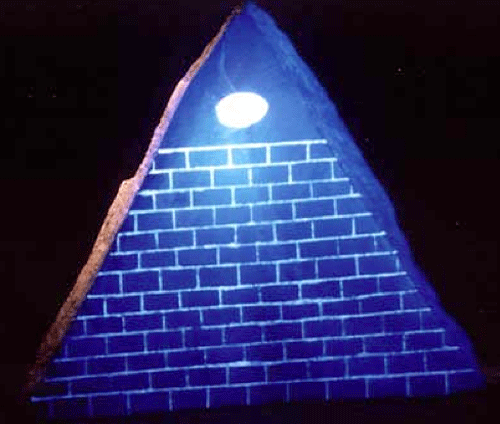
  • Resonating Pyramid Glowing Third Eye Ecuador Vedic Mandala

    Meru in Sanskrit means Pyramid shaped,as in the Meru of the Devi.

    She is the consort of lord Shiva who shares His Body with Her.

    Black Pyramid, La Man.gif
    Black Pyramid, La Mana, Ecuador.

    And the third Eye is Unique to Lord Shiva.

    It is interesting to find a Black Pyramid, with The Third Eye in the dead center that glows under Ultraviolet Light.

    It is the Black Pyramid of La Mana, Ecuador.

    Black Pyramid Glwing Under Ultra Vilolet.gif
    Black Pyramid Glwing Under Ultra Vilolet.

    I have posted articles on the migration of the Vedic People to the Americas and archeological evidence is piling up.

    Nazca Lines of Peru, the relationship of Incas with Tamil of Mayas with Sanatana Dharma.

    Please refer my articles filed under Hinduism.

    Black Pyramid Glows.gif
    Black Pyramid Glows.

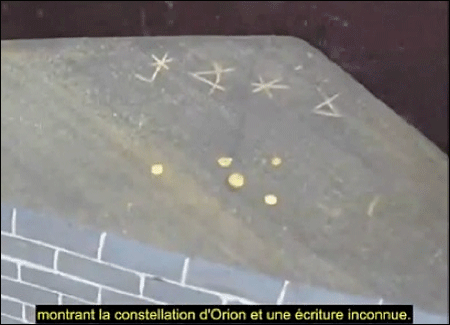
    Inscription on the Pyramid.gif
    Inscription on the Pyramid.La Mana

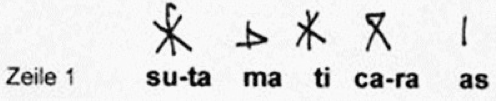
    Translation of the Balck Pyramid Inscription.gif
    Translation of the Balck Pyramid Inscription.


    The La Maná region has drawn attention for decades after the Head of the Ecuadorian Ministry of Mines Dr. E. Guillermo Sotomayor (1918-2009) made the surprise discovery of a cache of hundreds of ancient relics that included dozens of magnetic stone artifactswith inlaid designs that fluoresce under ultraviolet light. Sotomayor’s years of research concerning a set of 13 magnetic stone cups led him to recognize the astonishing purity and curative effects of the springwaters of these mystical mountains.

    Thick kaolinite clay beds filter rainwater while the activity of lightning and the presence of precious metals below ground imbues the water with trace gold and silver nanoparticles, forming the natural electrum colloid venerated by the pyramid-building Paleo-Sanskrit culture as the elixir of life: ‘Soma’…

    The most visible of these hidden ancient monuments is a riverfront pyramid construction that presents a triangular north-facing plane rising at a consistent inclination angle of 45° to its apex, over 70m in height. The symmetry of this ancient construction can be clearly observed from across the Calope River, while the apex platform and rear causeway are most visible from due west (above).

    This ancient monument has been named the Hummingbird Pyramid, after the great variety of local hummingbird species whose rhythmic wingbeats symbolized psychoacoustic influences among all ancient cultures of the Andes. The apex of the Hummingbird Pyramid (0.9978°S 79.2283°W) is situated closely along the 1° south latitude, 7,472 miles from the Great Pyramid of Giza, Egypt. This resonant distance interval represents 30.02% of the Earth’s mean circumference of 24,892 miles, exactly corresponding to the 2:3:5 Fibonacci proportional relationship known as the Golden Ratio.

    This sacred geopositioning relationship between the Great Pyramid and the La Maná pyramid complex was visually expressed in the designs of the UV fluorescent Third-Eye Pyramid and World Map stone artifacts. A pair of palm-sized octagonal stone disks engraved with UV fluorescent circles reference the mandala of Sanskrit tradition that has been decoded in previous works as thequantum iterated function [ zn+1 = zn2 ], expressing the global distribution pattern of infrasound standing waves….’

    Commonly referred to as Schumann Resonance, this fluctuating set of resonant planetary frequencies is composed of the sum of cosmic, solar, lunar, planetary and terrestrial vibrations that find continuity in the resonant cavity of Earth’s atmosphere. Earth’s energetic cocoon was extolled as the Akashic Field in votive passages from stone tablets preserved at Paleo-Sanskrit cultural sites on every inhabited continent of the world, praising the beneficial actions of Indra, the divine personification of resonant infrasonic influences from the planet Jupiter upon all living organisms of Earth.’

    This is a stone pyramid about ten inches high. It was found in the 1980s in the jungles of Ecuador, and this and other artifacts are referred to as La Mana artifacts.

    It is striking, at first sight, but there is a lot more to this out-of-place-artifact (or, oopart) than meets the eye.

    The stone is black and white, with thirteen levels of a brick pyramid engraved into it.

    There is also a cleverly inlaid eye at the top of the pyramid..

    Translation of the Inscription.

    The German site translates this line as:

    “The Son/Daughter of my creator moves/comes from outside into…” (Orion constellation inlay)

    This is the mirrored translation:

    “Venus mine, is from highest/creator Star”

    Vedic Connection.

    Su-ta ma ti kara as!

    Sutamam (सुतमाम्) most excellent
    Ati (अति) extremely
    Aakar (आकार) shape, configuration
    Aas or As (आस्) to be

    This is would pretty closely translate from Sanskrit as “This is an most excellent configuration’. This makes more sense when we take into the consideration that this inscription was found on an artifact that has to do with Orion constellation – a constellation that is visible from any point of the earth.

    Another La Mana inscription has been decoded as: “ash-ta-ma asta viupama as”. This was termed Pre-Sanskrit and translated as ” “Venus mine, is from highest/creator Star”. But the words probably have a more refined meaning if we look at it through the Sanskrit lens. Here are the meanings of the words”.

    Ashtamam – (अष्टमान) measure
    Ashtamah – (अष्टमः) eight
    Aashtamah – (आष्टम) eighth part
    Upamaa (उपमाम्) highest degree or compared with

    Asta (अस्त) sunset or decline.

    Citation.

    Black Pyramid La Mana

    Humming Bird Pyramid.

    Vedic Cafe


  • Tamil Heads World Languages With Sanskrit

    Recently I published an article on Sanskrit heading the world languages group.

    Though the source I have cited is a highly reputable educational research oriented site, curiously Tamil the ancient language is found missing.

    Jambai Tamil Brahmi inscription dated to the early Sangam age.‎(2,573 × 935 pixels, file size: 823 KB, MIME type: image/jpeg
    Jambai Tamil Brahmi inscription dated to the early Sangam age. “Jambai Tamil Brahmi” by Tnexplore – Own work. Licensed under CC BY-SA 3.0 via Wikimedia Commons – http://commons.wikimedia.org/wiki/File:Jambai_Tamil_Brahmi.jpg#mediaviewer/File:Jambai_Tamil_Brahmi.jpg

    I belive this is deliberate to divide the Indians as Dravidians and Aryans, meaning Sanskrit.

    The Facts.

    1.The Vedas have, by numerous quotes refer to Tamils,indicate that Tusks,Elephants,Spices were imported from the South, especially from the Chera Kingdom.

    Tamil Image..png
    Tamil Language.

    2.The Puranas repeatedly state that a Cheran King Perunchotru Udiyan neduncherallatha fed both the Panadava and Kaurava armies during the Mahabharata War.

    3.Arjuna and Krishna married Pandyan Princesses.

    4.Lord Krishna attended the Tamil Poets’ Conclave, Tamil Sangam.

    5.Balarama went ona Pilgrimage to south and worshiped Parashurama and Lord Subrahmanya, called as Murugan in Tamil.

    6.Tamil has been dated ,

    The archaeological finds from Attirappakkam northeast of Chennai evidences the existence of Tamils about a million years ago!

    “The prehistoric period during which Lower Paleolithic settlements existed in the Tamil Nadu region has been estimated to span the period from about 1,510,000 BCE[1] until around 3000 BCE.[2] For most part of the lower Paleolithic stage, humans lived close to river valleys with sparse forest cover or in grassland environments. The population density was very low and so far only two localities of this lower Palaeolithic culture have been found insouth India. One of these is in Attirampakkam valley in the northwest of Chennai in Tamil Nadu.[3] Archaeological research has uncovered evidence of fossil remains of animals and primitive stone implements around the northern Tamil Nadu that could be dated to belong to around 3000,000 BCE.[citation needed]Humans inSouth India, belonging to the species of Homo erectus, lived in this primitive ‘old stone age’ (Palaeolithic) for quite a long time, using only crude implements such as hand axes and choppers and subsisting as hunter-gatherers“(wiki)

    The Tamil History based on this, Tamil Literature,Sanskrit Literature and Arikkamedu findings,Puducherry is between   15,000 BCE to 10,000 BCE.’


    7.This is acknowledged.

    8.Sage Viswamitra banished his sons to the south.

    9.Lord Rama’s ancestor Satyavrata Manu, also called Vaivasvatha Manu is from the South.

    10.Sage Agasthya , the giver of Tamil dates back to  5000 BC, by some accounts based on Astronomy 25000 years earlier!


    3.That Time is Cyclic and the events occur in Cycles.


    4.Tamil Language is as old as Sanskrit.


    5..Agasthya existed around 5000 BC and around 25725 years before that.’


    11.Tolkaapiyam , the oldest Tamil Grammar Book is dated, at a conservative estimate,to  3 Century BC.

    12.The earlier Grammar Book Agathiyam by Sage Agastya was destroyed by a Tsunami.

    13.’ The linguistic evidence suggests that Proto-South Dravidian was spoken around the middle of the second millennium BC, and that proto-Tamil emerged around the 3rd century BC. The earliest epigraphic attestations of Tamil are generally taken to have been written shortly thereafter.( wiki Tail Language)

    14.As To Hitti heading the Anatolian languages,

    The Inca Empire was divided into Four Regions as in Ancient Tamils, Kurinji,Mullai,Marutham, Neythal , based on Geography.

    The Fifth one Palai is desert.

    Considering the fact that they were following most of the customs that are similar to the Customs of Sanatana Dharma. I checked and was pleasantly surprised to find that,

    The Ayar-Incas that primitive Aryan words and people came to Americaespecially from Indo-Arya by the island chains ofPolynesia. The very name of the boat in Mexico is a South Indian (Tamil) word: Catamaran.”-

    The Ayar-Incas (2 Volume Set): 1. Monuments, Culture, and American Relationship; 2. Asiatic Origins-Miles Poindexter,Former US Ambassador-

    The Incas celebrated the Makara Sankaranti in the South Indian Style.”

    And Hitti,

    Hittite (nešili) was the language of the Hittite Empire, dated approximately 1650 to 1200 BC, which ruled over nearly all of Anatolia during that time”

    Considering these facts, it is obvious that Tamil headed the Anatolian Group, based on its early date and the impact of Tamil on Hitti.

    Citation.

    Milion Year Old Tamil

    Agastya Canopus Validates Sanatan Dharma Tamil-dates

    Incas of Peru

    Tolkappiyam Wiki.

    Anatolian Languages wiki.

    Vedic Empire.